
- Oklahoma and child marriage: an example of how modern morality is not (and should not be) beholden to the Bible;
- A Yuval Noah Harari video on how cooperation throughout human history requires common stories, e.g. religions;
- An economic experiment that overturns the conservative assumption that raising the minimum wage kills jobs;
- Numerous items briefly noted, about Trump, a Christian sect and pets, daylight saving time, capitalism and socialism.

JMG, from Oklahoma Watch, today: Oklahoma GOP Rep Opposes Ban On Child Marriage Because Mary Married Joseph When She Was Underage
Senate Bill 504, which removed exceptions in the law that allowed minors to marry with parental consent and court approval, passed the House 51 to 36 after unanimously passing the Senate in March. All 36 no votes were cast by Republicans.
Some against the bill, such as Rep. Justin Humphrey, argued that the government should not interfere with parents’ rights. Others argued the bill would impede the creation of stable families; Humphrey anecdotally cited knowing people who married as minors and “remained married until they’re dead.”
This is precisely the problem with applying primitive Biblical ‘morality’ to the modern world, which *does* have standards of morality, for the sake of non-tribal, non-zero-sum civilization, that are more advanced than the morality of all those stories in the Bible. Note how this guy quotes scripture. Keep scripture out of the government.
Also, morality is *not* fixed. It depends on circumstances. There might be certain broad principles that remain fixed, e.g. to maximize well-being, but how that plays out in any given society at any given time depends on which people, how many, under what circumstances. Few recognize the idea that the Ten Commandments applied only to a specific tribe. Killing people in other tribes was perfectly fine, then. As it is now, by the US, as long as they’re brown people in other countries.
\\\
Here’s an apt video by Yuval Noah Harari that could precede all discusses of religion and morality.
Storytelling has always been important, from the Stone Age to the 21st Century, whenever a large number of people are trying to cooperate on something, whether it is to hunt a mammoth or whether it is to build at atom bomb. Just knowing the facts about the objective world, about objective reality, is not enough. If you want, for instance, to build an atom bomb, you need to know some facts about physical reality. You need to know that E = MC2. If you try to build a bomb and you ignore the facts of reality, the bomb will not explode. But just knowing the facts is not enough. Becuase in order to build an atom bomb, you need millions of people to cooperate on the project. You need physicists to write complicated equations, … [skipping some]
And this is where storytelling comes into the picture. What really motivates people. It could be religious stories, mythologies and theologies, secular ideologies like communism or capitalism. And it’s always the people who are experts in storytelling who give the orders to people who merely know the facts of nuclear physics.
We’ve read this before: it wasn’t tool-making as once thought, it was cooperation, that enabled primitive humans to build tribes and communities and eventually conquer the world. And communities are united by stories. It doesn’t matter whether the stories are true.
\\\
It strikes me that conservatives make relatively simplex assumptions about the world and human nature (e.g. people are bad by nature and need saving), whereas reality is more complex. (And: my conclusion is that humans default to good, and cooperation, unless betrayed. This is tit for tat in game theory, similar to reciprocal altruism in evolutionary biology.)

The Atlantic, Nick Hanauer and Eric Beinhocker, today: The Economic Experiment That Upended Reality, subtitled “Minimum-wage increases were expected to kill jobs. The fact that they didn’t should make us rethink a lot of assumptions.”
The writers describe their proposal some time back for a $15/hour minimum wage. They were laughed at.
In 2014, Seattle went ahead and implemented a $15 minimum wage anyway. And all the apocalyptic predictions failed to come true. The restaurants did not close. The jobs did not disappear. Instead, 100,000 workers got raises, and spent them. Seattle’s economy, far from collapsing, continued to boom. San Francisco soon passed its own $15 minimum wage. Then came minimum-wage hikes in state after state, including not just liberal New York and California but also Missouri, Nebraska, Florida, and Alaska—red states where voters, given the direct choice, said yes. In every case, predictions of economic catastrophe proved false.
Conservatives miss the part where, if people get more money, they will spend it. The same argument supports the idea of a universal basic income.
\\\
Briefly noted.
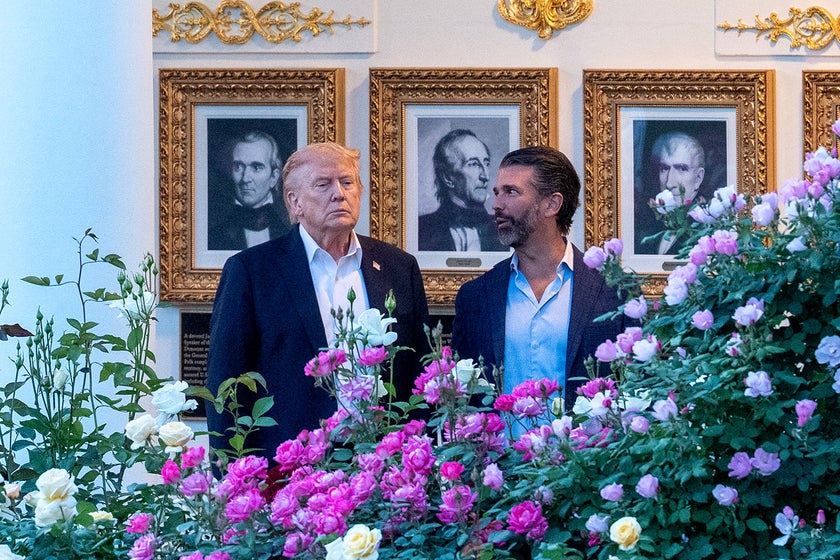
- Does Trump hate his son?
- Slate, Heather Schwedel, yesterday: Donald Trump’s Ritualistic Humiliation of His Children Reaches a Charming New Crescendo
- Trump isn’t attending his son’s wedding. Many more stories about this today.
- Salon, Brian Karem, today: Trump Exhaustion Syndrome is infecting the world
- Subtitled: At the Cannes Film Festival, international attendees mourn the decline of American culture — and democracy
- MAGA doesn’t know, nor care.
- Media Matters, Sophie Lawton, yesterday: Right-wing media react to Trump’s slush fund for allies with unquestioning loyalty — and some vague skepticism
- Actually there are stories today about significant pushback by Republicans to this $1.776 slush fund.
- Washington Post, Fareed Zakaria, today: Donald Trump’s incredibly reckless second term
- Subtitled: A presidency stripped of restraints — and turned toward profit.
- What a surprise.
- Salon, Garrett Owen, yesterday: The Trump phone is here. Critics say it’s junk
- Subtitled: Tech experts and reviewers say the long-delayed $500 phone has high costs, middling specs and murky origins

- Friendly Atheist, Hemant Mehta, yesterday: A secretive Christian sect is pressuring members to purge their pets
- Subtitled: The Plymouth Brethren Christian Church denies endorsing cruelty, but former members describe drowned puppies, euthanized cats, and abandoned animals
- An example of where religion can take you.
- Another essay about this issue.
- NY Times, guest essay by Jeffrey Toobin, 20 May 2026: Trump Just Pardoned Himself and His Family Forever
- Salon, Amanda Marcotte, 20 May 2026: White House ballroom is turning into a symbol of Trump’s failures
- Subtitled: The president’s only legacy will be greed and corruption
- Most of the world, and most of the nation, realizes this, while the MAGA folks don’t. Is this about anything other than the range of human nature, how some people are always drawn to authoritarians? Maybe; I’m reading a book by Kurt Andersen that provides an unflattering view of the origin of “American exceptionalism.”
- JMG, from Washington Post, 20 May 2026: House GOP Moves For Year-Round Daylight Saving
- Every year, sigh. This is nonsense. They (the Republicans of course) want to redefine time. They don’t remember that this has been tried before and failed, because year-round daylight saving time applies in the winter, too.

- Washington Post, 20 May 2026: Trump officials say they can build 250-foot arch without Congress’s approval
- Subtitled: To build a triumphal arch near Arlington National Cemetery, the administration hopes to rely on a 101-year-old authorization for a different project on the site.
- They skirt laws and rules at every opportunity, all for the greater glory of Trump.
/
Finally for today, a comment from Facebook:
If capitalism is the best option, why do the most “successful” corporations need so many tax breaks, subsidies, favors, grants, and bailouts? And when Americans need these things, why do they call it socialism?
There is a sunk-cost fallacy here. It’s always been this way, so it must always be this way. The way it’s always been is the true, proper way.