- A chart showing the actual relative sizes of the Messier objects;
- Rebecca Solnit on the potential for imminent revolutionary change;
- Jonathan Haidt’s graduation speech, today.
Now this is cool. The Messier objects, fuzzy objects in the sky listed in the 18th century Messier Catalog as objects to beware of for comet-spotters, and which were later identified has close nebulae and distant galaxies, have become objects for amateur astronomers to track down, as I did in my teens during summers in Apple Valley in the 1970s.
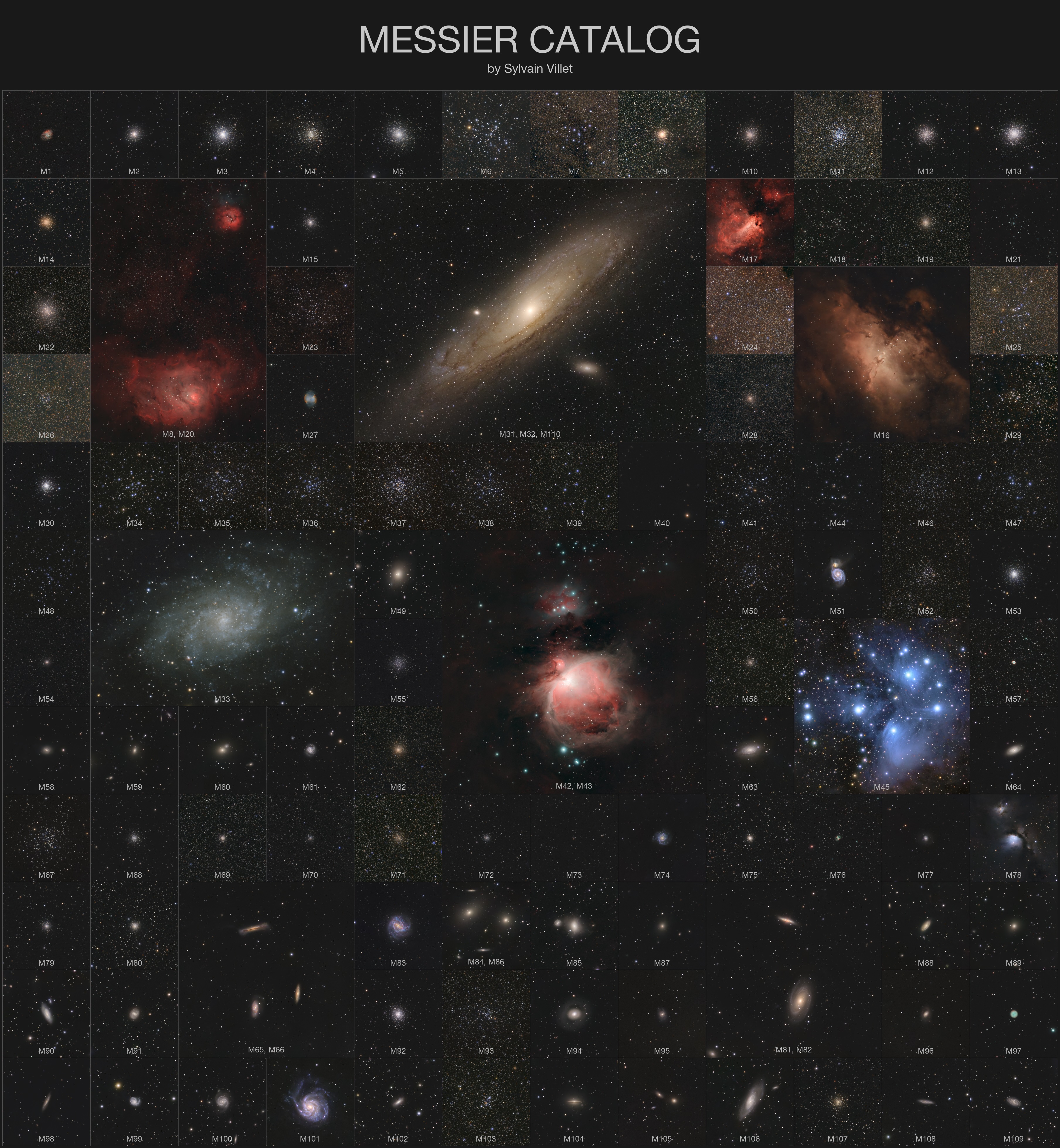
Astronomy Picture of the Day, Sylvian Villet, today: Messier Catalog at Uniform Scale
I’ll quote their entire brief explanation…
Explanation:
What are some of the most interesting astronomical objects you can see in the night sky?
Armed with a good pair of binoculars or a small telescope, if you live in the Northern Hemisphere, you can look for the very popular objects in the Messier Catalog.
Most of them, but not all, are also visible from the southern half of the Earth.
The featured image shows all 110 objects in the catalog at uniform scale — the same magnification.
Charles Messier created the catalog in the 18th century.
He was interested in comets, and his catalog was a list of known comet-like “objects to avoid” in the sky when observing or hunting for comets.
The deep sky objects in the catalog include a supernova remnant (the Crab Nebula, M1), other galaxies (such as Andromeda, M31), nebulae (e.g. the Orion Nebula, M42, a star-forming region) and stellar clusters (such as the Pleiades, M45, a bright young open cluster).
Only a few of these are visible with the naked eye, or even in binoculars: the Andromeda Galaxy of course, the Orion Nebula, the Pleiades. Many though perhaps not all of the others can be found with small telescopes, like the one I had then.
But what you lose in binoculars or telescopes is a sense of relative size, or scale. If the entire sky were somehow amplified so all of these objects were equally visible… they wouldn’t actually cover very much of the sky. OTOH there are photos of areas of the sky that show nebulae much larger than these particular objects, especially the area around the Orion Nebula, that suggest an amplified view of the sky would be *filled* with gaudy, swirly nebulae, covering much more of the sky than we realize. I’ve always wished there was an atlas, or set of photos, that connected these views all together. What we would see in the sky if our eyes weren’t calibrated for daylight, but for the vast night.
(Of course, such vision still wouldn’t reveal the depth of field — how big these objects and clusters actually are, given their distance from us. That would require some kind of 3-D mapping.)
\\\
We tend to assume that things will never change, or that they’ll keep changing in the same way that we’ve experienced. This is not always true.
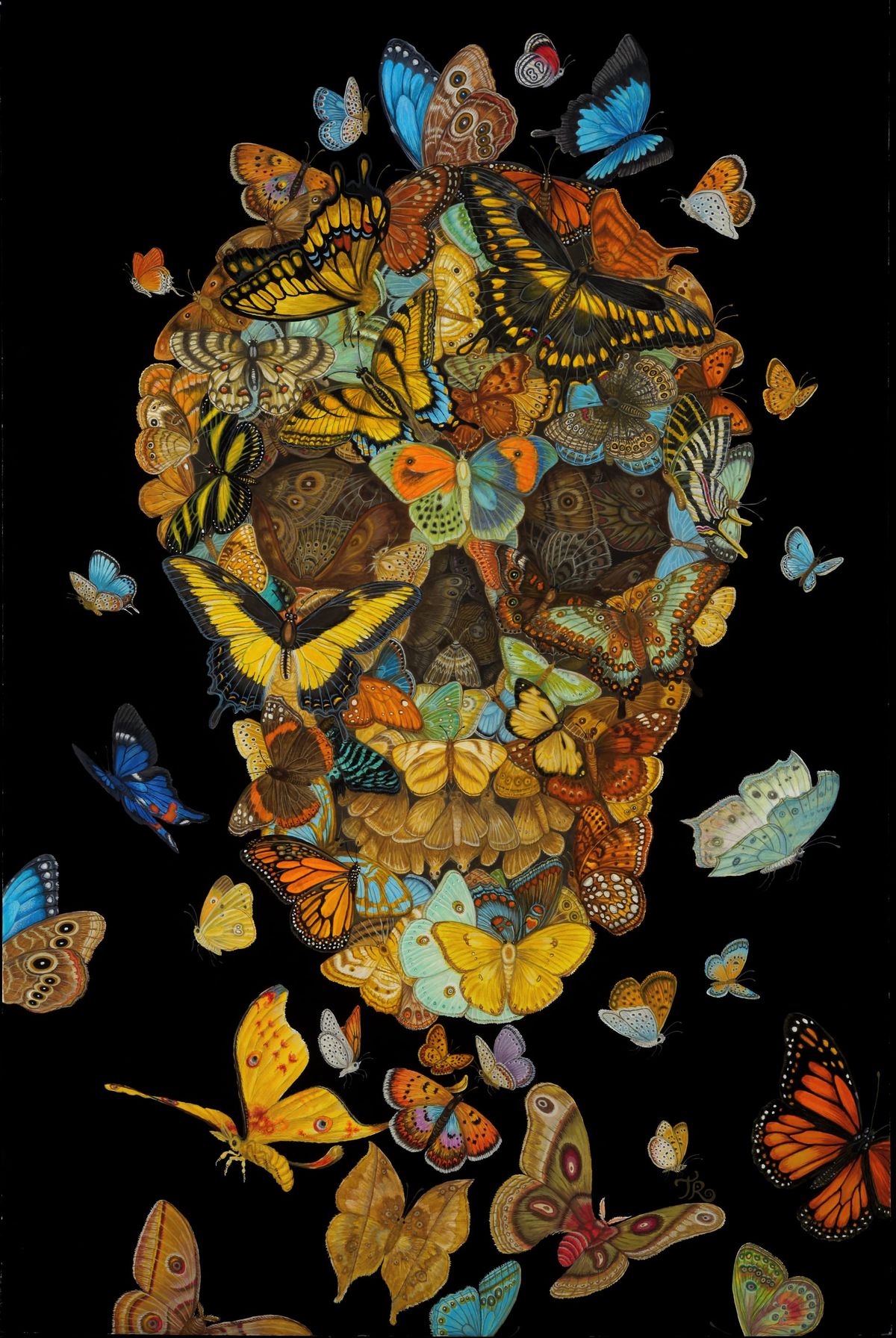
Rebecca Solnit, undated (but today): We Are Crashing Into the Future (Or It Is Crashing Into Us)
Opening:
One common and inaccurate picture of change assumes this thing so obvious, so potent in the present, will just continue to expand and the future will be like the present, only more so. This version ignores that individual actors and collective forces can suddenly emerge or implode, that history often takes sharp turns, that something that has held for decades or centuries can suddenly snap. Those who assumed that authoritarianism could only expand from the successes of the Orban regime in Hungary, the Putin regime in Russia, and the Trump regime in the USA should be making their adjustments now.
A caterpillar hatches out of the egg and begins to eat voraciously, growing so much it repeatedly splits its skin and emerges in a new skin – instar is the word for these molts. But change isn’t just successive instars. Several instars along, the caterpillar forms a chrysalis and literally liquidates itself into a kind of goo from which a butterfly will be formed. I believe that we are a global society in a state of dissolution, and out of this messy fluidity new things both monstrous and magical are emerging.
Case in point: Viktor Orban. And Trump. Perhaps things are falling apart. Solnit’s posts are long, and so it’s hard to quote judicious bits to capture the entire theme. But she discusses or mentions the ultra-rich, anti-elitism movements, backlash against AI, Timothy Snyder, fossil fuels, and much else. I’ll quote her p.p.s.
The four main subjects of this piece –the decline of the oligarchs, the fossil fuel decline, the tech monstrosity, and the gender politics connected to all that left no room for what was going to be the fifth subject of this essay: the rise (or at least rise in visibility and impact) of progressive Christianity, which feels like another epochal shift, but I’ll get to it sooner or later. It’s kind of exciting and encouraging.
\\\
There were items in the news today about protests against Jonathan Haidt giving a commencement speech today. Protests which, ironically, illustrate his point, in books like THE CODDLING OF THE AMERICAN MIND (my review here), which covered the idea of the “canceling” of professors and speakers on college campuses for offending student audiences.
The Atlantic, Jonathan Haidt, today: Pay Attention, subtitled “Essential advice for the class of 2026”
The magazine notes the objections from “a small group of student leaders” and says “We are reproducing his speech in full, so that readers may judge it for themselves.”
I’ll put it here for now; I have not read it in full. I’ve not been completely convinced by some of Haidt’s arguments (see my review of THE ANXIOUS GENERATION) but in general I think he identifies legitimate social trends. Here’s a bit to quote, for now.
In 2014, when she was nearly 80 years old, the poet Mary Oliver wrote a short poem titled “Instructions for Living a Life.” It goes like this:
Pay attention.
Be astonished.
Tell about it.It sounds simple. But paying attention is in fact one of the most challenging and meaningful things you can do. Because what you pay attention to shapes what you care about. And what you care about shapes who you become.
I’ll buy that.
The news about students protesting Haidt’s appearance don’t say, of course, what they objected to; not anything in his speech, of course, which they hadn’t seen. I’ll be fascinated to see if there’s any news about that.