Subtitled: Stop Wasting Your Talent and Start Making a Difference
(2024 in Dutch; Little, Brown, 2025, 285pp, including 53pp of Thanks, Notes, and Index)
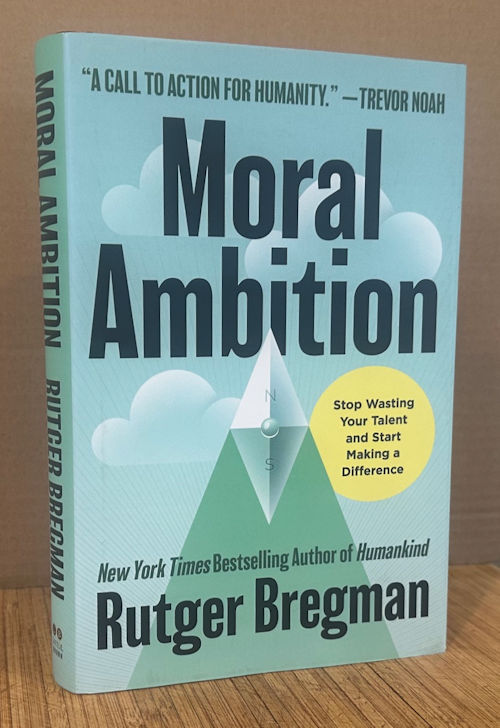
Here’s the third book by Rutger Bregman, a Dutch historian and thinker. First was UTOPIA FOR REALISTS (2017 in English, review here), which promoted the idea of a universal income, explained why the GDP is outdated, why we need to get over the dogma that you have to work for a living, and the benefits of open borders, and remembering that the Overton Window can shift – ideas that would horrify most conservatives of course, but which Bregman backed up with evidence and examples, echoing Harari and Rosling and others. Second was HUMANKIND (2020 in English, review here), whose thesis was that most people are pretty decent (despite what many conservatives are taught), coming down on the opposite side of the Hobbes/Rousseau as many other thinkers, as he reviewed incidents from history and even the novel LORD OF THE FLIES and concluded that most people have been peaceful, while famous incidents of savagery are rare or have been exaggerated.
The latest book is a call for ambition, for building a better world, and aligns roughly with ideas of some of the effective altruism (EA) crowd: think long-term, do good, don’t cruise through life.
It aligns with Ari Wallach’s LONGPATH (review here),William MacAskill’s WHAT WE OWE THE FUTURE (read but not yet posted about), Toby Ord’s THE PRECIPICE (just read, to be posted about soon), and others, though each of these titles has a slightly different purpose and perspective.
Bregman wants you to not glide through life, but take on some higher calling, which is very noble. My basic problem with the book is that it aims too high. The examples he gives of people who’ve made a difference are exceptional in extreme ways; chapters here are like bios of billionaires, the book implicitly promising that if you just follow their examples, you can made a huge difference (or become a billionaire) too. That would ignore all the chance elements of their stories, especially how many billionaires inherited much of their wealth, the risk some take in their life, and for that matter the many people we never hear about who great ambitions came to nothing. The author does admit up front that if you’re stuck with a mortgage and family, this book may not be for you. But how many is it for?
Key Points
- Life isn’t about being happy; it should be about making the world a better place.
- He outlines four kinds of jobs. Those that are not ambitious or idealistic; b.s. jobs. Those that are ambitious but not idealistic, e.g. corporate lawyers. Those that are idealistic but not ambitious: jobs for people who don’t want to work very hard. And those that are idealistic and ambitious, like those taken on by many of the great reformers in history.
- He emphasizes that even small gestures can lead to sizeable movements. And cites a study that for many passive people, all it takes to take action is to be asked.
- You can join a cult, or start your own, with the example of Ralph Nader.
- Avoid being a noble loser, becoming hung up on any of five myths: that awareness of a problem is sufficient; that good intentions are sufficient (e.g. giving to charities); of hearing what you want to hear; of collaborating only with people who agree with you on every point; that righteous causes all go together.
- Focus on where you can do the most good, i.e. run the numbers, see how many lives you can save. Look for causes that are sizeable, solvable, and sorely overlooked, and focus there. Effective altruism: look at global trends, but beware the realization that you can never do enough.
- Expand your moral circle; consider past atrocities, and what practices of today people in the future might consider atrocities. Author suggests the animal industry, how animal rights would expand the moral circle, and how to acknowledge the unpleasant facts of where our meat comes from.
- Finally, make future historians proud. Do something about the today’s major threats: climate change, vertebrate extinction, nuclear weapons, AI.
- In the epilogue, author asks what you personally have done for a better world.
At the end he directs you to his School for Moral Ambition website, where you can apply for fellowships, and the school’s principles:
- Action: awareness is overrated
- Impact: make a big difference
- Radical compassion: expand our moral circle
- Open-mindedness: cultivate a curious mindset
- Kindness: believe in the good in people
- Zest for life: live full, rich, well-rounded lives
- Perseverance: be determined not to give up.
Detailed Notes
Prologue, pxi
Leo Rosten quote about how the purpose of life should be more than being happy.
Then about a man neurologists discovered had a perfect brain – all upbeat and nothing negative. He was a Buddhist monk who’d spent his life meditating. But what, author asks, did he accomplish? He did nothing to make the world a better place. Maybe happiness shouldn’t be an ultimate life goal. This book is not about finding happiness. But this book might change your life.
1, No, you’re not fine just the way you are, p1
Quote by Allen Raine.
1, The greatest wasted thing is wasted talent. Many don’t have a chance to make the world a better place, but many do, and don’t. they’re stuck in pointless jobs. The antidote to such waste is moral ambition. You’ve only got one life. There are plenty of ways to make the world a better place. Maybe if you’re stuck with a job, kids, and a mortgage, maybe there’s no going back. Author would be happy to be proven wrong.
2, There are four categories of how you use your talents.
- Category I jobs: not that ambitious, not that idealistic. Jobs that don’t add must value. David Graeber called them bullshit jobs. They’re not ‘essential workers’. Chart p6 of people in various jobs who think their jobs are pointless. Worse are the ‘sin industries,’ like accountants helping the rich avoid taxes, etc. Addiction businesses. Oddly the highest paid jobs are often considered the more immoral. Others in this category are those who are financially independent, e.g. retired. But they’re still not contributing…
- Category II Jobs: ambitious, but not all that idealistic. Finance, consulting; they want the corner office, don’t care how. Waste of talent. Some do damage. Corporate lawyers. Even doctors, past a certain point, aren’t contributing as much as they could. Entrepreneurs. Solutions for problems we didn’t know we had.
- Category III job: idealistic, but not ambitious. Gen Z. Idealistic, but they don’t want to work very hard. Or simply want to have no impact at all. Some of ‘woke’ folk are like this. Getting lots of followers isn’t achieving anything. Awareness alone isn’t helpful.
- Category IV: idealistic and ambitious. Consider Thomas Clarkson, 1785, on slavery. He had to teach himself about it. He had two months. His essay won first place. But could he actually do anything about it? He discovers the Quakers and their cause. He became one of great reformers of his time.
3, We’ll meet others like him in this book. Who take action themselves. Who sometimes suffer burnouts. Whose brains may not be like the monk’s. But at least theirlives weren’t pointless.
2, Lower your threshold for taking action, p21
1, What sets people apart who are open to moral ambition? The one man in a crowd who doesn’t Nazi salute. August Landmesser. His story didn’t come out until 1995, and then became a poster boy. [[ here’s my issue with being part of a crowd… ]] Humans are herd animals. But only small groups of citizens change the world (Mead); most people stand on the sidelines.
2, Again, small groups can have a big effect. Pareto principle: 20% accomplish 80% of the whole. Only a very few people have enormous influence in the world. Power law. P27. Taleb: the most intolerant wins.
3, A town in the Netherlands that hid Jews during WWII. A man who found his calling by resisting the Germans. Few people actually did so. They remained passive. But we have that man’s journal.
4, Why do some people go against the tide? 1970s study of resistance heroes. Turned out, they weren’t that different from anyone else. Two things: feelings are overrated. And the rescuers had similar upbringings: independent; objecting to authority. And both communists and the super-religious were prominent. But still, why that town? Later studies were done. One circumstance stood out. You had to be asked. That may be the key to moral ambition. A very few pioneers, or zeros, need no encouragement to take action. ‘Ones’ need only to be asked; ‘twos’ need two allies, and so on—then it quickly takes off. Another example in France. Similar pattern in the industrial revolution. It doesn’t take much to get started; once you do, you keep going. MLK, an East German.
3, Join a cult (or start your own), p41
So having a moral ambition mindset, what do you do with it? Suppose you’re not inclined to be an activist? There are many ways to express moral ambition. Photo of the legendary nerds.
2, Ralph Nader. He encouraged fellow law students to fight for the have-nots, not the wealthy. Nader was a zero. He became obsessed with car safety. GM targeted him. LBJ signed a law.
3, Then he wanted to train a team of similar activists. What Peter Thiel calls cults. Complete devotion, little time for a normal life, good parents. Facebook, PayPal. The opposite of a cult is a consulting firm. Consider other cults, e.g. the Quakers. They were weird. Details. They were against slavery. And campaigned against the trade. Back to Thiel, who may be dangerous, given his authoritarian views.
4, Lessons from Ralph Nader. P53. Pragmatic. He got other laws passed. He attacked the FTC as being too lax. Many came to work for him. They put out a series of reports. Nader worked them mercilessly. Those reports led to more laws, for clean air, clean water. He became a household name. He inspired many. But even by 2015, there was much work left to be done. Yet recall 2000, when Nader wreaked havoc. He ran for president. Green Party. He bled votes from the Democrats, and so Bush beat Gore.
4, See winning as your moral duty, p61
Overton’s window: how the frame of serious ideas can shift. Shift the window. (Footnote says this was his idea in last chapter of previous book, but too simplistic.)
How to avoid being a Noble Loser. Consider resistance heroes. Rosa Parks. She was already an activist. There were others like her. Her arrest triggers protests. Others. They knew that winning is a moral duty.
2, Look again at that guy who refused to do the salute. It was brave but futile. A noble loser. We need to look at five myths about how social change works.
- I: The illusion of awareness. It’s overrated. It’s the belief-behavior gap. News junkies who never actually get involved. Examples.
- II: The illusion of good intentions. Giving to charities. Examples. Most have little effect.
- III: The illusions of the right reasons. You may need to find different reasons to accomplish the same goals. Taxing the rich. The life of sailors on slave ships. Example of one particular slave, who wrote and promoted his own book. The first black many British saw. He told the British what they wanted to hear. Accused of being a fake. Evidence is mixed; does it matter? His message still worked.
- IV: The illusion of purity. The problem of not collaborating with people who disagree about minor things. Calvinists and other Christians. Suffragettes. The idea of intersectionality: people are discriminated against on multiple grounds. That can lead to problems too. Abortion and trans rights, e.g.; that end up being counterproductive.
- V: The illusion of synergy. The idea that all good things go together. All the progressive issues, e.g. Compromises. All or nothing seldom gets off the ground. Recall the strategies for fighting slavery.
- There have seldom ever been so many protest movements. And the results are meager. Big protests, that resulted in nothing. Examples of people working in the shadows.
- And the guy who didn’t salute: it may have been someone else. …
5, Learn to weep over spreadsheets, p87
About a British executive who got fired for cause. He saw a documentary about a girl burned in a house fire.
2, Rob Mather saw the documentary and realized how privileged he was. Successful career.
3, Then, after the documentary, he wanted to make money for that girl. He organized swim-a-thons. What next? Malaria pills. 250,000 swimmers. 20 minute rule, asking other people to help.
4, About Holden Karnofsky, Harvard, 1999. Hedge fund job. Quit to cofound GiveWell to track data from charities. Mather’s malaria group was one of the best. Saved 100,000 lives. A village in which malaria disappeared.
Chart showing how many people were helped…
6, Enroll at a Hogwarts for do-gooders, p101
Such a school exists, in west London. Charity Entrepreneurship. How to help as many people and animals as possible. Ideas should be sizeable, solvable, and sorely overlooked – the three S’s. Each year the school announces a new cause. Students apply, a few are admitted, and given seed money. Examples. Lead exposure. Sex education. About the director, Joey Savoie. Bar for entry is high.
2, More about Joey Savoie. Bullying. Schools. Thought ahead. Suffering in the world. Studied psychology. Discovered the think tank GiveWell. …
3, At the same time, author thinks this guy isn’t a good example; he’s too weird. And so on… Charity Science Health.
4, Author identified four ingredients of moral ambition: idealism, ambition, analytical mind, humility. How he set up four ‘houses’ as in Harry Potter. …
7, Find out what the world needs and make it happen, p121
How rich people children used to die of things easily curable today. Most children died. Child mortality is far lower today. Extreme poverty has decreased. Yet most people haven’t heard, p124. People remain pessimistic.
2, We need more morally ambitious science geeks. Like Jonas Salk. And how he was celebrated back in 1955. Salk didn’t patent. Now, polio is nearly gone. Similarly with Viktor Shdanov and smallpox. It too disappeared by 1977. But he was not celebrated, due to the Russian regime. What about malaria? We have a vaccine for that too. What took so long? Funding problems…
3, We need more people to be for things, and not against. Women and bicycles. Dishwashing machines. Engines of liberation. Chart p131. Contraceptives were ‘obscene.’ Katharine McCormick. Margaret Sanger. Eventually, the pill.
4, How technology sparks moral revolutions. Meat grown in a lab. Singapore. The technology had been around for years. Another example: sustainable energy. The things we could do with unlimited energy. We have to stop with the fossil fuels. Fusion, solar. It wasn’t inevitable; it took individual efforts. Solar panels. Which Reagan removed from the White House. Hans-Josef Fell in Germany.
5, We live in pessimistic times, 140b.
8, Save a life. Now only $4,999!, p145
How do you prioritize? Go back to Rob Mather. He chose malaria simply by doing his homework. Not about what his passion was, but about where he could contribute the most. Money helps. But sometimes moral ambition can go off the rails.
2, Peter Singer, 1969. Philosophy was stodgy. Singer wanted to focus on real issues. He wrote about civil disobedience. Don’t we have a moral duty to donate to causes that save lives? Bangladesh was happening. You can never do enough, Singer thought. Yet our lives are full of extravagance. And things we waste. See chart of global income distribution, p151. We make excuses for not sharing the wealth. But does Singer ask too much of us? Even philosophers don’t follow his advice.
3, So Singer started giving away his income. Then in 2009 Toby Ord took action. He met William MacAskill. Who created the idea of effective altruism. Their organization was Giving What We Can. But do what? Ord discovered the best charities are 50 times as effective as the average charities. So focus on cost-effectiveness. Examples p156. The idea of triage. Examples.
4, But who wants to join a movement that rubs your nose in the fact that you can never do enough? Author lost interest. EAs were obsessive with their quantification and efficiency. And some went into finance to make more money to give away. They met Sam Bankman-Fried, who went into the financial sector. Until he was arrested in 2022. His schemes were hare-brained. Also, author was bothered by their indifference to our inequitable system.
5, Yet the movement was full of morally ambitious people. Some of them were aware of the system. … Example of Charles Garland.
So what unpopular causes should we fight for today?
9, Expand your moral circle, p167
Story about an English sea captain in 1734 who saved an African boy from being sacrificed, then took the boy and his mother to the Caribbean where they were sold as slaves. Slavery was common; before 1800 three-quarters of the world’s people were slaves or serfs. Details. It was celebrated. Even some of the Enlightenment thinkers. Which practices of ours will come to be seen as barbaric?
2, Are we on the right side of history? Are we already at some plateau? All civilizations have had a high opinion of themselves. But the past is full of what we know consider atrocities; examples. [[ whereas conservatives, some of them, would bring back some of those atrocities ]] So how do we figure this out? First, well, we’ve probably heard arguments about things that might be wrong already; they just haven’t grown into movements. Second, beware “that’s how things have always been done.” Considering wrongful acts normal, natural, or necessary. Third, don’t avoid unpleasant facts. There’s genuine ignorance, and willful ignorance. Fourth, prepare for angry responses to moral progress. Example Mary Wollstonecraft. Fifth, note how children detect our hypocrisy. Finally, what will future generations see as our gravest offense? There’s pattern over the past few centuries. Singer, The Expanding Circle. See chart, p177.
3, So let’s think of some, p178. Luxury items in a world where children starve; doing little against existential threats; how criminals are punished; storybooks about animals while factory farms exist. Consider the last one. There have been vegetarians throughout history. But animal rights movement began only in the 1970s. The animal industry is huge. Factories. Defended with the three N’s. We ignore unpleasant facts. Yet when asked, they would ban factory farming. Animal activists are met with aggression – fourth item. Many children don’t realize their meat comes from animals; why don’t parents explain it to them? And animal rights seem a natural next step following all the other rights movements. Reflecting again on vegan from history. The issue of including animals within our moral circle isn’t about whether they can reason, but whether they can suffer. Example of an investor who became concerned about the suffering of shrimp.
4, Beware thinking how the arc of history bends toward justice; that’s the sixth myth, the illusion of inevitability. Moral pioneers have their blind spots about causes other than their own. Examples.
5, It’s easy to get frustrated. One way forward is to reframe the problem. Example of woman fighting animal abuse who became friends with livestock holders, and discovered some of them hated their industry too. How their suppliers lied about their industry. She leaked a video, it went viral, and eventually one supplier, Perdue, came to her for help. It was about finding what works.
10, Make future historians proud, p191
Now consider the ultimate way to expand our moral circle. What’s the most important thing that’s happened in all of human history? Author considers a bunch, p194 chart. But look at global population—an explosion around the year 1750. The start of the industrial revolution. Look at energy use, global economy, human land use; similar graphs. Productivity examples. Will this explosion end? We’re not living in the end times; we may be on the verge of something far bigger. We have a responsibility to that future; we have power to shape it. So what do we do? More graphs: war-making capacity, carbon emissions, vertebrate extinction. Those are going up too. We’ve left a trail of destruction. Our livestock outweighs all wild animals. We’re recognizing climate change, but not working it fast enough. Are there other things we can tackle in time?
2, There are several other existential threats. Nuclear weapons. We came very close in 1962. We built them because we could. Then there’s AI. And a third threat: pathogens that escape from a lab. Smallpox could be recreated. And doomsday cults try these things deliberately. Sarin gas.
3, Four statements, e.g. the world’s better off than three centuries ago, but it’s also never been closer to its own demise. And we’re not doing much to protect ourselves. [[ of course this is all worse under Trump ]] We need the modern version of Nader’s Raiders. Too abstract? Examples. Nuclear material. Anthrax. Still, no one gets credit for disasters that don’t happen. Other examples. Pathogens, medicines. Hygiene. Clean air standards, for indoors. We can eradicate all known virus families within decades. Recalling the speech by JFK. We need new Apollo programs.
4, Recalling Voyager 1 and the pale blue dot photo.
Epilogue, p217
So, what have *you* done enough for a better world? 1840, the abolishment of slavery, Thomas Clarkson. Yet still some squabbled. Women were allowed only to watch. That is, whatever is done is never enough. … But be careful not to burn out. Orwell about Gandhi, inhuman. Recall the monk, speaking with Peter Singer. He could have put his compassion into action. But moral actions aren’t everything. Be ambitious, not perfect. Most of us aren’t there yet.
2, This book is written for you and no one else. See the good in others, but demand more of yourself. Beware the right-wing excuse, about bootstraps and how success is a choice, 225t. Beware the left-wing excuse: blaming ‘the system’. The people discussed in this book aren’t fundamentally different from you or me, but we’re all people, and we can all take on the moral ambition mindset.
\