
- What Trump’s latest attempted assassin reveals about modern American life;
- How right-wing influencers are now praising Islam, as an alternative to liberal modernity;
Trying to get a handle on the latest would-be presidential assassin.
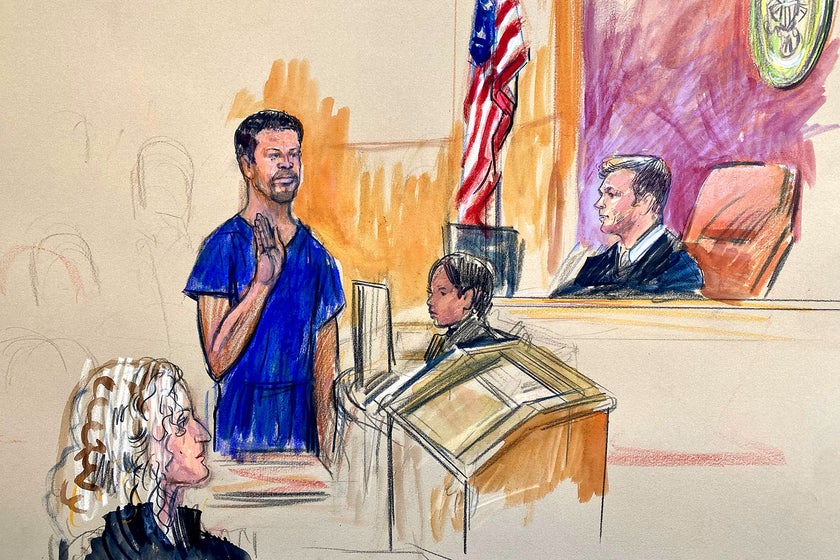
Slate, Luke Winkie, today: Donald Trump’s Attempted Assassin Had Shocking Motives—Especially What They Weren’t, subtitled “A decade of MAGA has really done a number on us.”
If Donald Trump is going to face assassination threats for the rest of his term—if the next three years will be intermittently interrupted by incidents like the one on Saturday, in which a gunman with a manifesto was apprehended outside the White House Correspondents’ Association dinner—it will not be because the revolution is here. That is what I found myself thinking after surveying the social media footprint of one Cole Tomas Allen, a teacher from California who allegedly attempted to kill the president and the rest of his Cabinet, and is now in federal custody.
On this point the writer concludes,
In other words, leaving aside the manifesto in which he lambasted Trump as a “pedophile, rapist, and traitor,” Allen’s public-facing words fall well within mainline Democratic boundaries.
So what, then? Comparing other would-be or real assassins.
…the person Allen reminds me the most of is, by far, Luigi Mangione, the shooter who allegedly gunned down UnitedHealthcare CEO Brian Thompson on the streets of New York.
… [he] recalls a character that has become increasingly common in American society—an adrift young man, angry at everything, who grows steadily more unhinged and unwell without any prodding from an ideologically bound terror network.
And concludes,
This leaves me with only one logical conclusion about the state of the union. Amid the decline of the American quality of life—to say nothing of the phantasmal, reality-blinkering disruptions of the modern internet, and the collective understanding that, within this political gridlock, nothing, on principle, can ever get better—I find myself wondering if people we once perceived as “normal” are, in fact, considerably more strange than they ever were before. That is the only way I can make sense of a Bluesky Lib going postal, or a podcast bro opening fire on West 54th Street. I think of the unfazed reaction the world at large had to this most recent Trump assassination attempt, how everyone quickly settled back into Wolves vs. Nuggets, or more grimly, instinctually asserted that the whole situation was a false-flag psyop. More to the point, I think about how I know, beyond a shadow of a doubt, that a huge swath of solid-blue mainstream liberals—those same wine moms at the rally—wish that Allen had found a better vantage point to mount his rifle. This is the status quo we are left with after 10 long years of MAGA, our norms and institutions chipped down to the bone. The man in the chair has foreclosed the future itself, and millions of Americans, passively or otherwise, want him dead for it.
So, what is this about? I have the same reaction as I did to yesterday’s item about the King Charles visit. What has happened to shared values and principles? Is society so complex that it’s fracturing?
At the same time, it’s difficult to draw generalizations from only a few cases. Yet it’s that these cases are so extreme that some explanation seems necessary.
\\\
Here’s another apparent trend that needs to be understood.

Washington Post, opinion by Matthew Schmitz, today: Why right-wing influencers are suddenly praising Islam, subtitled “Tucker Carlson and others conjure up an unexpected respect for a faith as an alternative to liberal modernity.”
I was not aware of this at all. Though the subtitle might explain it. (I might say that I find the claims of Islam no more ridiculous or implausible than the claims of Christianity. Though some commentators, like Sam Harris, think Islam is far more dangerous. Or did, 20 years ago.)
Since Sept. 11, 2001, commentators on the American right have tended to cast Islam as a menace to Western liberties. But in the freewheeling world of antiestablishment podcasts, something new is happening. Recent months have seen Candace Owens reading from the Quran, Nick Fuentes decrying anti-Muslim sentiment and Tucker Carlson praising sharia law. What was once regarded as a threat is increasingly considered an ally.
… Say goodbye to Judeo-Christian civilization — and hello to the Islamo-Christian right.
The term “Judeo-Christianity” gained currency in the 1930s as a way to describe a pluralist vision of Western society. A Judeo-Christian America was one in which the contributions of Catholics and Jews could matter as much as those of Protestants. It would also be the global champion of freedom and democracy.
The Islamo-Christian right, by contrast, is skeptical of pluralism and critical of U.S. foreign policy. It’s scornful of liberal attempts to promote interreligious understanding and therefore happy to criticize Islam on certain points even as it praises the faith on others.
The gist seems to that even fundamentalist Islam is preferable, to the right-wing, to a modern world of tolerance and diversity.
In his 2015 novel “Submission,” Michel Houellebecq predicted how opponents of liberal tolerance might agree with Muslims. “On every question that really mattered, the nativists and the Muslims were in perfect agreement,” the narrator states. “When it came to rejecting atheism and humanism, or the necessary submission of women, or the return of patriarchy, they were fighting exactly the same fight.” Whether the Islamo-Christian right’s vision of Islam is actually accurate is, for its adherents, beside the point. They are not engaging in a careful study of comparative religion; they’re imagining an alternative to liberal modernity.
And this all fits with one of my basic themes.