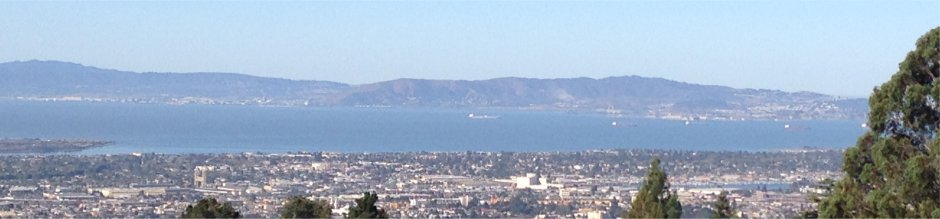
- Kevin Kelly’s take on a meaning of life: be the most improbable person you can be;
- And my provisional ideas about meaning and purpose;
- Hans Zimmer’s Interstellar.
I mentioned Kevin Kelly yesterday, and so I checked out his blog, his Substack, and saw this recent post that applies to my current reading, of books about the meaning and purpose of life. Yes, really. (Alongside reading more books about religion and the Bible.)
My provisional conclusions: Meaning is what you make of your life, it’s about what you choose in your life that is meaningful — significant, fulfilling, enriching — and you build that meaning. Purpose? There is no cosmic purpose; there are no handed-down orders from on high. You can choose your purpose. Perhaps whatever you personally are best at, and are uniquely able to accomplish. I’ve been developing these ideas, especially since both recent understandings of science, and the concepts explored by science fiction in recent decades, can inform these ideas in the way no contemporary philosophers seem to have considered.
But here’s Kevin Kelly’s take.
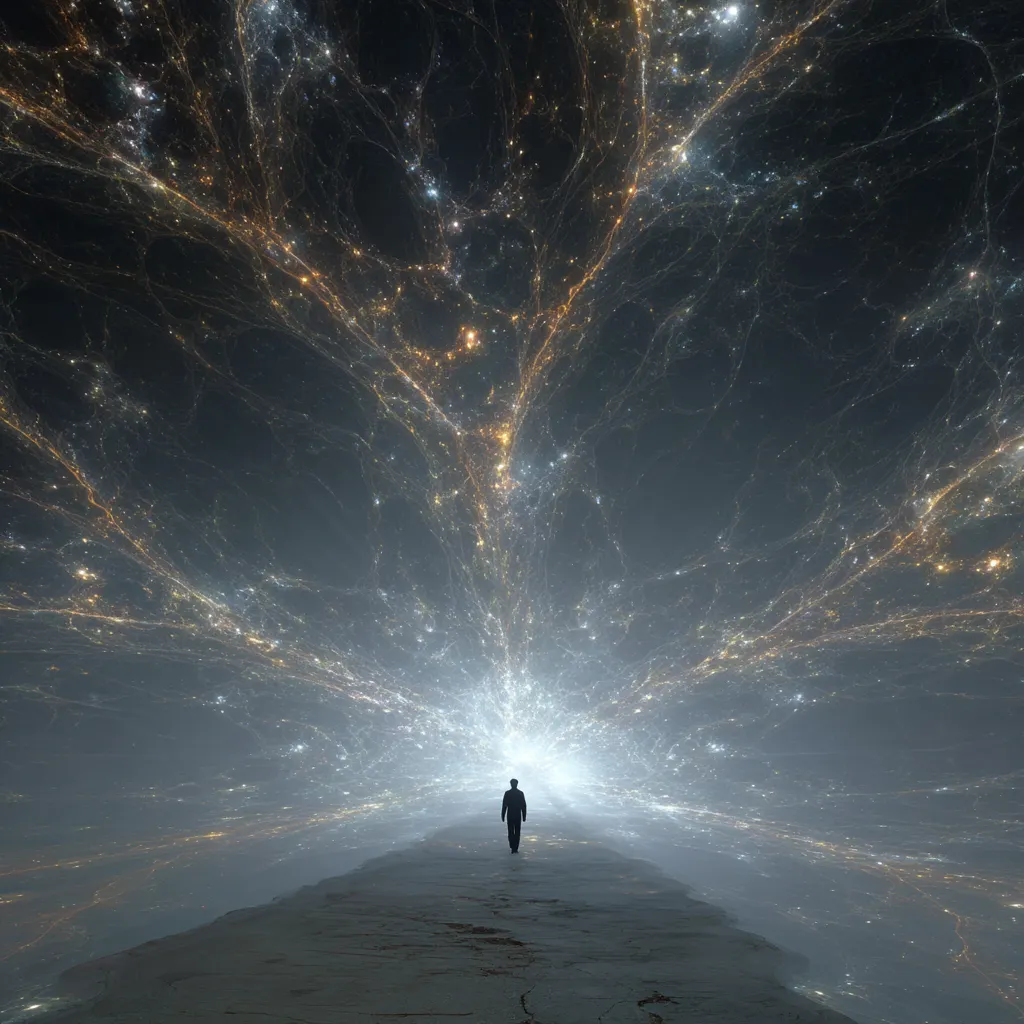
KK, Kevin Kelly, 18 May 2026: Your Most Improbable Life
Your life’s goal should be to become the most improbable person you can be. Your path, your character, your life, should be the most unlikely, the most unexpected, the least predictable version you can make. Improbable lives have fewer competitors, more unique rewards, and are harder to replace with AIs, since AIs run on the predictable. This is true whether you favor traditional humanist directions or work on a frontier.
He goes on, about the two inescapable properties of the universe we live in.
The strategy of seeking the most improbable life begins at the Big Bang. As far as we know there are two unbreakable laws in the universe: 1) Nothing travels faster than the speed of light, and 2) Everything runs down over time toward an end state of absolute uniformity. This motionless destination “without difference”, is also known as heat death, or entropy. With universal entropy, everything moves toward sameness and the totally predictable.
My thinking is going in two ways. For centuries and decades, humanity has gradually understood the size and age of the universe (which challenge the presumptions of primitive religions). Two new things have happened in recent decades. First, the psychological understanding of the human mind has revealed that we are not reliable witnesses, we are biased in our understanding of the universe, because our intuitions were formed over hundreds of thousands of years in a primitive environment quite different from the one we have come to live in now. Second, the realization that there are multiple levels of reality, each of which is best understood through certain kinds of ‘stories’ that don’t apply to other levels. Thus to ask “what is the meaning of life?” is a category error. There is no “meaning” outside of human relationships. Looking up at the stars offers no meaning. (I’m reading Todd May.) There is no cosmic order giving instructions for “meaningful” conclusions, or a purpose. Will keep working these ideas.
\\\
I’ll let today’s examples of political nonsense pass for today. I can’t withdraw from them altogether — they are examples of the primitive base human nature that we need to overcome.
\\\
Listening to this, this afternoon.