(Avid Reader Press, March 2025, 288pp, including 66pp of acknowledgements, notes, and index.)
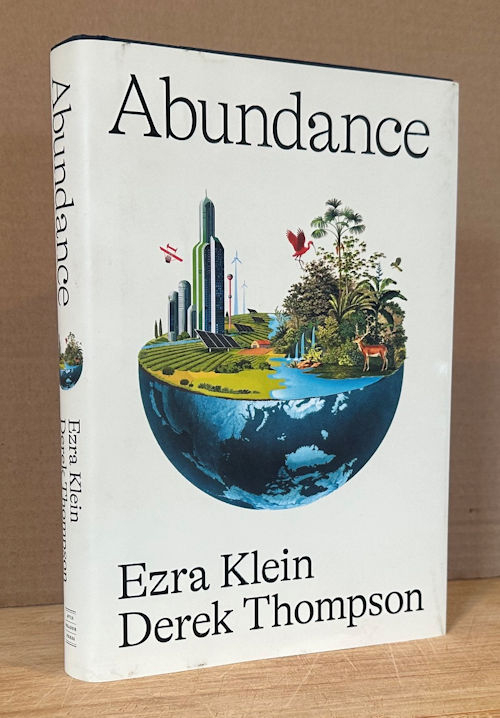
- This book takes the optimistic stance that we are capable of building what we need, and that we can solve many of the problems we perceive today.
- These problems include a right that fights he government, and a left that over-regulates it.
- We need to think bigger, creating risky technologies funded by the government, since the market won’t do it. Get better at weighing risks. Find a vision of the future.
- Authors are liberals, and won’t be appealing to the right, which simply doesn’t believe some of the problems we need to fix even exist. The future the authors want is: abundance. Not just more of everything; more of the things we need to create a better life.
- Then follow five sections on themes about creating abundance: Grow; Build; Govern; Invent; and Deploy. Generally, the book discusses problems that have arisen in doing these things, and explains how these problems came about, better than it identifies how to fix the problems. I’ll compile some specific points.
- A problem with growth is zoning rules in cities, which have brought about homelessness. Boarding houses, once common, were made illegal. Meanwhile, pollution got bad, triggering the environmental movement, and more regulatory laws.
- Fighting climate change may entail ‘degrowth’ despite the human need for more. Prosperity has greatly increasing since fossil fuels were exploited, but inequalities remain. We need to electrify everything. Big projects, like California’s high-speed rail, got bogged down because so many vested parties want their say. And their lawyers go into politics. Now no one trusts the government. We need to find a new balance.
- It’s more complicated than the liberal/conservative government divide. Liberals add too many goals to a project; Republicans demonize bureaucrats. Taking risks, the I95 bridge in Philadelphia was rebuilt in 10 years. [[ But these are the risks Boeing took. ]]
- Government grants for research have become too conservative, too success-oriented. We need more invention. Partly the problem is all the easy discoveries have already been made; part is that everything is more complicated now. And the US should be making immigration, especially with H-1B visa, easier, not harder. The 20th century has seen invention move from individuals to research labs with government control and sometimes ridicule (Proxmire). Innovative labs created the internet. We should experiment with how best to experiment.
- History is mostly *not* about Eureka moments. We’re stuck between a progressive movement that is afraid of growth and a conservative movement that is allergic to government intervention. History shows that government can pick winners, e.g. NASA, and losers, e.g. Reagan wrecked the solar cell program in 1980. The Covid operation “warp speed” was a success, but no one talked about it — Democrats didn’t want to give Republicans credit; Republicans didn’t want to rile their anti-vaccine base. We need to investigate wisely rather than impose ideology. AI, nuclear, desalination. We can make choices, and create an operation warp speed for any of those.
- We can choose: scarcity or abundance. It’s not about immigrants. Trump is now slashing what the government does; liberals have an opportunity to champion the politics of abundance. LBJ said the same thing about the 1964 World’s Fair.
\\
Detailed Notes
Introduction: Beyond Scarcity, p1
The author imagine morning in 2050. Getting up the morning, citing wind turbines, nuclear plants, geothermal wells. Desalination. Vertical farms grow things nearby. Cellular meat facilities. Drones deliver medicines synthesized in orbit. Electric cars and trucks, mostly self-driving. AI, labor rights, and economic reforms have reduced poverty and shortened the work week. Jetliners reach Mach 2. All of this far different from the crises of the early 21st century. Why did we not solve those problems?
Scarcity Is a Choice, p4
To have the future we want, we need to build and invent more of what we need. That’s the thesis of the book. Today, many Americans are against clean energy solutions; rich cities make it difficult to build new homes; our medical systems make it difficult for scientists to pursue promising work. Some problems reflect different beliefs or interests. Others reflect how the past overhangs the present. Examples. Over the 20th century, America developed a right that fought the government, and a left that hobbled it.
The Supply-Side Mistake, p5
Supply and demand. Democrats and Republicans have divvied them up. Supply-side is right wing: Laffer’s curve to tax cuts to voodoo economics. It’s been tried and failed again and again. Conservatives also wanted regulations cut so companies could produce more. Democrats did not respond appropriately. Progressives focused on giving people aid to buy more stuff they otherwise could not afford. ACA, food stamps, housing vouchers, Pell Grants, tax credits, social security, minimum wage. Without focusing on what those vouchers and money were actually buying. Subsidizing demand leads to higher prices or rationing. This has led to high home prices, higher health care premiums, higher tuitions, higher child care costs. Then inflation, and too much demand. More supply was needed. By 2024, inflation has eased. Policies began to change, 11t. A new theory of supply is emerging.
Society Is Not a Pie, p11
You can’t just grow the pie; growth has to deal with change. Not just greater productivity, but developing new things we never imagined. Compare 1875 with 30 years later. P12. Then consider 1990 with 30 years later, 2020. Aside from smartphones, most things are about the same in 2020. We’re mired in nostalgia, with too little utopian thinking. Example of Bastani’s 2019 book. We need new technologies, e.g. to limit climate change. We still need green hydrogen and cement, nuclear fusion, cancer treatments. Risky technologies must be funded by government; the market won’t do it. Yet government is neither the problem nor the solution. Consider nuclear power; despite its relatively safety, the US stopped building plants. It’s a failure of the government to properly weigh risk. Right v left, 15.8: “Too often, the right sees only the imagined glories of the past, and the left sees only the injustices of the present.” Neither has a vision of the future. This book is an argument for such a vision.
A Liberalism That Builds, p16
Author are both liberals “in the American tradition.” And they will focus on the problems the left has with big issues like climate change, affordable housing, and so on. They won’t be appealing to the right. They believe that decarbonization of the global economy is necessary, something the right simply does not believe. At the same time, why is it easier to build renewable energy in red states than in blue? Consider California’s problems, in a state run by Democrats. Trump moved almost every part of America to the right, even in California. California is losing residents.
The Abundant Society, p19
The future the authors want is described as: abundance. Not just more of everything. Recall 1954 Potter book. Our generation has seen a growing consumer culture. Authors are interested more in production than in consumption. Abundance is a state in which there is enough of what we need to create lives better than what we have, 20.2. Focus on the building blocks, the institutions, and the people.
Ch1, Grow, p21
Horace Greeley supposedly said “Go west, young man…” but he never did. We romanticize the frontier, but thrive in cities. The depression was partly a reflection of running out of more frontier—no continual growth. But the land that matters is that in cities. But that land can be expensive. New home construction has fallen. Thus a housing crisis. Affordability. People live outside of big cities, where they can afford to live. Now in a sense we’re closing the American frontier.
P25, Why cities matter now more than ever
Over the past few centuries, we fought distance, and we won. The economy has changed from making goods, to making ideas and services. Now big companies are international. Large cities are some 50% more productive than small ones. Different kinds of communities and ecosystems. Silicon Valley vs New York. Other examples. Despite the costs of living in big cities, they’re where companies are most likely to thrive. Even the pandemic hasn’t destroyed this relationship, as companies required workers to come back to the office. Innovation thrives in cities.
P30, The great divergence
About two thirds of American jobs are in the service sector. But now upward mobility has declined; it used to be commonplace. Such mobility is a product of place. Inequality among states has increased. And liberals bear much of the blame.
P33, The problem with lawn-sign liberalism
It used to be that Americans were ‘symbolically’ conservative but ‘operationally’ liberal. Now in blue states it’s the reverse. E.g. signs on lawns in San Francisco, which enact rules to prevent their ideals from taking place. Now liberals cling to stasis and conservatives embrace change—in housing policies. It’s all about zoning rules in cities. Starting in the early 1900s. They were reactions against the mobility brought about by trucks and buses. Now zoning has become anti-growth regulation. Examples of Lakewood CA, which welcomed growth, and Petaluma CA, which stopped it. To prevent sprawl. Housing permits are limited. Now prices are high and the population is shrinking.
P38, This is your state on a housing shortage
So now there’s high homelessness. With many familiar explanations offered. Other causes were studied. Poverty? No. no unemployment. Not mental illness. It’s all about housing. Cost of rent. It’s like musical chairs. These are policy choices. Matthew Yglesias studied this. Recalling boarding houses, or rooming houses. Where did they go? They were made illegal. They were considered incompatible with one- and two-family neighborhoods; they would bring blight. Zoning rules were established. And that created the housing crisis.
[[ Actually, I live across the street from a de facto boarding house. An owner and three tenants, rotating in and out over the years. ]]
P43, What happened in the 1970s?
Wages began to stagnate, inequality soared, inflation rose, housing prices rose. From a certain website. The government backed 30-year-mortgages, with interest tax deductible, that made it possible for more people to buy homes. Inflation made these homes, paid with flat payments, worth more and more. Homes became the center of peoples’ wealth. That provided an incentive to manage the area around that home. Through zoning and regulations. Atlantic essay, p46, see endnote 56. It can’t work for all. [[ This is all good because it challenges assumptions. But how could it possibly change? ]] But there’s more.
P48, America the ugly
LBJ speech in May 1964, about overcrowding and an ‘Ugly America.’ Galbraith’s 1958 book. Older growth politics swung to antigrowth politics. How things changed from 1900 to 1970. Air pollution. Water pollution. Examples. Silent Spring. The environmental movement. Earth Day. New laws. Supported by both parties. Clean Air Act, Endangered Species Act. Reagan in California enabled much of this. Then a 1972 case in Mammoth Lakes CA which challenged those laws. And won. Environment impact statements.
P54, The plague of growth
There were doubts about the interstate highway system too. Robert Moses trying to carve up New York. Worries of Californication. It boiled down to residents already there vs the hordes who wanted to move there. What to do about it?
2, Build
Climate change. Here the conservatives don’t care, while the left wants to conserve. To conserve requires remaking the world. Which may entail ‘degrowth’. But it’s an anti-materialist philosophy. A reversal of ideas of dominion over nature, capitalism. Reduce waste, etc, especially in military investment, meat and dairy, advertising, fast fashion. Consider how much land is used for agriculture. And the cruelty and suffering of animals. But no one can say this; people still want to eat meat. So politicians don’t mention it. The same applies to many other approaches to climate change. People want what they want. People protest over rising energy prices. Examples in many countries.
P62, “We Just Burned It”
All those measures of human well-being rose only once fossil fuels were exploited. But even today there are inequalities; example from Rosling. Air pollution has been a problem for centuries, but it passes. We learn how to use clean energy. The same will apply to climate change. Now we have wind and solar power. Soon they may be effectively free. [[ But again, Trump and MAGA are reversing all such progress. ]] The sun burns, so we don’t need to. Trends are going the right way. … Today’s technologies will look comical and barbaric a century from now.
P68, Electrify Everything
Start at home. We drive, heat our homes, cook our food. They will all need to run on electricity. Will need to replace a billion machines. People will need to want them. Where will all the electricity come from? Now, about 60% comes from fossil fuels. We need to convert that to 0%, and generate much more electricity. Wind and solar will require lots of land area. And we’ll have to move that energy. Transmission lines. Such projects are usually late. It will require a liberalism that builds.
P71, California’s No-Speed Rail
Imagined since the ‘80s and ‘90s. Brown. Obama, 2009. Well-funded. But progress crawled. By 2019 Newsom tried to salvage something. As of 2023, it’s stuck in limbo. Ezra visited Fresno. Political problems. 75-6. It’s not the construction itself, it’s negotiating. Which raises costs. Newsom knows how bad it all looks. The general theme: delays are so pervasive in government that we’ve forgotten how to build things. It’s not that government is inherently inefficient. Yet other countries spend far less for a kilometer of rail, 77b. So it’s not government per se. Nor unions.
P78, The Construction Puzzle
Productivity in construction rose in the 50s and 60s and began falling around 1970. The problem was studied. The trend was international. Not regulatory burdens. Perhaps there are multiple causes. The need for multiple bids. Safety rules. Paperwork.
P81, The Organizations of Affluence
Consider how quickly Germany and Japan recovered after the war. Book by Mancur Olson. Perhaps groups for collective action, which emerge in favorable circumstances, the more fights, bargaining, etc., and the harder it is to get projects done. Thus China vs California. Yet the theory isn’t perfect. Japan has slowed down. Olson overlooked certain factors. Not every group (collective action) is out to make a buck. Construction is all about balancing many competing perspectives. There were fewer of them 40 years ago. …
P86, Nader’s Raiders
Both conservatives and liberals wanted constraints on the government. Motor vehicle fatalities. Nader, LBJ, safety standards. The government was letting big business pollute and endanger consumers. Examples. Thus, emissions dropped, vehicles are 99% cleaner now than in 1970. Hazardous air days fell. But one result was an increase in the number of lawyers.
P89, Liberalism’s Lawyers Problem.
Later, Republicans learned to stymie the government by burying it in paperwork. Process-obsessed rather than outcomes-oriented. Two concerns were legitimacy and accountability. Americans mistrust their government, and centralized power. They wanted the government to do more without giving them the trust and authority to do it. More and more was turned over the courts. In America a significant percentage of our politicians were lawyers. And now no one has trust in the government. And so things don’t get done.
[[ Well, depends on risk assessment. I spent much of my career on “process improvement,” which was implemented to put quality (of spacecraft) over schedule or cost. Years later, Boeing abandoned process/quality in favor of market forces, and had two 737 MAX plane crashes. ]]
P94, The Green Dilemma
Whatever path we follow on energy and the environment, it will involve environmental impact assessments and permitting nightmares. We were successful bringing pollution down from the 1970s. Now we’re building too little and are paralyzed by process. There are so many agencies that must give approval. Example Wyoming wind farm. When things get built, they are more expensive. New laws will be required. Examples of actions in the Trump and Biden administrations to cut corners. We need a change in political culture. We need to speed up the system. We need a balance that allows us to meet our climate goals.
3, Govern, p101
Tahanan is a supportive housing building in San Francisco. Built quickly and cheaply. How? It used private money to avoid all the rules and regulations that would apply to government money. Examples of… Lots of reviews. Modular housing. Progressive goals can conflict.
P105, A False Divide
It’s more complicated than the usual liberal/conservative ideas of government. Neither side focuses on the ability to achieve goals. Health care in Europe vs America. Various remedies only solve parts of problems. Houston compared to other cities. Such as San Francisco. Details. And LA. Resistance to new housing projects. Cities like Singapore have 80% public housing. In the US, audits and more audits.
P113, The Problem with Everything-Bagel Liberalism
Liberals deny that trade-offs are necessary. They add too many goals to a single project. Like high-speed rail. Biden tried to revive the semiconductor industry, but plans included lots of requirements to achieve various equity goals. Processes are added but seldom lifted. [[ Requirements creep, in engineering ]]
P117, It Should Not Be This Hard to Serve the Public
The federal civilian workforce hasn’t kept up with federal spending – in part because Republicans demonizing ‘bureaucrats.’ Compare the high-speed rail project with BART. Example of Code for America. Government technology is like layers of sediment. Example of an EDD database built with COBOL for monochrome displays. Layers built on top of that. Contractors. Other modernization efforts. Systems become complex. … New regulations added on top of old ones.
P125, A government that chooses is a government that works.
Example of fire under I-95 bridge in Philadelphia. How long to replace the bridge? Rules were exempted. … they took risks. It took only 12 days. Summary by Brink Lindsey, 127-8. Government needs to be better, justified not through rules but through outcomes.
4, Invent, p129
About a woman from Hungary who came to the US and studied mRNA. She applied for grants and was rejected. Her work petered out. Decades later came Covid in 2020. Vaccines were created in 10 months. Based on mRNA technology. This was a problem not of regulations or building; we had to invent our way out.
P133, The politics of invention
Think back what the world was like three lifetimes ago. Technology has changed the world. Now progress depends on more invention. There are still major issues with health care. Our politics needs to take invention more seriously. Companies complain about government regulation, but are happy to take huge government loans.
P137, A shot to save the world
In 1997 Kariko, the woman from Hungary, was making photocopies of science articles. She met an immunologist and they formed a team. They succeeded in the early 2000s. but their discovery made no splash. But it did get attention from Moderna. In time to respond to Covid. Kariko and her partner won the Nobel Prize. Over the decades American science became risk-averse.
P141, The Kariko problem and the great science slowdown
Here are plenty of professors – some 1.5 million. Communication is good, AI tools available. Yet many fields are slowing down. Are ideas harder to find? Yes. Cancer, for example. Why? 143m because the low-hanging fruit has already been picked. “The burden of knowledge.” Examples of past discoveries. Mendel. And modern studies of genetics. Everything is more complicated now. [[ yes, this is my key go-to explanation for so many of these issues. ]]
So you need more scientists. Immigrants. Statistics of past successes. But now the US is making immigration harder. The H-1B visas for high-skilled workers are capped. The cap is too low for the population or the need. It should be doubled. There’s still the issue of risk-aversion. Science is getting older. Too many papers are inconsequential. Playing it safe. Example of Columbus. The NIH.
P149, The growth of the American innovation system
Before the 20th century individuals did most of the inventing. Then came Edison’s corporate research lab. Others copied him. The US government got involved only during WWII. Vannevar Bush and a new agency. It became a government job. Bush focused on ‘basic research’. NSF. Grew rapidly over the years. It’s been criticized: more rules, less efficiency; more paperwork. Proxmire. He inspired more and more rules. All of this analogous to the problem with building codes. Another problem: status-seeking rather than pure science. Another: modern science plays it too safe. Studies of peer reviews show highly novel ideas receive the worst scores. Example of how a study of Gila monsters in the 1990s led to Ozempic. Other examples. Geysers, CRISPR. Modern studies are doomed to succeed. But recently incentives for high-risk projects have been put into place.
P160, The Idea Factories
Recalling Oct 1957, Sputnik. The space race. DARPA. Works very differently than NIH. The first internet. Program managers are empowered. Another model: Bell Labs. AT&T. Where are today’s innovative labs?
P166, Experimenting with experiments
Neither liberals nor conservatives have much idea about promoting invention. We could fix immigration. Increase spending. Fix the system. And even, understand the science of invention. Experiment on NIH to see what parts we can eliminate. And see what works. Take risks. There are great possibilities. We need a better science of science.
5, Deploy, p169
Alexander Fleming and penicillin. A weapon against bacterial infections. Later Florey and Chain tested mice. But it was difficult showing it worked in humans. We have the idea that invention is a series of eureka moments. Specific names and dates. But this approach is wrong. For decades after penicillin was discovered, it had accomplished nothing
P171, The Eureka Myth
History is mostly about things not getting better. It’s getting more difficult for new ideas to be put into use. Passenger elevators were invented in 1853, but today American elevators have become “over-engineered” and expensive compared to other nations. Similarly nuclear reactors and solar cells. Lithium batteries. We’re stuck between a progressive movement that is afraid of growth and a conservative movement that is allergic to government intervention. Let’s consider how things should work. Back to 1941. Florey and Chain came to America. Things went well, enough for everyone by March 1945. Millions of lives saved by 2023.
P176, Building what we invent
So penicillin became useful due to implementation in the US. Tinkering, embodiment, scaling: microinventions. Often more important than the original invention. Edison. US policy doesn’t take this into consideration. Examples: solar cells. The solar revolution worked well until Reagan decimated it in 1980. R&D funding plummeted. Other countries stepped. Especially China. Wright’s law says that cost of manufacturing decreases as volume increases. Examples, like the Model T, and computer chips. The US lost decades in not developing solar energy. We’re only now beginning to recover. We’re still burdened by the eureka myth. A second myth is that the government can’t pick winners. History does not support this. Examples, 183. The question is *how* to choose. Do things that no one else is doing. NASA. Covid vaccines.
P184, Progress at “Warp Speed”
Consider spring of 2020. It took years to develop vaccines. Then Operation Warp Speed did a covid vaccine in 10 months. Details. They tried multiple strategies. A lot of coordination. Distribution issues. The private sector was enabled; no federal employees directly involved. The vaccines were free. All for $40 billion in government spending. Despite its success, both parties have abandoned it. The new administration in Jan 2021 just stopped talking about it. Democrats, to not give Trump any credit; Republicans, because their base are anti-vaccine. And they claimed the wrong lesson, 189. Rather, the government removed bottlenecks…
P189, The Bottleneck Detective
It means investigating wisely rather than imposing ideology. In the 1980s the government deliberately cut support for medical schools, fearing a surplus of doctors. It was a policy of deliberate scarcity. The government could easily reverse it. And it can fund new programs that should exist. Push funding and pull funding. Examples. Advance market commitment. Could be applied to removing CO2 from the atmosphere. Clean cement. We need to invent our way out of that. Details.
Then there’s AI. It will require lots of energy. New sources of energy are being sought. Nuclear plants. If we can’t find enough energy, AI sites will move overseas. Abundant energy would be useful anyways. Desalination. Energy abundance might be the biggest bottleneck of them all.
P199, Focus Is a Choice
OWS had a single goal. Sometimes it takes a disaster to create a focus. Examples. Important point. Depressing? But we can decide what to count as a crisis. Like the Soviet threat that launched the space race. Even then, NASA was unpopular. We chose it anyway. We could announce Warp Speed programs if we decided crises existed to be fixed. We’ve made other decisions instead. Our next steps require deliberate acts, laws, and policies. We need a plan to build what we invent.
Conclusion: Toward Abundance, p203
Politics draws our attention to conflicts and divisions, and there are lots of those now. Could some new order be emerging? A ‘political order’ is a group of policies that both sides, at any given time, seem to agree on. The New Deal order lasted until the 1970s and the neoliberal order then lasted until the 2010s. Summaries. Is something shifting again? The Great Recession, the climate crisis, trade with China. Pandemic, and trust in government. Unaffordability. A political order needs a narrative. The old stories ended.
P207, A Fork in the Road: Scarcity or Abundance?
It’s not inevitable. Republicans blame inadequate housing on immigrants. Right-wing populism 208.3… Both sides engage in scarcity politics. Trump never solved the problems he ran on, and he didn’t understand cooperation. Biden seems to accept many of Trump’s premises. But he did get several laws that challenged the anti-build trend of modern politics. Two big spending bills.
P211, Abundance Emerging?
Thus the opportunity open to liberals now. Trump became focused on slashing what the government does. Liberals can now embrace a politics of abundance. The YIMBY movement. The climate movement. Etc. The left has its degrowther movement. …
P215, A Lens, Not a List
It would be easy to provide a long list of policy ideas. But we need to focus on our values. Balance the interests of a town against those of a country. Authors want to ask the big questions, 216.6. Analogous to environmentalism in the 60s and 70s.
P217, Abundance Versus Scarcity
Recalling the 1964 World’s Fair in New York City. Exhibits. Johnson spoke. The existential binary is the same now: abundance or scarcity. Can we solve our problems with supply? Authors discovered blind spots, including their own. Last paragraph:
Abundance contains within it a bigness that befits the American project. It is the promise of not just more, but more of what matters. It is a commitment to the endless work of institutional renewal. It is a recognition that technology is at the heart of progress, and always has been. It is a determination to align our collective genius with the needs of both planet and each other. Abundance is liberalism. But more than that, it is a liberalism that builds.