
- Another story about a European loving his American experience, and also how Americans need this kind of validation;
- Brief items about Trump Derangement Syndrome, the demonization of Anthony Fauci, how Christian Nationalist candidates should conceal their agendas, and why there are no migrants from Norway;
- A longer piece about “post-liberalism,” which to me fails to take the long view;
- More brief items from Paul Krugman about Pete Hegseth’s undermining of the military, and The Conversation about why people avoid bad news.
Another perspective about this; a German tourist loves America.
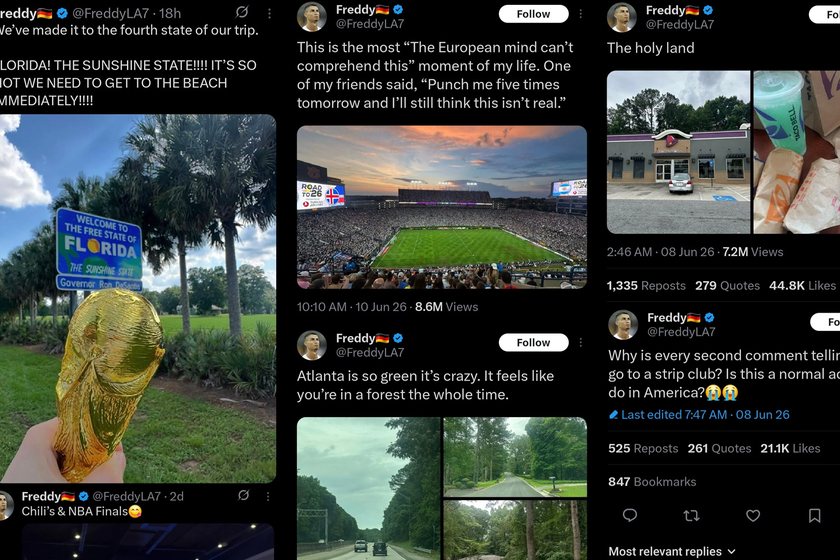
Slate, Alex Kirshner, yesterday: Freddy’s Big Adventure, subtitled “A German man’s World Cup road trip has turned him into an unlikely folk hero—and exposed how desperate Americans are for proof that their country is great.”
European tourists having a great time in America have been a recurring bit on my social media feeds lately, and perhaps on yours too. They’re driving on interstates. They’re trying ranch dressing. They’re eating at Taco Bell. But nobody has been a bigger sensation than a German man who goes by @FreddyLA7 on X. Freddy has gone megaviral for being a really good tourist and getting lots of fun gifts along his journey to watch the German soccer team (and others) all across North America.
So this much is true; but it’s also true about the popularity of such stories on social media.
This is where people have started to get it wrong about Freddy, and about a lot of the ranch-flavored tourism content that has surrounded the World Cup. The audience for this kind of posting is not Europeans who might now consider a pilgrimage from Brussels to Buc-ee’s. The audience is us, right here in America. We have the chance to absorb an interesting story from it, as long as it’s not the shallow one above.
…
We can learn something, then, from Freddy’s success. It’s that for various reasons, a lot of Americans are lusting after proof that America is good. Whether you are rolling around like a pig in slop at this political moment or devastated about it, you can find a reason to be jazzed about the German guy discovering joy in every little corner of the country. This is what Walmart, the publicists for the nation’s hottest rising country act, and many politicians have noticed too. There is currency right now in reminding Americans of something that I thought was pretty obvious to even the most doomerist segments of the U.S.: Not everything is bad. Like almost anywhere in the world, a tourist can have a fun time on vacation here.
What we can’t learn from this moment of World Cup tourism buzz is, well, anything else.
And the writer concludes by noting that a tourist can have a wonderful time virtually anywhere. You never see the whole picture.
\\\
Briefly noted.

- This is hilarious.
- Right Wing Watch, Kyle Mantyla, yesterday: ‘It’s All Very Scientific’: Is The Government Going To Declare ‘Trump Derangement Syndrome’ A ‘Diagnosable Mental Illness’?
- Based on what criteria? Criticism or mockery of glorious leader? Generally when conservatives claim “science” it reveals they don’t understand science. As in “Christian Science.” Will they also accuse the boy who cried out that the emperor had no clothes?
- JMG, yesterday: Navarro: “Fauci Created COVID And Killed Millions”
- No one believes this except for right-wing loonies. But they can say anything and be confidant that some people will believe it.
- Right Wing Watch, Kyle Mantyla again, 24 Jun 2026: ‘Hide Your Power’: Joel Webbon Tell Christian Nationalist Candidates To Conceal Their True Agenda
- In other words, lie? This is Christian morality?
- JMG, yesterday: Megyn Kelly: Why Can’t We Get Migrants From Norway?
- Moron. Because by any number of measures of health and happiness, Norway and the other Scandinavian countries are better-off than America. Why would they want to leave for a lesser country?
\\\
OK, so what is post-liberalism?
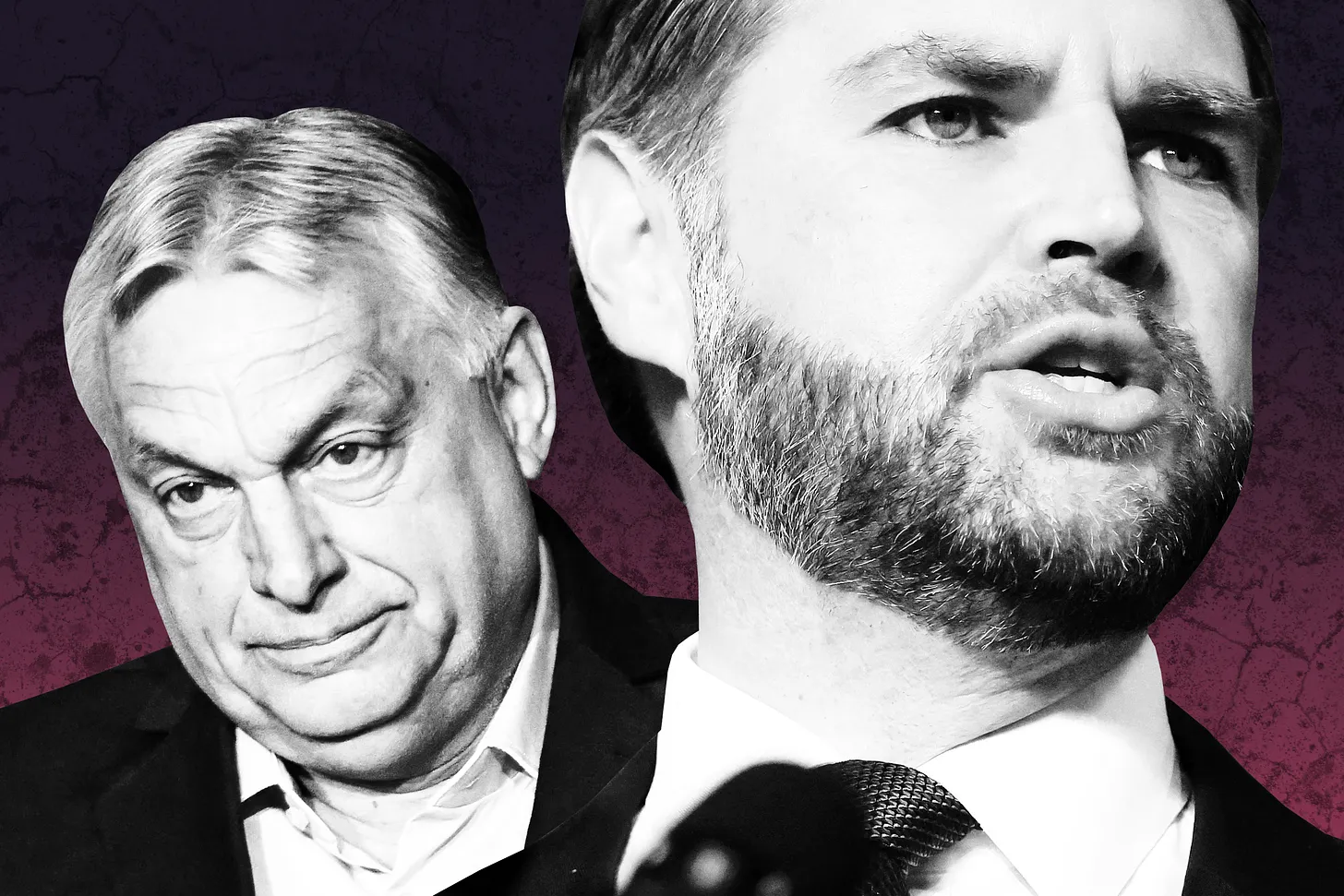
The Bulwark, Matt Johnson, 22 Jun 2026: JD Vance’s Ideas Will Never Work, subtitled “Postliberalism has been tried before, to ruinous results.”
A review of a book called Why Postliberalism Failed by James M. Patterson and Thomas D. Howes, where publisher Acton Institute is a conservative, libertarian think tank.
IN 2018, THE NOTRE DAME POLITICAL THEORIST Patrick Deneen published Why Liberalism Failed, a book that argues liberalism is in a state of terminal decline. It caught a cultural wave at the time and was widely discussed, even appearing on Barack Obama’s list of his favorite books that year. Since then, Deneen has been at the vanguard of a movement that calls itself “postliberalism,” which seeks to diagnose the reasons for the alleged failure of liberalism and build the foundations for the society and government that will succeed it.
Most commentaries I see like this strike me as being hemmed by short-term thinking. Over the course of human history, liberalism has won, and conservatives are losing ground. Despite temporary setbacks. That’s why, putting it crudely, we’re not still living in caves.
The central postliberal claim is that liberalism was always doomed to fail because it is inconsistent with human nature. Postliberals say the society liberalism creates is one of atomized individuals who privilege their own selfish interests over the “common good.” They deny or downplay the immense gains in human welfare secured by liberalism, from market reforms that lifted billions out of extreme poverty and catalyzed dramatic economic growth to the successive waves of democratization that secured political freedom around the globe. In the United States, liberal institutions have been under sustained assault for the past decade; postliberal intellectuals have played a pivotal role in the attack by providing illiberal elites with the intellectual justifications for their turn toward authoritarianism.
The solution here is that there is a difference between base human nature, which evolved over hundreds of thousands of years of tribal life, and the emerging human nature of the global society in just the past few centuries. All the intellectual standards advanced in past centuries, from the results of the Enlightenment to the US Constitution, were designed to *overcome* base human nature and install better standards.
The argument here is too recondite. Too focused in inward-thinking. The broad trend of human history counters.
\\\
More briefly noted, which I might have explored more fully on another day.

- Paul Krugman, 22 Jun 2026: How MAGA Undermined the Military, subtitled “Ideology, bigotry and cronyism have endangered national security”
- There was an interview about this on this morning’s KQED Forum.
- This is a fascinating new take.
- The Conversation, Ali Jasemi, 25 May 2026: Why 40 per cent of people are avoiding the news, according to a psychologist
- “Here is the problem: the human brain has not changed since then. We are the same species as we were thousands of years ago. What’s changed is the size of the world it’s asked to scan for threats.”
- Again, this is about the dichotomy between the evolved human brain, and the modern environment, which some people, but not most, can think through.