
First, posted on Facebook about our Napa Valley Wine Train trip yesterday.
Then, more about the role of science fiction in modern society.
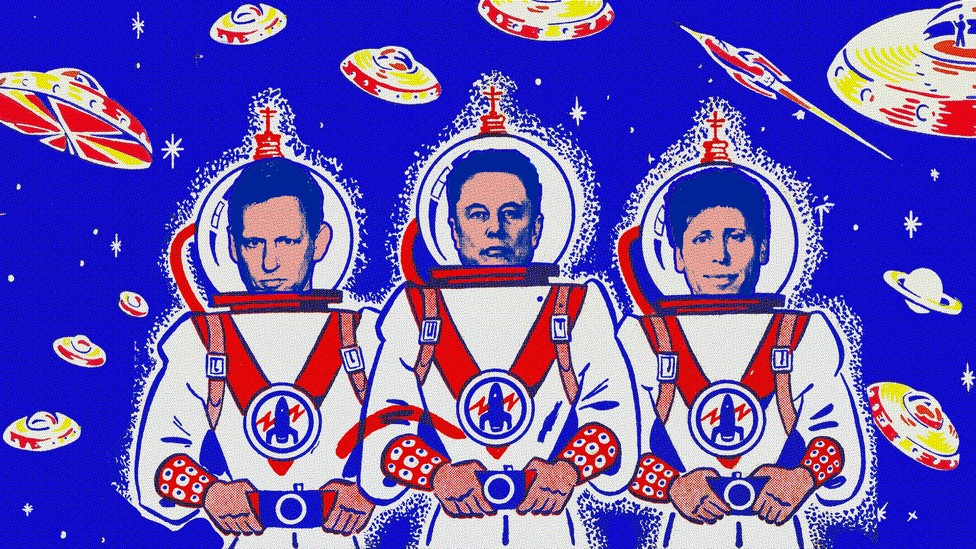
The Atlantic, Gal Beckerman, 31 Aug 2026: We Are Living in the Fantasy World of 13-Year-Old Boys, subtitled: “Many of the tech billionaires who built our world have taken the wrong lessons from their favorite science fiction.”
This is more about the new Jill Lepore book.
After reading Jill Lepore’s The Rise and Fall of the Artificial State, I have a new destination for a time machine, should I ever finally get my hands on one. I’d set the dial to some night in the late 1970s or ’80s and visit the boyhood rooms of the Silicon Valley titans Elon Musk, Peter Thiel, and Sam Altman. Then I’d confiscate all of their science fiction. Isaac Asimov, Arthur C. Clarke, Robert Heinlein—all of it.
No. This cannot be the response.
Lepore discusses Asimov, and Douglas Adams, and Star Trek. Asimov addressed ethics in his “three laws of robotics.” And then longtermism. And finally, about Heinlein.
As I was writing this, Bill Gates, who gushes all the time about his childhood love of science fiction, published a nearly 6,000-word essay worrying about AI. (He expanded on his thoughts in a Radio Atlantic interview.) He describes himself now as an “innovation lover” who “is scared and says we’re not ready and we’re crossing thresholds.” Heinlein was his favorite sci-fi writer—Gates particularly loved the 1961 novel Stranger in a Strange Land as a teenager. It is the story of a human who grows up on Mars and comes back to Earth; this traveler’s perspective reveals how contingent our established norms are, how changeable. Gates loved the “cool technology” in it, and the idea of “grokking,” a Martian term for connecting with a person or concept so deeply that you feel a part of it (Musk of course borrowed the name for his AI chatbot). But the Microsoft co-founder now points out that Heinlein was also illustrating the perils of believing that anything is inevitable—even our technology. This, he says, is the “grown-up” lesson.
Beware teenage obsessions. Many people see science fiction as some kind of adolescent fantasy of power — though I would say that this is more typical of fantasy, in which a single hero saves the world. Yet science fiction can be interpreted naively.
I would tentatively place this into the bucket about complex ideas reduced to simplex thinking.
\\\
The essence of the conservative mindset. Resistance to change.
JMG, today: Duffy Celebrates End To Stop/Start Buttons On Cars
He resists anything that is different from the way things were when he grew up. Does he miss clutches too?