I’m steadily tweaking and updating my Outline of Themes. It needs much work. Three items today. This illustrates the second:
The first: the primary issue goes back to that famous Essay on Man by Alexander Pope, which famously begins:
Know then thyself, presume not God to scan;
The proper study of Mankind is Man.
As this indicates, Pope was concerned about the impertinence of trying to know the mind of God, and in 1733 or so, there was little else left to study, but “man” himself.
But humanity does actually advance, in the sense that we know much more about the world, and ourselves, than we did 300 years ago. (Though not God. Has theology ever actually discovered anything new?)
I think Pope’s statement about the “proper study” is true, just not in the way he meant.
It’s because of this: the only way humanity knows *anything* is via the human mind. We’ve come to understand the limitations of our senses, of the way we think (the biases inherited from tribal life). But we can’t directly know what might be real that the human mind cannot perceive. (Science fiction has tried, with limited success.)
What humanity has done is to invent methods, like science and mathematics, that are self-correcting, to detect and understand the real world beyond our intuitions. Yet it goes to the power of human nature, that so many people *reject* those conclusions in favor of their intuitive and tribal thinking. This is the cognitive limitation of the human species that I’ve discussed. Though like so much of human nature — it varies across a wide spectrum.
To understand human nature, you have to understand human evolution. To understand human evolution, you have to understand evolution — the process. And you have to understand the reality of the ancient earth, and the ancient universe.
\\\
Next, this:
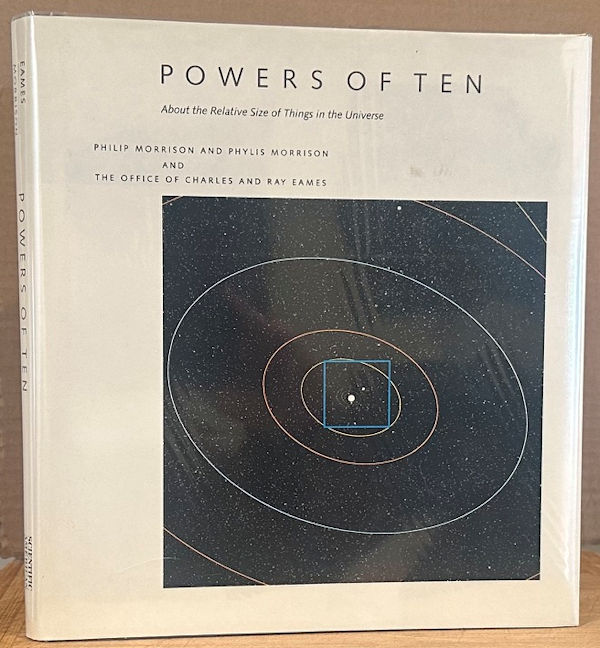
I’ve mentioned this before. There’s a book too, which I bought at a B. Dalton way back in 1983. This is earliest study I know of that depicted the relative sizes of the universe along logarithmic scales. It begins with a picnicer on a beach by Lake Michigan, zooms out as far as possible, by a factor of 10 every 10 seconds, then heads back and zooms in as far in as possible. The point is partly to illustrate how vast and deep the universe is; and it is partly to illustrate how human ‘intuition’ operates only within a very limited span of these huge ranges. This is why ‘common sense’ has only very limited application.
I watched some of this again, wondering, how many steps in either direction are familiar, or intuitive, to human beings? Tentatively: about 5 steps outward. Until a portion of several states. Humans retain their primitive intuitions, and primitive humans can easily imagine distances to the horizon, and perhaps somewhat beyond. Inward: only two or three steps. A millimeter; the size of a tick, perhaps. That’s a span of 8 orders of magnitude, out of some 50 or more. Yet we know the rest of the universe is there. We detect it indirectly. And some people, limited to their primitive intuitions, simply don’t believe it. Thus the flat-earthers, and others.
\\\

Scientific American, Mike Brown, today: Pluto still isn’t a planet—unless Earth’s moon is, too, subtitled “On the 20th anniversary of Pluto’s infamous demotion, Mike ‘Pluto Killer’ Brown explains why any reversal of that decision would be driven more by nostalgia than science”
Stepping out: conservatives don’t understand that science continually updates its conclusions, including its categories. If anything spherical in our solar system is a planet, then there are dozens of planets, including Earth’s Moon. If you apply other criteria for being a planet, then Pluto is not a planet, and neither is Eris.
(I’m reading the new book by Hakeem Oluseyi that makes an identical statement: he claims there would be some 38 “planets” in our solar system.)
\\\
This is terrific. You see the orchestral performers, and especially the conductor, who seems to be trying to passionately will the music into existence.
On the other hand, those couple quiet passages that I like so much were so quiet I could barely hear them, even with my laptop volume set to 100.
(And yet there are ads.)