
(Knopf, April 2026, 391pp)
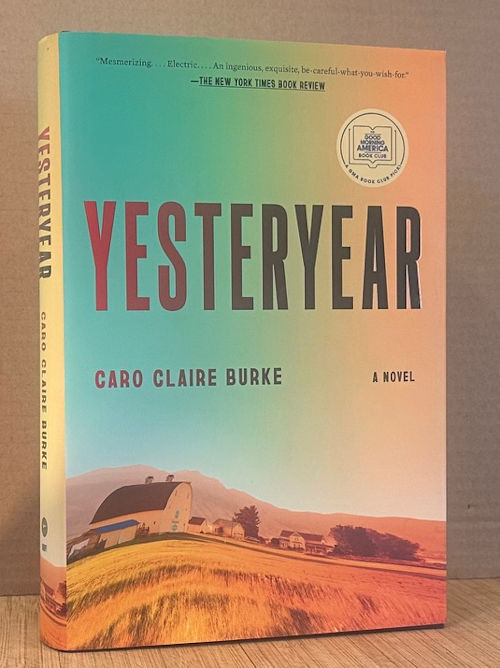
I read the bestselling novel YESTERYEAR, by Caro Claire Burke, three weekends ago, on a trip to LA to spend time with family on the occasion of a 1st birthday and a new house, and it turned out to be a perfect book for such a trip. In such family gatherings things are going on all around me that don’t need my attention (especially on Open House day when 50 people were wandering around the house and property), and this book was an easy read as I sat on the sofa, or retired to our guest room.
It’s difficult to discuss this book without spoiling it in one direction or another. I added it to my Weekly Bestsellers page, on Locus Online, beginning April 20th, because the various descriptions of the book implied it involved time travel — a contemporary woman goes back to 1855.
Spoiler: it’s not about time travel. It’s not a science fiction or fantasy book. But to say this, after 3 months, is a kind of spoiler in itself. To still compile the book on my Weekly Bestsellers page is a bit dishonest. But I was relying on the various short descriptions of the novel, on bestseller lists. But to admit that now would be another kind of spoiler. I’ve queried Locus HQ about this, but I think I’ll keep compiling the book on my weekly page, as an ‘associational’ book.
The novel has many virtues, nevertheless. It’s a satire of contemporary culture — tradwives, the manosphere, and social media, and religious fundamentalism.
The set-up is about a contemporary woman, Natalie, living in Idaho, who’s built an online empire as a ‘tradwife’ influencer. She’s come to make more money than her husband. We understand early on she’s a hypocrite; she’s built a ‘traditional’ farm in Idaho that hides all the modern conveniences behind pantry doors. She preaches simplicity and the word of God, and homeschools her children.
And then she wakes up in a primitive version of her modern reality, and gathers that it’s 1855. Living in the same house, more or less, with the same husband and children, more or less, and she comes to learn what life back in her ‘tradlife’ fantasy was really like.
That by itself would have been a suitable story: modern fantasies of the simple past are undermined by the reality of the past. The MAGA fantasy of an ideal past isn’t true, and here’s a demonstration.
But it goes on. Spoilers! It develops that she has not really gone back into the past. Our first clue is that she finds some tiny modern device in the dirt outside the 1855 house. She’s in some kind of simulation, or recreation, of her past, and for some reason her real husband and real children (except for one) are participating in this charade. Why? Well, we realize early on she’s an unreliable narrator, and perhaps she’s not entirely sane either, given the zealousness of her beliefs.
This was an engaging read that, on reflection now three weeks later, seems more and more superficial (as so many popular novels do). There are some good insights. Natalie wonders if she is being watched. She wonders if this is some test by God. She comes to think everyone is lying to her — that life is one big lie. And yet thinking about it in retrospect, there are more and more questions. How was this ruse arranged? Why did the husband and kids cooperate? Why is the husband, Caleb, almost impotent in the ‘present’ and virile in the ‘past’? (Well.) And why, as in any legitimate time travel novel, did not the protagonist sit up and ask, alarmingly, WHAT YEAR IS THIS??
Still, there are some pointed themes — i.e. captures of the current 21st century experience. Natalie’s influencer empire on the one hand, with “angry women” commenting about her posts; husband Caleb’s attraction to the manosphere, with its host of conspiracy theories.
There was one line I jotted down to quote. Natalie thinking about her life and destiny. P 95-96: “All my life, I’d understood and accepted that I was brought into this world for the explicit purpose of eventually bringing other lives into this world, like a never-ending baton pass, an infinite relay of God’s glory.”
Baton pass. Indeed. Is that all there is?