
Subtitled: “How Enemies Become Friends”
(Bright Matter Books, February 2026, xxi + 181pp)
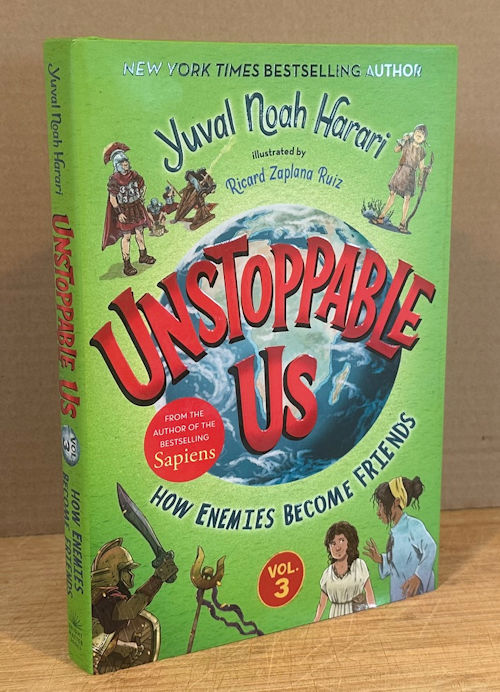
Here is the third of Harari’s world’s-history-for-children books, taking a 30,000-foot view of the big changes over the millennia of human history. Each book has four chapters. I’ll recall the first two volumes…
Volume 1: How Humans Took Over the World
- Humans are animals; there were once different kinds of humans, but only our branch, Sapiens, is still alive;
- The superpower of Sapiens is the ability to cooperate in large numbers, with the ability to tell imaginary stories and to invent stories about corporations, money, and religion, which work so long as everyone agrees to them;
- Early humans lived in tribes that grew and split into smaller tribes, were experts about their environment, believed in ghosts and spirits;
- Over the past 50,000 years humans spread across the globe and killed off all the big animals, especially in Australia and the Americas, without realizing what they were doing.
Volume 2: Why the World Isn’t Fair
- The agricultural revolution led hunter-gatherers to settle into villages and tend animals; problems of pests and droughts gave opportunities to chiefs and priests and sacrifices to appease the gods;
- As villages grew, diseases spread, people acquired more possessions, villages fought; farmers and gatherers learned to think differently;
- Larger communities led to problems, requiring leaders to make decisions, tax collectors, punishments for rule-breakers, and slavery; then writing, numbers, documents, and bureaucracy to keep track of all the documents.
- You get people to follow the rules by inventing stories about the gods who made the rules; stories weren’t about truth, but were necessary for society to function; and stories can change: part of growing up is learning which stories to keep, and which to change.
Here’s a summary of this third book on four points. (Though this book is a bit lop-sided, the early part consisting of stories about fictional characters discovering the world, the latter part being more substantive.)
Volume 3: How Enemies Become Friends
- Recalling the stories of Gilgamesh, Jason, Zeus, Jonah, Romulus and Remus; people in different cities worry about monsters, and strange ways in other cities;
- The secret that brought people together was the market. And that became possible with the invention of money. The most successful story ever told. Though it can be dangerous if people love it too much.
- History is full of wars, and empires. Empires are unfair, except when it’s your own. And conquered peoples forget their past; societies gradually become mixed. Author tells the story of the Romans, its playwrights, its emperors; its gods and the gods of others gave way to the Jewish god, called here Sky Father, who sent Jesus to tell stories of heaven and Hell. There were so many stories about Jesus a council met to decide which were true, and called that collection “the Bible.” Gradually stories about the old gods were forgotten. Still, people have multiple ancestors. History is complicated; we don’t belong to just one country, and we’re all descended from good guys and bad guys.
- Is there one true story? Everyone believes in their own. But they can’t all be right. What about those who don’t believe in the Sky Father? Christians gradually destroyed the temples of other gods, insisting those gods were just stories. Their Inquisition killed nonbelievers. Yet different versions of Sky Father said different things about wine and other things. Questions about Sky Father led to the idea of a second god: good and evil, God and the Devil. Questions remain: why do we suffer? A man in India, who came to be known as Buddha, decided instead of arguing about gods, we should look for ways to stop suffering. Sometimes we make ourselves miserable. So put these things out of your mind, said Buddha. Don’t worry about the gods; do your best to help others instead of harming them. Yet people still argue about how to live. Over thousands of years people came up with lots of different rules and stories. The biggest discovery in history helped people decide which stories to believe. That discovery was science.
(The subject of the next book.)
\
Detailed Notes
This book covers the period of history from 5200ya to 779ya. Author’s note: some characters are fictional. Most places and people are real.
Xvii: What do you call God?
In this book author uses “the Sky Father” rather than “God.” Specifically to mean the Jewish, Christian, and Muslim god.
Xviii: Are you like everybody else?
Do you feel like people want to put you in a box and force you to be someone you don’t want to be? People who dislike being different like to divide the world into neat little boxes to designate the proper people. Countries. Foreigners. And everyone in each country should behave the same. That’s just how the world should be. Greeks. Canadians. But it’s not true. It’s complicated with languages, and with gods. There used to be lots of Greek gods, but modern Greeks don’t believe in them anymore. The world isn’t divided into neat boxes. Box-people are upset by this idea. They want to go back to the way things ‘should’ be. But nothing today existed 5000 years ago. For new beliefs to spread, someone has to be first. So feeling different from other people is perfectly normal. Things change no matter how hard people try to stay the same. Why did belief in certain gods change? And what happens when foreign people meet? How can people who are different cooperate and become good friends? The answer is a strange tale – and it’s a true story.
1, Dragon-People, Ant-People, and Wolf-People, p1
5000 years ago the biggest city in the world was Uruk. Their gods included Ananna, An, and Enki. They told lots of stories, which helped unite them and helped them cooperate. Compare us to other animals. A thousand chimps can’t cooperate on anything. They can’t trust each other. Humans are different. The Urukians told stories about their gods, and rules about not killing each other. Their hero was Gilgamesh. Discovered by archaeologists who found ancient tablets. One day G’s friend Enkidu died. G decides to defeat death. He travels, kills monsters. He hears of an immortal man, beyond a great ocean. He sails across the Waters of Death to reach him. Utnapishtim. Who tells about a little plant that makes you immortal. He pursues the plant, but a snake eats it, and Gilgamesh returns empty handed. No one can defeat death, or prevent change. The city of Uruk eventually died. It was they who invented writing.
Beyond the Borders. Other cities and kingdoms emerged, each with its own language, heroes, gods, origins of the world. What happened when they met? Despite fears, people like to travel. Imagine a boy from Ephesus over 2200ya. Sailing to Carthage, perhaps the biggest city in the world at the time. Populated by Greeks then, part of Turkey now.
P10, One-eyed giants. The boy prays to Artemis to protect him, by visiting a huge temple. One of the seven wonders of the world. He says good-bye to his friends. They’re worried about one-eyed giants, like Cyclops. And other dangers. A girl says no, those are just fairy tales. Those creatures exist only in stories. Like those told by Homer. But foreigners are just as dangerous, the girl says. They have rules you might break. And disgusting food. And people in Carthage don’t worship Artemis! And no theaters!
P17, Stories of origin. Lots of people traveled in those days. We’ve found wrecks of some of their ships. Example found in 1982. It probably sank due to a storm. A sailor called Jason told about his voyages. How some of the sailors are from those other lands. A play about Thebes and a dragon, whose teeth became warriors, and those who survived founded Thebes. Dragon-men. A sailor called Achilles jumps in to nit-pick the story. He tells his story about the island of Aegina. Zeus performed a miracle. Myrmidons, ant-people. Another Jonah, talked about the Sky Father, being enslaved in Egypt, rescued, plagues, the sea parting, and the Jews. And Gaius talks about Romulus and Remus, raised by wolves, who founded Rome. He recalls seeing lots of violence as a legionnaire. He went to India, was rescued by this ship, the Theseus. And Jonah tells how he was rescued by a big fish.
P25, The ship and the market. Humans can learn to speak many languages. Languages don’t go with any particular countries. Greece was divided into hundreds of tribes, etc, with different stories and leaders. Example of Athens war with Sparta. So what brings different tribes together? On a ship, you get to know one another personally. What will happen in Carthage? Let’s explore its secret.
2, The Secret of the Market, p29
There really are lost cities around the world. Carthage is one. Now it’s ruins. It was once a big and rich city. It was founded 2800ya by the Phoenicians. Image two kids living there. They get lost quickly. They look for two temples. They see large apartment blocks, with plumbing. And many people, compared to their village. Different languages. Why are foreigners here? For the market. Spices, wine, perfume, pots and plates. Even elephants. Strange smelling foods. Garum. Olive oil. Some people stay. Just because you came from somewhere else doesn’t mean you still belong to that city. Everyone in Carthage originally came from another city.
On Tree and Humans, p39. People move all the time, from country to country. Foreigners become locals. How the Theseus, when repaired, becomes a different ship. More and more repairs. When does it stop being the same ship? It’s not easy to draw lines between different groups of people. But how do foreigners mingle in the first place? How do they trust each other? Because they do trust and agree upon one thing…
43, The cleverest invention ever. They go to a shoemaker’s shop. Can she buy a pair? Or trade? How many figs is a pair of shoes worth? The boy has a gold coin. The girl doesn’t understand. The boy explains. Money. The cleverest thing anyone ever invented.
46, The story of money. People use money every day. It’s what made it possible for large numbers of foreigners to get along. Many countries created their own kinds of money. Some used shells, some lumps of metal, some coins, some paper banknotes. Today most money is electronic information in computers. You spend money just by transferring electronic dollars to other accounts. Money makes it easier to buy and sell things. And easy to trade. Everyone wants money. No animals are interested in money. Why are we? Because of the stories we hear about money. About what you can do with it. It’s the most successful story ever told. As long as everyone believes it.
P53, Connecting foreigners. But what makes the story of money so convincing? Consider that market. Anyone can see that everyone wants money. Doesn’t matter what images or words are on them. Money can buy anything. You just need to believe that other people believe in it. Money is made of trust. If people lost their trust, money would lose all value.
P57, The dangers of money. It can be dangerous if people love it too much. Midas, turning things to gold. But *everything* turned to gold, even his food. Just a legend. Money can harden people’s hearts and make them greedy. Robbers. War.
3, The Children of the Bad Guys, p63
History, fantasy books, games, are all full of wars. Ancient kingdoms, or outer space. Games like chess. Wars aren’t just about fighting and killing, they’re also meetings. People see their enemies. That doesn’t happen in games.
P67, The Empire is coming. Carthage also attracted enemies. Especially the Romans. Who’d built an empire. Enforcing others to speak Latin and pay taxes. There were many other empires in history: Chinese, Arab, Spanish, British. Rome wanted Carthage too. Carthage had swords, warships, catapults. Rome offered peace if Carthage gave up their weapons. Carthage agreed. Then Rome insisted on burning their city down. Now Carthage decided to stay in their city and fight. They made new swords and new catapults. Made ropes from hair. And they were defeated anyway. Many enslaved. Others were allowed to live in villages. This isn’t a happy ending. Bad guys sometimes win.
P76, Gladiator school. The Romans defeated many others. Kids could exchange stories of how mean they were. One Greek boy was sent to gladiator school. Boys fighting their friends.
P78, It’s Okay when we do it. Most people agree that empires are unfair – except when their own nation becomes one. Carthage had an empire of its own. They conquered African land, and Sicily and the other islands. The Greeks had an empire; Alexander the Great built an empire from Greece to India. The Jews had an empire—so they say. They conquered Canaan. King David conquered Jerusalem. Romans took it away from them. So the Jews told stories about how wonderful their own empire was. The wise Jews said actually there should be no wars or empires at all. The golden rule. Most people didn’t agree; they were not wise. Only in recent generations have most people accepted that all empires are bad.
P82, Becoming Romans. And yet, many people conquered by empires came to like them. Time can change things. People forget, and accept what they have now. Julius Caesar rebuilt Carthage, only to be murdered and replaced by Augustus, who continued the rebuild. The people mixed. Carthaginians like the theater. Becoming more like the Romans. The Romans actually got theater from the Greeks. One famous playwright came to be known as Terence. He wrote plays about poor children who discovered they actually came from a wealthy family. The Girl from Andros. His plays were popular for hundreds of years.
P87, Everybody is Roman. Another famous Carthaginian was Septimius Severus. He became emperor of Rome. … Later he dies and his son Caracalla becomes emperor and gives Roman citizenship to everyone in the empire, except for the slaves.
P89, The boy who became emperor. The commander of Caracalla’s bodyguard had him killed. Macrinus. He lived in fear that someone would get rid of him. And a 14yo boy, Varius, kills him and becomes emperor. Claiming to be Caracalla’s son. Just like in those plays. Soldiers heard the boy’s story, and killed Macrinus.
P92, The emperor’s new wedding. But Varius was bored and wanted to have fun. He has multiple marriages. To both women and men. By age 18. Until Alexander becomes emperor, at 13.
P95, A new god. When that family came to Rome, they brought a new god with them, Elagabal, the god of the sun. At the time the Romans had Jupiter, Mars, Venus; Greeks had others, as did the Carthaginians. But peoples began to mix their gods. They could visit the temples of those other gods. Eventually they heard about a new god from the Jews. What we’ll call the Sky Father. A very powerful god. Then why did the Romans conquer the Jews? The Jews had no answer. Until they had a new story: that Sky Father sent a man called Jesus. Sort of like one of Terence’s plays, this man turned out to be very powerful. He said, it doesn’t matter what happens on earth, just like it doesn’t matter what happens in the play; afterwards, if you believe, you go to a place called heaven, and enjoy eternal bliss. Or else, Hell. Some Jews didn’t believe him. Others did, and called him Christ, which means “someone smeared with oil.” Or, anointed. But how could anyone be sure what happened after you die? No one came back. But people desired to believe it.
P101, Too many stories about Jesus. So many stories about Jesus went around, that Christian leaders held meetings, including one in Carthage, to choose which they deemed true, and gathered those together in “the Bible.” No one was allowed to add or delete any of its stories. Eventually even the Romans became Christians. So who conquered whom?
P103, Vandals and ghosts. 600 years later Vandals from the north invaded the Roman Empire, took over Carthage, and conquered Rome. The Carthaginians didn’t like it. The ghost of Hanniba’al might like it, but not a contemporary boy. Who feels Roman now. Has forgotten the old gods. And worships only the one god, the Sky Father, and his son Jesus Christ. Another ghost, even older than Hanniba’al, a Numidian, is disappointed that his language and gods have been forgotten. Who’s right? Actually, people always have multiple ancestors, likely from different backgrounds. Go back 600 years, and you have millions of ancestors. Think of all their ghosts squabbling. What’s the solution? The boy quotes a play by Terence: I am human, and nothing human is alien to me. One person can enjoy the heritage of many different ancestors.
P113, A new empire. When an empire falls, it’s usually replaced by another empire. The Vandals were eventually defeated by the Greeks, and Carthage became part of a new “Roman Empire.” Then came a new Arab Empire, with Arabic and Islam. They destroyed Carthage and built Tunis.
P115, History is complicated. Humans like simple stories, with good and bad guys. But history is complicated. As in the history of Carthage. … Simple stories are usually only in fairy tales. Real people too are complicated. We don’t actually belong to just one country, but we owe a lot to other countries. And we’re all descended from good guys and bad guys. But we can behave differently than any of them.
4, The Meaning of Life, p119
The one true story? Most of the time people get along, just as most of the time kids don’t fight. People get along, tell stories. Everybody believed their own story was true. How could that be? They can’t all be right. You might experience this every day. We hear different explanations for events we didn’t witness. One person who wanted to know which was the true story was Mongke Khan, ruler of the Mongol Empire.
P123, An invitation to Karakorum. He was the grandson of Genghis Khan. Mongke extended the empire from the Pacific to the Mediterranean. But he knew that he too would die one day. Could he find out which story was true? Perhaps a debate among wise men. In 1254 he held a big conference in Karakorum. One invitee was Abdallah, who brought his daughter Fatima. The girl meets other kids. They can all learn from each other. But each of them wants to spread their own story. A boy Paul tells about the Sky Father. And his rules. About clothes, food, games, holidays. The young, women, priests. Tithing money. And you have to follow all the rules.
P129, What if I don’t believe in the Sky Father? Priests told stories like these in many countries around the world. Many of them became Christian. Not because they found the stories convincing. But because the Christians would destroy the temples of other gods. Those other gods are just stories. But isn’t forcing people to believe barbaric? Paul insists those other gods and spirits are just superstitions. So why isn’t Sky Father just a story the priests came up with?
P131, The Inquisition. As Christianity spread, Christians hated the people who didn’t believe in the Sky Father. And sometimes started fighting. New wars. A girl said a Christian army came to her town and killed anyone who didn’t believe. And searched them out, with an Inquisition. Burning people alive. Paul apologizes but distinguishes between Catholics and Orthodox. But both of them destroyed temples and started wars. People always fought wars. They didn’t always care about god. But Christians did.
P135, What the Sky Father said about kids. The Christians argued among themselves too. The kids argue about whether priests can marry and have kids. Entire wars have been fought over such disagreements. Example of battle in Constantinople.
P137, What the Sky Father said about wine. There were others who called Sky Father by the name of Allah, and disagreed with Catholic and Orthodox about what Sky Father said. Like about wine. The Muslim girl Fatima explains that Sky Father said not to drink wine, or eat pork. And for one month not to eat or drink during the day. Muslims, too, spread their stories about Sky Father. Sometimes they would fight too. Stories caused even more wars.
P141, The big problem with Sky Father. The kids all agree that Sky Father created the whole universe. Why can’t he stop suffering? Maybe life is all a test, to see who gets into heaven. But how does anyone know this? Why not just create good people in the first place? And why are there diseases and earthquakes? Why do animals eat each other? Why so much suffering?
P143, Two gods. Some people had a simple answer: there are actually two gods! Good and evil. Prince of Light and Prince of Darkness. And the way to defeat the Devil is by doing good things. An old story. It was adopted by Christians and Muslims. And yet, why couldn’t Sky Father, if he’s so powerful, just get rid of the Devil? But people believe a lot of things that don’t quite make sense.
P146, A third god? The kids wonder who sets the rules, about what to do in order to win? Well, both gods are constrained by laws that don’t change—laws of nature. These can’t be changed or ignored. But then who created those laws? A third god, who just doesn’t care about suffering? Meanwhile, the wise people debating for the khan couldn’t think of an answer either.
P149, Why do we suffer? Maybe there’s no point in arguing about gods, but rather people should look for ways to stop suffering. A man in India called Siddhartha thought that. He talked with people of many lands. Wealth doesn’t bring happiness. Ordinary people, kings, priests. Jealousy, anger, and fear, everywhere. It is often those closest to us who make us miserable. Why? What he discovered changed the world, and people started calling him Buddha.
P152, My worst enemy. Fatima goes for a walk. A boy warns her about stepping on an ant. The boy knows what Buddha taught. The person who hurts us the most is often ourselves. Like trying to focus on math when we want to play with our friends. We procrastinate and make ourselves miserable. Remembering an insult. Why can’t we control our thoughts and memories? So try doing exercises for the mind. Meditate. It’s hard to focus. The point is, we don’t really understand what’s going on inside us. Buddha discovered that people feel greed and anger in their mind and this makes them miserable [[ in other words it’s about psychology, about human nature ]]
P158, A way out. It’s not about gods. We do it to ourselves. To change requires practice, training. Buddha went to many countries to teach this. It’s very hard.
P160, Liberty. Buddha didn’t forbid people to believe in gods, but to find a way out of suffering. Other people have concluded this, and have concluded that we shouldn’t argue about gods or food or clothes, we should follow one basic rule: do your best to help others instead of harming them. Then, you have the liberty to do anything else you want. These people are “liberals.” Being good isn’t about believing in gods; it’s about not harming anyone. (This is a much broader notion than what is meant by liberal in the US currently.) Liberals do good not because some god says so, but to avoid needless harm. It doesn’t matter what hat you wear, or food you eat. Unfortunately some liberals don’t follow this rule very well.
P162, Talking is easy, doing is hard. A story about two neighbors, Baba and Gugu, who both got sick and went to different doctors. Different prescriptions. They insult each other’s doctor. They get angry and fight. People tend to have very strong opinions about how everyone should behave.
P165, How they became us. Over thousands of years different people came up with lots of different rules and stories. They keep changing their minds about these things too. The world isn’t what the box-people claim. The world keeps changing. We owe much to many different people who lived in many foreign countries. You inherit most of you language and food and religion. Chocolate, tea. Games. Our ancestors were quite different from us. The box-people think different people can’t get along and fight, but that’s not always true.
P170, The biggest discovery in history. So now we know being different isn’t bad. But people told different stories, and everyone was sure their own story was true. And people still suffered. Then some people made a big discovery to help people decide which stories to believe. That discovery was science. And to find solutions to our problems. It’s because of science that we know all the things that this book has discussed. Scientists have given us the powers that ancient gods supposedly possessed. We can hear and see things happening on the other side of the world. We can fly through the air. We can kill people from a distance too. We can cure diseases. We can even create new kinds of creatures, like AI. But what is science, and how can it help us do all this? That’s a different story.
\\
Thoughts while reading, in written in May 2026, some discussed on this blog since:
The kinds of biases, how they include the fallibility of memory, and the way we turn everything into ‘stories,’ that cannot be trusted to be literally true. To think so is to be naïve; the opposite of wise.
Also, the idea of different ‘levels of meaning’ or realms or whatever is probably the solution to many of the as-yet unsolved problems of science, e.g. consciousness. We think there’s an answer at one realm, when really it’s at a different one. That’s why there’s no ‘meaning’ to the entire universe. Example of ‘love.’ Example of QM.
And a key idea: people are so beholden to their stories they will reject objective evidence that contradicts them. That some of the evidence is counter-intuitive (because bias, scale-blindness, etc.) makes it easy. You can tell because the creationists and flat-earthers never, never, have legitimate evidence; their ‘evidence’ is always often absurd misunderstandings of things outside their parochial experience.
And motivated by vanity.
Like, what came before the big bang? Where did all that stuff come from? There are explanations but they don’t ‘satisfy’. Which is why people turn the entire universe that is as flat as human experience.
(Note from second book: So the core of the moral divide isn’t just expanding population; it’s farming, which requires planning, vs hunter-gathering, which is living day to day and resenting rules and planning.)
Part of wisdom is about reciprocity; the golden rule, etc. moral conscience.