Subtitled: A Darwinian View of Life
(Basic Books, March 1995, xiii + 172pp, including 11pp Bibliography and further reading, and index.)
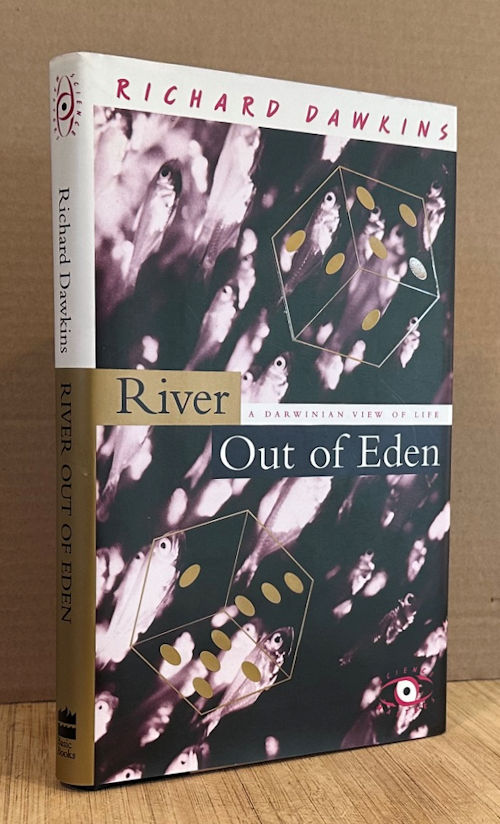
By the time Dawkins wrote this short book for the publisher’s Science Masters series, he had already published three foundational books: THE SELFISH GENE, THE EXTENDED PHENOTYPE, and THE BLIND WATCHMAKER. (The third of these I reviewed here.) This book doesn’t try to replicate the breadth of those books. Rather, it could be described as ‘topics in evolution,’ especially topics of interest to general readers, including how science is not faith, creationism, and purpose.
Key Themes
- Dawkins describes evolution as a river of information, all life on Earth using a common genetic code, overturning notions of vitalism. Bodies are where genes meet, where genes that most enhance the body’s ability to survive will more likely be passed on.
- He addresses how science is not cultural relativism or another ‘faith’; it works, and its beliefs are supported by evidence. It’s impossible for there to have been a single ‘Eve.’ But we can study genes to reconstruct family trees of species. And we can study mitochondrial DNA (which inherits only female genes) to establish that a ‘Mitochondrial Eve’ did live, between 125,000 and 250,000 years ago.
- Creationism is attractive but is not true. Despite its claims, there are plenty of ‘intermediate stages’ that were in fact useful. Human intuitions about this amount to a fallacy, the “argument from personal incredulity.” An arch is a rare example of a device that must be finished before it works at all. There are many types of eyes in the animal kingdom, and half an eye is better than no eye at all. And we can calculate how long it would take for an eye to evolve: about half a million years. Evolution works gradually.
- Then a discussion about purpose, and how ‘why’ questions aren’t always appropriate. Better to talk about purpose, or function; if a feature exists, it’s probably good for something. We can reverse engineer features in terms of their utility functions, with examples of sex ratios and human senescence, even in systems that seem inefficient to humans. There is no design, no purpose, no evil and no good in the universe, just indifference.
- Finally Dawkins describes the emergence of life on Earth as a ‘replication bomb,’ beginning with a chemical event and proceeding though ten thresholds: replicator; phenotype; replicator teams; many cells; high-speed information processing; consciousness; language; cooperative technology (with Dawkins’ idea of the ‘meme’); radio; and space travel. The plaque on the Voyager spacecraft is a sign that at least some in our civilization have moved beyond primitive tribal superstition.
Full Summary
Ch. 1, The Digital River
Every organism alive today comes from a string of ancestors who did not die in infancy, who successfully reproduced before dying. Their success does not mean good genes; it is good genes that mean success. This passage through time of genes RD conceives as a river of information through time. When species divide, the river splits; this happens usually through accidental geographic separation. There are 30 million rivers (species) in the world now…
All separations occurred similarly; there was nothing any different about the separations which, in retrospect, were splits between major groups of animals. (There is something rather misleading about using the German word ‘bauplan’, ‘blueprint’, for such major groups, as if there were something fundamental about them.) Divergence was gradual, to some degree or another.
The genetic code of all life on Earth is identical — a 64 word to 21 word mapping which is in effect a digital code. Just as modern electronics is increasingly digital, because discrete signal levels allow perfect transmission if the signal is properly decoded. Modern telephones put thousands of conversations on a line simultaneously, divided into slices on the same line. Nerve cells work in a combination of analog and digital signaling.
Crick and Watson should be honored as Aristotle and Plato. The consequences of their unraveling of the molecular structure of the gene are profound. Now, molecular biology has become digital. Genes are strings of digital information. This is dealt the killing blow to vitalism; there is no mysterious property special to living protoplasm.
In hindsight it could hardly be otherwise that genes survive through digital transmission.
Bodies are important too. They are where the genes meet. A polar bear is a machine composed of hundreds of different types of cells, within which occur chemical reactions catalyzed by enzymes (which are analogous to machine tools), all going on simultaneously. Enzymes are made up of amino acids that are determined by code sequences in the genes; which enzymes are present depends on which genes are turned on, which in turn depends on which chemicals are present — a situation analogous to computer bootstrapping, in which the most basic instructions are hardwired in. The embryo works similarly, starting with an initial polarity of up and down, which creates gradients of chemicals from front to back, etc., which cause different combinations of genes to be turned on in different cells. Development of the embryo continues with gastrulation… folds of cells, like an origami performance. These shifts throughout the entire development of the individual lead to differing structures of different bodies, or to chemical differences resulting in allergies, etc. The process is both sensitive and robust.
The result: genes which enhance the body’s ability to survive and reproduce will more likely be passed on. It is those genes which have physical effects that can be acted on by natural selection. Other genes which are less good at surviving will tend to disappear from the river of genes…
Ch 2, All Africa and Her Progenies
It is fashionable to put forth an extreme form of cultural relativism: that science is no different, no truer, than the myths of any primitive culture. But western science works: planes fly, etc., because engineers have gotten things right.
Another common reaction is, isn’t belief in evolution no more than any other ‘faith’? True, in a sense, science provides the same function as some religions: it’s a story to account for the universe and humanity. But — scientific beliefs are supported by evidence, and produce results. Myths and faiths aren’t, and don’t.
So consider the scientific version of the ‘Eve’ myth common in our culture.
Logically, each of us has twice as many ancestors going back each generation as the one before. But this would imply a trillion human beings around Jesus’ time. The flaw is in not accounting for marriage between cousins. Far enough back, *everyone* is cousins. (Just as far enough in the future, and any two people today who breed are likely to have had their genes mingled.) Travel far enough back, and every individual must be either an ancestor to all us in 1995, or none of us.
One can also trace back DNA between individuals to deduce how much mixing has occurred since a presumed common ancestor; like looking for common words in the four-letter alphabet… a little like tracing mistranslations in Biblical scholarship. But sex confuses everything greatly, randomly mixing halves of sources into new originals.
This actually helps when comparing genes between different species, to reconstruct family trees of species with dates. For instance, the number of letter changes in the gene for a particular protein is greater between humans and yeast than between humans and horses. The ‘molecular clock’ assumes that the rate of mutations (that don’t affect the protein; like random font changes of words in a fixed sentence) stays the same over the millions of years. The rate for important molecules is slower than that for molecules which function in a variety of forms, since the latter can tolerate more mutations that survive natural selection. Hundreds of different molecules can be used to trace lineages on different scales.
Another way to avoid the confusion sex causes is to look at the DNA of mitochondria, little power stations. In a theory originally due to Lynn Margulies, mitochondria were originally bacteria that migrated inside larger cells, creating a vast community of organisms. Each cell is an enclosed garden of bacteria. Once disputed, this theory is now widely accepted. Mitochondrial DNA simply reproduces by dividing, and inherit only through the mother’s egg. It can be traced back only through the maternal line. But it’s subject to mutations — more in fact that sexual DNA.
In the 1980s Allan Wilson at Berkeley took 135 samples of m.dna and had a computer construct a parsimonious family tree, i.e. construct a tree with the fewest required coincidences. Sampling methods must be used to reduce the number of possible combinations for analysis, and different methods don’t produce identical results. The Berkeley group concluded that the most parsimonious tree is rooted in Africa. (Since different Africans are more distantly related than they are to the rest of the world.) And the date that Mitochondrial Eve lived is… between 125,000 and 250,000 years ago.
Older fossils of pre-humans in other parts of the world imply that these people have no ancestors still living. But the Eve theory doesn’t mean there was only one woman alive on Earth, etc etc.; others alive then may have descendants living now, just not through solely female lineages. And Eve is only our most common ancestor *through the purely female line*, not necessarily our most recent common ancestor. Tracing back, there may have been many Adams and Eves. (In fact the most recent is more likely to have been an Adam…) It is unlikely that the most recent, the Focal Ancestor, was the same as Mitochondrial Eve.
Ch. 3, Do Good By Stealth
Creationism is attractive not so often due to some commitment to a tribal origin myth, but because people become impressed by some aspect of nature which they feel ‘must’ have been designed — e.g. a letter from a former atheist impressed by the way orchids attract bees to have their pollen spread.
Many are impressed by some marvel of nature; in particular, often by the notion that this or that natural feature (an eye, a wing), cannot have evolved in stages, since only the entire phenomenon is useful.
But this is not true. Anyway, how can anyone be so sure that intermediate stages are not useful? Think how often human eyes are fooled by close resemblances; and how easy it is to fool some animals into mating behavior — sticklebacks, gulls, turkey mothers who guard against predators, bees who identify corpses by a specific chemical. Insect eyes respond to ‘flicker’ more than shape. Wasps which repeat programmed behavior — Hofstadter’s term ‘sphexish’.
In other ways wasps’ eyes are good — they can fixate and relocate a nest position. But they can be fooled by moving specific markers.
Never use human intuition or judgment in assessing such matters. To do so is to use what RD calls the fallacy of “The Argument from Personal Incredulity”.
[[ This theme could be generalized to many convictions that people form on the basis of ‘weight of evidence’ or a subjective impression that something must be so based on some degree. frequently a statistical sort of thing. two are coincidence, three is conspiracy, four is determinism and proof. mostly it is a ‘feeling’.. of being overwhelmed? As of looking up at the stars, as if the majesty of the night sky is somehow more a proof of god that any other thing (like a stinky puddle) — even though if god created the universe, surely he created it *all* and all of it is equally evidence of his creation. To think that something is more evidence than something else is therefore merely a statement about human psychology, not anything objective.
[[ Another view on this is that the need for humans to attribute something to a god is a malfunction of the human brain tendency to detect cause-effect relationships. This tendency is useful in learning how to manipulate the world; but it leads astray when it causes the invention of an imaginary cause to account for an effect that a person can’t account for any other way. It rubs a person the wrong way to just ‘leave something to chance…’ ]]
Are there ‘brittle’ devices that must be perfect to work at all? Not true of airplanes, radios, etc.; but it is true of an arch.
The wasp orchid case is one example of the general principle of mimicry. But must mimicry be perfect? For one, predators’ eyes are different than humans’ eyes, so we cannot necessarily judge. More generally, lighting conditions are always variable and often imperfect, and distance provides another gradient of visibility. Angle of vision is another. As evolution proceeds the range of successful mimicry decreases. Another gradient is the range of predators’ eyes, some good and some poor.
What is the use of half an eye? (Continuum of age is another gradient.) In fact there is a spectrum of types of eyes in the animal kingdom. Half an eye is clearly superior to no eye at all.
[[ There’s also the point that people don’t have ‘perfect’ eyes now. Lots of people have imperfect eyes. And it’s easy to imagine even better eyes than those of any person. ]]
The question, has there really been enough time for an eye to have evolved from nothing? is another form of the Argument from Personal Incredulity. For one, the sheer magnitude of geological time. Besides which, a study was done using a computer model to simulate slight changes to successive forms of eyes. The model swiftly became more complex. Using conservative estimates for rates of heritability, etc., the time to evolve a fish eye from flat skin was just four hundred thousand generations… say, half a million years. And in fact ‘the’ eye has evolved at least 40 times independently…
Gradualness is the key feature of evolution; do good by stealth. (Not all evolution may have been gradual, but for complex features gradual development is necessary or there is no explanation at all.) Not being able to imagine intermediate steps in a complex development is only evidence of our lack of ingenuity. One example is the bees’ ‘dance language’, which indicates distance and direction to a food source, keyed off the position of the sun (which is detected by polarized light even when cloud-hidden). How could this have evolved? Von Frisch studied near relatives of the honeybee. Repetition of take-off run; energy left inversely related to distance; and a quirk of insect navigation by the sun that translates to an analogous angle from vertical.
Similar arguments can be employed for every Argument from Personal Incredulity… [[[ this goes under cognitive limitations ]]]
Ch. 4, God’s Utility Function
Some people are inspired to faith by nature; others lose their faith from nature, as in Darwin’s remarks about digger wasps.
Humans have purpose on the brain, seeking purpose everywhere, asking What is it for? and Why? At one time we asked that of rivers and thunder and rocks; we still give in to animistic thinking when we wonder why some tragedy ‘strikes’ us. But in fact sometimes ‘why’ simply isn’t an appropriate question, anymore than is asking about the color of a prayer. Being able to frame the question doesn’t make it reasonable. The process which created life is well understood: Darwinian natural selection.
[[[ and this goes to mismatch of realms ]]]
Still, Darwinians do frame a kind of ‘why’ question in the way they talk about the ‘purpose’ of this or that biological phenomenon, but only in a metaphorical sense. If a feature exists, biologists presume it must be for some reason, and seek this reason — i.e. function. E.g., bees have a type of color vision that includes the ultraviolet; and certain flowers turn out to be patterned with spots and stripes visible in ultraviolet. Again, the function of the bee dancing was called into question by a scientist who doubted that the other bees actually acted on the information in the dance. Another scientist, Jim Gould, devised an ingenious experiment to validate the original claim: he blinded the dancing bee, then turned on a light in hive, changing the pattern of interpretation; the dancer used up and down, the others used the light as the direction marker. In doing such experiments, scientists assume that if some complex feature exists, it must serve some purpose (function).
‘Reverse engineering’ is the concept of deducing something’s purpose from its form. ‘Utility function’ is an economic term for ‘that which is being maximized’. So you can reverse engineer life and ask, what does it seem to have been designed to achieve, i.e. what is being maximized?
The utility function of life is DNA survival. And the DNA is locked up in bodies. This makes sense of lots of natural phenomenon. Sex ratios, the proportion of males to females, for example. Apparent discrepancies, e.g. elephant seals, in which only a minority of males ever mate. Why shouldn’t there be fewer males overall then? Because the sex ratio achieves an equilibrium, based on the probability of passing DNA onto the generation after that. In this case, some males never mate, but a few mate a lot, so the overall probability of a male’s having grandchildren is equal that of a typical female. Similar reasoning accounts for even wilder variations, like bee hives in which the hive’s legacy is all bound up in one Queen.
Schemes like the elephant seal harems seem ‘wasteful’ to human economic terms, just as are the beauty displays many birds, and the songs of nightingales. But they all make sense in terms of DNA survival. Trees in a forest are tall because they outcompete each other until they reach the same heights, even though it might be more ‘efficient’ for them all to remain lower. Like loud conversation in a party. The good of the whole, of the species or ecosystem, is largely a human conceit.
Another aspect of the utility function is that components of an animal are no better than they need to be. There’s no point in having especially strong bones of one type if the others are weaker. (Henry Ford and the Model T’s kingpins.) If one component were too good, natural selection would favor its weakening. Many species have distinct phases of their lives: e.g. mayflies, salmon. Pacific salmon die after spawning; the energy goes into the spawning. Nature’s utility function never values longevity for its own sake, but only for the sake of future reproduction.
The pattern of human senescence has been worked out. Genes turn on at different times of life. A gene that causes death, like the Huntington’s chorea gene, is controlled by some modifier gene, which itself activates later in life rather than earlier, to allow the H gene to be passed on at all; natural selection selects for it this way. Other genes are sublethal, and they tend to accumulate late in life. In addition (cf. George Williams) individual genes often have many effects. Genes that enhance youth might cause a disease in old age, but these genes would get passed on. Modifier genes exacerbate the situation.
Everyone is descended from a line of ancestors who were all at some time young, but many of whom were not old, so we inherit genes for being young.
The utility function is not a recipe for happiness. DNA doesn’t care; nature is not kind, or unkind.
Theologians worry over the problem of evil, and rationalize tragedies like children dying in a school bus crash. But in a universe of electrons and selfish genes, meaningless tragedies and meaningless good fortune are just what we should expect, and they are what we see. No design, no purpose, no evil and no good, just indifference.
Ch 5, The Replication Bomb
Just as stars occasionally go supernova, a star can also undergo an information explosion, or suffer a ‘replication bomb’. It’s slow to build and may be over quickly. We know of just one, on Earth, and it’s called life. We humans are part of that bomb, the part through which the explosion may proceed to the next stage and expand into space. It’s an exponential growth. It must have begun as a chemical event. The critical event was the arising of self-duplicating entities, or the phenomenon of heredity. Molecules don’t ordinarily replicate themselves, though those that have mirror images, like tartrate molecules, and form into crystals have the minimum potential to do so.
Other more complex molecules have more varieties. But what is needed is self-replicating molecules. DNA and RNA are the ultimate complex molecules which self-replicate.
Our own solar system’s replicator explosion has just recently expanded beyond the planet, in the form of patterned radio waves. It’s just the latest threshold in the sequence; the first and most important was the replicator threshold. The power of exponential growth is like that seen with chain letters. Variations of such letters will be more or less effective in getting themselves duplicated. Success simply means frequency in circulation. A famous example is the St. Jude letter — p148. (He wrote a paper about it in Nature.)
Success for chemical replicators means having what it takes to get duplicated. But the means of doing so can be infinitely varied. DNA is simple, but the means (the bodies of animals) are varied.
How DNA got started we can only guess. The chronology of the life explosion can be described in terms of a series of thresholds.
First is the Replicator Threshold itself. A self-copying system, with hereditary variations.
Threshold 2 is the Phenotype Threshold. Replicators survive by virtue of their effect on something else, the phenotype, i.e. the bodies of plants and animals. Proxies. Phenotypes can be extended, too, beyond the individual body (see The Extended Phenotype).
Threshold 3 is the Replicator Team Threshold. Genes work in teams, e.g. via all the chemicals in a cell. But it’s still individual genes that are selected.
Threshold 4 is the Many-Cells Threshold. Many cells clump together and form larger bodies, not like crystals do, but with separate functions.
Threshold 5 is the High-Speed Information-Processing Threshold. Or the Nervous System Threshold. Reaction times faster than those of the replicators themselves.
Then comes the Consciousness Threshold, an elaboration of the neuron threshold, involving on this planet brains and sense organs and memory.
And the Language Threshold, which may be separate; a networking system to exchange information of sufficient intimacy to allow the development of a cooperative technology.
Threshold 8 is itself the Cooperative Technology Threshold, the explosion of technology. This may involve an entirely separate kind of replicator, a ‘meme’, which Darwinizes culture.
Threshold 9 is the Radio Threshold by which external observers can see the bomb in progress. Deliberate attempts at communication have been made, but no responses have been received.
The last is physical space travel itself, Threshold 10, the Space Travel Threshold. Here we have barely begun. The Voyager plaque is a worthy record of a civilization that produced at least something beyond primitive tribal superstition.
\\