(Free Press, March 2012, 83pp, including 17pp acknowledgements, notes, and index)
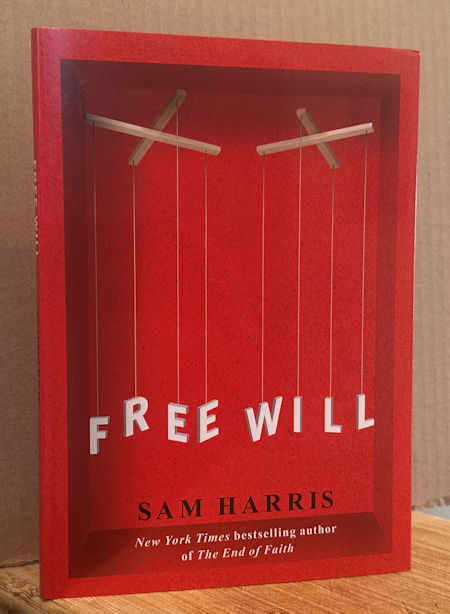
Here’s another short book on a theme of continuing debate. Like most current scientists and philosophers, Harris tries to explain why the free will humans (naively) think they have cannot actually exist, given what we know about how brains work and how causality works. (Coincidentally, there a case in the news about a mother who killed her children, supposedly under the influence of post-partum syndrome, and how the jury could not reach a decision. The core issue is related to that of free will.) Note claims that free will doesn’t exist doesn’t mean the future is predetermined. That’s where quantum matters make a difference.
This may be a quandary best thought of in terms of different ‘realms,’ as I’ve been exploring. Free will may not exist in the naïve way we think it does, but it’s useful to think it does in the realm of ordinary human interactions.
\\
Key Points
- Free will is an illusion. It’s not conceptually coherent. Either we’re determined by prior causes, or we’re the product of chance; in either case we’re not responsible.
- We think we have free will because we are unaware of most of our brain activity, including our prior thoughts and actions.
- We can still distinguish between voluntary actions and accidents.
- Perhaps free will is a necessary illusion.
- We can still talk about personal responsibility; we can understand people, without condemning them to be evil. We can move away from ideas of sin and eternal punishment.
- Conservatives’ ideas of the ‘self-made’ man ignores the background conditions of which he was merely the beneficiary.
- Thoughts and intentions arise in the mind; we can still do whatever we want, without worrying about we were ‘free’ to do so.
Comment: not having “free will” does not mean we are coerced in any way. Perhaps that’s what people are worried about. More comments below.
Summary
Most people reject the idea that we don’t have free will; it would mean criminals aren’t at fault and successful people aren’t deserving. Example of two guys attacking a family. Aren’t the villains guilty? What if they had brain tumors?
But free will is an illusion. It cannot be made conceptually coherent. Either we’re determined by prior causes, or we’re the product of chance; in either case we’re not responsible. The popular idea is that 1, we could have behaved differently; 2, we are the conscious source of our thoughts and actions. But each of these is false.
P7, The unconscious origins of the will.
We’re conscious of only a tiny fraction of our brain processes at any moment. Why choose coffee one morning and tea the next? There’s the famous experiment that showed activity exists in the brain *before* a person decides something. Your brain makes a decision before you are aware of it. It just happens. An experimenter could, in principle, record a string of decisions seconds before you were aware of making them.
This argument doesn’t depend on philosophical materialism. Thinking of souls makes no difference. This doesn’t make social and political freedom any less important.
What would it take to have free will? You’d need to be aware of all factors that determine your thoughts. But you can’t control the storm; you are the storm.
P15, Changing the subject.
The idea emerges from a felt experience. Psychology considers determinism, libertarianism, and compatibilism. Only the last is currently respectable. Even if their ‘free will’ is not what most people think they have. Most people think they are the source of their thoughts and actions. Compatibilists have no answer to the problem of the murderer. We are all ruled by mutually incompatible desires and goals. What not choose the freedom of not wanting anything? We don’t do things that don’t occur to us. A puppet is free as long as he loves his strings.
Thoughts from Daniel Dennett and Tom Clark. Our brain processes are our own. There are cases where people feel responsible for things over which they have no influence. They confabulate. Author says this is always what’s happening. [[ See my comments below ]]
P27, Cause and Effect
Does chance or quantum uncertainty have room for free will? Random events in the brain. They’re still events in the brain. How does that make one free? It would make one live randomly. And flies are subject to quantum effects too. If determinism is true, the future is set. If quantum effects occur, we can take no credit for them.
P31, Choices, Efforts, Intentions
We can still distinguish between voluntary actions and accidents. That we are ignorant of the prior causes of our thoughts and actions gives rise to the feeling of free will. Don’t confuse determinism with fatalism. Fatalism is itself a choice. And is difficult to do. Human choice is still important, even if it’s the result of conscious intent.
If your life unravels, how did you get this way? You tell a story…. Then your resolve changes. But where did the idea come from? Your story is just a post hoc description. … Regression.
We are still able to interpret and reinterpret the meaning of our lives. The person you are was determined by random events over which you had no control. And they control your current choices. Is that freedom?
Eddy Nahmias. We can evaluate alternatives. Author replies, this is not about free will.
P45, Might the truth be bad for us?
Is free will a necessary illusion? Maybe. Yet author isn’t particularly worried. It helped him be more empathetic. But you would not tell rape victims that.
P49, Moral responsibility.
Belief in free will has given us both sin and the idea of retributive justice. The US Supreme Court affirmed it on such grounds. What would happen to right and wrong, good and evil? How do we talk about personal responsibility? We can. Examples of violence. Background conditions matter. We condemn the conscious intention to do harm. We find predators to be unlucky to be who they are; we can fear them without hating them. The more we understand the human mind in causal terms, the more we should not hate or condemn them as evil. People are not responsible for their genes or their backgrounds. Suppose we determined a cure for evil. The urge for retribution depends on our not seeing underlying causes of human behavior. This understanding is progress away from religious metaphysics. Sin, eternal punishment. We can still build prisons to protect ourselves from criminals. Retribution can be tricky; article by Jared Diamond. Perhaps punishment would remain appropriate in some cases. But we do not punish people for what they cannot help, e.g. sneezing.
P61, Politics.
Liberals understand that a person can be lucky or unlucky. Conservatives retain a religious fetish of individualism. The idea of the ‘self-made’ man depends on numerous background conditions of which he was merely the beneficiary. Which they would nevertheless take credit for.
P64, Conclusion.
It is not that free will is an illusion; we are mistaken about experience. We need to pay closer attention. Thoughts and intentions simply arise in the mind. The illusion of free will is itself an illusion. And so the author writes whatever he wants. What compelled him to do so?
\\
Comments
- Does it seem free because usually we can create a ‘story’ of ‘reasons’ why we did what we did? That’s confabulation.
- Anyway, the brain makes its decision based on *something*; we don’t act in any random way.
- The brain is controlling everything, at some level; the ‘mind’ is the rider, rationalizing external actions, with those ‘stories’.
- I’m guessing this is a matter of naïve thinking vs subtle thinking.
- The play and film Equus deals with this matter, as the psychiatrist tries to understand how the boy became the way he did:
- Here’s a quote from this post, http://www.markrkelly.com/Blog/2016/05/29/equus-part-1/
A child is born into a world of phenomena all equal in their power to enslave. It sniffs—it sucks—it strokes its eyes over the whole uncountable range. Suddenly one strikes. Why? Moments snap together like magnets forged in a chain of shackles. Why? I can trace them, I can even with time pull them apart again. But why at the start were they ever magnetized at all. Why those particular moments of experience and no others, I do not know! And nor does ANY BODY ELSE!