
Subtitle: Of the origin and design of government in general. With concise remarks on the English Constitution.
(First published January, 1776; expanded edition February 1776; this edition Dover, 1977, 58pp)
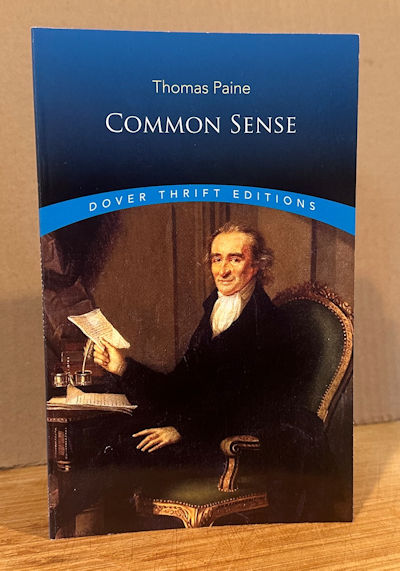
I finally read this short book, or essay, in July, around the 4th, since I couldn’t find my Penguin 60 copy of the Declaration of Independence. (I have since.) I read one little book by Thomas Paine (considered one of the Founding Fathers) previously, THE AGE OF REASON (review here), a critique of Christianity and the Bible, published twenty years later.
This essay is said to have inspired the American Revolution. It sold 500,000 copies within a few months, according to this Dover Thrift edition. So what is its point? Common sense about what?
Gist
- Kings are bad. Especially hereditary ones. In America let the law be king.
- Also, America should build a navy. The time is now, not later.
Words shift meaning in 250 years and I could quibble with some of his comments. Others quibbles are more fundamental; times change, in the sense that we’ve learned a lot in 250 years. Also, I found this book more of a slog to read than the later one, Age of Reason.
Summary
Society is produced by our wants, government by our wickedness. Government is a necessary evil. But what form is preferable to the others? Imagine a small number of people in a pristine wilderness. No one man could built a house all by himself. Thus a society forms. Then follows a State-House, and Regulations. At first everyone will meet. As the colony grows that won’t be possible, so select numbers will be chosen to represent the rest. With regular elections. The idea is drawn from a principle in nature, that simpler things are less liable to be disordered. With this in mind consider the constitution of England. It is too complex; one can never tell which part is at fault. It retains two ancient tyrannies: a king, and the peers, both of which are hereditary. What’s been added are the commons. It is farcical to think these three bodies check on each other. It presupposes the king is wiser than others. Where did this power come from? From the constitution (not from God).
[[ Very Hobbesian – the government is the necessary Leviathan. Thus rather outdated. Yes, that’s part of it, but the government is necessary to manage a complex society, too. It’s not evil. ]]
Of Monarchy and Hereditary Succession, p8
How is it if mankind were originally equals, this equality could be destroyed? What is this distinction between kings and subjects? [[ Well, because humanity is naturally hierarchical; the notion of equality was an idealistic one, not supported at face value. ]] According to scripture in the early days there were no kings. They were introduced by Heathens. Christians borrowed the idea. Yet Gideon and Samuel disapproved of the idea. The Jews requested a king after some 3000 years. They glossed over the bits of scripture that disapproved of them. History. The ‘children of Israel’ were oppressed by the Midianites. The Jews wanted one and they supposed it was due to divine interposition. So they supposed Gideon should be king. Gideon declined; the Lord would rule. 150 years later it happened again. Now the Lord claims that he is the one rejected. So Samuel would show them what it meant to be a king. A tenth of everything. The people rejected him. So the Lord brought a storm to punish them. And so on. We have added heredity succession. It’s an insult and an imposition on posterity. Once established it’s not easily removed, from fear or superstition or self-interest. We can’t even say the current kings had an honorable origin. A few have been good, most of them bad. Especially William the Conqueror. Where did the first kings come from? By lot, election, or usurpation. Heredity succession is a little like inheriting sin from Adam. It’s the evil of hereditary succession that most concerns us. These kings are inevitably out of touch. Another problem is those who inherit as minors. Or becomes worn out with age. Nor do kings avoid civil wars. Examples. Some countries have none. …
[[ Interesting to see the perspective of how ‘kings’ were not inevitable but were chosen… so they say. ]]
P17, Thoughts on the present state of American affairs.
Simple facts, plain arguments, and common sense. The time for reconciliation has passed. It’s false that the US should always have some connection to Britain. Yes, Britain protected the colonies, but only to protect its own interest. And so on. How acquaintance enlarges, 20m, from neighbor, to townsman, countryman, Englishman, and so on. [[ The kernel of Singer’s circle of empathy. ]] To admit we’re all of English descent means nothing. The first king of England was a Frenchman, as are half the peers. America’s interest is commerce, openly with all nations. There’s no advantage in maintaining connection to Britain, and many disadvantages. Including the threat of war between Britain and some other European kingdom. The distance between, and time America was discovered, support the Almighty’s plan [[ There’s a strain of religious thought here, despite his later book. ]] And the timing of the reformation. Those who support reconciliation are of several times, 23t. Imagine the inhabitants of occupied Boston. Others cannot judge. Quotes Milton. Quiet methods have been ineffectual. They can’t be counted on to never attempt it again. Nature never allows a satellite to be larger than its primary planet. Britain has made no sign of compromise. Author was open to it until April 1775, the massacre at Lexington.
Several reasons. First. The king’s influence on the continent will be negative. He will do what he pleases. The continent will go backward. Kings can have the same effect on England. But America is second to his concerns. Second: at best, the situation will be temporary. Independence is far less risk. Author hints at how to do it. Annual assembly, with a President. Divide each colony into several districts. Congress shall be at least 390. Vote for the president. Conduct a Continental Conference. Two grand principles: knowledge and power. Frame a Continental Charter setting the rules for elections, the free exercise of religion, etc. The goal is “the greatest sum of individual happiness, with the least national expense” according to Dragonetti. There is no king; the king is above; instead proclaim the law in king. There is no more freedom in Europe…
P33, Of the present ability of America, with some miscellaneous reflexions
Everyone seems to understand that this separation will eventually take place. And that time has found us. We have unity. And numbers. Consider debt. America has none, and no navy; England has both. List of calculations for the cost of different sized ships. And the sum of the entire British navy. America is rich in resources to build new ships. Even a fleet. For defense. The British won’t defend American harbors. And they’re far away. A constant navy might be needed, using merchants. More about resources. And America has great lands yet uninhabited. Populations. It might not be possible to unify the colonies fifty years hence. Interests would be too varied. And diversity in religion must be enforced. And a large representation is needed. Congress. We can learn from the mistakes of our enemies. Concluding: we can settle our affairs only by declaring independence. For reasons… A manifesto must be published. Break connections, but pursue trade. Don’t keep putting it off.
Appendix, p44
The first edition of this pamphlet coincided with the King’s Speech. Which proved his point. A piece of villainy. Savage. An address to the inhabitants of America. Toryism: idolatry. Author reviews his points. More hints. “We have it in our power to begin the world over again.” 51.6. Nothing like this since Noah. Let the American states be free and independent.