Subtitled: “Understanding the Wonders of Nature”
(Pantheon, November 2024, ix + 193pp, including 8pp acknowledgements and notes.)
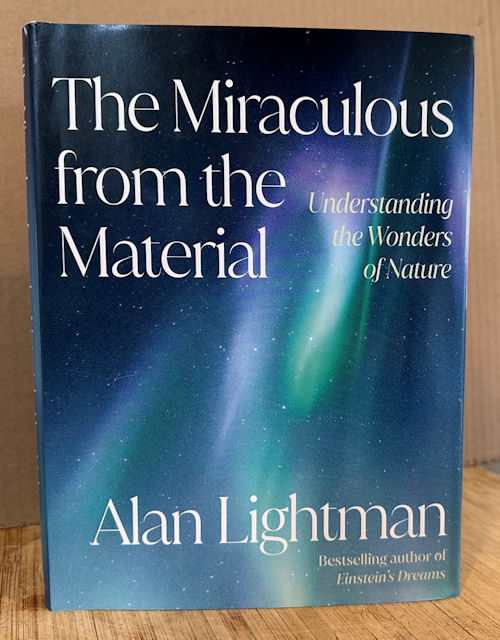
This is a valuable book even though Lightman irks me, as he has in some of his other books, by casually using words like “miraculous” and “spiritual” in ways to indicate his subjective feelings of awe but which are quite different from the common definitions of these words by ordinary people, e.g. that miracles involve God’s intervention, or that spiritual indicates something supernatural. Lightman (who has a PhD from CalTech in physics) is too honest a scientist to literally invoke supernatural causes, and by using those words he’s doing a bait and switch, in a sense, to draw readers in to explore what he explains are entirely naturalistic aspects of the world.
This book aligns with two by Richard Dawkins, THE MAGIC OF REALITY (review here) and UNWEAVING THE RAINBOW (review here with its apt quote from Carl Sagan), who avoids such words.
The book consists of 36 short, independent chapters arranged alphabetically (except for the last one) by topic, from Atmosphere, Atoms, and Aurorae, to Volcanoes, Waterspouts, Yosemite Firefall, and finally Humans. Each chapter is 3 or 4 pages plus a full-page color photograph illustrating the topic. More comments at the end.
\\
Introduction
Author calls himself a spiritual materialist. [[ Again, his notion of ‘spiritual’ is just the barely understood sense that everything relates through various analogous processes, which can be understood through hierarchies or phases with language and stories appropriate to each. These ideas go to the notion of ‘realms’ that I’ve developing on my Themes page ]] He believes the world is made of material stuff, and nothing more; yet feelings of connection to other human being and the larger cosmos, and the appreciation of beauty, is what he means by ‘spiritual’ experience.
He recalls his bedroom at age 12, where he made a pendulum. A communication device. Page ix top: “There was no need to invoke magic or supernatural or any nonmaterial essence to explain earthly phenomena. The physical world was miraculous all on its own.” Later: Microscope. Mist over the lake. Saturn’s rings. “The miraculous abounds, and the material world and its laws are quite enough to explain it.”
Atmosphere, p3
Photo of Earth from low orbit. We wouldn’t exist without the air around us. Why the sky is blue. Why the atmosphere is thin. 6 miles thick roughly. There was no oxygen in the atmosphere early on, not since 2.5bya.
Atoms, p7
All cultures have notions of fundamental elements of nature. Examples. The Greeks imagined atoms as ‘uncuttable.’ Lucretius. No evidence for them until John Dalton, 1808. Their size, by Loschmidt in 1865. Photographs of them, in 2021. Particles behave like water waves. And atoms are made of even smaller parts. Protons, etc; then quarks. At the Planck scale, time and space don’t exist. Yet we can conceive of such an end point…
Aurorae, p13
Records go back to 680bc or so. Dead spirits in the sky, etc. They’re actually emissions of oxygen and nitrogen molecules in the upper atmosphere. The sun’s magnetic field. Particles collide with molecules in the air. Galileo coined the name. An especially spectacular display occurred in 1859.
Bioluminescence, p17
Saw it near his island house in Maine. Darwin saw it. Aristotle described it. Chemical reactions, involving algae and plankton. Why? Some survival benefit? To keep from being eaten, perhaps.
Birds, p21
Over the rainbow. Da Vinci. The first human powered flight occurred Nov 9, 1961. Only for a minute. How do birds do it? Shape of the wing. And so on. The V formation of bird flight saves energy. The square cube law explains how big birds can get. And airplanes fly because they burn fuel…
Bubbles, p27
Perfectly spherical. A thin layer of soap, between two layers of water, surrounding a sphere of air. The physics makes them spherical. And systems tend toward lowest energy, to be stable. Minimum energy principle. as with the hexagonal cells of honeycombs.
DNA, p31
Recall Data and his fractured arm. We’ve discovered our own mechanism just in the last 75 years. Helical structure. Details. Minimum energy principle again. Structure discovered in 1952.
Eclipses, p35
First noted by the Sumerians. Beliefs of the Chinese and Egyptians. They are easy to explain. Until Copernicus most people believed the Earth was motionless in space. It’s an accident that the sizes of the Moon and Sun in the sky are almost exactly the same. Author saw the one in August 2017, just 58% in Maine. The animal sounds changed. It brought a profound awareness.
Fall Foliage, p41
Author sees it every season in New England. What makes the colors? A falling asteroid. Or, a change in the balance of pigments in the leaves. Details. The origin of colors. Oneida’s tale chasing the bear. And how the seasons are caused by the tilt of Earth’s axis. Which was in turn caused by an ancient cosmic accident—a collision of something with the Earth.
Fallstreak Holes, p47
These are holes in a layer of clouds. Unusual and weird. Some see them as evidence of UFOs. Author has never seen one. There’s a natural explanation. When an airplane flies through a cloud… Water and its phases. Temperature and pressure. Seeding.
Fireflies, p51
Grew up in Tennessee. Fireflies have been around 100 million years. More about bioluminescence. Oxygen is taken in and then cut off. Natural selection; does this trait serve a purpose? Or just a by-product? In this case, a warning signal. Fireflies sometime synchronize. An emergent phenomenon. Similar to termite cathedrals.
Flowers, p55
Recalls the Huntington Library. The crane flower, or bird of paradise. From South America. Floral color is about bees and birds. Flowers are the sexual organs of plants. Diversity enhances survivability. Sprengel noticed these things and influenced Darwin. The bird or insect gets nectar. And they can see more colors than we can. And beneficial mutual relationship. Maybe even the whole planet: the Gaia hypothesis.
Galaxies, p61
The Milky Way is a flattened disk that orbits its center, as planets do in a solar system. 100 billion stars, 100 thousand ly across. Aside from Andromeda, other galaxies require telescopes to be seen. Most of their stars have planets, and perhaps living beings, but we will likely never meet them. Measurement of sizes and distances began with Henrietta Leavitt at Harvard College, up to 1921. Beginning with Cepheid variables. Periods related to luminosities. Harlow Shapley measured the size of the galaxy, and Edwin Hubble realizes that Andromeda and others were galaxies themselves, beyond our own. By now we know there are several hundred billion galaxies in the observable universe.
Glaciers, p67
Author visited one near Anchorage. There are myths about their origin. The Greeks described them 2000 years ago. They cover about 10% of Earth’s land area. Mostly created in the last million years. They can move 3 feet per day. Like a slow river. We can map past climate change from glaciers. That’s how we know CO2 has been rising in the past couple of centuries.
Grand Canyon, p71
First seen by a white explorer in 1869, John Wesley Powell. Seen from the river. Began forming 2bya. A major uplift 30-70mya. Everest, at 29,000 ft, is as high as a mountain on earth can get before the base rock liquefies. The river has been carving rock for the last 5 to 6 my.
Ha Long Bay, p75
In northeast Vietnam. Pillars of rock. Dragons that fought off foreign invaders. They’re karst towers. Caused ultimately by tectonic plates. These created about 8000ya. All dating through radioactive decay. Examples. The earth is 4.5byo.
Hummingbirds, p79
Their wings beat 50 times per second. They have a high metabolism, with heart rate of 1200 per minute. Flap rate of 40 to 50 per second. They need to hover to access the nectar of the flowers.
Lightning, p83
Associated with the actions of the gods, of course. Zeus. Flows of electricity. Understood beginning in the 18th century. Protons and electrons. Friction between water droplets. Though it’s not fully understood. … Around 9 million lightning strikes per hour around the world. Author once experienced ball lightning.
Mammatus Clouds, p89
Another weird phenomenon. Many different types of clouds. Unpredictable. Basics about clouds. Water vapor and droplets of water. Very cold high in the atmosphere. Clouds float because the water droplets are so small. These particular clouds have been described since 1883. Named after female breasts. Various theories about how they form.
Mandarinfish, p95
How they mate, at sunset. They have various names. Native to the Pacific. Tiny. No scales. Striking coloration. Colors can be for camouflage, to attract mates, or warning of poison.
Moon, p99
More myths. [[ Just as Dawkins in one of those books recounted world myths about natural phenomena. ]] Scientists find that the moon was formed about 50my after our solar system. From a collision between Earth and some Mars-sized planet. It was once closer to Earth and has since spiraled outward. Lots of crater, due to lack of atmosphere and absence of erosion. One side facing the earth. Tidal locking.
Morning Mist, p105
Jogging in the morning, seeing the mist. The ground cools over night. More than the air does. Add, condensation of water from gas to liquid. Details of hydrogen bonds.
Paramecia, p109
Author had a microscope. Waterdrops. Antonie van Leeuwenhoek. Microscopes since 1600. Animalcules. Named in 1752. Single-celled organisms. Sexual fission. Cilia. First such organisms 600mya. Dynein protein. Diagrams. “A reminder that the scale of our human lives in only a narrow slice between the small and the large.”
Rainbows, p115
Recalls seeing one while kayaking in Maine. Birds apparently saw it too. All it takes is rain and sun. Refraction and reflection of sunlight. Details. Some Persians understood the principles around the first millennium, but the forces involved not until James Clerk Maxwell in the 1800s. And why it’s curved.
Saturn’s Rings, p121
They seem so perfect. Other planets. Very thin. A moon ripped apart by tidal forces. Galileo saw them in 1610. Huygens more clearly. Why planets are spherical. Laws of physics.
Scarlet Ibises, p127
At Stone Zoo, near Boston. Very bright. Why? The usual ideas. Examples. Perhaps this color is an accident, from what they eat. There are also white ibises. What they scarlet ones eat, eats algae, which etc etc. Everything is connected.
Shooting Stars, p131
From their island in Maine. Perseids. Cosmic perspective. Recorded in 2000bc. Meteors. About 60 miles above sea level, moving at 100,000 mph. Remnants of comet Swift-Tuttle. Different colors are from different elements burning. Recalling the Leonids in 1833.
Snowflakes, p137
Author and his microscope. Why the symmetry? Why are they all different? Geometry. Growing on motes of dust.
Spider webs, p143
Perfect architectural structures. Many species, different methods. Example of one method. Webs are both offensive and defensive. Electric charges. The first spiders lived about 400mya, and will outlive us all.
Spiral Plants, p149
One spiral structure was built in 3200bc. Spiral is an ancient symbol of evolution. Many plants have spiral structures – Fibonacci spirals. Another kind of minimum energy. After the 12th century Italian mathematician. Is this pattern why humans like the golden ratio, or golden mean? It’s a part of nature. Such understanding enhances our amazement.
Stars, p155
Ideas about stars go back through recorded human history. Egypt. Plato. Up to the 17th century thinkers believed heavenly bodies to be perfect. Made of aether. Until Galileo saw the sun and moon through his telescope. Bruno. Later astronomers analyzed sunlight and deduced the chemical composition of stars. Ordinary chemical elements. Newton first estimated their distance, by comparing relative brightness. Their energy was unknown, until the discovery of nuclear energy. Even so, they won’t last forever. Eventually the atoms that fuse run out, and gravity wins. Our sun will last about 5by. Then become a white dwarf. Larger stars explode in supernovas. Which leave neutron stars.
Sunsets, p161
Stories about the sun and its light. The Greeks. Why the red sky? Recall earlier discussions. Why the daytime sky is blue. Sun gods.
Volcanoes, p165
Mark Twain in Hawaii, 1866. Slabs of rock in the Earth’s crust, tectonic plates. About 1500 active volcanoes. Recall the formation of the earth, and the moon. Rocks melt about 2000 F and become magma, very dense. They sink to the center of the earth, where it’s 9,400 F. Then radioactivity, heats the magma. Volcanic eruptions can create lightning. Mount Vesuvius, 79 AD. And there are volcanoes on other planets—e.g. on Mars.
Waterspouts, p171
Author sailed a sailboat in the Greek isles. And saw a waterspout. Like a tornado, but over water. Rising warm air. Uneven heating of the earth by the sun causes most weather phenomena. Spin. The earth is like a merry-go-round. Coriolis effect.
Yosemite Firefall, p177
Recalls Yosemite in the 1970s, Tuolumne Meadows. Years later, Horsetail Fall, over El Capitan. In winter the angle of the sun makes it light up. Only for about 10 minutes. Like other brief things: the green flash, the shooting star. Our perceptions of long and short. 179t. Half a second, to a human lifetime. The eye of the beholder.
Humans, p181
More amazing than any of those are us human beings. Consider everything we’ve accomplished. Music, poetry, equations that quantify how the universe began. Our brains are the most complex objects in the known universe. And consciousness. Which remains mysterious. Maybe an unbridgeable gap, like Nagel’s bat, or Mary and the color red. First-person sensation. We’ve recognized emergent phenomena. Like those fireflies. We’ve advanced beyond evolution, with technology. Homo techno. Where will we be in 500 years? Author hopes we will still do all these things. And is grateful for all these experiences. For witness this grand spectacle of a universe.
\\
Comments
All the god explanations are ways humans try to reduce phenomena outside their everyday experience to situations that occur in everyday life, e.g. parents and children, negotiation between parties, predator and prey, etc. Humans presume agency in everything.
None of those stories is true.
In reality, things just happen, as if built into the essence of the universe from the very beginning.
Author notes the oldest cultures for which we have records are the Sumerians and Akkadians, back to 4000 bc, p163.
\\\\\\\\\\\\\
A proper definition of ‘miracle,’ as used colloquially, is something outside ordinary experience, as understood via basic human intuition. That’s not the same as saying it’s supernatural. It’s saying there’s more to reality than what humans intuitively understand, given the scales that humans exist at. This is the source of ‘awe’ also.
This book helped crystalize an emerging theme here: the universe is materialistic of course in ways most humans don’t appreciate, given ideas of chaos, complexity, emergence, evolution, and so on. This is to say that everything in it, from stars and galaxies to life and human nature, *formed* naturally given the very fabric of the universe. Far from requiring ‘special creation’ by God or any kind of micromanagement by God to keep things going from moment to moment, believers might appreciate how very clever it was for God to set up a structure for the universe that would enable all of these things to emerge all by themselves. All the stories about creation 6000 years ago are childish and naïve; the actual universe is far more wondrous and complex.
And how naïve to think that it was all ‘created’ by some entity who thinks like we do. Who walks through a garden. Especially given how frail our own intuitive understanding of reality is. Recall the Sagan quote in one of those Dawkins reviews. Which I’ll repeat:
How is it that hardly any major religion has looked at science and concluded, ‘This is better than we thought! The universe is much bigger than our prophets said, grander, more subtle, more elegant? Instead they say, ‘No, no, no! My god is a little god, and I want him to stay that way.’ A religion, old or new, that stressed the magnificence of the Universe as revealed by modern science might be able to draw forth reserves of reverence and awe hardly tapped by the conventional faiths.
So many of these concepts, like free will, or does god exist?, are UFOs ‘real’?, are sorta wrong, they ask the wrong question, with presumptions of some simple order that matches our intuitions. And, how does the universe exist without god?
All the myths about where things came from merely extrapolate ordinary human interactions onto the natural world…
Another recent thought: maybe evolution of human nature *has* occurred in recent thousands of years, just by the variation of how many people survive in various environments. That is, some kinds of people have been better suited than others to live in crowded urban environments, and their inclinations become self-reinforcing to become a cosmopolitan human nature that overcomes the tribal inclinations toward hierarchy, fear of strangers, short-term thinking, and so on. This is expanded on my Outline of Morality page.