Trek Season 1 Rewatch, Introduction

In April 2017 I sat down, having planned for many years to do so, to systematically rewatch Star Trek, the original series, that ran from 1966 to 1969. I was 11 years old when the series debuted, and I saw most of the episodes when they were first broadcast (albeit in black and white), and the show had a great and lasting influence on me. When the show went into syndication (that is, reruns shown by local TV stations typically five nights a week) in 1969, I became obsessed with the show, catching up on episodes I’d missed, and compiling notes on each episode, e.g. the stardate(s), names of any guest crew members, names of planets, and so on, as my own personal concordance. I read James Blish’s adaptations and Stephen Whitfield’s THE MAKING OF STAR TREK over and over.

This obsession lasted only a few years; by the time I was in college, at UCLA, I’d discovered literary SF, both in magazines and books. My fondness for Trek waned somewhat. (For a more detailed account of my personal history… see this post: http://www.markrkelly.com/Blog/2017/04/03/about-to-re-watch-star-trek/)

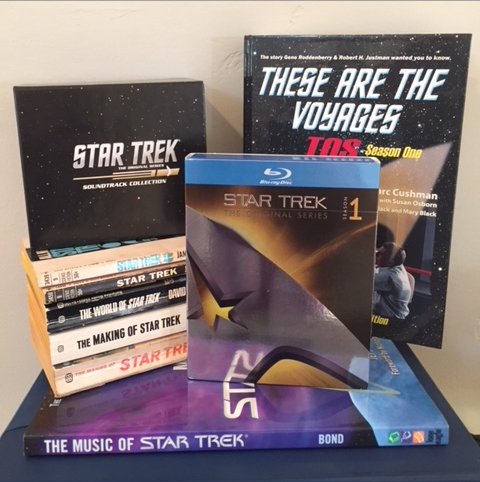
Now decades later I decided to revisit the show, with an eye both nostalgic and critical. So I acquired the recent Blu-Ray set of 2009 remastered episodes put out by CBS. And I discovered the set of three books by Marc Cushman, THESE ARE THE VOYAGES, just published beginning in 2013, that document, in exhaustive detail, the history of the production of all three seasons of Trek. Furthermore, as a fan of musical scores, I was pleased to discover the exhaustive CD boxed set of the complete Trek music, from La La Lands, just released in 2013, as well as an earlier 1999 book by Jeff Bond, THE MUSIC OF STAR TREK. The Cushman books especially, and the CD set of Trek music, made this revisit of Trek’s episode far more rewarding than a revisit only five years ago would have been.

So in this revisit of Trek TOS, I’m writing detailed comments about each and every episode – so far, just of the first season. My comments run along several general themes:

  • Considering the episodes at face value, to what extent do they make sense, or not?
  • Considering my slightly dicey history of seeing the original series, mostly in syndication when I was a teenager, would there be scenes in the complete episodes that I would not recognize, because they had always been cut from the syndicated reruns that were the only versions I ever saw?
  • Considering Cushman’s books, what insights into the production process, especially how early drafts of the stories changed, or how the results were affected by post-production, might influence my understanding of the final episodes?
  • Considering James Blish’s ‘novelizations’ (or ‘episode short story adaptations’ to be more accurate), how do they reveal changes in stories from earlier scripts, or did Blish in some cases make improvements on the original scripts?
  • Considering what I call ‘intuitive physics’ (or ‘Trek physics’ and ‘Trek astronomy’), how did Trek’s portrayal of the physical and astronomical universe reveal the protocols of storytelling, or simply sloppiness by the producers and writers, in ways that betrayed actual scientific understanding? (The prime if almost trivial example being why the Enterprise makes a swooshing noise as it flies by, in the opening credits.)
  • Considering the era in which Trek was made, how did cultural values of the time, especially the roles of the sexes, and also the presence of physical violence, justify what we see in those episodes that would not be considered appropriate today?
  • Considering Trek’s music, with so many themes that became familiar without always identifying themselves to any particular episodes, how would study of the ultimate CD soundtrack set, and Jeff Bond’s book, inform understanding of how those themes were created and developed?
  • Considering the remastered episodes – in which the special effects of the 1960s were updated to the special effects of 2009 or so – would they truly be improvements, in the sense of correcting the astronomical and physics errors of the original productions?

Above is a photo showing my legacy Trek books by Blish, Whitfield, and Gerrold, with the new resources used for these posts. Here are links for the new resources:

Posted in Star Trek | Comments Off on Trek Season 1 Rewatch, Introduction

Link and Comments: Hollywood and Liberals

NYT: Neil Gross, Why Is Hollywood So Liberal?

Best guess:

There is, however, a third explanation worth pondering: that the emotional requirements of acting are conducive to progressive politics. “The overwhelmingly liberal orientation of actors,” Professor Ross has written, “can be partially understood as a byproduct of the demands of their craft. Playing a variety of characters, many of whom they did not necessarily like, fostered a sense of empathy and ability to understand issues and people outside their personal experience.”

Professor Ross suggests that empathy develops as actors gain experience on the job, but we can also speculate that empathetic people are more likely to become actors. Either way, is there any evidence that empathy correlates with liberal ideology?

Surveys show that liberals see themselves, anyway, as more empathetic and kindhearted than conservatives, a self-conception reinforced by political rhetoric. But in a recent paper, the psychologist Adam Waytz and his colleagues report a more nuanced finding: The main thing distinguishing liberals and conservatives in this regard isn’t how empathetic they are overall; rather, the key difference is how much empathy they feel for specific groups. Where conservatives empathize foremost with family members and country, liberals extend the bounds of empathy to include friends, the socially disadvantaged and citizens of the world, to whom they’d like government to lend a hand.

The circle of empathy is larger for liberals than for conservatives. Or rather, those for whom the circle of empathy expands beyond local family and tribe become characterized as liberals. Those for whom life is a zero-sum game between us and the world become characterized as conservatives.

Posted in Conservative Resistance, Social Progress | Comments Off on Link and Comments: Hollywood and Liberals

Links and Comments: Sports and Trump; Pinker and Gates; Tribal Allegiance and Actual Progress

NYT, 3Feb18: Trump’s Blood Sport Politics.

The writer recalls “”The Sporting Spirit,” an essay written by George Orwell in 1945 that sought to reckon with the rise of our modern athletic-industrial complex.”

For Orwell, the rise of sports was bound up with the rise of nationalism, both of them examples of “the lunatic modern habit of identifying oneself with large power units and seeing everything in terms of competitive prestige.”

But the current occupant of the Oval Office has given voice to a more primal, and frankly powerful, vision of sports, the same one Orwell identified seven decades ago: “Serious sport has nothing to do with fair play,” Orwell wrote. “It is bound up with hatred, jealousy, boastfulness, disregard of all rules and sadistic pleasure in violence.”

Mr. Trump is ruled by a lust for competitive prestige, which he achieves by bragging and stoking feuds. Like no other president before him, he has abandoned the Jeffersonian ideal of compromise in favor of the zero-sum game. For him to win, the other side must lose.

The president, naturally, continues to exploit this tendency. He uses the news media to sow discord, to inflame warring cultural and racial factions in a manner designed to steadily erode the common good.

\\

NYT, Jan. 11th: Social Media Is Making Us Dumber. Here’s Exhibit A.

In which a clip of a speech by Steven Pinker is misrepresented (by the right) to make it look like he endorses alt-right beliefs. The incident

highlights a disturbing, worsening tendency in social media in which tribal allegiances are replacing shared empirical understandings of the world. Or maybe “subtribal” is the more precise, fitting term to use here. It’s one thing to say that left and right disagree on simple facts about the world — this sort of informational Balkanization has been going on for a while and long predates Twitter. What social media is doing is slicing the salami thinner and thinner, as it were, making it harder even for people who are otherwise in general ideological agreement to agree on basic facts about news events.

Whereas,

It would be impossible for a reasonable person to watch the eight-minute video and come away thinking Mr. Pinker’s point is to praise the alt-right rather than to make a psychological argument about political correctness, alt-right recruitment and how to better fight that movement’s bigoted ideas.

Conclusion:

It’s getting harder and harder to talk about anything controversial online without every single utterance of an opinion immediately being caricatured by opportunistic outrage-mongers, at which point everyone, afraid to be caught exposed in the skirmish that’s about to break out, rushes for the safety of their ideological battlements, where they can safely scream out their righteousness in unison. In this case: “Steven Pinker said the alt-right is good! But the alt-right is bad! We must defend this principle!”

This is making us dumber.

\\

And then on Jan. 27th, The Mind Meld of Bill Gates and Steven Pinker.

Gates, who runs a blog mostly about books he’s read, made Pinker’s The Better Angels of Our Nature a bestseller when he tweeted about it last May. Here Gates and Pinker talk about the latter’s new book, Enlightenment Now. Here’s Gates’ blog post about the book: My new favorite book of all time.

I’m all for more reason, science, and humanism, but what I found most interesting were the 15 chapters exploring each measure of progress. Pinker is at his best when he analyzes historic trends and uses data to put the past into context. I was already familiar with a lot of the information he shares—especially about health and energy—but he understands each subject so deeply that he’s able to articulate his case in a way that feels fresh and new.

Pinker also tackles the disconnect between actual progress and the perception of progress—something I’ve spent a lot of time thinking about. People all over the world are living longer, healthier, and happier lives, so why do so many think things are getting worse? Why do we gloss over positive news stories and fixate on the negative ones? He does a good job explaining why we’re drawn to pessimism and how that instinct influences our approach to the world, although I wish he went more in depth about the psychology (especially since he’s a psychologist by training). The late Hans Rosling explains this more fully in his excellent new book Factfulness, which I plan to review soon.

The world is getting better, even if it doesn’t always feel that way. I’m glad we have brilliant thinkers like Steven Pinker to help us see the big picture. Enlightenment Now is not only the best book Pinker’s ever written. It’s my new favorite book of all time.

I’ll catch up here with my summary of Better Angels in the next week or so.

Posted in Conservative Resistance, Culture, Social Progress, Steven Pinker | Comments Off on Links and Comments: Sports and Trump; Pinker and Gates; Tribal Allegiance and Actual Progress

SFNF: Bretnor, Modern Science Fiction

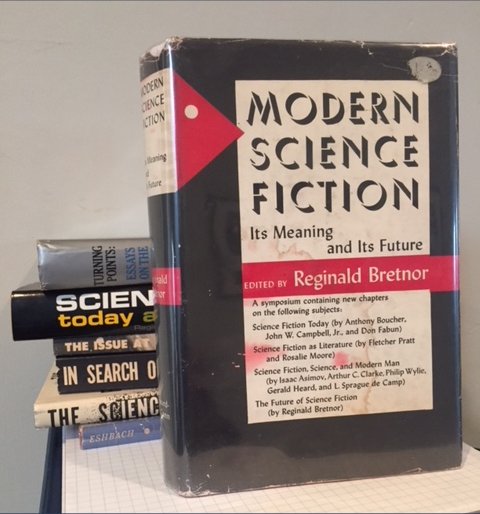
Reginald Bretnor’s 1953 Modern Science Fiction: Its Meaning and Future is one of the earliest critical volumes about SF. If follows Lloyd Arthur Eshbach’s 1947 OF WORLDS BEYOND (summarized here) and precedes the anonymously-edited 1959 volume THE SCIENCE FICTION NOVEL (here), but is substantially longer than either of those.

The book consists of 11 essays written (with one partial-exception) especially for it, and the contributors range from Heinlein, Asimov, and Clarke, to relative unknowns like Don Fabun and Rosalie Moore.

The first section of three essays is about “Science Fiction Today”.

John W. Campbell, Jr.’s “The Place of Science Fiction” is a quick survey of human history that identifies SF as a response to the current state, since 1910 or so, of permanent ongoing change. He notes that interest in SF increased significantly following the atomic bomb in 1945 (i.e., as one of early science fiction’s wild-eyed ‘predictions’ that actually came true). SF, Campbell says, is a kind of practice zone, a place to try out new ideas before implementing them in a world where they might be too dangerous. And he makes a case that, while the circulation of SF magazines is tiny as a part of the overall population, his own Astounding is reaching “about one third of the men in the most creative age levels who are interested in technical developments.”

Also worth noting is that Bretnor in his introduction, Campbell in this piece, and Boucher in the following, all claim that SF “as a self-aware system of literature” in Campbell’s words, is just a quarter century old.

The Publishing of Science Fiction” is by Anthony Boucher, co-founder and at the time still co-editor of The Magazine of Fantasy & Science Fiction, as well as being a mystery reviewer and author of seven novels. (And like Bretnor, and Fabun, and Moore, lived at the time in Berkeley or nearby the Bay Area, according to Bretnor’s bio notes.) Boucher sketches out how the distinction between ‘popular’ and ‘serious’ fiction was a recent one, using mystery novels as a first example. Such genre books had a guaranteed minimum audience, so publishers learned they couldn’t lose money on such books; yet neither could they make big money. (Aside: Boucher refers a couple times to ‘rental’ libraries that many readers would use rather than buy books outright, which in that day cost typically $2.50 for a hardcover. This is a concept outside of my personal experience.)

Boucher goes on: The history of SF began with Hugo Gernsback and his magazines. Amazing, 1926; Astounding, 1930; Campbell taking over Astounding, 1937, with the field expanding to some 30 magazine titles (!) at the time of writing. Book publishing became feasible as interest in SF was triggered by the atomic bomb. The first anthologies were the two big ones in 1946 [Raymond J. Healy & J. Francis McComas, eds. • Adventures in Time and Space and Groff Conklin’s The Best of Science Fictin]. SF books are different than mysteries in that far more of them are anthologies, and SF readers keep buying hardcovers for years, even after paperback editions are available. (Whereas, apparently, mysteries were more like commodities, one book ceasing to sell as soon as the next came along.) And are willing to spend money to buy books from specialty houses like Arkham House, et al.

Still in recent years, most SF books are reprinted from magazine serials: in 1949, 15 sf novels published from magazines, 5 without previous publication; in 1950, 29 and 13; in ’51, 17 and 14; etc.

Writerly pay? In this era, typical rates were $100 for a short story, $1200 for a novel, for an annual salary [for a full-time writer] of perhaps $3600. (Note reference to the “newly organized Science Fiction Writers of America” – p40, in 1953! Obviously this never came about; the SFWA we know was formed by Damon Knight in 1964 or so…)

*

Science Fiction in Motion Pictures, Radio, and Television” is by Don Fabun, at the time a reviewer for the San Francisco Chronicle. He explains the disappointing examples of SF in the mass media as being an effect of how the mass media needs to reduce complex prose to simple pictures. SF is built on the myth that “the mind of man is capable of solving all problems directed to it by the exercise of rational thinking and through the logical disciplines of orthodox science.” P47.0. But mass audiences need emotional appeal, or character symbols — the heroine, the villain, and so on. So when SF was adapted for mass entertainment the obvious model was the western; thus, ‘space opera’ like current TV shows of the time. These shows aren’t just for juveniles — p49m “Any theatre manager who stands in the lobby of his theater and listens to the remarks of this departing patrons will agree that, no matter how juvenile his fare for the evening, many of the people going out apparently have failed to understand it.”

Fabun goes on to examine SF films. The first successful SF film was Rocket Ship X-M in 1951. Soon after that, George Pal’s Destination Moon, successful, very accurate, but rather documentary-like. The Thing was next, also very successful – but a prime example of good prose story made “a complete and inexcusable mess” p53m. Also in 1951, The Day the Earth Stood Still, which writer here calls “a wan mish-mash of several science-fiction themes, carried out in a weary manner which made one think that the producers must have had a captive audience in mind.”

He then moves on to TV, with very detailed descriptions of the popular shows, and their radio antecedents — Buck Rogers in 1932, superseded by Superman, then Orson Welles’ War of the Worlds radio broadcast.

On TV, Captain Video came on in June 1949, Tom Corbett: Space Cadet in October 1950; then Space Patrol. Writer describes their doubletalk gadgets and weapons (cosmic ray vibrator; atomic rifle; thermoid ejector; nucleamatic pistol, etc., p63b) and how they all had prohibitions against bloodshed, violence, and death. These were serials, shown up to five days a week in 15 minute or half hour segments, both live and filmed.

Tales of Tomorrow was an anthology show adapting short stories, e.g. Heinlein’s “The Green Hills of Earth.” The problem was with needing writers – the assumption here is that writers for TV had to establish a track record in print first, then be able to write dramatically; still, most TV productions are written by TV writers, who often adapt stories from print. Example from a 1952 magazine article, of outlining a story, getting technical advice from Willy Ley, turning out a script in a week, and to the director just one week before telecast.

(I won’t bother to comment on how these assumptions have changed radically, again and again, over the decades since.)

In time, Fabun predicts, most SF might be written primarily for TV or motion picture screens (rather than adapted from published stories).

*

The next section, “SF as Literature“, begins with Fletcher Pratt’s “A Critique of Science Fiction.” His issues are familiar even today as criticisms of bad science fiction; many of these still apply, only a few have been overcome by SF’s merging with popular culture. I’ll bullet-point them.

  • SF has too many unscientific elements, e.g. the fiction of A.E. van Vogt. Writers owe us at least plausible explanations for how something should work; else we have pseudo-science, the “label we all hate so much” p75.7. (But see my point on this issue, about a similar comment by Heinlein, here)
  • It’s bad when authors produce new gadgets at the end of a story to solve all the problems. [Some episodes of various Trek incarnations, anyone?]
  • Characters who all sound the same; no details of everyday life. George O. smith, EE Smith.
  • Stories with a brilliant concept but no story– “The Absolute at Large”; “E for Effort”; “The Xi Effect”.
  • Gigantism, in which the stakes grow to whole galaxies at war, and so on; Foundation; de Camp’s Johnny Black, often in response to editorial urging of more and more sequels. [ Of course this is a common feature of modern SF superhero and space opera series. ]
  • Writers who imagine English spoken by aliens, or the same English in the far future. [ too many examples…]
  • Using terms of disintegrator and space-warp, perhaps only understood by cultists. [ not any more! ]
  • Mystification via mumbo-jumbo. Van Vogt.
  • The cult of the superman story. Stories in which we wonder why characters who have some unusual ability that makes us wonder why they don’t use it to take over. Sixth Column.
  • The overuse of surprise ending, especially currently in Galaxy magazine.
  • And how SF dates, both in the language of the writing of the time, and in obsolete predictions. When the Sleeper Wakes.

*

I’ll not summarize all of the following essays in quite such detail.

Rosalie Moore’s “Science Fiction and the Main Stream” says a lot of obvious things about how we read a fantastic story differently from a realistic or mainstream story, a theme developed greatly in decades since, notably by Samuel R. Delany. She does make some familiar points about the difference between a mainstream story and an SF one. 115.4: How “all too often the effect of the mainstream story—over and over—was one of dejections and defeat.” Mainstream stories conclude, “Isn’t it terribly sad?” while sf asks, “Precisely what are we going to do next?” And how “the typical New Yorker” story, p116b, is about frustration and taking no action. As if the idea of plot is vulgar. 117.4

L. Sprague de Camp’s “Imaginative Fiction and Creative Imagination” is about how de Camp writes stories. Creative imagination is about free association. A handicap for any writer is simply not knowing enough. A writer’s sources are his experiences, personal or vicarious. Killdozer. These can include legends and myths, the author’s contemporaries, paying attention to the progress of science. A writer is trying to do three things: entertain the reader; express himself and his feelings; and convey some idea or opinion. He goes on to explore why SF depends on the glamor of the exotic, to explain why stories about the future should exploit “such archaisms as pre-gunpowder weapons, hereditary monarchy, and all-powerful hierarchical religious cults”. Not all progress is uniform. And most cultures have a “myth of a heroic age, when mankind was young and all men were virile, all women beautiful, and all problems simple.” 135.4, followed by “the modern Western belief that ancient times were mostly hard, cruel, dreary, and unsanitary, while probably closer to the facts that the heroic-age concept, is a relatively new one.”

*

The final section, “Science Fiction, Science, and Modern Man“, begins with the longest essay in the book, by Isaac Asimov, about “Social Science Fiction.” This strikes me as an essential, classic essay, but perhaps I think that only because I read this essay in Damon Knight’s volume TURNING POINTS back in 1977, and it struck me at the time, especially because I didn’t think I agreed with it. In this essay Asimov makes a distinction between proper science fiction and mere ‘social’ science fiction — like Gulliver’s Travels, or More’s Utopia.

I think at the time I thought Asimov was being persnickety, trying to distance himself, and his own brand of proper science fiction, from the claimed antecedents who didn’t really do it the way he thought it should be done.

(As an aside, I had a well-read friend once, not an SF fan, who was flabbergasted that anyone would try to claim NINETEEN EIGHTY-FOUR as science fiction. I think his literary intuitions aligned with what Asimov was trying to get to in this essay.)

Asimov claims it’s a question of intent. He describes literature’s response to increased change over recent centuries in phases: social fiction, then gothic horror fiction, then science fiction. And he declares his new definition of science fiction, p167.4: “Science fiction is that branch of literature which deals with a fictitious society, differing from our own chiefly in the nature or extent of its technological development.”

Asimov goes on to describe four eras in the history of science fiction: 1815-1926; 1926-1938; 1948-1945; 1945-present. The earliest was ‘primitive’; the second defined by Gernsback founding Amazing Stories; the third by Campbell taking over Astounding; the final by the atomic bomb.

He then goes on to distinguish between ‘chess game stories’ and ‘chess puzzle stories.’ The rules by which pieces move are the impulses of humanity [human nature] – p178m. The chess game story has a fixed starting position, our own socio-economic society: the city, an agricultural economy, etc. p179.3.

The purest chess-game story takes advantage of the idea that “history repeats itself.” Asimov has used this idea repeatedly – in his Foundation stories, in other novels, 180t. [Asimov knows his history! More than most casual readers, I’d guess.]

Noting that author and critic Damon Knight has taken issue with this idea [in a review reprinted in Knight’s IN SEARCH OF WONDER], Asimov counters with a detailed outline of an historical episode, with blanks for key names, p181-183, and then provides a table of three columns, each a set of names to fill in the blanks: 17th century England; 18th century France; 20th century Russia. There are a few mismatches, but the number of matches is impressive.

Then he provides some examples of ‘chess puzzle’ stories by Leiber, Wyman Guin, Tenn, Russell, de Camp.

Finally he considers the effect of SF on society, and dismisses the idea that SF is only escape literature. The future has to be thought about, and SF can accustom the reader to the idea of change. He cites FDR’s willingness to experiment; that’s what SF does. And the effect of SF is to expand the scope, to break down hostility between tribes and states, to consider anything less that “Earthman” doesn’t make sense.

Summary 195-6:
“1. For the first time in history mankind is faced with a rapidly changing society, due to the advent of modern technology.
2. Science fiction is a form of literature that has grown out of this fact.
3. The contribution science fiction can make to society is that of accustoming its readers to the thought of the inevitability of continuing change and the necessity of directing and shaping that change rather than opposing it blindly or blindly permitting it to overwhelm us.”

….So after all these years I’m more sympathetic to his distinction between “social science fiction” and other forms of SF than I was when I read this essay 40 years ago. Though not quite on basis Asimov makes it, but from another perspective, analogous to my distinction between SF and fantasy, where the former is about recognition of an objectively knowable universe, distinct from human values, and the latter is a literature in which human values, and wishes and dreams, are projected into various imaginary settings. What Asimov calls social SF is, in a sense, an extrapolation of human nature, rather than a consideration of how human nature reacts to discoveries of science or changes in technology. So that might indeed dismiss Plato et al from SF; but not Orwell, and surely not Huxley, whose imagined dystopias do indeed depict social changes in reaction to technological changes.

*

In contrast, Arthur C. Clarke’s “Science Fiction: Preparation for the Age of Space” is a rather dry survey of the various ways writers over the centuries have imagined voyages into space. Clarke doesn’t mention the book, but he might well have read J.O. Bailey’s PILGRIMS THROUGH SPACE AND TIME, a 1947 survey of the many precursors of utopian thinking before modern SF, all the names that most of the writers here dismiss as not belonging to the modern genre. (I have a copy of this book too, but am not motivated to read it.) Thus, Clarke describes voyages into space via the supernatural (Kepler, Stapledon, Lewis); by natural agencies (Lucian of Samons, Bishop Godwin; de Berjerac); via ‘subtle engines’ such as wings, firecrackers, or magnets; space guns in McDermont, of course Verne, and the 1936 Wells film; antigravity; rockets; miscellaneous; and space stations.

*

Philip Wylie’s “Science Fiction and Sanity in an Age of Crisis” is fascinating in its revelations of what worried people in the 1950s. Democracy requires an educated citizenry, but we live in an increasingly complex society in which it’s impossible to keep up, in which everyday people are necessarily specialists, and Congress is ignorant about the atom. In fact Congress took the action to assign such knowledge (of the atomic bomb) to the military, making it ‘secret’ — a subversion of democracy, Wylie claims. That’s what he’s worried about — an unprecedented development, he seems to think, about an issue (secrecy) that we take for granted today.

So is SF educational, he wonders? Does it help people to reason, or merely muddle their thinking? Does SF have any obligation to the standards of science?

His answer: it can help, but it seldom does. SF isn’t mythology; it’s religious in form, but must be honest toward outer objects. On page 232 he says this: “This is, essentially, a mere transposition of the subjective teaching of Jesus to the outer world. Many authors have said, rightly, in the opinion of this one, that true science was impossible before the teachings and ideals of Jesus had been disseminated.” I have no idea what he means; it doesn’t correspond to anything I understand from reading the NT or about the history of science.

He goes on to worry primarily that SF doesn’t take into account what is known about “man’s nature” — that is psychology. “Without a science of such matters, what they write is irresponsible, in the sense that it pretends to be ‘modern’ whereas it is contemporary in detail only—and inevitably, in meaning, archaic.” The result is that SF has made audiences credulous about matters like flying saucers. The amorality of SF/F is a symptom of a general mental disorder. He mentions Freud, Adler, and Jung, about the importance of myth, and implies this understanding is what is lacking in SF.

This piece suffers because Wylie alludes to good and bad examples of SF, without naming any of them. Presumably he assumed his readers know what’s talking about; but 60 years on we can only guess.

What I find extraordinary about the essay, though, is that he was on to something — psychology was indeed primitive 60 years ago, but it has advanced greatly since — cf. Kahneman, Haidt, Pinker, McRaney — and in fact understanding of this psychology can deeply inform our understanding of human interactions, of politics, of science fiction and fantasy. If mainstream fiction has done better at portraying human nature, it’s done so intuitively, unconsciously. Whereas scientific understanding of psychological issues — mental biases and the persistence of logical fallacies in everyday life — has in fact begun to filter down into the fiction of SF authors. The first example that comes to mind is KSR’s AURORA…

*

The next essay is “Science Fiction, Morals, and Religion,” by Gerald Heard (http://www.sf-encyclopedia.com/entry/heard_gerald), an author and journalist mostly forgotten by now, I think. For me this was the most intriguing essay in the book, for its topic; what were the issues about morals and religion in the 1950s that science fiction had anything to do with? Heard quickly identifies several issues: artificial insemination; the understanding that hormones affect human personality; the general issue of what is ‘natural’ and whether science can enforce the “simplicities which uninformed moralists thought was all that was natural.” More broadly, how will atom bombs affect how power is fought? And what will future societies be like, as individuals become increasingly specialized?

SF can address not just the “pursuit of truth” but the idea of “future alternate universes” and identify what the potentials for humanity might be. SF can build up a ‘tolerance’ to new ideas (unlike, he claims, science, with its failure to take reports of ESP or flying saucers seriously -!! p260).

Heard’s style is roundabout and pompous, as if he assumes the reader knows and agrees with his conclusions so that he need barely mention them, let alone spell them out. He finally gets around to discussing religion in the middle of a long paragraph on p261 and, typically, claims no conflict between science and religion: science is empiric research, religion is the frame of meaning, and how those meanings are applied is morality. This makes religion alive in a way it was not when all it did was defend the past and its “outgrown cosmogonies, inaccurate history and inapposite codes.” And he goes on about Julian Huxley and how the pessimism of evolution and materialism has been overcome. (It has?) And so a task of SF is to “construct an ethic deduced from a modern cosmology and producing rules of demonstrable psychiatric, hygienic and social value.” OK. But he loses me when he claims that meaning is not just anthropomorphic or mechanomorphic. …rather “an extension of conscious thought which indicates and will tend to explicate a vast directive, a concept that is more inspiring to the modern mind than any forecast of a concrete goal.” (p264.)

*

Finally, editor Bretnor’s “The Future of Science Fiction” spends time defining SF, and then defending it from ‘mainstream’ detractors.

Like a couple others he’s concerned with the problem of modern-day specialization, and claims the misunderstanding of science, and the scientific method, is a driver for the emergence of SF. p272: “Today, science fiction appears as a genre because the main currents of our literature still adhere to sets of principles which are pre-scientific – principles whose validity can only be maintained by rigidly excluding the knowledge which would prove them false.”

His definition of SF again stresses awareness of the scientific method. He identifies three categories, in descending order:

1, works which reveal the author’s awareness of the scientific method not just in circumstance and plot but in the thoughts of its characters;
2, works with such an awareness, but only in circumstance and plot;
3, works that reveal the author is aware only of the products of the scientific method.

While ‘serious’ fiction emphasizes feeling rather than thought. And with this he challenges critics in the popular press who disparage SF on one ground or another. One of his examples is the paragraph from Saturday Review that Heinlein further attacked in his essay in THE SCIENCE FICTION NOVEL. Another is a mischaracterization by Look magazine of Donald Menzel dismissing a particular UFO incident — Look implied the entire field of UFO studies was thereby discredited. Bretnor then makes this extraordinary statement:

This statement is in the same general category as—to use the most familiar of absurd examples—those which flatly deny the existence of a God or gods, the possibility of survival after death, the actuality of ESP phenomena, the prevalence of witches, or life on other worlds, or poltergeists, or the meteorological effectiveness of the Hopi snake dance.

Is he serious? Three sentences later: “Nevertheless, much evidence has been accumulated—evidence of varying reliability, true—which indicates either that they exist or that some corresponding areas do.” Is that so.

Bretnor does distinguish between the “verified” “new maps” of Heinlein and Clarke, and the topics mentioned above for which no “new maps” have been drawn, but that this does not mean the latter are automatically fantasy.

(Is he coining the term “new maps” or quoting someone else? Can’t tell. Kingsley Amis uses the term a few years later in his book NEW MAPS OF HELL.)

And then Bretnor sketches the future of SF: the adoption of the attitudes of SF by non-SF; increased academic interest; mediocre SF by non-SF writers; and the growth of the field, including one ‘slick’ magazine within two years. (On this last point, I don’t think it ever happened, with the exception of Analog‘s switch to slick format in the early ’60s, only for a couple years.)

*

To summarize key, repeated points:

    • SF as a distinct genre was, in 1953, only a quarter century old
    • Much of it is poorly written and conceptually shallow
    • Media (movie and TV) SF is even worse
    • SF became ‘respectable’ following the atomic bomb
    • Opinions about UFOs, parapsychology, and the like, varied widely, but the subjects were taken quite seriously by some
    • Proper science fiction is about the impact of technology on society and especially relies on conscious application of the scientific method, and is a benefit to society by helping readers cope with continuing change.

Posted in Book Notes, Science Fiction Nonfiction | Comments Off on SFNF: Bretnor, Modern Science Fiction

Link and Comments: Paul Krugman on Know-Nothings

Today’s NYT: Know-Nothings for the 21st Century

Krugman has a few themes he repeats over and over again in his twice-weekly columns, not because he has nothing else to say, but because there is so much new evidence to support those favorite themes. In the Trump administration, and in Republican/conservative behavior generally.

Here, he evokes the “Know Nothing party of the 1850s, a bigoted, xenophobic, anti-immigrant group that at its peak included more than a hundred members of Congress and eight governors”, with the reminder that the targets then were the Irish and Germans. (My own Kelly family ancestors immigrated to the US from, not Ireland directly, but from the Isle of Man, in the 1860s; Genealogical Post: My Family Trees.)

After all, Ireland and Germany, the main sources of that era’s immigration wave, were the shithole countries of the day. Half of Ireland’s population emigrated in the face of famine, while Germans were fleeing both economic and political turmoil. Immigrants from both countries, but the Irish in particular, were portrayed as drunken criminals if not subhuman. They were also seen as subversives: Catholics whose first loyalty was to the pope. A few decades later, the next great immigration wave — of Italians, Jews and many other peoples — inspired similar prejudice.

Conservatives, racists, and xenophobes exhibit similar behaviors in all eras.

Krugman goes on about lower-case “know-nothings”, and why there are not many conservatives in leading universities.

The range of issues on which conservatives insist that the facts have a well-known liberal bias just keeps widening.

One result of this embrace of ignorance is a remarkable estrangement between modern conservatives and highly educated Americans, especially but not only college faculty. The right insists that the scarcity of self-identified conservatives in the academy is evidence of discrimination against their views, of political correctness run wild.

Yet conservative professors are rare even in hard sciences like physics and biology, and it’s not difficult to see why. When the more or less official position of your party is that climate change is a hoax and evolution never happened, you won’t get much support from people who take evidence seriously.

And

But conservatives don’t see the rejection of their orthodoxies by people who know what they’re talking about as a sign that they might need to rethink. Instead, they’ve soured on scholarship and education in general. Remarkably, a clear majority of Republicans now say that colleges and universities have a negative effect on America.

This rejection of education and knowledge is reflected in the Christian home-schooling movement, and, at an extreme, the West African Boko Haram movement, whose name means, the NYT reminds us this morning, “Western education is forbidden.”

Posted in Conservative Resistance | Comments Off on Link and Comments: Paul Krugman on Know-Nothings

Links and Comments: Optimists; Bible; Children

Time Magazine’s current issue is called “The Optimists,” and is edited by Bill Gates. Steven Pinker has a piece:

Why We Refuse to See the Bright Side, Even Though We Should

According to the latest data, people are living longer and becoming healthier, better fed, richer, smarter, safer, more connected–and, at the same time, ever gloomier about the state of the world. As the political scientist John Mueller once summed up the history of the West, “People seem simply to have taken the remarkable economic improvement in stride and have deftly found new concerns to get upset about.” How can we explain pessimism in a world of progress?

One answer is an issue I’ve noted repeatedly: the news media, by their nature, focus on the bad, no matter how rare bad incidents may occur. (This doesn’t make the news media bad or dishonest; that’s just the nature of the medium. It has to be understood, the same way advertising must be understood.)

News is about what happens, not what doesn’t happen, so it features sudden and upsetting events like fires, plant closings, rampage shootings and shark attacks. Most positive developments are not camera-friendly, and they aren’t built in a day. You never see a headline about a country that is not at war, or a city that has not been attacked by terrorists–or the fact that since yesterday, 180,000 people have escaped extreme poverty.

NYT writer Nicholas Kristof occasionally echoes the same theme. Today, Why 2017 Was the Best Year in Human History

As recently as the 1960s, a majority of humans had always been illiterate and lived in extreme poverty. Now fewer than 15 percent are illiterate, and fewer than 10 percent live in extreme poverty. In another 15 years, illiteracy and extreme poverty will be mostly gone. After thousands of generations, they are pretty much disappearing on our watch.

And he cites Pinker (who has a new book coming out in February). Both address psychological issues, how human biases betray clear thinking. Thus there will always be an audience for the likes of Trump.

President Trump rode this gloom to the White House. The idea “Make America Great Again” professes a nostalgia for a lost Eden. But really? If that was, say, the 1950s, the U.S. also had segregation, polio and bans on interracial marriage, gay sex and birth control. Most of the world lived under dictatorships, two-thirds of parents had a child die before age 5, and it was a time of nuclear standoffs, of pea soup smog, of frequent wars, of stifling limits on women and of the worst famine in history.

And one more, at Vox.com: 9 ways the world got a lot better in 2017, by Charles Kenny.

Less famine, fewer deaths from wars and natural disasters, progress against pestilence (via vaccinations), greater life expectancy, more democracy, expanding human rights, fewer very poor people, greener energy.

\\

Also in NYT, an essay about the new Museum of the Bible, which apparently is more a shrine to uncritical veneration than a true museum exploring origins and influences.

The Museum of the Bible Is a Safe Space for Christian Nationalists.

If you walk in thinking that the Bible has a single meaning, that the evidence of archaeology and history has served to confirm its truth, that it is the greatest force for good humanity has ever known and that it is the founding text of the American republic — well, then, you will leave with a smile on your face and a song in your heart.

Also, a fascinating piece about what it means if your child is lying to you.

Is Your Child Lying to You? That’s Good.

On the one hand,

Why do some children start lying at an earlier age than others? What separates them from their more honest peers? The short answer is that they are smarter.

On the other, concerning an experiment in which a child is told not to look for a toy,

(Children who don’t peek at the toy in the first place are actually the smartest of all, but they are a rarity.)

Posted in Children, Culture, Human Progress, Religion | Comments Off on Links and Comments: Optimists; Bible; Children

Link and Comments: UFOs and Other Fairy Tales

No I don’t “believe” in UFOs, in the sense of believing them to be evidence of extraterrestrial visitors, because I’ve long been too familiar with the many ways human perception can go awry and of the many ways reports of supernatural phenomena have turned out to have mundane explanations.

It’s probably worth making this key point: science fiction writers, and readers, are generally far less credulous about such matters than the general population is. That is, just because we read SF doesn’t mean we believe in UFOs or psychics who predict the future or any other supernatural phenomena; that these are recurring themes in mass media SF — movies and TV shows — is because these must appeal to audiences far wider than the relatively hard-minded crowd of SF readers, and it’s partly for this reason that SF movies and TV shows are disrespected by the more knowledgeable and rigorously thinking readers.

Ross Douthat, of all people, makes this in a recent NYT op-ed, Flying Saucers and Other Fairy Tales.

Rather, it’s that our alien encounters, whether real or imaginary, are the same kind of thing as the fairy encounters of the human past — part of an enduring phenomenon whose interpretations shift but whose essentials are consistent, featuring the same abductions and flying crafts and lights and tricks with crops and animals and time and space, the same shape-shifting humanoids and sexual experiments and dangerous gifts and mysterious intentions.

He recalls the Victorian zeal for beliefs in fairies (you know, tiny little winged creatures found amongst the garden flowers), and Erich von Däniken’s of evidence for ancient alien astronauts in the 1960s.

Certainly for most sensible secular scientific-minded people, to say that our era’s close encounters are of the same type as encounters with the unseelie court of faerie is to say that they are all equally imaginary, proceeding from internalized fancies and hallucinatory substances and late-night wrong turns, plus some common evolved subconscious that fears shape-shifting tricksters in modern Nevada no less than in the mists around Ben Bulben.

But then Douthat takes refuge in the (to me equally imaginary) contingencies of his Christian faith.

So the glamour of U.F.O.s, like the glamour of faerie, is an understandable object of curiosity but a dangerous object for any kind of faith. The only kind of God worth trusting is the kind who does not play tricks.

It is trivially easy, of course, to imagine ways in which God’s presence might be made less evasive and dubious than the experience of the real world, and the fragmentary inconsistency of the Gospels, actually provides; and dismiss that fairy tale too.

Posted in Psychology, Religion | Comments Off on Link and Comments: UFOs and Other Fairy Tales

Link and Quote: Hitchens on Christmas

Slate reposts a 2008 essay by curmudgeon Christopher Hitchens: ’Tis the Season to Be Incredulous: The moral and aesthetic nightmare of Christmas.

Aesthetics aside; whether Jesus existed or not, was the Son of God or not…

Suppose we put the question like this: Imagine that conclusive archaeological and textual evidence emerged to prove that the whole story of the birth, life, and death of Jesus of Nazareth was either a delusion or a fabrication? Suppose the mother had admitted shyly that, in fact, she had fallen pregnant for predictable reasons? Suppose we found the post-Calvary body?

Serious Christians, of the sort I have been debating lately, would have no choice but to consider such news as absolutely calamitous. The light of the world would have gone out; the hope of humanity would have been extinguished. (The same obviously would apply to Muslims who couldn’t bear the shock of finding that their prophet was fictional or fraudulent.) But I invite you to consider things more lucidly. If all the official stories of monotheism, from Moses to Mormonism, were to be utterly and finally discredited, we would be exactly where we are now. All the agonizing questions that we face, from the idea of the good life and our duties to each other to the concept of justice and the enigma of existence itself, would be just as difficult and also just as fascinating. It takes a totalitarian mind-set to claim that only one Bronze Age Palestinian revelation or prophecy or text can be our guide through this labyrinth.

Posted in Religion | Comments Off on Link and Quote: Hitchens on Christmas

Link and Comment: Evangelicals Embrace Trump Because They’re Frightened in a Big World They Don’t Understand

NYT, from Dec. 15th. Amy Sullivan, who describes herself as “a progressive evangelical and journalist covering religion”, wonders “how white conservative evangelicals could support Mr. Trump, who luxuriates in divisive rhetoric and manages only the barest veneer of religiosity.” And realizes, “Fox evangelicals don’t back Mr. Trump despite their beliefs, but because of them.”

America’s New Religion: Fox Evangelicalism

(On the one hand, I’ve realized it’s not especially productive to react to every opinion piece that observes something new about the Trump phenomenon, because a few weeks later the reference is dated and there are fifty new opinion pieces. On the other hand, I do comment when I see something that speaks to some larger issue… in this case, what the true motives of evangelicals are, since it’s obviously not fidelity to the messages of Jesus and the New Testament.

I do have to say, in general, that the Trump phemenon proves once and for all that evangelicals are not about any kind of spiritual purity or possession of a truth that the heathens refuse to accept. Rather the past two years has shown, beyond everything else to their discredit, that evangelicals are motivated by base tribalism — fear of strangers and change. And in the current case, a visceral reaction by the most racist among us to the occupation of the White House by a black man for eight years.

And the larger point is that this is an enduring aspect of human nature, ready to erupt at any time, anywhere, in any nation no matter how supposedly advanced and convinced of its own superiority. The descent into fascism; one reason civilizations collapse.)

The regular Fox News viewer, whether or not he is a churchgoer, takes in a steady stream of messages that conflate being white and conservative and evangelical with being American.

The writer attends a screening of a film about gun restrictions at a Bible College in North Dakota.

As two dozen of us gathered for a post-screening discussion, I was both astonished and troubled, as a fellow evangelical, by the visceral sense of fear that gripped these young adults. As a child in the Baptist church, I had been taught to be vigilant about existential threats to my faith. But these students in a town with a population of some 1,200 saw the idea of a home invasion or an Islamic State attack that would require them to take a human life in order to save others as a certainty they would face, not a hypothetical.

These fears are far removed from the reality of life in North Dakota, a state that saw a total of 21 homicides in 2015. Of those deaths, seven were caused by firearms, and only three were committed by someone unknown to the victim. Yet the students around me agreed unreservedly with Wayne LaPierre, chief executive of the National Rifle Association, who was seen in the film asserting that “in the world around us, there are terrorists, home invaders, drug cartels, carjackers, knockout gamers, rapers, haters, campus killers, airport killers, shopping mall killers.”

It’s mostly about being frightened, about realizing that your small corner of the world isn’t all there is, that there are other kinds of people, people you don’t understand.

They might hear a sermon about what the Bible actually reaches for 30 or 40 minutes a week, but they watch Fox News three or four hours a day. Sullivan quotes evangelical writer Jonathan Martin.

“Now the Bible’s increasingly irrelevant. It’s just ‘us versus them.’”

“It explains how much evangelicals have moved the goal post,” said Mr. Martin. “If there’s not a moral theology or ethic to it, but it’s about playing for the right team, you can do anything and still be on the right side.”

Posted in Conservative Resistance | Comments Off on Link and Comment: Evangelicals Embrace Trump Because They’re Frightened in a Big World They Don’t Understand

Links and Comments: Regulations; Science on Sundays; How to Talk to Someone in a Conservative Bubble

Slate: Trump’s quiet attack on the regulatory state is another part of his broader class war

The conservatives’ simplistic rebellion against “regulations” will have consequences, and costs. Regulations are there for a reason.

Yes, these rules and regulations might technically kill jobs. But which jobs, and in order to accomplish what? Protections of this sort chase dodgy sellers out of the marketplace. If that’s job killing, good riddance.

Deregulation, in turn, paves the way for the return of these jobs for financial snake oil salesman.

The White House’s insistence that deregulation is liberty enhancing just goes to show how warped today’s political discourse is. Deregulation privileges the worst products, producers, and service providers over consumers, workers, and responsible businesses. All of these individuals benefit from clear, evidence-based regulations enforced by capable and conscientious public servants.

\\

NY Times, Thomas Hooven, M.D.: Sundays at the Altar of Science

About atheist parents not taking their children to church to hear Bible tales, but by performing basic science experiments instead.

Their communion bread and wine are replaced by baking soda and vinegar, which when combined generate a satisfying volcanic eruption and the opportunity to talk about the ethereal realm of atoms. Sprouts in our windowsill herb garden offer a chance to introduce the concept of DNA. When I tell my son that the granular basil seed holds millions of chromosomes, the look on his face can only be described as revelatory.

The advantage science has is that it’s real.

While I’m sure my kids will encounter religious ideas and stories of miracles before long, I won’t rush them there. Christmas in our house is a celebration of festive decorations and family reunion. We steer clear of the virgin birth and angelic tidings. And although my kids have heard about Santa, they express doubts that I make no effort to dispel. I don’t want to indicate that the natural laws they’ve painstakingly established are subject to occasional suspension.

When they eventually ask me about God, I’ll say that He’s part of a theory a lot of people believe, but which no one has ever proven. And if they want to go to a church, temple or mosque to learn more, I’ll gladly take them. Above all, I want them to reach their own conclusions, whatever those might be.

\\\

Daily Kos: Cults, Cons and how to talk to someone in the conservative bubble

As a liberal, part of me keeps hoping that if we can just give conservative the right information their behavior will change.  If we can just prove Russian collusion or show that the tax plan benefits the 0.01% mainly, things will be better. Before being a liberal, I was a borderline 9/11 conspiracy theorist and I did the same thing. I have the truth and if people will only listen to the facts about the second tower or Iraqi oil people will change their behaviors. 

But that’s not how people work. We don’t care about information — at least at first.  We like people and stories we trust most of all.

As smart, information- and fact-based people (“reality  has a liberal bias”) how do we communicate with our co-workers, friends and loved ones? Is it all a lost cause?

It’s not a lost cause because I experienced the change. I was a Rush Limbaugh listening Republican when I was a young man and I changed. It took a lot of love and care from people to get me to change but I did. Did anyone ever sit down and give me all the answers? No. I never said “You know, You are totally right. I see it right here in the newspaper. I am a fool.”  Liberals expect that outcome, but that will never happen. 

In trying to understand my own conversion and the current GOP/Trump mindset, I did a bunch of reading on cults, con artists, FBI negotiators and salesmen- anyone who changes minds. Here are some proven tools that you can use this Holiday season to make some progress…

Points include: don’t argue the facts, that just makes things worse; realize you are dealing with the animal minds, not the rational one (cf. Kahneman); ask them to articulate their thinking; keep lines of communication open; turn off the TV and rely on printed sources. With case studies.

Posted in Conservative Resistance, Psychology, Religion, Science | Comments Off on Links and Comments: Regulations; Science on Sundays; How to Talk to Someone in a Conservative Bubble