
Interesting items from Sunday’s New York Times

Frank Bruni: The G.O.P.’s Gay Pretzels

Bruni imagines a letter from the RNC to the Republican presidential candidates on their handling of the question, would you attend a gay wedding?
From Bobby Jindal

We do not recommend the tint picked by Bobby Jindal, who just tripled down on his opposition to gay marriage while casting big business — corporate America — as a principal enemy of righteousness on this front. Earth to Bobby!?! We are big business. Big business is our cuddling partner. We spoon with it. We do not vilify it. Bobby is a desperate man, trying to find a point of entry into a crowded primary field with no room for him. Tune him out, and do not, under any circumstances, follow his lead.

to Jeb Bush.

Jeb Bush’s tack is more comprehensible. He utters much of what religious conservatives want to hear. But he also brings enough gays or Republicans who support same-sex marriage into his campaign to give Americans a signal of where so many of us in the party really are. We have gay children, grandchildren, siblings, nieces, nephews, colleagues, bosses, employees. We want the world for them and a world that’s fully open to them.

\\

William N. Eskridge, Jr.: It’s Not Gay Marriage vs. the Church Anymore

Eskridge (A Yale law professor) reflects on the upcoming arguments before the Supreme Court on same-sex marriage in the context of past civil rights battles resisted by the Church.

Race relations in this country show how religious practice and doctrine can change when public attitudes and the law change. Before the Civil War, many Mormons and Southern Protestants maintained that the Bible supported slavery for persons of African descent; when slavery ended, the same denominations read Scripture to require segregation of the races and to bar interracial relationships. Apartheid was the legal regime codifying those religious and social attitudes.

Biblical support for slavery, segregation and anti-miscegenation laws rested upon broad and anachronistic readings of isolated Old Testament passages and the Letters of Paul, but without strong support from Jesus’ teachings in the Gospels. The Southern Baptist Convention now concedes that its churches misinterpreted the word of God on matters of race. The current Baptist view that God condemns “homosexual behavior” and same-sex marriages comes from the same kind of broad and anachronistic scriptural readings as prior support for segregation.

With examples of the many Biblical spiritual heros who marriages were hardly what is now called “traditional”.

Eskridge predicts churches will change about this topic too.

With greater tolerance and acceptance of gay married couples, more religions will, slowly, modify doctrinal discourse to match social discourse — exactly the way they did for their previous disapproval of marriages between two people of different races. It’s beginning to happen already: Last summer, the Presbyterian Church (U.S.A.) voted to allow its ministers to perform marriage ceremonies for gay couples, a stance ratified by a majority of presbyteries last month.

\\

A “Gray Matter” about The Economics of Suspense, in terms of sports rules and narrative structure. If you tell someone a game or a novel is a real nail-biter… that sorta destroys the suspense.

It’s a lesson that the filmmaker M. Night Shyamalan, for one, seems to have missed. Once it’s common knowledge that your movie will have a dramatic, unexpected plot twist at the end, then your movie no longer has a dramatic, unexpected plot twist at the end.

To be thrilling, you must occasionally be boring.

This has implications in how to make literary plots suspenseful.

For instance, to maximize suspense, a mystery novel should have no more than three major plot twists on average. Of course, that last qualification is crucial: The exact number of plot twists should be unpredictable.

One example of how, upon deep analysis, there is remarkable uniformity to most popular fiction.

\\

Maureen Dowd (a regular NYT columnist) muses about artificial intelligence and the new film Ex Machina: Beware Our Mind Children.

She mentions the concern that some — including the likes of Stephen Hawking — have that robots could become more intelligent than humans. Alex Garland, director of the film, also as a commentary about this in the Movies section of the paper.

I find this concern unlikely, and ironic, considering how different strata of humanity regard each other…

Garland concludes,

I can imagine a world where machine intelligence runs hospitals and health services, allocating resources more quickly and competently than any human counterpart.

Public works aside, the investigation into strong artificial intelligence might also lead to understanding human consciousness, the most interesting aspect of what we are. This in turn could lead to machines that have our capacity for reason and sentience, but different energy requirements and a completely different relationship with mortality. That could mean a different future. A longer future. In which case, we could rephrase the warnings of Mr. Hawking and Mr. Wozniak. Where they say that A.I. will spell the end of humans, we could say that one day, A.I. will be what survives of us.

\\

And this week’s count of the number of same-sex wedding announcements among the total printed: 2 of 23. E.g.

Posted in Culture, Narrative, Science, The Gays | Comments Off on Interesting items from Sunday’s New York Times

Naïve Physics

Here’s a fascinating article from The Conversation: Infections of the mind: why anti-vaxxers just ‘know’ they’re right (via).

My interest in this piece isn’t about anti-vaxxers per se, it’s about the more general issue of how people form beliefs, what the article calls “naïve theories”.

We all have what psychologists call “folk” theories, or “naïve” theories, of how the world works. You do not need to learn Newton’s laws to believe that an object will fall to the floor if there is nothing to support it. This is just something you “know” by virtue of being human. It is part of our naïve physics, and it gives us good predictions of what will happen to medium-sized objects on planet earth.

As I’ve called out in my Provisional Conclusions — #3, “many things people believe about themselves, and about the world, have turned out to be false upon rigorous examination” — many things people “know” intuitively are not actually true, or are true only within the limited experience of the scope of human existence. As the article says,

Naïve physics is not such a good guide outside of this environment. Academic physics, which deals with very large and very small objects, and with the universe beyond our own planet, often produces findings that are an affront to common sense.

The article goes on with examples about bloodletting and Stanley Kubrick’s film Dr. Strangelove.

Posted in Physics, Psychology | Comments Off on Naïve Physics

Links and Comments: the vastness of the universe; Hubble photos; the physics of everyday life; science books; creationists and the possibility of alien life

Vox: 11 images that capture the incredible vastness of space.

Related: Phil Plait celebrates 25 Years of Cosmic Treasures: Hubble’s 12½ Greatest Hits

\\

Physicist Sean Carroll this week references an earlier post that spells out an important point: The Laws Underlying The Physics of Everyday Life Are Completely Understood

Yes, there are super-colliders still trying to generate exotic particles that might exist in extreme conditions of pressure or energy… but if they exist, they don’t affect everyday life. Those extremes aside, we’ve figured pretty much everything out in the past century.

A hundred years ago it would have been easy to ask a basic question to which physics couldn’t provide a satisfying answer. “What keeps this table from collapsing?” “Why are there different elements?” “What kind of signal travels from the brain to your muscles?” But now we understand all that stuff. (Again, not the detailed way in which everything plays out, but the underlying principles.) Fifty years ago we more or less had it figured out, depending on how picky you want to be about the nuclear forces. But there’s no question that the human goal of figuring out the basic rules by which the easily observable world works was one that was achieved once and for all in the twentieth century.

\\

Guardian: Steven Weinberg’s 13 best science books for the general reader

From Voltaire and Darwin to Feynman, Brian Greene, Richard Dawkins, Timothy Ferris, Lawrence Krauss… Weinberg’s latest book, To Explain the World, is on my to-read shelf.

\\

This is fascinating: God’s Chosen Planet: Why creationists are praying we never find alien life.

Because the whole point of creationism is that Earth and humanity are so very special, and that entire vast cosmos, with seemingly infinite number of other galaxies and stars and planets, many with the potential for life, are just… decoration. It’s all about us.

The article goes on about the ironically named Discovery Institute and their contorted rationalizations (based on Scripture of course) for how no other planets that support life could possibly exist.

Mark Strauss concludes:

And that’s what really worries the missionaries of intelligent design. The discovery of extraterrestrial organisms would confront them with two unpalatable conclusions—that evolution is the driving force behind life, and that God has plans that don’t necessarily include us. For creationists, it’s far more comforting to pin their faith upon a dead universe.

Posted in Astronomy, Physics, Religion, Science, Space | Comments Off on Links and Comments: the vastness of the universe; Hubble photos; the physics of everyday life; science books; creationists and the possibility of alien life

Links and Comments: Emperor’s New Clothes, Presidential Piety

Salon has been running essays by a contributing editor for The Atlantic [n.b.: ‘contributing editor’ might only mean, as it does in the case of Locus, that he is a regular contributor — he submits a column once a month; not an ‘editor’ exactly — to that magazine] named Jeffrey Tayler, who comments about religious and political matters in a take-no-prisoners manner, not afraid to call out what many of us see in religions as the emperor’s new clothes — for all the ceremony and deference to them, there’s actually nothing substantive there.

Bill Maher terrifies Bill O’Reilly: An atheist has the Fox News host running scared, subtitled: What flabbergasts O’Reilly & Coulter is nonbelievers are no longer keeping mum about Christianity’s rank stupidity

I’ve added some emphasis.

All in all, rationalists should applaud [Bill] O’Reilly and [Ann] Coulter for having the courage to so boldly air their mendacity, mischaracterizations, and lopsided analogies, which are in fact illuminating. Namely, they both argue from a premise so widely accepted that they leave it unstated: that those who believe, without proof, fantastical, far-reaching propositions about the nature of our cosmos and how we should live our lives have nothing to explain, nothing to account for, while those of us who value convictions based on evidence, reasoned solutions, and rules for living deriving from consensus must ceaselessly justify ourselves and genuflect apologetically for voicing disagreement.

Beneath this unstated premise lies another more insidious notion: that there are two kinds of truth – religious and otherwise. That, say, the assertion that God created the earth in six days and rested on the seventh might not be literally true, but it merits respect as “religious truth” (or, as Reza Aslan puts it, “sacred history”), as a metaphor for some ethereal verity, one so transcendental that boneheaded rationalists obsessed with superfluities like evidence cannot grasp it.

This is sophistry of the most contemptible variety. By such unscrupulous subterfuge the faithful (and their apologists) commit treason against reason, betray honest discourse, and hope to render their (preposterous) dogmas immune to disproof and open to limitless interpretation, depending on their needs of the moment.

What really flabbergasts O’Reilly and Coulter is that nonbelievers are no longer keeping mum about the rank stupidity embodied in Christianity. A virgin birth? A rib-cum-woman? A man walking on water? The vicarious redemption of “sin” through a cruel and unusual act of human sacrifice? All these fantasticalities offend thinking, sane individuals. No one should expect us to accept the truth of such fantasticalities or to allow dogma arising from them to determine discourse on how we live, which laws pass, and whom we marry, without fierce resistance.

The one thing both O’Reilly and Coulter do get right is that there is a war going on, but it’s not between hapless Christians and “vicious” atheists. It is between rationalists who seek to live in ways they reason to be best, and the faithful cleaving to fatuous fables and Paleolithic preachments inscribed in ancient books that should be pulped, or at best preserved as exhibits for future students majoring in anthropology, with minors in mental derangement.

This isn’t about Christianity in particular, of course; Christianity is just the latest and currently one of the most popular dogmas among human beings around the globe, out of many thousands that have existed throughout human history, all of them generally involving deference to authority, submission to group thinking, hostility to individual thinking and questioning, and so on and so on. (A kind of intellectual socialism, if you like.) The existence of such dogmas is evidence about human nature… not about the reality of the universe.

\\

Tayler brings the issue closer to home in a follow-up essay on April 19th: Marco Rubio’s deranged religion, Ted Cruz’s bizarre faith: Our would-be presidents are God-fearing clowns. Subtitle: Rand Paul, Jeb Bush and Hillary Clinton all spout pious religious lies. We must grill them on what they really mean

Note he doesn’t excuse Democrats; for that matter, more than a few suspect Obama of being more-or-less atheist, spouting religious platitudes as a job requirement. It’s unimaginable that any political candidate could get into office *without* at least spouting religious platitudes… and Obama knows (knew) it.

Professing belief in a fictitious celestial deity says a lot about the content of a person’s character, and what sort of policies he or she would likely favor. So, we should take a look at those who have announced so far, and what sort of religious views they hold.

He examines the announced Republicans first, pointedly, e.g.,

Among the faith-deranged, Rubio stands out. He briefly dumped one magic book for another, converting from Roman Catholicism to Mormonism and then back again. (Reporters take note: This is faith-fueled flip-flopping, which surely indicates a damning character flaw to be investigated. Flip-flopping of a different sort helped sink John Kerry’s 2004 presidential bid.) Yet even as a re-minted Catholic, Rubio cheats on the Pope with a megachurch in Miami called Christ Fellowship. As religion and politics blogger Bruce Wilson points out, Christ Fellowship is a hotbed of “demonology and exorcism, Young Earth creationism, and denial of evolution,” and is so intolerant it demands its prospective employees certify they are not “practicing homosexuals” and don’t cheat on their spouses. (Check out its manifesto under “About Us – What We Believe.”) As regards evolution, Rubio confesses that he’s “not a scientist” and so cannot presume to judge the fact of evolution on its merits, and holds that creationism should be taught in schools as just one of many “multiple theories” about our origins.

And he does not ignore Hillary.

Yet Hillary does believe. Not only that, she claims to have grown up in a family elbow-to-elbow with none other than the Almighty: “We talked with God, ate, studied, and argued with God.”

Reporters, to verify her truthfulness, might ask her to be more specific: what type of cuisine did God prefer? Did God use Cliff Notes while hitting the books with you? How was God in a debate? Did he, being God, simply smite with thunderbolts those he disagreed with? If she replies that she didn’t mean to be taken so literally, then what exactly constituted evidence of the Almighty’s presence in her home? Did she actually hear a voice respond as she prayed? Did she have visions? If so, did she consult a psychiatrist? Which was more likely – that she was rooming with God or that she was suffering some sort of protracted, especially vivid mental disturbance? There are meds for that.

And to the point, he asks candidates in general, do you endorse your religious teachings?

So, if you accept the Bible in its totality, do you think sex workers should be burned alive (Leviticus 21:9) or that gays should be put to death (Leviticus 20:13)? Should women submit to their husbands, per Colossians 3:18? Should women also, as commands 1 Timothy 2:11, study “in silence with full submission?” Would you adhere to Deuteronomy 20:10-14 and ask Congress to pass a law punishing rapists by fining them 50 shekels and making them marry their victims and forbidding them to divorce forever? Given that the Bible ordains genocide (as in 1 Samuel 15:3:), will you work for the release of Athanase Seromba, the Catholic priest imprisoned for his role in the mass Rwandan slaughter of 1994? Will you call on Congress to repeal the Thirteenth Amendment and reinstate slavery, since the Bible, in 1 Peter 2:18, de facto sanctions the horrific practice and demands that slaves submit to their “masters with all respect, not only to the good and gentle but also to the cruel?” Please clarify.

If any of the candidates have boned up on their Reza Aslan and laugh off your questions, telling you they don’t take the Bible literally, you might ask what scriptural authority they can cite that permits them to disavow some parts of their holy book but accept others. Answer: there is none.

Fortunately, times are changing. His second to last paragraph might well be true — *without saying* — within decades, in the US. It probably is true already, in some European countries. One can hope.

Posted in Culture, Religion | Comments Off on Links and Comments: Emperor’s New Clothes, Presidential Piety

Settling in, Catching up, Puppygate

I’m two or more weeks behind posting links and comments, though not without collecting them in my blogposts word doc, so I’ll be catching up eventually — I think this next week. The context is settling in to our new home in Oakland: until a couple weeks ago, I was still unpacking boxes of books, arranging bookcases, etc. Then followed preoccupation with dealing with an accountant to have our taxes done (very complicated this year, what with layoffs, severance payments, selling and buying houses, etc.) And still dealing with expensive repair issues to get our old house in LA sold.

While most of my links and comments deal with recurrent themes of interest to me in the very broad context of how science fiction informs the big issues of humanity and the universe (life, the universe, and everything), the overpowering issue in recent weeks, in the SF community, is what has come to be called ‘Puppygate’, the circumstance in which a group of right-wing writers have bought their way onto this year’s Hugo ballot.

Without making any specific commentary on this issue, I would relate this issue to my provisional conclusion #7, which says that resistance to the historical trend of inclusions of previously demonized human groups is “is driven by subconscious, evolutionary-grounded desires to maintain social cohesion among one’s group against threats that might undermine the group’s religious or ideological narrative.”

The worst member of the groups behind Puppygate is clearly extremely racist and homophobic. And he brags about it. And he’s extremely Christian.

Posted in Personal history | Comments Off on Settling in, Catching up, Puppygate

Links and Comments: Republican analogies; Hugo Awards trolling; Religious freedom laws

I’m way behind with day to day links and comments, so let me spend an hour catching up, if with minimal commentary or alignment into general issues.

First, one of many examples of Republicans unclear on the concept of analogies (are they just not very smart?): Ted Cruz Wrongly Believes Preventing Anti-Gay Discrimination is Like Forcing Rabbis to Eat Pork

No, preventing anti-gay discrimination would be like forcing Rabbis, if they are operating a public market, to sell pork to those who want to buy it.

\\

Even the science fiction community has its share of reactionaries and right-wing trolls: Salon’s Arthur Chu: Sci-fi’s right-wing backlash: Never doubt that a small group of deranged trolls can ruin anything (even the Hugo Awards)

This issue has gotten much coverage, from Slate and Salon to The Atlantic. Mike Glyer at File 770 has compiled many, many responses about this from various SF blogs including those of George R.R. Martin, Adam Roberts, Peter Watts, Elizabeth Bear, Scott Edelman, John Scalzi, David Gerrold. The issue is mostly about right-wing white males upset that their privilege has been undermined by writers who are not white and male and who have won Hugo Awards in recent years — but there’s also (surprise!) a religious component. Charles Stross quotes one of the Sad Puppies’ core members, Vox Day (aka Theodore Beale):

It’s time for the church leaders and the heads of Christian families to start learning from #GamerGate, to start learning from Sad Puppies, and start leading. Start banding together and stop accommodating the secular world in any way. Don’t hire those who hate you. Don’t buy from those who wish to destroy you. Don’t work with those who denigrate your faith, your traditions, your morals, and your God. Don’t tolerate or respect what passes for their morals and values.

Always beware those whose religious faith would determine the way everyone else should live their lives.

\\

On the whole “religious freedom” laws issue, while it’s obvious that the motivation for these laws is to permit discrimination against gays, there’s also a counter-argument that, well, gays could just go to some *other* florist or cakemaker. There are a couple problems with this: first, there are many small towns across America in which there might well be only one florist or cakemaker, leaving a hypothetical gay couple trying to be married without a nearby resource. And second, these laws might well allow even *government officials* in any sized city the license to refuse service to gay couples. This point is made by a gay couple, Rock and Ledge, who have four children (!), whose blog I follow:

Keep Your Cake and Flowers

I’m not worried about cake and flowers. I will happily go elsewhere and do business with better people that are more receptive to my family. What troubles me is how these laws are so broadly worded that they may allow for government employees to refuse service. If a county clerk has a problem with me when I apply for a marriage license or refuses to process my homestead tax exemption because they don’t agree with my family structure, that is a problem that is not as easily remedied with going somewhere else. I feel that government officials, law enforcement officers, and healthcare professionals have a duty to serve the public, and if they can’t handle working with certain minorities, then they should resign and find another more insular line of work.

This reflects my own thoughts: Florists and cakemakers should be willing to serve the entire public, not just those whose religious scruples match their own. If they cannot do that, they should find another line of work.

\\

More tomorrow.

Posted in Children, Culture, Religion, science fiction | Comments Off on Links and Comments: Republican analogies; Hugo Awards trolling; Religious freedom laws

Links and Comments: Religious Freedom and Gay Animus

I’ve been busy the last couple weeks unpacking books and arranging the house, and so am backlogged with links and comments, including this past week’s news and many commentaries about the ‘religious freedom’ laws in Indiana and elsewhere. For the moment I’ll try to gather my reactions to these.

After reading online and newspaper articles about Indiana’s and Arkansas’ “religious freedom” laws for several days, and squinting to see exactly what the purpose of these laws were *if not* to refuse service to gays and lesbians — and not finding any examples — I finally found one yesterday in a New York Times op-ed column by Gail Collins. Apparently Indiana governor Mike Pence, in a Wall Street Journal piece, referring to the Supreme Court’s Hobby Lobby decision, felt that the principle needed to be established at the state level. That is, Pence felt that Indiana businesses need to be able to refuse birth control to their female employees. Oh, well then. That’s not so bad?

Pence repeatedly rejected the idea that the Indiana law was intended to discriminate against gays and lesbians. The evidence is otherwise: the viral Facebook photo of Pence signing the original bill, with identifiable anti-gay activists standing behind him; and the reaction this past week to the Indiana pizza shop who proudly announced their intent to deny service to guys — while, dimly, simultaneously stating this was not discrimination — which brought about $50K from supporters to their anti-gay policy. So don’t believe Mike Pence’s insistance that his law is not about gays. See his interview with George Stephanopoulos for his inability to answer a direct question. Six times.

I sympathize slightly with folks who suggest that in practice, why would any gays insist that a bakery who disapproved of them make a cake for them? David Horsey has a cartoon on this point today, which suggests that such a baker might well poison any cake he would be forced to provide for a gay marriage. (Can’t find a link at the moment.)

To all of this, I will repeat my general reaction: why are Christians so thin-skinned, why do they insist on identifying themselves in the wider world as people who cannot get along, civilly, with people who are unlike themselves?

Finally for now, I think this essay at Slate today by Nathaniel Frank tries to find a deeper meaning in all this: Christian Discriminators May Not Know They’re Anti-Gay.

This pivots off the statement from that pizza shop that while they would not cater to a gay marriage, they don’t see this as discrimination, because religion. It’s tempting to raise eyebrows, see this person as obviously dumb, and illiterate. But the Slate article suggests it’s deeper than that. (I’ve added some bold emphasis.)

Now, just because it may be sincere does not make it right; it’s still discrimination. Indeed, it’s abundantly clear to anyone who thinks about it that citing religion in asserting anti-gay beliefs is prejudice pure and simple—just ask them for evidence of giving divorced people the same litmus test as gay people, and you’ll have proof of cherry-picking religious texts to suit a bias. Where, for instance, is the outcry to let adherents of the Old Testament stone adulterers to death?

And:

Prejudice is universal, but particular prejudices are learned in particular contexts. This is what too many anti-gay Christians seem not to realize — there is no religious reason why the Bible’s anti-gay passages should have come to dominate the hearts and minds of Christian conservatives more than its passages condemning divorce or environmental degradation. Christianity doesn’t require actually withholding services for same-sex weddings any more than it requires stoning adulterers.

And:

There is no doubt that many Christians truly think that by refusing to cater to same-sex marriages, they are simply being faithful to their religious tradition. They’re wrong. But they’re wrong because they lack self-knowledge, not because they are expressing socially unpopular views. And as fun as it may be to publicly sneer at their ignorance and to attribute it to malice, it may be more effective to nudge them toward self-examination, to offer a kind of amnesty for their sins of omission.

I see this as one example of how most people live their lives and acquire values and prejudices from their communities (tribes), without every thinking through the rational bases for these values and prejudices. Perhaps one in a thousand might, and grow up, and the other 999 are how religions survive.

Posted in Culture, Religion | Comments Off on Links and Comments: Religious Freedom and Gay Animus

Unpacking Books

Still unpacking boxes of books. It’s curious that, whether I packed the boxes, or the moving service’s packers packed the boxes, you’d think that boxes would be packed and stacked in a relative order to what was on the shelves. And then moved onto the moving van, in relatively the same order. And then unmoved from the van into my garage, in relatively the same order. But no. In my second or third week of unpacking boxes that were moved into the garage of our new home… I’m finding them in almost random order. (Not quite.) As I’ve unpacked boxes of ‘main sequence’ books — those novels and collections by particular authors — in the past couple weeks, and then unpacking boxes of anthologies in the past three days, I find odd gaps: I’m missing the early Dozois best-of-year anthologies (the six Dutton, and first six Bluejay/St. Martin’s volumes); almost all the Best of F&SF anthologies (in small paperbacks, SFBC editions, and later Van Gelder volumes), and the first 8 Nebula Awards anthologies, which I only have in paperback. Did I use them as fillers in boxes of digest magazines that I packed? Don’t remember; but haven’t found boxes of these, and haven’t opened the boxes of magazines yet (not sure where to put them, in our smaller house).

Posted in Personal history | Comments Off on Unpacking Books

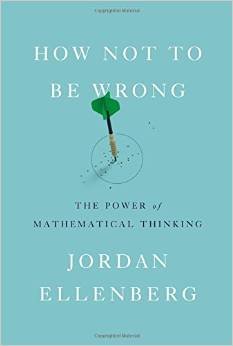
Jordan Ellenberg, How Not to Be Wrong, Post 3

Subtitled: The Power of Mathematical Thinking.

Third post (after this and then this) about this fascinating book, an examination of several basic principles (linearity, inference, expectation, regression, and existence) and how they apply to every-day, real world situations, situations that are often misunderstood by ordinary “common sense”. The author, a one-time child genius, is a professor of mathematics at the University of Wisconsin-Madison, and has written for Slate, Wired, and other publications, including an occasional column for Slate.

The third of five parts is about “Expectation”. He discusses how to calculate the ‘expected value’ of a single lottery ticket — which is not the same as the value you expect of any given ticket (which is 0). Should you play? Yes, when the jackpot is high enough that the expected value is higher than the cost of the ticket. Famous case of a Massachusetts game, WinFall, in which a bunch of MIT students figures out the odds, bought huge numbers of tickets when the odds favored it, and won. And kept winning — Massachusetts authorities didn’t care, as long as they were making money — until a newspaper uncovered the story, the state shut down that game.

(Ch12) If you never miss a plane, you’re spending too much time in airports. This balance of cost vs inconvenience applies to other areas of life, e.g. occasional reports of government waste, such as paying benefits to dead people. The cost of eliminating *all* waste outweighs the benefits of never making such mistakes. (That such incidents of government waste, no matter how rare, get media coverage, exaggerates the issue and hides the true cost/benefit analysis.)

Same logic applies to the famous “Pascal’s wager” about belief in god; the flaw in his argument is that he doesn’t consider other options, e.g. the existence of a god who damns Christians and favors others.

This discussion leads to the idea of ‘utils’, how to evaluate cost vs benefit in subjective ways, e.g. a thousand dollars is worth more to someone who has no money than to someone who already has a thousand dollars. Different people have different util curves; some people work only until they have enough money, then stop.

(Ch13) WinFall involved different strategies, which correspond to the idea of finite geometries, e.g. the Fano plane, which has just seven points and seven lines or curves, each with three points. And these correspond to winning strategies for choosing lottery numbers.

This carries over into the redundancy codes invented for transmitting signals to satellites, and analogous patterns in natural language, and the problem of packing spheres into the least possible volume.

Lotteries? Despite the odds, people play them anyway, because of some concept of ‘fun’ that is independent of those expected values. Just as people start businesses, despite the odds against.

Part IV is about “Regression”, (Ch14) beginning with a 1930s study about successful businesses that discovered that the most and least successful businesses didn’t stay that way; they ‘regressed to the mean’. This wasn’t a discovery about human nature; it was a discovery about statistics, and explains why second novels aren’t as good as first ones, and why football players perform worse in the second year after they are signed.

(Ch15) The idea of ‘scatter’ charts, their patterns, and early ideas of profiling criminals by compiling data about their head size, finger length, and so on — “bertillonage”, which eventually gave way to fingerprinting.

(Ch16) Correlation: you can find correlations between virtually any two variables. As everyone knows, that doesn’t imply causation.

Even in the 1950s, strong correlation was seen between smoking and lung cancer, but some analysts warned about drawing conclusions about causation. (Really. Maybe, e.g., having early stages of cancer, such as symptoms like a slight chronic inflammation, prompt a desire for the relief and comfort of smoking…)

Author makes a crucial point: It’s not always wrong to be wrong. The detections of correlations like that between smoking and lung cancer lead to public healthy policies that are sometimes mistaken, and have to be changed. But if you wait for absolute certainly before any such policy, you’ll never get anywhere, and people will die while you’re waiting for perfect evidence. “If you never give advice until you’re sure it’s right, you’re not giving enough advice.”

Part V is about “Existence”. These chapters address ideas that are relatively more familiar to me.

Ch17: “There Is No Such Thing as Public Opinion”. This addresses the paradoxes of opinion polls, how, depending on how questions are asked, contradictory results appear. E.g., Americans want a smaller government, but when asked which government programs they would cut, more people want to increase spending on programs than cut them (education, health, defense, etc.).

The central issue is that each voter’s stance is rational, but in aggregate, they’re nonsensical. (A prominent example: a binary poll about Obamacare shows that most are opposed; but a more nuanced poll shows that more approve or *want it expanded* than those who disapprove of it altogether.)

This leads to a discussion about voting methods — a topic I’m familiar with, given the science fiction community’s nerdish obsession with fairness in voting, in the elaborate ‘Australian ballot’ procedures applied to the Hugo Awards. (This idea has trickled down to some examples of ‘instant-runoff’ voting in some state elections.)

As has been revealed before, there is no voting system that cannot lead to counter-intuitive results. Example: a three-way presidential election; if most people prefer candidate A, or candidate B, yet most of them rate candidate C second, candidate C might well win. (There are examples.)

Ch18: “Out of Nothing I have Created a Strange New Universe”. The idea of what is *true* vs what is *right* via rules and procedures exists in many fields. The most fundamental is in math, the struggle for two thousand years to try to deduce Euclid’s fifth axiom (the one about parallel lines) from the first four. The breakthrough came in the 19th century, when several mathematicians realized that it could not—in fact, alternatives to Euclid’s fifth would be equally valid logically, and would describe different geometries! E.g., that of a sphere. This was an astonishing result; thus the chapter title’s quote.

This leads to a discussion about whether mathematical expressions *mean* or whether they should be *defined*. The parallel is in law, where issues are *defined* by the results of the voting process, never mind what voters might have meant. The famous example: the 2000 election, where Justice Scalia’s policy of deferring to the process reigned.

The problem with this is that such procedures never admit new evidence. [Not in this book, but recently in the news: cases where someone was convicted to Death Row, and despite DNA evidence of innocence, are left there, because after all the *procedures were followed*, and later evidence doesn’t matter.]

The champion of formalism in math was David Hilbert, who famously, in 1900, put forth a list of 23 great problems for math to solve. His intent was to build mathematics from the ground up, using precise formalism, and assuming that no contradictory results could emerge.

That assumption wasn’t true, as Kurt Gödel demonstrated in 1931 — his famous “incompleteness” theorem.

Conclusion: How to Be Right

Author discusses a summer job with a researcher who *wanted an answer*, never mind qualifications; quotes FDR and John Ashbery; and discusses reactions to Nate Silver, how people misunderstand his predictions of percent chance of voting results.

Conclusions? Avoid precision; it’s misleading. People are more tolerant of contradictions than computers are (citing Captain Kirk’s numerous defeats of computers through logical paradoxes). If you have an idea, try to prove your theorem by day, and disprove it by night. Apply that idea in all areas of life, and it will force you to confront the reasons why you believe what you believe.

What’s true is that the sensation of mathematical understanding – of suddenly knowing what’s going on, with total certainty, all the way to the bottom — is a special thing, attainable in few if any other places in life. You feel you’ve reached into the universe’s guts and put your hand on the wire. It’s hard to describe to people who haven’t experienced it.

…To do mathematics is to be, at once, touched by fire and bound by reason. This is no contradiction. Logic forms a narrow channel through which intuition flows with vastly augmented force.

Posted in Book Notes, Economics, Mathematics | Comments Off on Jordan Ellenberg, How Not to Be Wrong, Post 3

Link and Comments: Common Core

I don’t have a horse in this race, at least not yet, but I’m fascinated by how conservative resistance to the Common Core educational standards have swung 180 degrees since the Obama administration signed on to them. Common Core standards were originally put together by state governors, many of them Republican. But when Obama endorsed it, conservatives reflexively rejected it… because, well, anything Obama does must be evil. (Obama could discover the cure for cancer, and Republicans and conservatives would denounce it as a socialist scheme.)

I haven’t followed the Common Core standards closely, but the controversy over them reminds me of the New Math controversy in the ’60s and ’70s. I gather that the central issue is similar: an emphasis on understanding basic concepts, rather than rote procedures.

Here is an example: It’s Worth Taking a Full Minute to Learn How to Add 9 and 6: A Response to the “Common Core” Critics

His example: how do you add 99 + 47?

The smart people realize that 99 is 1 less than 100, and so add 100 to 47 minus 1, and get 146.

They don’t write down the numbers in columns, and ‘carry the 1’, and so on — the standard rote method for addition that is… traditional.

I gather that Common Core teaches such methods, that take a bit longer to learn at first, but that save much time in the long run. (Analogous to taking time to learn to type, rather than hunt-and-peck.) Yet, conservatives and right-wingers reject this reflexively. (See that post for links to examples.)

Posted in Culture, Mathematics | Comments Off on Link and Comments: Common Core