
- How the great books appeal both to literary standards and our lizard brains;
- With my speculations about the appeal of science fiction;
- July 4th. The Guardian on how the US is a global citizen gone rogue; how the stain on America is the narcissist Trump;
- Brief items about the MAGA indifference to Trump’s billions in personal gains, the jingoistic view that only the USA benefits from the greatness of Jesus; and Republican idiocy about wind and solar power.
What is the appeal of stories? Both in books and at the movies?

The Atlantic, Boris Kachka, today: The ‘Have It Both Ways’ Theory of Great Books, subtitled “Many literary classics have a way of appealing to our lizard brains while making us question why we’re so compelled by them.”
A standard answer goes to the roots of tribalism and the human understanding of cause and effect in the natural world. We tell stories to relate cause and effect, e.g. thunder is caused by the god Thor tossing lightning bolts. And we tell stories to valorize heroes and leaders who unite the tribe. Why the appeal of stories about danger and violence? As lessons about the risks of the world. Or as rehearsal to situations we might face. A kind of abstract, inverse, play. What about science fiction stories? But let’s not get ahead of ourselves. To the article:
This week in The Atlantic, Michael O’Donnell took aim at a film critic who is himself notorious for takedowns. Point by point, O’Donnell debunks the arguments in A Sudden Flicker of Light, David Thomson’s new book about how cinema has harmed society. O’Donnell dispenses quickly with Thomson’s idea that “movies are more prone to violence” than literature is: “If depictions of violence truly warp us, then we had better set aside not just gangster pictures but Homer, Shakespeare, Shelley, and Melville too,” he writes. But then he addresses the critic’s “most interesting point”: Movies “veer toward extremes, favoring crime and spectacle instead of stories about ‘the frequently amiable muddle.’”
I didn’t link the earlier item about David Thomson’s book because it’s specific about cinema.
O’Donnell questions this dichotomy between gangster fantasy and quiet realism—why should we be forced to choose between The Godfather and The Tree of Life? He likes each of these movies, as do I. But his invocation of classic literature made me think of another category of work entirely: memorable fiction that critiques and indulges the human hunger for lust, violence, and recklessness. Great books can have it both ways.
With examples. Well, OK, but what about movies (which perhaps are experienced more viscerally than books) that portray extreme violence? Or gore? We would be repulsed to see such in real life, but I’ve sat in audiences that are apparently unmoved by grotesqueness seen on the screen. Even attracted? It’s hard to know. Back to the article.
So much ink has been spilled in debating literary dichotomies: Should fiction provoke empathy, or just pleasure? Is literary fiction inherently better than genre work? Many enduring books, like many classic movies, explode these categories. And they ask important questions about why our lizard brains are so strongly drawn to the stories they are telling.
Oops, that’s the end! OK, no answers here; the piece is mostly a guide to earlier articles on this same general subject.
So let’s speculate a bit. I do think books and movies are a kind of vicarious life, in that we can vicariously experience events we hope never to be witness to, or be a part of, in real life. Sort of the way that sports is sublimated warfare. If playing or watching sports satisfies your adrenaline jollies, you’ll be less likely to engage in street violence. Perhaps. It’s probably not that simple.
What about science fiction? (Leaving fantasy and horror aside — completely different ideas would apply to them.) The appeal of science fiction, I think, is the realization among its readers that things exist outside the mundane world of human relationships, and human competition. Things that exist and can be understood. And yet — being able to understand such things brings a kind of power, and so in some sense it’s about human competition after all. It’s hard to escape basic human motivations. We like to think our appreciation of art, of beauty, of mathematical and scientific truth, is somehow higher than our base animal protocols. But it’s hard to say why — we are stuck inside ourselves, being humans, and we have no objective alternative or viewpoint.
Leave it there for now.
\\\
OK, tomorrow is July 4th, and it’s the 250th anniversary of the United States. Actually, since the signing of the Declaration of Independence; the first president, George Washington, didn’t take office until 1789. Whatever. Most people don’t care about the details.
It’s disheartening that this anniversary is being celebrated while the buffoon Donald Trump, who ruins everything, is in office. But let’s note a couple items.
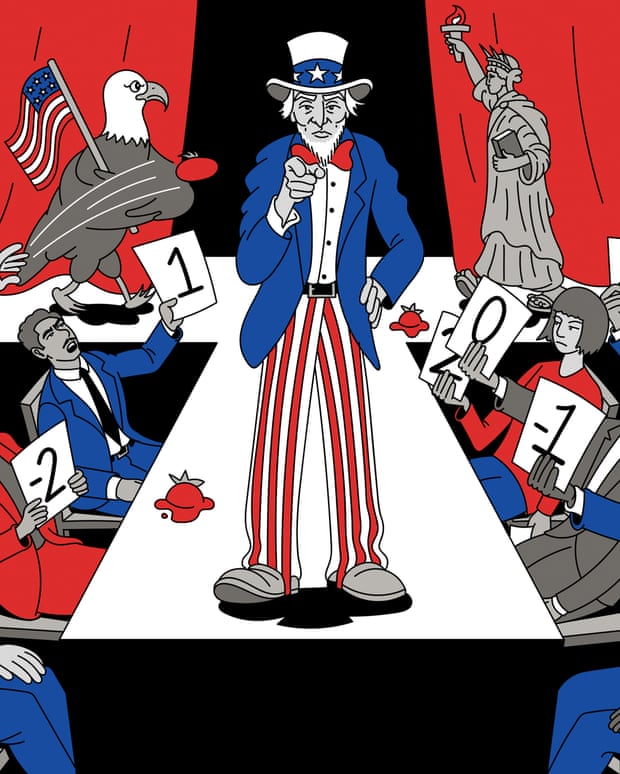
The Guardian, today: For allies and adversaries alike, America at 250 is a solid global citizen gone rogue
Subtitled: America has long stood for freedom and prosperity, but under Trump insults, threats and unpredictability have become the new norm. As the US marks its 250th anniversary, Guardian correspondents around the world report on how it is perceived elsewhere.
With short items about China, Mexico, Iran, Ukraine, Israel, Canada, France, Russia, the UK, Japan (“Not angry, just disappointed”), Cuba, India, Australia, and South Africa.
\
The stain on America’s standing on the world is the narcissist Trump. And those who support him. (It’s not only about those Americans, exactly; it’s also about how the American system of government, with its checks and balances, has failed to keep such a person out of office. The Founding Fathers set up a system they thought would work. But it’s never worked in all of human history. Tribal human nature will out.)

CNN, analysis by Zachary B. Wolf, today: Tricorn hats or Trump rally? Americans have July Fourth options
\\
More briefly:

- NY Times, yesterday: MAGA Base Stays Quiet After Trump Reports Billions in Personal Gains
- Subtitled: A new mandatory disclosure revealed that the president has earned $2.2 billion during the first year back in the White House.
- Does MAGA understand the idea of corruption? Either not, or they don’t care.
- Patronizingly.
- JMG, today: Perkins: The Foundation Of USA’s Greatness Is Jesus
- Nonsense. Jingoism. Billions of people in other countries around the world believe in Jesus. Why does he think only the USA is so blessed?
- I do think it’s significant that these people are all so dumb.
- JMG, today: Energy Sec: No More Subsidies For Wind And Solar: “Sun Doesn’t Always Shine, Wind Doesn’t Always Blow”
- And such short-term thinkers.