Tonight’s favorite song: John Grant, Where Dreams Go to Die

Wikipedia has this post about the album.

There’s a lyric here — “I know you know I know you know that I know that you know…” * — that illustrates the idea that human minds are able to speculate on what other minds are thinking, to three or four orders (though not children; it takes a while for children to develop this ‘theory of mind’). It reminds me of the Ted Talk we were listening to this morning as we drove to the trail head of today’s hike. It’s a fascinating talk about the subjunctive, a grammatical ‘mood’ that exists in English and not in some other languages, like Vietnamese, and therefore an example of how different languages really do allow, or inhibit, different kinds of thinking. (And the subjunctive is, perhaps, the philosophical essence of science fiction.)

*Reminds me a bit of that punctuation challenge, to make sense of “John, where Sarah had had had had had had had had had had had the teacher’s approval.” Insert the right punctuation marks, and it makes sense.

Posted in Music, Thinking | Comments Off on Tonight’s favorite song: John Grant, Where Dreams Go to Die

Goonan Quotes

Like the meaty interview with Joan Slonczewski a couple months ago, Locus Magazine’s May interview with Kathleen Ann Goonan, of which I posted excerpts this afternoon, has several passages of particular interest to my theme here.

About science fiction:

At Georgia Tech, the student’s minds are prepared for science fiction because it’s one of the top engineering schools in the world, so I also taught ‘The Short Story in Science Fiction’ during my first semester there. Since then, I’ve taught the SF Novel, and used Neuromancer, The Female Man, Dawn, Do Androids Dream of Electric Sheep, The Lathe of Heaven, The Diamond Age, and Zendegi. It was a wild ride, a lot of reading, and very intensive. The student’s enthusiasm regenerated my interest in science fiction – its history, its long-running conversation, its boldness in bringing important issues to life.

About brain/mind/consciousness:

For a long time we had no tools to study the brain, so consciousness was a subject for religion and philosophy. I minored in philosophy because I was so interested in not only the mind, but in what is going on around us – everything. I started from the ground up, I suppose, since gaining the tools to see what is very small or very distant is what moved humanity from religion and philosophy as explanations for phenomena to careful observation – science. Philosophy and religion, disciplines that examine questions like what is free will, what is life, what is really going on? They fascinate me. That is why my own interests turned from pre-science philosophy and religion to science.

What we think of as ‘reality’ is the brain putting together an idea of what’s happening around us, and we base our behavior on that interpretation. We live in a shared reality. That’s what the title, This Shared Dream, means to me. What we think of as the familial past is actually a lot of different people’s versions of the past. Every child in a family has a different idea family history, depending on their birth order, because their very presence changes family dynamics. That’s another thing I wanted to explore, because it echoes the concept that consciousness has much to do with how we perceive time.

This resonates as I think back on my own personal history and how different that history must have been for my siblings.

One more, which I didn’t include in the post:

I am always struck by the idea people have that consciousness is just in the brain. They think, ‘Oh, we’ll freeze the brain and live forever.’ That’s a mostly discarded idea now, although Henry Markram, head of the European Blue Brain Project, wants to slice the brain really thin, including his own brain when he dies, with the idea that all the information of memory and consciousness will be there. But consciousness involves your entire body, and time. A lot of what happens in the body simply isn’t known by the conscious mind. These processes are totally mysterious, and we don’t even realize they’re happening. It’s counter-intuitive, but it’s true: we are not just our conscious state of mind. We are not only our brain. We are our whole bodies, our entire hormonal system. Everything is all one system. The history of humanity in religion and philosophy is about how the soul will survive: the idea that there is something in us that is not physical. But I don’t think that’s true. There’s not anything that isn’t physical, including consciousness. If you are going to preserve yourself, what self do you want to be, really? What a nightmare that could be. In 2005 I was totally depressed – what if that’s the age at which you’re preserved, by chance? Or, ‘I will be in a perfect digital world and everything will be fabulous.’ It’s a bit like the questions that might plague one about the possibilities of heaven.

Posted in Quote at Length, Science, science fiction | Comments Off on Goonan Quotes

Another Revised Ten Commandments

I’ve been collecting these. This is is from Facebook today.

https://www.facebook.com/photo.php?fbid=10152110608613553&set=a.32904403552.30927.597123552&type=1

Posted in Religion, Ten Commandments | Comments Off on Another Revised Ten Commandments

Amateur Astronomy and Cultural Mythology

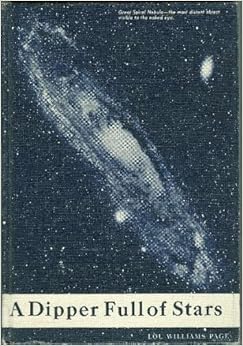
Since my post the other day about the my trigger to amateur astronomy in my youth, a grade-school textbook called A Dipper Full of Stars, I picked up the copy of that book I bought for a few dollars over the internet a few years ago and skimmed through it more than I had recently. It’s basically a guide to constellations, starting with the Big Dipper; from there, the North Star, then other constellations in the area; then other bright stars, like the three in the Summer Triangle, and their constellations, and so on and so on around the sky. With interludes about the planets, the ecliptic, why there are seasons, and so on. A good basic introduction to the fundamentals of what might be called spatial geography – how our planet is situated in space and how to understand what you see in the sky every night.

What struck me this time were the descriptions of various cultural myths that were applied to the various constellations, or groups of stars other than the constellations our culture currently recognizes. What various Indian tribes said about the stars we call the Big Dipper, what each star represents, what Alcor means in its attendance to Mizar, for example.

Cosmos is doing the same thing, to great effect, notably in this past week’s episode, which described various cultures’ myths about the Pleiades star cluster. And Richard Dawkins’ book The Magic of Reality did this quite well, in a book not just about the heavens and cosmos, but about all sorts of basic questions about reality – what are things made of? What is a rainbow? Who was the first person? Each chapter begins with a variety of ancient myths that attempted to answer such questions, and Dawkins mixes, without any particular emphasis, the myths that survive to our day with all the ones that have been discarded. For example, in the chapter about “Who was the first person?”, he points out that all peoples of the world have origin myths, and then goes on to describe one from the Tasmanian aborigines (a tale involving two rival gods, an absence of knees in the first created humans, and kangaroos); then a similar myth from a neighboring tribe (to suggest how tellings of such stories drift); then a tale from Hebrew tribes, about their single god, about Adam and Eve and the snake, and the resultant concept of ‘original sin’, a story “still taken seriously by many people”; and then a description of the Norse myth involving Odin and two tree trunks who were turned into the first man and woman. (The balance of the chapter is about the scientific answer to the question, which is of course that there was no *single* first person, because humans evolved from earlier species, and there’s never a single clear division between one species and another, and so on.)

What strikes me now about astronomy, at least in its amateur form, and as distinguished from most other branches of science I would think, is that it is imbued and colored by these ancient descriptive myths. (As well as reflecting the history of science in various cultures – at some point any astronomy enthusiast picks up the fact that most of our common star names have Arabic meanings, because during Europe’s Dark Ages (when Christianity ruled and there was no such thing as scientific investigation), it was the Arabs who preserved what astronomical knowledge survived from the Greeks and Romans, later to be passed back to reformed European cultures.)

It doesn’t take much extrapolation to suspect that the myths of one’s own culture are as fragile and ultimately evanescent as all those earlier ones.

P.S. As of this post I will turn on comments, just to see what happens. My experience with the various WordPress blogs that comprise the Locus Online site is that auto-generated spam outnumbers legitimate comments by 100 to 1, and it takes time for me to examine all the comment email to be sure what is spam and to find the very few legitimate comments. We’ll see about this blog.

Posted in Astronomy, Culture, Personal history, Science | Comments Off on Amateur Astronomy and Cultural Mythology

Cosmos and My Amateur Astronomy

I liked last Sunday’s episode of Cosmos for a couple reasons. The second reason is what the bulk of the show explored: the process of scientific data collection and analysis, the way simple classification can give way to insight about the reality of what the categories mean – in this case, how stellar spectra reveal both the temperatures of stars and also their chemical composition (or at least of their atmospheres), a crucial link in what has become a very long sequence of chains of evidence about the distance of the stars, their age, and the size of the entire universe. (As well as, of course, the often unsung role women have played in the history of science, a theme examined in Adam Lee’s review of this episode.)

But the first reason was the opening of the episode, about how all human societies invoke pattern recognition to see shapes in the stars (i.e. constellations), which reminded me of my own earliest interest in astronomy. In fact, when I think back on my life and try to identify the key events that led to my interest in science, and in science fiction, I can think of two key events, one for each (and I’m not sure which came first). The science trigger was this: in my sixth grade classroom, at Vanalden Avenue Elementary School in Reseda CA (a typical LA suburban school consisting mostly of bungalows), there was a cabinet beneath a coat closet that contained a row or 20 or 30 copies of a book called A Dipper Full of Stars, a very basic astronomy book. The multiple copies suggested they had been used as a class textbook, though it wasn’t used so during my 6th grade session. But I was curious and asked to borrow one copy and took it home and read it, and it was my first introduction to the sky, the constellations, the planets, and the vastness of the universe (it was up-to-date enough, in that era, to realize that the Andromeda ‘nebula’ was in fact a separate galaxy from our own Milky Way).

(I’ll save the science fiction trigger for another post.)

That led to The Sky Observer’s Guide, a little ‘Golden Guide’ book I must have bought through the school’s book ordering program, and my request as a birthday present for a basic telescope, which was granted. (A 3 1/2 inch refractor, if I recall correctly.) I remember setting it up in the driveway of our house in Reseda, pointing it up toward the sky, and being shocked by the apparent sizes of the stars, before I realized how to adjust the focus knob.

I think the most basic fact that one learns as an amateur astronomer is that the apparent brightness of anything you point your telescope at is no indication of its actual brightness or size; apparent brightness is a combination of actual brightness and *distance*. The planets are bright because they are near. Some stars are bright because they are relatively close (like Sirius). Others (like Deneb) are about as bright as closer stars because, even though they are very far away, they are really really bright. (How do we know they are very far away? A chain of evidence beginning with parallax.)

The Cosmos episode illustrated this nicely – showing how the stars in the sky are moving, how the constellations will change over millennia, how the stars of the Pleiades will drift through the galaxy over time.

Posted in Astronomy, Personal history, Space | Comments Off on Cosmos and My Amateur Astronomy

The Range of Human Perception

Alternet, Chris Mooney: Why Right-Wingers Think the Way They Do: The Fascinating Psychological Origins of Political Ideology

These experiments suggest that conservatives actually do live in a world that is more scary and threatening, at least as they perceive it. Trying to argue them out of it is pointless and naive. It’s like trying to argue them out of their skin.

Chris Mooney has written on this theme before – he wrote a whole book called The Republican Brain: The Science of Why They Deny Science- and Reality.

My fascination with his research is not to pester the partisan divide in American politics, but to wonder about the broader implications of how different people perceive the world. The liberal/conservative spectrum is surely a simplistic take on the vast variation among human perception. Is one extreme more ‘right’ or ‘accurate’ than the other? How could one tell? [Science, perhaps?] Or are they just different, selective ways of perceiving the world — each perspective revealing only a part of a greater whole? (Like a Venn diagram of two overlapping circles amidst a much larger set of potential perceptions.)

How could the greater whole ever be perceived? And what about all the parts that lie outside the overlapping but necessarily narrow ranges of this spectrum of human perception?

The issue is analogous to a Facebook graphic I saw today… which, of course, I can’t find now, because Fb changes its selection of posts to display every time you log in (or perhaps I just have too many ‘friends’)… but it was about how humans see only a small fraction of the spectrum, only a small fraction of the audio range, and so on. The point being, there is a larger reality than that with which human perception is compatible. (See Cosmos for examples.)

Ah, here it is: Before you judge other or claim any absolute truth…

Posted in Cosmology, Culture, Psychology, Science | Comments Off on The Range of Human Perception

American Christianity and Conservatism

Andrew Sullivan strikes at Sarah Palin’s glib, despicable remark that “Waterboarding is how we baptize terrorists” — to which her audience cheered — with this post:

Sarah Palin: Anti-Christian

It reveals that vast swathes of American Christianity are objectively anti-Christian, even pagan, in their support for this barbarism. … In the best recent polling on the question, 62 percent of white evangelical “Christians” back torture as often or sometimes justified, with only 16 percent holding the orthodox position that it is never justified. Now compare those numbers with Americans who are unaffiliated with any religion: the number in that demographic is 40 percent in favor in some or many cases, and 26 percent against it in all circumstances. Is this a function of wayward and uncommitted Christians? Nope. Support for torture is highest among those who attend church at least weekly and lowest for those who rarely or never go to church. In America, torture is a Christian value. And some people wonder why I prefer to term “Christianist” to describe these people.

It seems to me, moreover, that torture is a far graver evil, even for orthodox theologians, than non-procreative or non-marital sex. And yet today’s Christianists are obsessed about the latter and not just indifferent to the former, but actually in favor of it. It’s this twisted set of priorities, this exquisitely misplaced set of fears, and this utter ignorance of even basic Christian teaching that reveals all that’s so terribly wrong with American Christianity. It has become its own nemesis.

***

Second, Paul Krugman’s take on why conservatives (some of whom call themselves ‘patriots’) are rallying behind racist lawbreaker Cliven Bundy.

Paul Krugman: High Plains Moochers
Salon: Paul Krugman: Cliven Bundy is proof conservatives are dumber than ever

From the latter:

But that day, Krugman says, is over: “[T]oday’s conservative leaders were raised on Ayn Rand’s novels and Ronald Reagan’s speeches … They insist that the rights of private property are absolute, and that government is always the problem, never the solution.”

The trouble is that such beliefs are fundamentally indefensible in the modern world, which is rife with what economists call externalities — costs that private actions impose on others, but which people have no financial incentive to avoid. You might want, for example, to declare that what a farmer does on his own land is entirely his own business; but what if he uses pesticides that contaminate the water supply, or antibiotics that speed the evolution of drug-resistant microbes? You might want to declare that government intervention never helps; but who else can deal with such problems?

Well, one answer is denial — insistence that such problems aren’t real, that they’re invented by elitists who want to take away our freedom. And along with this anti-intellectualism goes a general dumbing-down, an exaltation of supposedly ordinary folks who don’t hold with this kind of stuff. Think of it as the right’s duck-dynastic moment.

Coincidentally, blogger Adam Lee read Ayn Rand’s Atlas Shrugged (a book I’ve never attempted to read) and wrote an article called 10 Things I Learned About the World from Ayn Rand’s Insane “Atlas Shrugged’. The 10 things:

1. All evil people are unattractive; all good and trustworthy people are handsome.
2. The mark of a great businessman is that he sneers at the idea of public safety.
3. Bad guys get their way through democracy; good guys get their way through violence.
4. The government has never invented anything or done any good for anyone.
5. Violent jealousy and degradation are signs of true love.
6. All natural resources are limitless.
7. Pollution and advertisements are beautiful; pristine wilderness is ugly and useless.
8. Crime doesn’t exist, even in areas of extreme poverty.
9. The only thing that matters in life is how good you are at making money.
10. Smoking is good for you.

Posted in Culture, Religion | Comments Off on American Christianity and Conservatism

Dignity of our Lives: “I burst into tears”

There was so much coverage of the right-wing outrage and vitriol over passing depictions of gay families in a couple TV commercials earlier this year, from Coke and then Nabisco, which I saw reported on some of the news sites I follow, that it was very refreshing today to see this post by a gay father about what seeing these commercials meant to him.

Rob Watson: A Gay Dad Confesses: Nabisco and Coke Made Me Realize the Dignity LGBT Families Have Been Missing

Recently, Nabisco stepped into a similar limelight with its commercial “Honey Maid: This is Wholesome”. The thirty second spot shows a baby, in the arms of a man. Another man comes and kisses the baby on the head.

This time, I did not miss the subtlety. The minute I saw that simple scene, I burst into tears. That was me. That was my family. While the Coke commercial may have made history for the Superbowl, Nabisco made history for me. It was at that moment that I realized I had never, ever recognized my real life in a commercial before.

I now understood what LGBT families had been missing in the landscape of America — we have been missing from the branding of the national consciousness. Naturally, there have been those who rudely trashed the Nabisco ad as they had done to the Coke ad before it. They did not get to me though or the euphoria of having a wisp of a thread in the public awareness known as the “TV commercial”.

They did not get to me because I see more clearly now what it is they want to take from us. The protest remarks are from ones who decry “normalizing” LGBT relationships and families. They do not want us to have dignity. They want our dignity, even if it is the simple dignity in being depicted in a commercial to hawk cookies. Or soft drinks. Even that is too much for them.

Posted in Culture, The Gays | Comments Off on Dignity of our Lives: “I burst into tears”

Cosmos So Far

I should update my thoughts about the new version of the TV series Cosmos, since earlier I posted a mild critique about it needing to explain the background of scientific discovery – presenting not just the grandiose conclusions humanity has reached about the size and age of the universe, but the reasoning that went into these conclusions.

After seven weeks, on this count, I think the show is doing just fine. This past week’s episode, “The Clean Room”, was especially good, focusing as it did on a single scientist, Clair Patterson, and his decades-long quest to apply observations about radioactive decay to ancient samples of actual rocks, including meteorite fragments, his inconsistent results and therefore quest to remove sources of contamination, and his arrival at a conclusion about the age of the Earth. It was the first of many chains of evidence that support our understanding of the age of the Earth, and the universe.

At the same time, the episode ties this discovery to political pushback. The idea that lead was contaminating the environment was resisted by the petroleum industry (of course! It threatened their profits!), with their own hired ‘scientists’ to dispute any such accusations. It’s a pattern that’s been repeated again and again, by the tobacco industry, and lately by corporations who in their own interest need to dispute climate change science. (The lesson is, as in so many other issues, especially political: follow the money.)

Ironically, the pushback against this episode by creationists, who can’t believe the Earth is any older than some 6000 years because Bible, is that the fact that scientists hired to defend corporate interests disagree with non-affiliated scientists somehow proves that science is inherently unreliable, and therefore you can’t trust anything scientists conclude about anything.

(See this Alternet article:

Each week’s episode drives creationists like Ken Ham and his band of pseudoscientific faith-heads to the brink of insanity. They rush every week to find what things they can find to dispute in each episode. They never actually offer up their own evidence to the contrary, but instead simply attack Tyson for not using the Bible as the source of all science.

)

Sigh.

I also give credit to Cosmos — perhaps not to deGrasse Tyson himself, but to the scriptwriters, led by Carl Sagan’s widow Ann Druyan, though I have no idea to what extent they collaborated – to confronting the myths of creationism and science-denial, almost in every episode. In this one, dismissing the Bible’s many “begats” as an early guess but ultimately a discredited method of determining the Earth’s age. Naturally, these episodes drive the creationists crazy.

Here is a link to a a review of episode 7 by a better writer than me, Adam Lee.

If I still have a slight reservation about this new Cosmos series, it is that while each individual episode is very interesting, I don’t see a progression, in the way I thought I remembered the original series had – though I haven’t rewatched that show, or more than glanced at Sagan’s book, in 30 years.

Posted in Cosmology, Culture, Evolution, Philosophy, Physics | Comments Off on Cosmos So Far

Today’s Classic Song – Mercy Street

A soul with no leaks at the seams.

It’s about the poet Anne Sexton.

Wait for the last lines:

Anne, with her father is out in the boat
Riding the water
Riding the waves on the sea

Posted in Uncategorized | Comments Off on Today’s Classic Song – Mercy Street