
Links and Comments: Memory is Fallible; Fundamentalists Are Alike All Over

A couple informed articles appeared today about the Brian Williams kerfuffle, how the NBC News anchor was discovered to have inflated his account, increasingly over the years, of being on a helicopter in the Iraq War in 2003, and speculation about whether he was deliberately lying to aggrandize himself, or whether he ‘conflated’ his own memories with accounts by others. Most people aren’t giving him the benefit of the doubt.

I’m inclined to give him the benefit of the doubt, because of the many accounts I’ve read over the years of the fallibility of memory. Memory is not a videotape that gets recorded and then played back without error; our memories tend instead to be memories of memories of memories, stories we tell ourselves (and others), with each repetition becoming slightly less accurate, like a game of telephone (or Chinese whispers, a term for the game I’ve never seen until just Google now), and modified according to subconscious psychological motivations.

[That I’d give him the benefit of the doubt doesn’t necessarily excuse him; in his line of work, the tendency for such memory conflation should be guarded against to the extreme.]

Here’s a good article on Slate, How Not to Be the Next Brian Williams: Ten ways to avoid false memories, by Christopher Chabris and Daniel Simons, authors of The Invisible Gorilla: How Our Intuitions Deceive Us (which famously concerns an experiment about students told to watch a video of a basketball game, focusing on the players, and did so without noticing that a man in a gorilla suit walked through the frame).

Common sense tells us that memory shouldn’t break down to this extent—especially when we recall significant events in our lives. That belief makes us assume the worst of those who misremember. Yet a full century of scientific research tells us that these intuitive, common-sense beliefs about how memory works are often wrong.

The article touches on many of the conclusions of psychological experiments that reveal the fallibility of memory. Some of this has filtered down to popular culture, such as the increasing skepticism about eye-witness testimony (validated by the DNA tests that show many people convicted via such testimony turn out to be innocent after all). The article then, usefully, lists ten tips for “minimizing the chances that false recollections will put you at odds with your audience, your bosses, or the truth.”

Great article; it appeals to my provisional conclusion that common-sense, ‘obvious’ truths are likely false (or true only within a narrow frame of experience), and the reality of existence is not easily perceived, given that it’s filtered through our subjective biases.

The other piece today on this subject is New York Times Tuesday Science Section: Was Brian Williams a Victim of False Memory?. (Curiously the print article is titled “False Memory vs. Bald Faced Lie”)

Memories don’t live as single, complete events in one spot in the brain. Instead they exist as fragments of information, stored in different parts of our mind. Over time, as the memories are retrieved, or we see news footage about the event or have conversations with others, the story can change as the mind recombines these bits of information and mistakenly stores them as memories. This process essentially creates a new version of the event that, to the storyteller, feels like the truth.

Obama gave a speech about religion the other day, and touching on recent violent events associated with Islam, matter of factly pointed out the history of violence associated with Christianity throughout its history. And freaked out the right wing.

William Saletan in Slate: For Christ’s Sake: Some Republicans would rather defend Christianity from all criticism than stand clearly against religious violence.

The subtitle on the homepage: “When conservative defend Christianity at all costs, they’re thinking the way Islamic fundamentalists do.”

Several past and current Republican presidential candidates—Rick Santorum, Rudy Giuliani, Mike Huckabee, Bobby Jindal, Jim Gilmore—have attacked the speech. So have dozens of conservative commentators. They reject the suggestion that Christianity has anything to apologize for. Many go further. They claim that Islam sanctions violence, that Islam is our enemy, or that Christianity is the only true faith. In issuing these declarations, Obama’s critics validate the propaganda of ISIS and al-Qaida. They’re not just pandering to the Christian right. They’re aiding the Islamic right.

Because, the apologetics claim, the Crusades were justified; the Inquisition wasn’t that bad, and so on; anyway, Christianity is the only true faith, they say, without any shred of irony or self-awareness, or humility, even as they condemn the Islamic extremists who think exactly the same about their religion.

The theme is analogous to American exceptionalism and jingoistic patriotism: my side can never be wrong because, well, it’s my side. These are all ideas that appeal to a similar mindset.

Saletan:

In this respect, the debate within Christianity mirrors the debate within Islam. On one side are Bush, Obama, and the millions of Christians and Muslims who reject religious conflict. On the other side are Santorum, Giuliani, Fox News, ISIS, and al-Qaida.

When you start to think that you know God’s mind, that he speaks only to you, that you alone are in possession of the truth, that’s when you become dangerous. And being a Christian won’t save you.

Posted in Psychology, Religion | Comments Off on Links and Comments: Memory is Fallible; Fundamentalists Are Alike All Over

Links and Comments: Audiences Cheering and Egging Them On; Christian persecution and criminalization; Why people doubt science

It’s been widely observed that the Internet has allowed like-minded people of all stripes to find each other, create online communities, and reinforce each others opinions and prejudices, in increasingly specific bubbles of interests and ideologies. But the visibility of the internet makes these communities visible to outsiders. Thus the new visibility, to me in the past couple years, of right-wing, fundamentalist ideologues preaching to their followers about the evils of gays and their [our] complicity in the downfall of western civilization. Who knew?

I admit I don’t look at such sites directly — I see selected excerpts from them on edited sites like Right Wing Watch, which I find gruesomely fascinating for endlessly exposing the vitriol of conservative/reactionary/fundamentalist pundits and politicians who are forever (among other topics) demonizing gay people, blaming them for every possible circumstance they disapprove of, and predicting their complicity in the very end of western civilization, if not the world. (Virtually every post could be countered with my Jack Smith Rule. They predict evil consequences; the rule says, no this will not happen.)

In contrast — it’s nice to see some of these folks called out in a much more general venue, as columnist Frank Bruni did in last Sunday’s New York Times, Do Gays Unsettle You? Same-Sex Marriage, Republican Scorn and Unfinished Work. He addresses the progress of marriage equality in contrast to continued Republican animus. (Of course I realize that all the followers of those right wing sites are not likely to be reading the New York Times. Still.)

Bruni:

And a politician who says awful, hateful things about gays and lesbians can still find a warm enough reception and plenty of traction in one of our two major political parties. The Republican winner of the Iowa caucuses in 2012, Rick Santorum, has said that the marriage of two men or two women is no more like the marriage of a man and a woman than a tree is like a car or a cup of tea is like a basketball. He has also lumped homosexuality together with incest.

So has Mike Huckabee, the winner of the Iowa caucuses in 2008. Both are poised to run for the presidency again, in a field potentially including Ben Carson, who has mentioned homosexuality and bestiality in the same breath, and Ted Cruz, who urges ardent prayer against what he considers the society-threatening outrage of two men or two women tying the knot.

I don’t expect any of them to win the nomination, partly because their particular, pronounced degree of closed-mindedness won’t wash with the number of Americans whose favor they need. Hurray for that.

But I expect that on their way to defeat they’ll turn us gays into punch lines and punching bags. I expect that I’ll hear and watch large audiences cheer and egg them on. It’s a sickening spectacle, if you pay it any heed.

Related: here’s Mike Huckabee, explaining why My Point In Running For President Is To Fight Secular Atheism.

Christian feel themselves so persecuted, even though they remain the largest religious affiliation in the US.

Has anyone ever announced an intention to run for office in order to “to fight Christian privilege”?? No, of course not.

Meanwhile, Right Wing Watch has a related item from a couple days ago about an upcoming anti-gay documentary produced by activist Janet Porter called… “Light Win: How To Overcome The Criminalization Of Christianity”. Increasingly the idea that everyone is equal before the law means that religion, or at least Christianity, will be criminalized, to these people.

Which people? Participants in the documentary include Rand Paul, Mike Huckabee, David Barton, Phyllis Schalfly, Scott Lively, Louie Gohmert, and others. The usual suspects. I’m surprised Rick Santorum isn’t among them.

On a not unrelated note, a trenchant essay in Salon yesterday by Jeffrey Tayler, a contributing editor to The Atlantic, called It’s time to fight religion: Toxic drivel, useful media idiots, and the real story about faith and violence.

It takes to task the numerous religious apologists who excuse religion as a source of violence, no matter how explicitly terrorists like the Charlie Hebdo attackers announce their motivations. Tayler cites specific examples (of apologists, like Reza Aslan), and then generalizes about how society still defers to religious leaders…

We are accustomed to reflexively deferring to “men of the cloth,” be they rabbis and priests or pastors and imams. In this we err, and err gravely. Those whose profession it is to spread misogynistic morals, debilitating sexual guilt, a hocus-pocus cosmogony, and tales of an enticing afterlife for which far too many are willing to die or kill, deserve the exact same “respect” we accord to shamans and sorcerers, alchemists and quacksalvers. Out of misguided notions of “tolerance,” we avert our critical gaze from the blatant absurdities — parting seas, spontaneously igniting shrubbery, foodstuffs raining from the sky, virgin parturitions, garrulous slithering reptiles, airborne ungulates — proliferating throughout their “holy books.” We suffer, in the age of space travel, quantum theory and DNA decoding, the ridiculous superstitious notion of “holy books.” And we countenance the nonsense term “Islamophobia,” banishing those who forthrightly voice their disagreements with the seventh-century faith to the land of bigots and racists; indeed, the portmanteau vogue word’s second component connotes something just short of mental illness.

Then there is SFGate blogger Mark Morford, whose take on E.O. Wilson’s recent interview in New Scientist (and his book The Meaning of Human Existence, which I blogged about), is appropriate to this theme. Morford:

It’s no secret that nearly all religions of the world were designed to, if not completely deny, certainly belittle ideas of conscious, sustainable growth and scientific understanding in favor of blindly believing we are the “chosen ones,” that we have a special, divine allowance to breed at will and abuse the planet as we please. Pestilence? Shortages? Overpopulation? 1,000 times the natural extinction rate? Climate change? “Don’t worry,” power-hungry religious leaders say, “there’s a ‘master plan’ somewhere. Surely ‘God has a reason’ to which puny, flawed humans cannot possibly be privy.” Right.

Religion as the abjuration of responsibility to one’s descendents, and environment.

On a broader topic, Joel Achenbach at National Geographic asks Why Do Many Reasonable People Doubt Science?.

Topics include ‘naive’ beliefs, those notions that are common-sensical and intuitive but wrong — and which take some intellectual effort (via math, or science) to correct. Our tendency to see patterns where there are none. Our vulnerability to confirmation bias and herd thinking. Why journalism, and story-telling, misleads about the process of science —

The news media give abundant attention to such mavericks, naysayers, professional controversialists, and table thumpers. The media would also have you believe that science is full of shocking discoveries made by lone geniuses. Not so. The (boring) truth is that it usually advances incrementally, through the steady accretion of data and insights gathered by many people over many years. So it has been with the consensus on climate change. That’s not about to go poof with the next thermometer reading.

And

Science appeals to our rational brain, but our beliefs are motivated largely by emotion, and the biggest motivation is remaining tight with our peers. “We’re all in high school. We’ve never left high school,” says Marcia McNutt. “People still have a need to fit in, and that need to fit in is so strong that local values and local opinions are always trumping science. And they will continue to trump science, especially when there is no clear downside to ignoring science.”

And the way the Internet proliferates all ideas, whether justified or crazy — bringing us back to the opening of this post.

The scientific method doesn’t come naturally — but if you think about it, neither does democracy. For most of human history neither existed. We went around killing each other to get on a throne, praying to a rain god, and for better and much worse, doing things pretty much as our ancestors did.

Now we have incredibly rapid change, and it’s scary sometimes.

Posted in Atheism, Culture, Religion, The Gays | Comments Off on Links and Comments: Audiences Cheering and Egging Them On; Christian persecution and criminalization; Why people doubt science

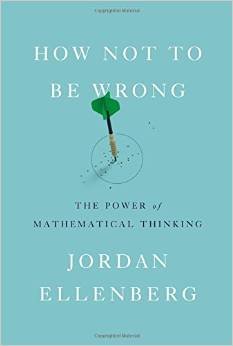
Jordan Ellenberg, How Not to Be Wrong

Subtitled: The Power of Mathematical Thinking.

This is the first of what may turn out to be several posts about this book, an examination of several basic principles (linearity, inference, expectation, regression, and existence) and how they apply to every-day, real world situations, situations that are often misunderstood by ordinary “common sense”. The author, a one-time child genius, is a professor of mathematics at the University of Wisconsin-Madison, and has written for Slate, Wired, and other publications, including an occasional column for Slate.

The book is breezily written, with only rare equations, though with occasional very detailed examples described in words. Also, it’s over 400 pages long, which is why I’m not waiting to compile all my notes on it in a single post. (I’m just over half-way through.)

The introduction addresses the common question from math students: when will I ever use this? Ellenberg’s answer is that math is about understanding how to reason; “Math is a science of not being wrong about things, its techniques and habits hammered out by centuries of hard work and argument.”

He gives an historical example, about an engineer thinking about where to apply extra armor on World War II fighter planes, from examining bullet patterns on returning planes. Extra armor where there are the most bullet holes? No, that’s the obvious answer, and it’s wrong, because they weren’t seeing the planes that didn’t return….

“Mathematics is the extension of common sense by other means.” It may be obvious to most people that a + b = b + a, but math extends such principles to more complex conclusions that are not obvious at all.

Author advises that the book covers ideas that are profound (not shallow) and simple (not complicated); one quadrant of ideas out of the four.

Part I is about Linearity, the idea that trends change along straight lines.

His first example is political and economic. The libertarian Cato Institute wondered at one point why Obama wanted to make America *more* like Sweden, when Sweden itself was pulling back on its benefits and taxes, i.e. becoming *less* like Sweden. The implicit relationship is a linear one, a graph with prosperity and Swedishness as the axes, and the extremes labeled sardonically by the author as “Libertopia” and the “Black Pit of Socialism.”

Ellenberg’s point is that this linear relationship is overly simplistic; the actual relationship might well be more like the infamous Laffer curve, in which the relationship is an arc, with an optimum balance between taxes and government revenue somewhere in the middle, with (for example) the US to one side of the peak, Sweden to the other, both moving in opposite directions to find that optimal balance.

(This reminds me inevitably of the perpetually simplistic policy of the Republicans, and libertarians: there is no economic state, good or bad, for which the solution is not “cut taxes”! If the economy is doing well, then people need to get back more of their money (this was Bush 2’s justification, after the prosperity of the Clinton years); if it’s doing badly, then stimulate it by cutting taxes (Reagan’s ‘trickle-down’ economy, long-since discredited). This policy always benefits the wealthy corporations who support Republicans; coincidence?. And there’s never, ever, any discussion of circumstances in which taxes might need to be *raised*. Because everyone hates taxes, right? End of story. [Still, reality strikes back: cf. currently the economies of Kansas, and Louisiana; contrast California.])

Ellenberg acknowledges that the Laffer curve is still controversial, and suggests that the ‘real’ curve might not be so simple. But his point is that to assume a *linear* relationship here is almost certainly false.

The next chapter explores how, at small enough scales, all curves *are* straight lines; thus calculus. And discusses the paradoxes and dangers of infinities; Zeno’s paradox; what the infinite series 1+1-1+1-1+1-1… means. His answer: playing with such series don’t make sense in ordinary arithmetic terms; you need to *assign* values for such series, in order to avoid contradictions. (That series means 1/2. And 0.999999…. = 1.)

Next chapter: avoiding simplistic trend extrapolations that lead to implausible conclusions, e.g. “by 2048 all Americans will be obese”. Or calculating the relationship between college cost and SAT scores. But you can’t do that, these things are probably not linear.

Fourth chapter in this section: “How Much Is That in Dead Americans?” More implausible conclusions by extrapolating (linear) proportions, e.g. saying 1400 Palestinian deaths is the equivalent of 300,000 American deaths (based on total population of both groups). You can realize this thinking is flawed by extending the proportion to ridiculous extremes – e.g. if one of two people is beat up, is it useful to compare that to half of the entire population being beat up? Well, no.

Better to study rates. But they have perils too. Interesting example of study that calcuated rates of deaths by brain cancer, which reveals that small, relatively less populated states lie at *both* ends of the range. Why? Because random variation has a greater effect in small groups than in larger ones; keep expanding the population, and random fluctuations cancel each other out. The so-called “law of large numbers”. Similarly, the best basketball scorers tend to be those who played very little, and happened to have gotten lucky. Another example: performance of individual schools; bigger schools lie in the middle of the range. Actual distribution is the ‘normal curve’, shaped like a gendarme’s hat.

(This reflects one of my own heuristics about any kind of prediction or trend: imagine the trend take to the extreme, and see if it still makes sense.)

Fifth chapter in this section: “More Pie than Plate”. The dangers of proportions, when trends can be either positive or negative. Example of Scott Walker of Wisconsin claiming his state had provided 50% (!) of the job growth in one period across the entire nation. No — because the national job growth was a mix of gains and losses from all the states.

Another: a Romney campaign claim that under Obama, 92% of job losses were suffered by women. No; they were comparing numbers that were composites of many gains and losses…

End of Part I, of V. (That the examples of bad math so far come from conservative/libertarian groups I will let speak for themselves. Surely liberals and progressives aren’t blameless, and I will note any of those in future posts about this book.)

Posted in Book Notes, Culture, Economics, Mathematics, Thinking | Comments Off on Jordan Ellenberg, How Not to Be Wrong

Links and Comments: The Size of the Universe; The Size of the Planets

» NPR’s blog Cosmos & Culture: Lessons From The Beginning Of Time.

One report, among many in the past few days, that the apparent detection of ‘gravitational waves’ from the Big Bang, a year ago, was a false alarm: the evidence is explained via mundane intergalactic dust.

That’s fine; this is how science examines and corrects itself. This post is nice in summarizing the many things that *have* been firmly established about the size and age of the universe.

We should take note of what we do know about the early universe, which is nothing short of spectacular. We know that the universe is about 13.8 billion years old (a number that, updated from 13.7, has given us pause about the name of this very blog). We know its composition, or at least the relative contribution of the ingredients — if not the ingredients themselves (dark matter and dark energy remain a mystery). We have a firm grasp of the cosmic history from 400,000 years after the Big Bang to now — and we can even push it earlier, to a minute or so after the event, when the first atomic nuclei were synthesized. We also understand how galaxies form and how they are distributed across space, even if we still don’t know where the seeds that leapfrogged their emergence came from.

We share with our ancestors the urge to understand our origins, to unveil the mystery of creation. The fact that science opens a window for us to peer into our deep past should be a cause for celebration, irrespective of what we find when we are finally able to look.

At Slate a couple days ago, Phil Plait asks Can You Really Fit All the Planets Between the Earth and Moon?.

He’s responding to a claim in a cool viral video called 209 Seconds That Will Make You Question Your Entire Existence, which suggests that, given the sizes of the planets, and the distance between the Earth and Moon, you could fit all the planets in that gap.

It’s pretty much true; Plait quibbles here and there, but it’s mostly true.

To me it’s an example of how our intuitive grasp of sizes and distances offers no clue to the truth of this claim. Put the numbers together, and they substantiate the claim. More remarkable are those comparisons of the distances between the planets, and the sun, compared to their sizes…. a basketball 500 yards to an apple, a mile to a pea.

(File this under Provisional Claim #2.)

Posted in Astronomy, Cosmology, Science, Space | Comments Off on Links and Comments: The Size of the Universe; The Size of the Planets

Links and Comments: The Secular Life; Anti-Vax conspiracy theories; demonizing political opponents; the hell of heaven

A couple days ago NYT op-ed columnist David Brooks wrote Building Better Secularists, in which he presumes to instruct those who do not share his religious beliefs how they are obliged to construct the social infrastructure that religion would otherwise provide. (He’d read Phil Zuckerman’s Living the Secular Life, which I also read and blogged about.)

I didn’t get around to responding to that column, though PZ Myers did in some detail, in his typical (rude and crude) style.

Brooks’ column struck me as a typically obtuse and presumptious comment from someone who, like most religious people, *cannot understand* how anyone can live their lives or understand the universe without the mystical religious premises they have, in all likelihood, inherited from early childhood. (There is a deep truth about human nature here, somewhere.)

But today I am inclined to capture the letters in today’s NYT in response to Brooks, most of which take exception. I especially appreciate Daniel C. Dennett’s lead response, from which I will quote:

Secularists don’t have to “build” anything; we can choose moral philosophies from what’s already well tested. If religious people think that their “faith” excuses them from evaluating the duties and taboos handed down to them, they are morally obtuse.

Does Mr. Brooks think that religious people are not “called upon to settle on their own individual sacred convictions”? Children may be excused for taking it on authority, but not adults.

Mr. Brooks writes, “Religious people are motivated by their love for God and their fervent desire to please Him.” We secularists have no need for love of any imaginary being, since there is a bounty of real things in the world to love, and to motivate us: peace, justice, freedom, learning, music, art, science, nature, love and health, for instance.

Our advice: Eliminate the middleman, and love the good stuff that we know is real.

One more link about the anti-vaxxers: Salon: Amanda Marcotte on 4 Reasons Right-Wingers Are Embracing Anti-Vaxxer Conspiracy Theories. [My emphasis]

Anti-vaccination advocates are, at their core, conspiracy theorists. You’d have to be in order to believe that all major health organizations in the world are colluding to cover up the supposed dangers of vaccines and that only a few non-scientists on the internet have access to the truth.

At its core, the anti-vaccination movement has always been a reactionary one: Hostile to poor people, obsessed with the conservative myth about bodily “purity,” hostile to the expertise of scientists and doctors.

How to argue cultural issues when you have no actual case: demonize your opponents. Again in Salon, also from Amanda: 12-year-olds are fair game: Michelle Malkin and the right’s ugly new smear strategy.

These kinds of harassment campaigns aren’t just immoral, but illogical. For one, the targets seem to be chosen almost at random. … No matter how successful Malkin may be at publicly humiliating a sixth-grader, she can’t change the fact that millions of children get necessary healthcare coverage through SCHIP.

Valerie Tarico at Alternet: 10 Reasons Christian Heaven Would Actually Be Hell

I mentioned, in my review of The Tree of Life a couple years ago, how boring I would think the film’s vision of heaven would get, very quickly. Life is about growing, working toward goals, experiencing change, even if only the raising of the next generation. How could heaven actually work? (Perhaps a daily reset, as in Groundhog Day?) This article expands on these thoughts.

The writer first summarizes the common concepts of heaven, and then spells out the objections. Perfection means sameness; forget physical pleasures; no free will; 98% of heaven’s occupants are embryos and toddlers (according to religion! do the math!); your job in heaven is to sing God’s praises; and it goes on forever.

Forever. Curiously, there’s been religious objection to the mathematical concept of infinity, because, well, infinity is the reserve of ‘God’. But I think it safe to say that, aside from intellectual manipulations of the idea of infinity, human nature has no appreciation of the concept of infinity, and no idea how the idea of existing forever is so counter to the fact of human nature.

This reminds me of Christopher Hitchens’ comment about Heaven, which I’ve quoted before:

Heaven sounds like North Korea — an eternity of mindless conformity spent singing the praises of a powerful tyrant.

Posted in Atheism, Culture, Thinking | Comments Off on Links and Comments: The Secular Life; Anti-Vax conspiracy theories; demonizing political opponents; the hell of heaven

Links and Quotes: Science and Humanities; Babies; American Exceptionalism

Science and the Humanities

For decades, ever since C.P. Snow characterized the Two Cultures of science and humanities, debates have raged about the divisions between the two. Recently writer Leon Wieseltier posted a screed in the New York Times Book Review about, again, the affrontery of science to investigate topics traditionally within the province of the humanities. Among letters in response to his essay is this by evolutionary biologist David P. Barash, which I hope no one minds if I quote in full:

With friends like Leon Wieseltier (“Among the Disrupted,” Jan. 18), humanism doesn’t need enemies. The greatest weakness of humanism ­— painfully manifest in deservedly defunct postmodernism — has been its opposition to science, tantamount to and denying reality itself. A key component of this reality is the fact (not a contention) that human beings are part of the natural world.

Moreover, contra Wieseltier, we know for certain that our species is not central to the universe, that to recognize our animality — which is to say, our situation as products of evolution by natural selection — is not to give up on our quest for self-knowledge, but rather to identify precisely the starting point from which such self-knowledge can proceed. Mutually respectful and informed, the natural sciences and the humanities have an unprecedented opportunity to genuinely understand the world, including ourselves. If Wieseltier really thinks that humanists will find “substance” by derogating science, he isn’t a humanist, or a post-humanist, but simply ignorant.

I also like the letter from Michael Kaspari.

Human Nature; Babies

On a completely different topic: babies. Here’s an op-ed from last Sunday’s New York Times, by Michael Erard: The Only Baby Book You’ll Ever Need. The book he identifies is “The Anthropology of Childhood: Cherubs, Chattel, Changelings,” by David F. Lancy, from which the writer took this point:

Humans have a tremendous capacity for living inside their culture and accepting those arrangements as natural, and finding other arrangements weird, unnatural, even abhorrent.

Bottom line is, kids turn out just fine, no matter what culture, whatever parenting philosophy, they are exposed to. He contrasts cultures that “pick when ripe” vs “pick when green”. Whole essay worth reading, but here is a quote:

Professor Lancy calls the American way of doing pick when green a “neontocracy,” in which adults provide services to relatively few children who are considered priceless, even though they’re useless. One senses him rolling his eyes at modern American parents, impelled to get down on the floor to play Legos with their kids. But he admits that each culture evolves the child-rearing strategies it needs to reproduce itself, and he posits that pick when green is necessary in a complex society like ours. Whether it should be exported is another question.

Narrative vs Reality: American History

On the issue of narrative, here is a prime example, from Salon, about The right’s textbook freakout: What the fight over new A.P. history standards is really about

The textbook wars are about acknowledging the true history of the past vs the ‘narrative’ of American exceptionalism. (Cue David Barton.) To some people, it’s more important to instill in their children the idea that the US is the *most special ever country ever* because, well, because, it’s all about *us*. It’s just so. Never mind all those other people around the world who believe their countries are the most special. (And never mind the evidence about how standards of living in so many other countries, especially those in northern Europe, are so much higher than those in the US.)

In my narrative arc, it’s about everyone needs to feel special, regardless of evidence. Subtitle for this article: “Conservatives are at war with the College Board over U.S. history. But proper education isn’t among their concerns.” Quote:

The general contours of the debate, then and now, are eerily similar. In both cases, you have a small but dedicated bloc of reactionary populists who are fighting desperately to protect the truth from the advances of a radical, elitist cabal. And in both cases, you see those supporters of the new standards, who tend to be more educated and self-consciously cosmopolitan, react to the anti-reformers’ cries with a mix of bemusement and contempt.

Posted in Children, Culture, Morality, Science | Tagged | Comments Off on Links and Quotes: Science and Humanities; Babies; American Exceptionalism

Links and Comments: About Vaccine Denial

» New York Times [and elsewhere, it’s syndicated], Frank Bruni, The Vaccine Lunacy:

We’re a curious species, and sometimes a sad one, chasing knowledge only to deny it, making progress only to turn away from its benefits.

And

We rightly govern what people can and can’t do with guns, seatbelts, drugs and so much more, all in the interest not just of their welfare but of everybody’s. Are we being dangerously remiss when it comes to making them wear the necessary armor against illnesses that belong in history books?

» NPR, Shankar Vedantam: The Psychology Behind Why Some Kids Go Unvaccinated

The more interesting articles recently aren’t about accusing “vaccination skeptics” of being lunatics, or of being irresponsible, but of trying to understand what their motivations are (some of whom are even high-income, supposedly well-educated folks in West Coast liberal enclaves, like Marin County).

Slate has this by Phil Plait: Disneyland, Measles, and Blame

I for one try not to castigate parents for this. What people forget is that most parents who don’t vaccinate aren’t dumb, and they don’t think they’re being selfish. They simply love their children, and don’t want them to be hurt. This belief is quite mistaken, of course, but it doesn’t change the fact that they believe it.

The NPR item is audio and I’m not going to try to transcribe, but it’s about how to and how not to persuade vaccination skeptics – reasoning and evidence don’t work. It’s about building relationships and trust. Otherwise it’s more important to them to conform to the narrative of their community/tribe [Vedantam actually uses the word tribe]. And (and I’m conflating this item with another report on BBC later today) the need among certain people, including those high-income liberals, to feel superior to those elitist scientist eggheads and medical professionals who must have something to hide. The need to be special; the need to remain pure. Oh, and of course suspicion that any government mandate is tantamount to socialism, ick! Some people are happy to let kids, even their own kids, get measles, because freedom!

On that note, this, also from Slate: Republicans put liberty ahead of life. Title says all.

And in Slate’s series about how news events like this would be covered by American media if they happened in other countries: Traditional Beliefs and Distrust of Authority Fueling Disease Outbreak:

Despite funding cuts that have impacted the country’s byzantine and often insufficient health care infrastructure, vaccines against measles and other diseases are widely available. But in most regions of the country, they are optional, and many parents—under the influence of celebrities, political ideologues, and radical clerics—choose not to have their children vaccinated, due to the mistaken belief that the vaccines are dangerous. As a result, this prosperous nation now has a lower vaccination rate than Zimbabwe

File all this under narrative is more important than reality. (This is how this subject fits into my narrative — see provisional conclusions — for which I’m having no trouble finding real world evidence.)

Posted in Culture, Lunacy, Narrative, Science | Comments Off on Links and Comments: About Vaccine Denial

New Blog Title and Header Pic

Now relocated in Oakland, I am changing the name of this blog, and posting a new header photo — the best I’ve been able to do this past week on my iPhone. Over time I’ll do better.

The thing about CSS files, and website redesigns in general, is that they are applied to an entire site in retrospect; that’s how CSS files work. Which is to say, now that I’ve replaced the header pic, the old header pic has been overwritten on all previous posts. There’s no easy way to rig the blog to retain the old pic, or for that matter any old style layout. The only way to do it that I know offhand would be to create a new blog (a new WordPress install, etc), and copy everything except for the name and header photo…

Posted in Website Issues | Comments Off on New Blog Title and Header Pic

Links and Comments: Michael Shermer, Science and God, Religion vs Education, Your soul

Michael Shermer’s new book

As mentioned a couple posts ago, Michael Shermer has a new book out this week (I got my copy yesterday), The Moral Arc: How Science and Reason Lead Humanity toward Truth, Justice, and Freedom, which addresses a theme of one of my ‘provisional conclusions’ about the arc of human history, expanding social and moral acceptance, and progress; but no doubt covers much more, which is why I’ll be interested to read it.

So Shermer is publicizing his book in various places; he was a guest on an LA NPR station’s weekday talk show Air Talk last Monday; and he had an op-ed, The influence of science and reason on moral progress in the LA Times the same day. (And today, as I post this, he had an interview with the Bay Area NPR station, KQED: Michael Shermer on How Science and Reason Shape Morality.)

Excerpt:

To what should we attribute this moral progress? Understandably, most people point to religion as the primary driver, given its long association with all matters moral. But the evidence shows that most of the moral development of the last several centuries has been the result of secular forces, and that the most important of these are reason and science, which emerged from the Enlightenment.

Over time, we have expanded the moral sphere of who we consider a member of our community worthy of respect, dignity and equal treatment. We’re still working at it, but it is only a matter of time before all are included.

And the other day I came across an interview with Shermer on Sam Harris’ blog, which addresses themes of the new book.

Harris: What role has religion played in our moral progress?

Shermer: I like to paraphrase Winston Churchill in his description of Americans: You can always count on religions to do the right thing…after they’ve tried everything else. It’s true that the abolition of slavery was championed by Quakers and Mennonites, that the civil rights movement was led by a Baptist preacher named Martin Luther King Jr., and that gay rights and same-sex marriage were backed early on by some Episcopalian ministers. But these are the exceptions, and for the most part people who opposed abolition, civil rights, and gay marriage were (and still are, in the latter case) their fellow Christians. In my debates with Dinesh D’Souza, he holds up William Wilberforce—the British abolitionist—as an example of how religion drives moral progress. But when I looked into that history a bit more carefully, it turns out that Wilberforce’s opponents in Parliament were all his fellow Christians, who justified slavery with religious and Bible-based arguments. (Plus, as I note in my book, “Wilberforce’s religious motives were complicated by his pushy and overzealous moralizing about virtually every aspect of life, and his great passion seemed to be to worry incessantly about what other people were doing, especially if what they were doing involved pleasure, excess, and ‘the torrent of profaneness that every day makes more rapid advances.’”)

The gay rights revolution we’re undergoing right now is a case study in how rights revolutions come about, because we can see who supports it and who opposes it: The vast majority of conservative and fundamentalist Christians have opposed (and still do oppose) same-sex marriage and equal rights for gays, whereas secularists and non-religious people support the movement; and those religious people who do endorse same-sex marriage are members of the most liberal and the least dogmatic sects.

So, while I acknowledge that many religious people do much good work in the world, manning soup kitchens and providing aid to the poor and disaster relief to those in temporary need, religions overall have lagged behind the moral arc, sometimes for an embarrassingly long time.

Science and God

No, the former isn’t proving the latter. In The New Yorker, Lawrence M. Krauss (an actual scientist) responds to a recent Wall Street Journal article titled “Science Increasingly Makes the Case for God” by one Eric Metaxas (a writer and TV host and not a scientist). The WSJ article took various observations from astrobiology, and the so-called ‘fine-tuning’ of universal physical constants, as evidence that the universe must have been rigged (by ‘God’ of course) to enable humanity’s existence. Krauss takes his arguments apart, e.g.

In fact, one of the most severe apparent fine tunings often referred to by creationists like Metaxas is that of the so-called cosmological constant, the energy of empty space that has recently been discovered to be causing the expansion of the universe to accelerate over time. It remains one of the biggest mysteries in physics, as it appears to be over a hundred and twenty orders of magnitude smaller than our theories suggest it could be. And if it were as large as the theories suggest it should be, then galaxies, stars, and planets would never have formed.

Is this a clear example of design? Of course not. If it were zero, which would be “natural” from a theoretical perspective, the universe would in fact be more hospitable to life. If the cosmological constant were different, perhaps vastly different kinds of life might have arisen. Moreover, arguing that God exists because many cosmic mysteries remain is intellectually lazy in the extreme. The more we understand the universe, the more remarkable it appears to be. Exploring how this remarkable diversity can arise by potentially simple laws has been one of the most successful, and intellectually beautiful, efforts in human history.

Religion vs Education

Here’s another news item that supports one of my provisional conclusions, #7, in which I mention that resistance to greater understanding of the real world exists because religious and ideological groups consider them threats to their group’s narratives… from political isolation to religious inculcation.

Here’s a scary example: Jehovah’s Witness Leader Rants Against Higher Education, Saying It’ll Lead to “Spiritual Disaster”.

Rather than sending kids to secular universities, Morris advises parents to encourage their kids to learn a trade like carpentry. There’s nothing wrong with learning a skill like that, of course, but to demonize knowledge that might contradict one’s silly beliefs is one of the obvious problems with religion. To people like Morris, ignorance is bliss and fact-based education is kryptonite.

Your soul

On another topic, Salon has an excerpt from a new book by Julien Musolino called The Soul Fallacy: What Science Shows We Gain from Letting Go of Our Soul Beliefs. That is, the mind is the brain; there is no ethereal, incorporeal “soul” that exists independently from the the functioning of the brain.

This is not news; it’s been an apparent conclusion of neurobiological studies for decades. What’s remarkable is I’ve never seen it spelled out so bluntly in a popular media essay. (Also, it makes an initial point by describing an obscure SF story. And it quotes Lawrence Krauss.)

Posted in Atheism, Culture, Evolution, Morality, Religion, science fiction | Comments Off on Links and Comments: Michael Shermer, Science and God, Religion vs Education, Your soul

10 Provisional Conclusions about Life, the Universe, and Everything, subject, of course, to revision based on evidence

Inspired by my post last night about A Secular Ten Non-Commandments, and the book’s invitation to generate one’s own set of beliefs, I sat down today to write out my own response… not of *commandments* (who am I, or anyone, to command anyone else to do anything?), or even of “beliefs” – because a ‘belief’ is a commitment to a proposition about reality that is immune from further evidence or discussion. No; instead, I have written up a set of “provisional conclusions” about life, the universe, and everything, based on my experience in life and reading about science and faith and religion, honestly trying to understand the various viewpoints and their bases for their claims, and what I’ve concluded to be true, as far as I can perceive.

All my posts on this blog, or most of them anyway, fit into this context of these provisional conclusions, on these ten points.

  1. All supernatural phenomena – including gods, ghosts, angels, demons, devils, spirits, souls, telepathy, telekinesis, precognition, faeries, elves, and so on, as well as religious concepts such as heaven, hell, prophets, messiahs, chosen people, sin, karma, and reincarnation – are projections of human behavior and human motivations onto an indifferent, inanimate universe. They are not real, except as concepts in the minds of their adherents.

  2. The actual universe is vast in size, age, and scale, in ways barely comprehensible, even intellectually, to human beings. Most human beings are both unaware of this vastness, and of the minute portion of this vastness that human existence spans.
  3. The human species’ understanding of itself and the world has been honed by natural selection to maximize the perpetuation of the species, including the incentive to prioritize one’s own social group over others, in ways that are not necessarily optimized for perceiving and understanding the real world. Thus, many things people believe about themselves, and about the world, have turned out to be false upon rigorous examination. Increasingly, ‘common sense’ turns out to mislead more often than not.

    At the same time, the ways in which humans have expressed their perception of the world, through art, music, story-telling, architecture, cuisine, and so on, have generated vastly rich cultures, many of them throughout history independent of one another, that have enhanced and continue to enhance human existence, and to fulfill countless lives — even while nevertheless being constrained to the tiny slices of perception that human existence is constrained to.
  4. Traditions, including the religious deference to holy books and the political allegiance to ideological states, provide narratives about the meaning of human life that function to strengthen families and social groups small and large, from tribes to nations, at least to the extent that these narratives do not directly conflict with the real world in a way that impacts human survival. (For example, understanding of evolution or the vastness of the universe doesn’t matter much to everyday life, but disbelief in modern medicine, such as the efficacy of vaccines or of blood transfusions, might well lead to premature death. Communities committed to denying these propositions are at a disadvantage, in the long run.) Thus, most people find these narratives far more important than evidence about the real world; and these narratives are so powerful, their adherents *cannot change their minds* about their implications, even in the face of explicit evidence to the contrary.

    These narratives, that emphasize the superiority of one’s social group over all others, are manifest in human psychology, religions, patriotism, and competitions including sports. And they tend to be the most important things in most people’s lives, in ways that cannot be easily dismissed. Even when you suspect that those who adhere to such narratives are smart enough to understand that it’s not about the claim that other narratives are untrue; it’s about the utility of such narratives to unify a social group, a community, that strengthens social bonds and promotes the happiness, and survival, of the group.

    This preference for narrative explains many things, from the interpretation of near-death hallucinations to the shouting down of critics of historical and science fiction movies who point out factual errors: “It’s just a story!” – because story is so much more important than reality.

    And, for that matter, to the interpretation of any single life, which for many people is about having children and raising them to adulthood, after which, all things considered, the end of life is not such a bad thing, considering it has to happen eventually anyway. As long as the story of raising the next generation has been completed, the end is almost fitting.
  5. An arc of human history has been a gradual shift between allegiance to immediate social groups to larger social groups that include more and more people previously demonized as ‘the other’. That is, the recognition of the common humanity of former slaves, of women, of other ‘racial’ and ethnic groups, of sexual minorities, and even of those who adhere to minority narratives.

    This shift has been an historical tension between those who would ‘progress’, expand options and expand the parameters of the social group, and those who resist any change that might disadvantage them and those most like themselves. The former are typically described as ‘liberals’; the latter, as ‘conservatives’. That the trend of human history has nevertheless been progressive, such that conservatives in any era accept propositions that would have been unthinkable a generation or two before, suggests that conservatives do change over time, but only 50 years or so behind the liberals. Thus conservatism is relative.

    And thus, ‘progress’, the expansion of options, and the gradual rejection of practices of ancient human cultures once common but now considered barbaric (slavery, sacrifice of children to appease the gods, etc.) is generally a liberal project, modulated by conservative resistance. The balance of progress vs conservative resistance worked out to minimize the impact on individual lives, but over the past few centuries, the pace of change has been rapid enough that it is apparent even within individual lives (thus the emergence of science fiction), and the change over the past several generations has been astonishing.
  6. Another arc of human history has been toward a greater understanding of the real world, and the subsequent benefits of that understanding through manipulation of that world through science and technology. Thus our species now dominates the planet in a way unprecedented in history.
  7. Resistance to these historic trends is driven by subconscious, evolutionary-grounded desires to maintain social cohesion among one’s group against threats that might undermine the group’s religious or ideological narrative. Such resistance ranges from political isolation (e.g. North Korea) to religious inculcation of children by parents around the world. Daily evidence of such resistance is provided by numerous right-wing, religious fundamentalist pundits.
  8. Thus another trend of human history is the persistence of conflict between different religious and ideological groups, as they inevitably come into contact with one other and their competing narratives, and their need to feel superior, which are quickly seen to be mutually inconsistent. Resistance and tribal loyalty will always endure, but the stakes, over time, will gradually, necessarily, reduce in scope; thus, e.g., political parties in the US do not demonize each other as heathens who deserve death, as tribal groups around the world, over previous millennia, have typically done. While there will always be conflict between the educated and the naive — elites vs common folk — since naive human motivations exhibit base human nature, and lack of education is the basic human condition, unless addressed, the points of political contention in future decades and centuries will become more and more issues of cultural taste.
  9. The benefits of these trends will be the expanding potential for humanity to explore and comprehend the universe in a way that vastly supersedes the priorities of mere human existence. In this sense, the sum of human awareness will be a consciousness of the universe that extends beyond the survival protocols of a single species.

    Science fiction, at its best, explores the many ways this might happen; it is a heuristic for understanding why any one person’s experience of the world, or perception of reality, is not necessarily the only possible one, let alone the best.
  10. In the event of any kind of species ‘reset’ – e.g. a worldwide catastrophe that reduces human survivors to the state of primitive humankind of thousands of years ago, or of a small group of humans stranded out of contact with civilization – all progress described in the previous items would vanish, and humankind would be left only with the evolutionary motivations given toward tribalism, the value of narratives over evidence, and the susceptibility toward supernatural perceptions, that preceded them – i.e., baseline human nature.

    Eventually, such a rebooted segment of humanity would create a new culture, would create new religions, new art, new music, new literature — all unlike any specific religions or art or culture that preceded them, but all of them reflecting the priorities of human nature. The science that would eventually emerge would, however, be like ours; it cannot help but be, since it would be a rigorously tested perception of the reality of the universe.

    The plausibility of such catastrophes, especially given the relatively rapid ascent of our species in recent centuries, might well explain the Fermi paradox – why we have detected no similar sentient races on the planets of other suns.

I will be refining this post and will eventually post it as a ‘page’ linkable from the top menu bar of my blog. This is my worldview.

[revised 2Feb15]

Posted in Culture, Evolution, Humanism, Morality, Philosophy, Religion, Science, Ten Commandments | Comments Off on 10 Provisional Conclusions about Life, the Universe, and Everything, subject, of course, to revision based on evidence