
Clarke, Childhood’s End, part 3 – passages

Passages from Clarke’s Childhood’s End.

The early part of the book involves a faction of the public that objects to the Overlords’ presence, on the grounds that their influence deprives them of “Freedom to control our own lives, under God’s guidance.” (p16.6) The religious right is ever-present.

The Overlords actually intervene very little, but one case where they do is described, to defeat a racial strike in South Africa. So that “full civil rights would be restored to the white minority”. (Sic!) This is a classic example of an SF writer casually overturning the reader’s expectations about how things will or won’t be in the future. (p20.2) (Another intervention later in the book concerns the Overlords’ directive to stop killing animals, except for food, i.e. to stop hunting for sport. This strikes me as another example of the tendency of SF to bequeath attitudes on superior aliens that humans, or at least the author, idealize themselves.)

Later, the UN secretary-general challenges his Overlord liaison, Karellen, about the Overlords’ refusal to reveal themselves. Karellen replies, “They know that we represent reason and science, and however confident they may be in their beliefs, they fear that we will overthrow their gods…” (p23.4) And, “Believe me, it gives us no pleasure to destroy men’s faiths, and all the world’s religions cannot be right, and they know it.” (p23.8)

Clarke, over his career well-known for his interest in the sea-depths and in scuba-diving, and who wrote at least one whole novel about it (The Deep Range), manages to get an underwater scene in this book. (chapter 11)

Once the Overlords have revealed themselves, we get more description of [Clarke’s] notion of an idealized world (chapter 10): The age of reason arrives; humans have great amounts of leisure time, and are well-educated; most people have two homes; there’s little crime, and no militaries. Sports are big, and entertainment. But people ask, Where do we go from here?

(The key failure of prediction here is the idea that higher standards of living lead to greater amounts of leisure time. Our present society has standards of living unimaginable only a century ago… but human nature drives competition, and people seem busier, not less busy, these days compared to the past — a past which is now, ironically, idealized.)

Later, more about how culture develops (chapter 15), on an island colony called New Athens, that has rejected the 500 hours of radio and TV available every day (p141t, a remarkable anticipation). On this island with no vehicles, only bicycles, painting languishes, music is experimental, and cartoon films become indistinguishable from photography. (Another anticipation.) And a new medium of “total identification” seeks to expand film to all the senses.

There is a passage near the end, as Jan, the last man, who witnesses the dissolution of the Earth, is all alone, and listens to music to find peace. (p209m) He listens to Bach. There is a similar passage in 2001.

It turns out the Overlords’ initial purpose was to keep humanity from destroying itself, and secondarily, to stop early 20th century investigation into paranormal phenomena, those hints of humanity’s true destiny. They explain how, tragically, they cannot participate in a similar uplift; but describe what they understand this destiny to be:

We have glimpsed only the vague outlines of the truth. You called us the Overlords, not knowing the irony of that title. Let us say that above us is the Overmind, using us as the potter uses his wheel.

And your race is the clay that is being shaped on that wheel.

We believe—it is only a theory—that the Overmind is trying to grow, to extend its powers and its awareness of the universe. By now it must be the sum of many races, and long ago it left the tyranny of matter behind. It is conscious of intelligence, everywhere. When it knew that you were almost ready, it sent us here to do its bidding, to prepare you for the transformation that is now at hand.

All the earlier changes your race has known took countless ages. But this is a transformation of the mind, not of the body. By the standards of evolution, it will be cataclysmic—instantaneous. It has already begun. You must face the fact that yours is the last generation of Homo sapiens.

(p183-184)

So here is what the best science fiction does: it alerts your mind to the possibility that everything you know and assume about what you think is true is but a tiny fraction of what may be real. We, the human race, may be as fish living in a pond who are not aware of the presence of water, much less that there are other realms apart from water, like air — not to mention other ponds.

In the final pages, the last human narrates, for his Overlord sponsors, the dying moments of Earth.

Everything we ever achieved has gone up there into the stars. Perhaps that’s what the old religions were trying to say. But they got it all wrong: they thought mankind was so important, yet we’re only one race in—do you know how many?

Posted in Arthur C. Clarke, Cosmology, Evolution, science fiction | Comments Off on Clarke, Childhood’s End, part 3 – passages

Clarke, Childhood’s End, part 2 – themes

Last week I started my discussion of re-reading several classic Arthur C. Clarke novels, and summarized the plot of Childhood’s End, in this post.


Now some comments on themes. My purpose in these rereadings is not to explore the history of science fiction necessarily, in the sense of identifying influences (in Clarke’s case, of course, Olaf Stapledon was a huge influence), or of following the development of ideas in these books through the history of the genre. Rather, I’m taking these texts at face value, as examples of science-fictional thinking, and relating such thinking to current issues of how humanity understands or thinks of the universe, especially, to put it crudely, the divide between science and faith – the theme of this blog. And between the speculation of these 50 and 60 year old novels, and how reality turned out.

So as I reread Clarke’s Childhood’s End last month, I took extensive notes, and will here summarize them into some broad themes.

First — the book’s central premise is that humanity’s current state is but a prelude to a higher order of being — an ethereal, non-physical realm of pure intellect. Given this idea’s prominence in the later 2001 (1968), I suspect this is an idea that Clarke held dear [perhaps inspired by Stapledon], rather than extrapolated. Because while in this book, he tries to justify this premise with the history of mankind’s ‘paranormal’ experiences, there’s no allusion to that in the later book.

So here’s the first big issue: A central theme of this book is that the history of humanity’s parapsycholical events presages this ‘uplift’. That is, incidents of precognition, telepathy, and so on, are taken as evidence by the visiting Overlords that humanity is on the verge of transitioning to this higher state of being. The idea that there was something supernatural about mankind’s mental state was a theme taken very seriously in the science fiction of the 1940s and 1950s, to the extent that even the hard-headed editor of the pre-eminent ‘hard SF’ magazine of the era, John W. Campbell of Astounding Science Fiction (renamed Analog Science Fiction/Science Fact in the early ’60s), promoted this theme well into the 1960s.

Without claiming to be a scholar on this subject, my impression is that this theme has been abandoned by serious SF writers. After all these decades, the actual scientific evidence for precognition, telepathy, and so on, has not materialized. On the other hand, these themes are taken as assumed premises for the currently very popular genres of paranormal romance, in which young female protagonists have various paranormal powers. (This is just one reason I have no interest in these books.)

A secondary theme is how science fiction imagines aliens — that is, other intelligent races who have evolved independently on other planets. There’s always the recognition that it’s impossible to imagine truly alien aliens. As human beings, anything we can imagine about other intelligences, independently evolved, is necessarily filtered through our own understanding of what such an intelligence might be. In the history of SF, a number of writers have done impressive jobs about such imaginings — but as readers, we always understand this fundamental understanding is likely impossible. If we truly meet other intelligences, it is just likely that they will be completely incompressible to us.

(On the other hand, there are arguments that suggest that intelligence necessarily drifts to certain correspondence with reality; Voltaire-like, perhaps — only certain kinds of intelligence are possible.)

Still, it’s a common meta-theme in science fiction to see portrayals of alien beings as idealized imaginings of how human beings might be better. In this book, examples include an Overlord order to stop killing animals for sport, and a mention that they read very fast, a page every 2 seconds.

A third theme is how Clarke himself imagines an idealized future. In a crucial sense, science fiction isn’t about prediction — not about what SF writers *predict* will happen — but about what they might like to imagine will happen. It reveals their own idea of what they would like to come to pass. In this novel, there is a revealing chapter about the effect on human culture of the Overlords’ appearance. This is in the first chapter of the novel’s Part II, after the Overlords have revealed themselves as devil-like:

War and poverty are gone; production is automated; life has slowed. Education continues through life. Contraceptives and certain identification of fathers change sexual mores. Aircars take anyone anywhere. The world becomes secular. A device from the Overlords that images any event from the past 5000 years — revealing the true origins of all the messiahs — undermines religion.

And in this world, creative art diminishes.

The idea the religion would diminish as humanity matures is a central Clarke theme through all his books — and it is one that impressed me, at an impressionable age. (I’ve since had back and forth opinions about the plausibility of this premise. I would like this to be so as well, but I suspect a fundamental premise of the human genome, given lack of education, is a susceptibility to superstition and thus religion.)

Other thoughts about this book:

  • Technology — however far-ranging some SF writers are about the vast future, they tend to under-imagine technological advances. In this book [though remember, this was relatively near-future, from 1953], we have references to fax machines (page 29.6 in my Ballantine edition), and a whole roomful of them (37b, i.e. bottom of page 37), though on page 38.6 we see that words typed appear on a screen.
  • A very interesting and rather progressive social premise appears several times: on p79b it is mentioned the men are fundamentally polygamous. Later it is mentioned that one of the main characters, George, while he is committed to his wife Jean, has “no intention” of abandoning his other girlfriends (p105m). There is a repeated understanding about what we would now call open relationships.
  • [On the other hand, while we know now that Clarke was openly gay, as far was possible in his time, there are no hints about that in this book, as there were in his later novels, beginning at least with Rendezvous with Rama (1973), in which one character is described as having a very close male friend, without any further explicit details; an idea that reappeared, not much more explicitly than that, in his later novels.]
  • There are other social speculations, some of which did, or did not, play out. While in stories by Asimov and Heinlein of that era and before, men were always smoking cigars (!), Clarke barely mentions this, only once, i.e. that people still smoke, on p89t (top of page 89 in my edition).
  • And on p90.7, he indicates that the word ‘nigger’ is no longer taboo — a big fail, as it’s turned out.
  • This book indicates that terminology about the universe was not so precise as what we use today, e.g. p136m: “You are looking at your own Universe, the island galaxy of which your sun is a member…” indicating that “universe” was a synonym for what we today call “galaxy”.

As I reread this book, I hit upon one passage that I have remembered all my life, without necessarily remembering from what book it was from. There is a passage at the end in which a human stowaway takes passage to the Overlords’ home planet. He discovers that they have a museum devoted to mankind, and he is taken in and asked for advice.

Jan spent several hours there, talking into a recording device while the Overlords presented various terrestrial objects to him. Many of these, he discovered to his shame, he could not identify, His ignorance of his own race and its achievements was enormous: he wondered if the Overlords, for all their superb mental gifts, could really grasp the complete pattern of human culture.

We fantasize about alien beings and cultures, without appreciating the diversity of human culture here on Earth. I am certain that I could not pass Jan’s test, and I doubt than anyone else on Earth could, either. (Though in the microculture of the SF field, I gather that the diversity of SF writers and stories has been expanding, much for the better, in the past couple decades.)

Finally, let me summarize. Despite its easily antiquated aspects, Childhood’s End is still effective after all these years. Its dramatic arc plays on two emotional themes — the tragedy of the “uplift” involve the death/disappearance of children, and the tragedy of the Overlords, who however advanced, are intrinsically unable to participate in the transcendence they can only witness.

For all their achievements, thought Karellen, for all their mastery of the physical universe, his people were no better than a tribe that had passed its whole existence upon some flat and dusty plain. Far off were the mountains, where power and beauty dwelt, where the thunder sported above the glaciers and the air was clear and keen. There the sun still walked, transfiguring the peaks with glory, when all the land below was wrapped in darkness. And they could only watch and wonder; they could never scale those heights.

(As always with substantial posts like this one, this is a first draft, which I might well revise in the day or two.)

Posted in Arthur C. Clarke, Book Notes, Personal history, Reviews, science fiction | Comments Off on Clarke, Childhood’s End, part 2 – themes

Mathematics and Reality

A new book called How Not to Be Wrong: The Power of Mathematical Thinking, by University of Wisconsin professor Jordan Ellenberg, is getting some attention.

Here’s an NPR interview.

And Slate has been posted several excerpts of the book by Ellenberg (I see there are earlier posts on Slate by Ellenberg as well), including How to Lie With Negative Numbers and Does 0.999… = 1? And Are Divergent Series the Invention of the Devil?.

This second item reminds me of the suspicion of the concept of infinity expressed by Christian apologist William Lane Craig (in this previous blog post) over certain non-intuitive results of dealing with infinite series. I’ve gathered there is a whole strain of doubt among religious conservatives about not just modern science (evolution, cosmology, etc), but also about certain branches of mathematics, including the notion of infinity — because, you know, the only infinity is *God*, and therefore any abstract consideration of the idea of infinity is… blasphemy. While I can’t find, offhand, a link to any particular article about this, I suspect Conservapedia has something to say about this.

It seems the notion of parallel worlds is true, at least subjectively. The divide between those who try to honestly negotiate with reality and those who filter existence through ideology is so extreme (it seems, these days), that it indicates a de facto set of parallel worlds, in which visible reality is but a superficial shared illusion behind radically different fundamental realities.

I shall be reading the Ellenberg book soon.

Posted in Mathematics, Religion, Thinking | Comments Off on Mathematics and Reality

No One Can Be An Expert on Everything

This post by Andrew Sullivan, about GOP denialism of climate change, raises fundamental epistemological questions about how we know *anything*.

I’m not a scientist either. I have no expertise in measuring carbon levels back thousands of years; I have no clue how to balance measurable heat in the oceans as opposed to the deserts; I cannot say what would likely shift in weather patterns if we keep boiling our planet like the proverbial frog; and on and on. But I can read temperature charts and I can read the IPCC report and I can glean something relevant from the crushingly overwhelming majority view of the relevant climate scientists.

And that simple act of amateur reasoning is all we ask of ourselves as citizens, and it is all we can ever ask of our elected representatives. We elect them to make decisions about the future of Afghanistan, the sectarian conflict in Syria, the intricacies of Internet regulation, and any number of complex questions usually grasped only by experts. Sometimes, they can become kinda experts themselves. But what’s vital is that they simply use reason – a core democratic practice – to figure stuff out.

Sullivan’s jabs at Republicans, however well-deserved, aside, there’s a basic, unexamined issue here of how any person decides, however provisionally or certainly, whether he or she takes something to be true. No one is an expert on everything, or even (with rare exceptions) any one thing; no one can travel the world and verify the existence of every place in the world. (Certain creationists train their children to challenge evolutionists by asking “where you *there*?” – a cartoonish, reductionist version of this epistemological question. Was there really an Abraham Lincoln? Is there really a city called Paris? How do you know, were you there?)

There must be some skill or basic instinct that guides human beings to make provisional judgments that are more or less accurate – for the sake of survival, in an evolutionary sense. This leaves judgments about things that don’t necessarily affect survival, judgments that are realized via certain kinds of superstitions and religious beliefs, that survive in a no-harm no-foul sense. (E.g. there’s little harm in avoiding black cats or walking under ladders.)

But our society seems to have entered a realm where such beliefs have hardened into ideologies that actively resist understanding of and engagement with the real world. An extreme example, vis a vis climate change: the fundamentalists who are so sure that God created the Earth just for human beings, and couldn’t possible let it come to harm, that they refuse to believe that human activity could be having the effects that climate scientists claim. Or even worse: the fundamentalists who so welcome the imminent apocalypse (apparently including the long-delayed second coming of Christ, and their own [of course] ascent into heaven) that they *welcome* the calamity of climate change. These are the people who are truly dangerous, and could possibly drag the rest of us down with them.

Posted in Culture, Religion, Thinking | Comments Off on No One Can Be An Expert on Everything

Clarke, Childhood’s End, part 1

I have been re-reading several classic novels by Arthur C. Clarke, published in the 1950s and ‘60s, because they were books that I read in my formative years (i.e. ages 13 to 15), and so influenced my early thinking and worldview. Some four decades later, I’m revisiting them mostly in the spirit of reconsidering them in the context of my current worldview – the theme of this blog, which is about how science fiction informs the tension between traditional and exploratory approaches to understanding the world. To some extent also, to re-examine these books’ premises and speculations, to consider how they hold up in the light of 50 or 60 years of scientific and cultural advances.

The first thing to say about Arthur C. Clarke, for anyone who has never read him (or these particular novels), is that he is a writer of great scientific discipline and of great appreciation for the vast expanse of the universe. Moreso than the other core SF writers of his era (Asimov, Heinlein), Clarke evoked vast expanses of time and space, often in portentous tones, and set his stories in those contexts.


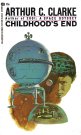
[The cover image shown here is of the 1969 reprint in paperback by Ballantine Books, the edition I just re-read; one of five Clarke reprints they did with similar covers — all obviously inspired by spaceship images from the just recently released film 2001: A Space Odyssey]

For example, in Childhood’s End (1953) the prologue concerns near-future [from 1953] efforts by the US and the Soviet Union to be the first to launch a rocket into orbit. The opening line, concerning the site of the US attempt, is this:

The volcano that had reared Taratua up from the Pacific depths had been sleeping now for half a million years.

In The City and the Stars (1956), the first page prologue delays the reveal until the last paragraph—here are the first two and last lines of that:

Like a glowing jewel, the city lay upon the breast of the desert. Once it had known change and alteration, but now Time passed it by. … They had lived in the same city, had walked the same miraculously unchanging streets, while more than a billion years had worn away.

A city that’s existed unchanged for a billion years!!? (Clarke does provide some plausibility for this claim, but that’s for a subsequent post.)

And the opening line of the novel 2001: A Space Odyssey (1968):

The drought had lasted now for ten million years, and the reign of the terrible lizards had long since ended.

Everything is set in the context of vast amounts of time. This was very impressive to me as a kid who until then had been told Bible stories about events that had happened a mere 2000 years ago. And it’s still impressive now, or should be – though having read many Clarke novels over the years, I have to admit that a little of this portentous tone goes a long way.

*** Spoiler alerts to what follows, for anyone who has not read this 60-year old novel ***

Childhood’s End, to summarize briefly, is about advanced aliens who appear above Earth in huge spaceships, hovering above all of Earth’s major cities. Their presence alone affects Earth’s culture in many ways. Moreover, the ‘Overlords’ are reluctant to reveal themselves – none of them ever appear in person before the human public; their appearance is a mystery. There’s a big reveal about a third of the way through the book: that the ‘Overlords’ appearance is that of devils, complete with wings, horns, leathery skin, and barbed tails. (I think this might be the most memorable take-away from this book, even though it’s not really crucial to the novel’s central theme.)

Decades pass, during which humanity still does not understand the purpose of the Overlords’ visit. In an island society ‘New Athens’, in the Pacific Ocean, one of the Overlords takes special effort to save the life of one child from a tsunami. It develops that the Overlords have come to supervise mankind’s transition into a higher order of being, of which this child is a harbinger. The history of paranormal phenomena among humankind was evidence of mankind’s destiny.

The children of the world gather and ascend to a higher state of being. And disappear. One man, who’d snuck away on an Overlord spaceship to see their homeworld, is back on Earth to witness its collapse and destruction, as it implodes with departure of those children. Once this happens, the Overlords having observed, they move on.

This theme strongly presages that of 2001 — that humanity’s current form might give way to an advanced state of being. In Childhood’s End, it is inevitable, while in 2001, it is triggered by alien interventionists, in an ‘uplift’ procedure, an idea that became a recurrent SF theme, especially in the novels of David Brin.

A subsequent post will explore themes and details.

Posted in Arthur C. Clarke, Book Notes, Personal history, science fiction | Comments Off on Clarke, Childhood’s End, part 1

Sean Carroll: The Meaning of Life

I was checking out Sean Carroll’s blog today, and saw this post with a YouTube excerpt of comments he made during a debate with Michael Shermer, Dinesh D’Souza, and Ian Hutchinson. Can’t resist quoting extensively, since he summarizes much of my own thinking, and the themes of this blog.

…Religion and science have gone their separate ways over the years. 500 years ago this debate would not have been held; there was no demarcation between what we would now call science and what we call religion, there was just attempts to understand the world.

And what happened is that science came about by developing techniques, methodologies for gaining reliable knowledge about the world, and the reliable knowledge that we got was incompatible with some of the presuppositions of religious belief.

The basic thing that we learned by doing science for 400 years is something called naturalism — the idea that there is only one reality, there are not separate planes of the natural and the supernatural, there is only one material existence and we are part of the universe, we do not stand outside it in any way.

And the way that science got there is through basically realizing that human beings are not that smart. We’re not perfectly logical; we as human beings are subject to all sorts of biases and cognitive shortcomings. We tend to be wishful thinkers and to see patterns where they’re not there, and so forth. And in response to this science developed techniques for giving ourselves reality checks, for not letting us believe things that the evidence does not stand up to.

One technique is simply skepticism, which you may have heard of. Scientists are taught that we should be our own theories’ harshest critics. Scientists spend all their time trying to disprove all their favorite ideas. It is a remarkable way of doing things; it’s a little bit counter-intuitive, but helps us resist the lure of wishful thinking.

The other technique is empiricism. We realize that we are not smart enough to get true knowledge about the world just by thinking about it. We have to go out there and look at the world. And what we’ve done by this for the last 400 years is realize that human beings are not separate, that the world is one thing, the natural world, and it can be understood.

This is very counter-intuitive; it is not at all obvious, this naturalism claim. When you talk to a person, they have thoughts and feelings and responses. When you talk to a dead person, a corpse — hate to be morbid here — but, you don’t get those same responses, those same thoughts and feelings. It’s very natural, very common-sensical to think that a living person possesses something that a corpse does not. Some sort of spirit, some sort of animating soul or life force.

But this idea as it turns out does not stand up to closer scrutiny. You are made of atoms. You’re made of cells which are made of molecules which are made of atoms, and as physicists, we know how atoms behave. The laws of physics governing atoms are completely understood. If you put an atom in a certain set of circumstances and you tell me what those circumstances are, as a physicist, I will tell you what the atom will do.

If you believe that the atoms in your brain and your body act differently because they are in a living person than if they’re in a rock or a crystal, then what you’re saying is that the laws of physics are wrong. That they need to be altered because of the influence of a spirit or a soul or something like that.

That may be true — science can’t disprove that — but there is no evidence for it. And you get a much stronger explanatory framework by assuming that it’s just atoms obeying the laws of physics. That kind of reasoning is a big step toward naturalism.

The argument is finished; the debate is over. We’ve come to a conclusion. Naturalism has won. If you go to any university physics department, listen to the talks they give or the papers that they write, go to any biology department, go to any neuroscience department, any philosophy department, people whose professional job it is to explain the world and come up with explanatory frameworks that match what we see — no one mentions God. There’s never an appeal to a supernatural realm by people whose job it is to explain what happens in the world; everyone knows that the naturalist explanations are the ones that work.

And yet — here we are. We’re having a debate. Why are we having a debate? Because, clearly, religion speaks to people for reasons other than explaining what happens in the world…. People turn to religious belief because it provides them with purpose and meaning in their lives, with a sense of right and wrong, with a community, with hope.

So if you want to say that science has refuted religion, you need to say that science has something to say about those issues. And on that I have good news and bad news for you.

The bad news is that the universe does not care about you. The universe is made of elementary particles that don’t have intelligence, don’t pass judgment, do not have a sense of right and wrong. And the fear is, the existential anxiety is, that if that purpose and meaningfulness is not given to me by the universe, then it cannot exist.

The good news is that that fear is a mistake. That there’s another option. We create purpose and meaning in the world. If you love somebody, it is not because that love is put into you by something outside; it is because you created that from inside yourself. If you act good to somebody, it’s not because you’re given instructions to do so, it’s that’s the choice that you made.

This is a very scary world. You should be affected at a very deep level by the thought that the universe doesn’t care, does not pass judgment on you. But it’s also challenging and liberating that we can create lives that are worth living.

I’ve never met God; I’ve never met any spirits or angels. But I’ve met human beings, and many of them are amazing people. And I truly believe that if we accept the universe for what it is, if we approach reality with an open mind and an open heart, that we can create lives that are very much worth living.

Posted in Culture, Psychology, Quote at Length, Religion, Science | Comments Off on Sean Carroll: The Meaning of Life

Believers, the Bible, the Internet, and Humanity’s Future

The writer is a blogger who deconverted from Christianity and is frustrated by discussions he has on the internet: Why don’t theists admit they’re wrong?

He’s reacting as I did earlier to the New Yorker article about how no evidence was able to correct false beliefs about vaccines. He notes strategies of religious apologists — faced with logic or evidence against their belief, they change the subject, or move the goalposts — and engages in some honest self-reflection about what could possibly cause him to re-convert. He suggests that in-group thinking (can 2 billion Christians possibly be wrong? [what about however many Muslims?]) and the sunk-cost fallacy, to explain resistance to reason by the faithful. And he goes on, as an example, with what strikes me as a fair description (from a nonbeliever’s perspective) of the Bible:

To paraphrase Sam Harris, there is nothing that is written in the Bible that could not have been conjured up in the minds of the people who wrote it; that is, there is absolutely nothing whatsoever which compels a rational skeptic to accept the claim that some quality of the Bible (it’s supposed cohesiveness, purported prophecies, etc.) was in any way influenced by or the product of any divine being. It’s a hodgepodge of mythology, hagiography, and uncorroborated history, and the overwhelming evidence demonstrates there is no reason to take claims of divine inspiration of ‘scripture’ even remotely seriously.

I think that’s a pretty damning problem for Christianity. This is supposedly the one book gifted to humanity by the all-powerful, all-knowing lord and creator of the universe, and that’s what we got? That’s to say nothing of the bizarre conundrums that are attached to claims of divinity, like why an all-loving God would go out of his way to have a ‘chosen people’, why he would choose people in the tribal Middle East (not exactly a beacon of enlightenment), why he’d tell them to just go around killing everyone else, and why all this stuff pretty much looks exactly as we’d expect it to if it were just a cultural fabrication and not actually a reliable account of history. Clearly, the Bible is much better explained as a product of mundane cultural affairs rather than a miraculous gift from an all-powerful deity.

I have often challenged Christians on this matter, and without exception the first tactical response has always been to shift the goalpost: I cannot disprove the claims of divinity associated with the Bible. Perhaps this or that scripture is meant to be understood in this or that context, etc. etc. And I sit there, flabbergasted. You’re not even close to addressing the central issue, I think to myself. I would think the distinction between providing incontrovertible evidence of divine inspiration and the weasel excuse that divine inspiration can’t be disproved (which is true for literally anything, including this very blog post) is obvious. But the discussion quickly reaches an impasse as we are, to pull from Tim Michin again, operating on completely different assumptions.

(Why would God go out of his way to have a chosen people? Well, obviously, because the authors of the Bible were writing in an era when it was assumed there were multiple gods, one or more for every tribe, and they were advocating their own one god — who had, of course, chosen *them*. Thus the First Commandment. Which doesn’t say “false gods”; it says “other gods”.)

I suspect that the reason the vast majority of people put their faith in the Bible (or any other holy book), and sign on to the local religion where they grow up, is simply that it’s the default position of their family and community. There’s no thought behind it at all. (This is Adam Lee’s Argument from Locality.) If they do think about it, and reflect later in life that while there are many competing religions in the world, all of them necessarily wrong, they must feel so, so lucky that they were born in just the right place to be exposed to the one true religion.

At the same time, there’s not much competition in western culture to the Bible (or its parts), except perhaps the Qur’an. The philosopher A.C. Grayling wrote, a few years ago, a fat volume called The Good Book: A Humanist Bible, composed of patched-together excerpts from many philosophers and other great writers from throughout history, divided into chapters such as “Genesis”, “Wisdom”, “Sages”, “Songs”, and so on, with each sentence assigned a verse number — but without (to my mind a great flaw) attribution of anything to particular authors. The result sacrifices the context of when and why the original authors wrote. Just as, of course, the traditional Bible does. Context should be essential, because knowledge, and wisdom, keeps expanding, as human culture and science grows and expands.

It’s been said that Religion may not survive the internet, and while I think human credulity and self-interest will endure despite the internet, exposure to competing ideas — and to the details of the ideas one has supposedly already signed up for (posts like this one and this one) — will help some of us see through the presumptions and superstitions of the ancient faiths.

The broad perspectives of human history and possible futures, the discoveries of science about the age and scope of the universe, and of the psychological biases the human mind is prey to, are consistent with the notion that religion is a primitive mechanism for dealing with unknowns and with aspects of life beyond human control. Just as a child grows up to learn that the world is not all about them, so might the human race mature over the centuries to live in and understand the universe as it is, not as it was imagined by our illiterate forebears. There are signs every decade and century that this is happening.

Posted in Culture, Religion, Science | Comments Off on Believers, the Bible, the Internet, and Humanity’s Future

Kalam, Infinities, and Intellectual Honesty

I was glancing around Adam Lee’s website and noticed his archive of foundational essays (some of which have been partially incorporated into his book). One is a very long, detailed response to the traditional arguments for the existence of God. Lee notes that,

In my experience, many of the people who present these arguments are under the impression that they are either new or irrefutable. Therefore, it may surprise them to learn that all the most commonly heard arguments for God’s existence have been around in one form or another literally for centuries, and all of them were refuted soon after they were first proposed.

These arguments include the ontological argument, the cosmological argument, the design argument, and so on.

And I happened to notice that one subsection concerns the version of the cosmological argument as advocated by… William Lane Craig, the Christian apologist who debated physicist Sean Carroll a couple months ago, during which this “Kalam argument” was addressed yet again.

As summarized by Lee, part of his argument hinges on the concept of infinity, which he claims cannot exist in reality, because the idea of infinity is self-contradictory. “For example, the set of all numbers is infinite in size, as is the set of even numbers, but if we subtract the latter from the former the resulting set is still infinite,” as Lee summarizes.

Heh. I studied this stuff in college – I was a math major. Yes indeed, it is counter-intuitive that, for example, the set of even natural numbers and the set of all natural numbers are, in fact, equivalently infinite. This is because you can state a rule to describe a one-to-one correspondence between members of both sets. Even more counter-intuitive is that there are infinities that are *not* equivalent — for example, the set of all “real numbers” (including all those numbers with infinite fractional components, like pi) is a higher order of infinity than the set of all natural numbers. This is because any proposed correspondence rule between those sets can be proved to miss infinitely many real numbers. (Aleph-naught) These concepts were invented by Georg Cantor in the 1880s. I’ve always thought this stuff was really cool.

But infinities are no more imaginary than negative numbers, and different orders of infinity are analogous to multiple dimensions — a geometric plane is, for example, more infinite in some sense than an infinite line. There’s nothing incoherent about the idea, as Craig claims. As Lee notes,

But this does not prove that such a thing is impossible, merely that the human mind cannot adequately conceive of it. There is no law that requires reality to conform to our expectations. Most people would also find the idea that light can behave both as a particle and as a wave to be counterintuitive or absurd, but nevertheless, quantum mechanics has taught us that it is so.

That a concept at first glance seems counter-intuitive does not mean it is self-contradictory, as Craig claims. A theme of this blog is how science fiction can suggest, if only by implication, many things that may be true about the universe but which are not intuitive to the human mind, or even conceivable to it at all. Keep in mind that our intuitive understanding of the world, how things move and interact, works only at scales similar to our own. There are other interactions at much much small scales, where quantum mechanics reigns, or much larger ones, where the immensities of time allow for the development of complexity the human mind assumes must have been designed. Science in the past few centuries has done a pretty good job of revealing scales and interactions of the universe that were and are completely invisible to ordinary human perceptions and inclinations.

Another thought about Craig’s use of this argument (and Lee dismantles his other premises for it as well) is that it calls into question his intellectual honesty. Surely he’s had critics point out the flaws in his argument before… Many people have described them, again and again … and yet he goes on promoting that argument. Why would he do that? Does he not understand his critics? Is he in his own mind so committed to a belief that, via confirmation bias, counter-evidence simply goes, so to speak, in one ear and out the other? Or is he not so much interested in pursuing the truth as promoting an agenda, or playing to credulous supporters?

Posted in Personal history, Philosophy, Religion, Science | Comments Off on Kalam, Infinities, and Intellectual Honesty

Assorted Links and Quotes: Selective Thinking, Southern Atheists, Creationist Logic, Fox News, Neuroscience

Assorted links from the past couple days:

Neil deGrasse Tyson vs. the right: “Cosmos,” Christians, and the battle for American science, by Sean McElwee.

About the selective thinking of the religious right in denying those Enlightenment values that threaten their ideology.

In truth, we cannot get fundamentalism without the scientific revolution. Fundamentalism does not exist independently, but rather defines itself in relationship to post-Enlightenment values. It is the odd melding of science and religion that creates fundamentalism — the belief that the Bible is ultimately both a scientific and religious text. Fundamentalists, like the conspiracy theorists they resemble, will build up reams of evidence creating the case for something that can be disproven with a simple logical proposition. Few thinkers have built such an impressive edifice of logic and evidence upon such a thin foundation of speculation.

With an example from Dinesh D’Souza.

Come to think of it… Was there a similar backlash from religious conservatives to Carl Sagan’s Cosmos series 30 years ago? Don’t know. If there had been, perhaps the rest of the world simply wouldn’t have heard about it. It’s much easier now, with the Internet, to hear about the crazies from every direction.


CNN’s religious blog: Atheists in the Bible Belt: A survival guide

With examples of nonbelievers in southern states who feel like they’re the only one… and then discovering they are not. And the perspectives of University of North Carolina religious scholar Bart D. Ehrman:

But Ehrman told the atheists gathered in Raleigh not to bother arguing with fundamentalists.

“You can’t convince a fundamentalist that he or she is wrong,” he says.

Their theology is a closed system, according to Ehrman, and their social bonds with fellow fundamentalists are too tightly knit to admit any wiggle room.

“You can point to any contradiction in the Bible and it just doesn’t matter. They will either find some way to reconcile it or say that even if they don’t understand it, God does.”

Technically, the term fundamentalist refers to a movement of 20th-century Protestants who rejected modernity and clung to a literal interpretation of the Bible.

But Ehrman has a different definition: “Someone who is no fun, too much damn, and not enough mental.”

And discussion of assumptions believers have about atheists.


Would you learn the philosophy of science from a creationist?

PZ Myers sees the film God’s Not Dead and addresses talking points of creationists who make an imaginary distinction between ‘historical’ and ‘observational’ science. And how any “document” can prove anything.

The Bible is not trustworthy; it’s a hodge podge of historical accidents assembled in a biased and political process 1500 years ago, it’s full of contradictions, and even if you accept the crappy distinction of science as AiG presents it, it is not a document that is at all contemporary with the creation of the world. (I wonder…maybe they are so delusional that they think the Bible is 6000 years old.)

You can’t simply accept an account of the past because it is a “document”. People lie all the time. More charitably, people make up stories for entertainment. With their kind of uncritical swallowing of myth because it is simply written down, we’d have to conclude that Ilúvatar was the creator, and Tolkien was his prophet. Hey, were you there? Then how do you know it was wrong? I have a book right here that explains how the Ainur sung the world into existence. A real book, with words even.

Then they go on to claim that Observational Science confirms that every word in the Bible is accurate. So why does nearly every scientist in the world disagree?

Finally, they trot out Plantinga-style baloney: we must have been created by an intelligent being, because if our brains are byproducts of chance…we couldn’t trust their conclusions to ever be accurate. To which I have to say…EXACTLY. We can’t trust our brains — the whole elaborate edifice of science is a collection of protocols we follow to avoid trusting our brains. They have to know this; by their own ideas, they think that the majority of the world’s scientists, who all use their brains rather than the Bible, have come up with a set of explanations for the world that the creationists consider wrong.


Why I don’t watch Fox News.

Slate’s Mark Joseph Stern suggests that you not (referring to speculation by an on-air “psychotherapist” the other day that the Isla Vista shooter might have been fighting against homosexual impulses) Waste Your Umbrage on Fox News’ Homophobic Ramblings

Some liberals see Fox News as a grotesque cesspool of anti-intellectual idiocy, a creepy, paranoid grotto of ignorance where bigots can huddle together in the dark and stoke each other’s prejudice as the rest of the country embraces the light of progress. But I’ve always found Fox vaguely charming, mostly because it is so fantastically terrible, so obviously low-rent in literally every way, that it serves as its own best parody. Sure, it is possible to be deeply offended by the execrable dreck the channel pumps into an upsettingly large chunk of the American consciousness day in and day out. But it’s much more fun to watch in amusement as Fox’s unrelenting mediocrity slowly curdles into an arresting form of black comedy.

It strikes me that it’s just as likely, perhaps even slightly plausible, that Elliot Rodgers’ sense of entitlement (as revealed in his videos) were influenced by … watching Fox News. I have no evidence at all for this (aside from my impression that Fox News plays to self-entitled, paranoid whites who feel their privileged position in the world is threatened from every direction — by Obama, minorities, gays, etc.), but then neither did that psychotherapist for her speculations.


The main story in today’s Science section of the New York Times is All Circuits Are Busy, by James Gorman, is about current research in neuroscience, and the work of one H. Sebastian Seung, of MIT and Princeton.

The article provides some hard numbers about the size and complexity of the brain, as I was crudely speculating about in a post a couple weeks ago, Rainbows and the Afterlife.

H. Sebastian Seung is a prophet of the connectome, the wiring diagram of the brain. In a popular book, debates and public talks he has argued that in that wiring lies each person’s identity.

By wiring, Dr. Seung means the connections from one brain cell to another, seen at the level of the electron microscope. For a human, that would be 85 billion brain cells, with up to 10,000 connections for each one. The amount of information in the three-dimensional representation of the whole connectome at that level of detail would equal a zettabyte, a term only recently invented when the amount of digital data accumulating in the world required new words. It equals about a trillion gigabytes, or as one calculation framed it, 75 billion 16-gigabyte iPads.


My internet connection has been frustratingly slow all day; not sure if the problem is Time Warner, my router, or what.

Posted in Atheism, Culture, Evolution, MInd, Religion, Science, The Gays | Comments Off on Assorted Links and Quotes: Selective Thinking, Southern Atheists, Creationist Logic, Fox News, Neuroscience

Cosmos and the Future of Humanity

Last week’s episode of Cosmos, episode 11, The Immortals, was one of the best and most moving. Neil deGrasse Tyson examines humanity’s desire for immortality, and the ways that this has happened in some sense: writing, that captures thoughts for future generations; the idea that life may have survived periodic meteor bombardments, that might easily have wiped out all life on earth, but being ‘reseeded’ by fragments of debris floating around the solar system before landing back on Earth, or Mars.

And SETI, the Search for ExtraTerrestrial Intelligence, and why there have been no results. (This is a theme still being mined by science fiction writers.) One possibility: despite the likelihood of habitable planets that might give rise to life, and intelligent life, maybe intelligent civilizations simply don’t last very long: they burn themselves out quickly, through internal discord that triggers nuclear wars, or through inattention to environmental dangers. Tyson:

Our economic systems were formed when the planet and its air, rivers, oceans, lands, all seemed infinite. They evolved long before we first saw the Earth as the tiny organism that it actually is. They’re all alike in one respect: they’re profit-driven, and therefore focused on short-term gain.

The prevailing economic systems, no matter what their ideologies, have no built-in mechanism for protecting our descendants, of even 100 years from now, let alone 100,000.

In one respect, we’re ahead of the people of ancient Mesopotamia: unlike them we understand what’s happening to our world. For example, we’re pumping greenhouse gases into our atmosphere in a rate not seen in a million years. And the scientific consensus that we’re destabilizing our climate.

Yet our civilization seems to be in the grip of denial: a kind of paralysis. There’s a disconnect between what we know and what we do. Being able to adapt our behavior to challenges is as good a definition of intelligence as any I know.

And the episode gets better: speculating on what immortals would actually do. And the Cosmic Calendar of the next 14 billion years. And what humanity might accomplish in the next few seconds of that calendar.

It will not be we who reach Alpha Centauri and the other nearby star systems on our interstellar arks. It will be a species very like us, but with more of our strengths and fewer of our weaknesses, more confident, far-seeing, capable and wise. For all our failings, despite our flaws and limitations, we humans are capable of greatness.

A very science-fictional, expansive, and optimistic, vision. (Free of the deadweight of primitive religious dogma.)

Posted in Cosmology, Science | Comments Off on Cosmos and the Future of Humanity