
- Rethinking categories and provisional conclusions;
- XKCD on holes;
- A new Atlantic column on The Wonder of Everyday Life;
- A Star Talk video about the limits of human intelligence.
Rethinking again the categories of posts I do here, while working on a new set of overview pages to supplement or replace my decade-old Provisional Conclusions. I tend to collect links about reality illiteracy (e.g. flat-earthers) and tribalistic morality (conservative yearning to retreat to a simpler past), but also about modernity and secularism, and about reality.
Let’s do a couple three on the last theme. But I only have a few minutes…
Here’s one that explores the idea of scale. A key component of ‘reality illiteracy’ is that humans evolved in an ancient environment where, over hundreds of thousands of years, human nature developed intuitions at local scales. We’re intuitive about distances of a few miles or down to an inch; we’re intuitive about time scales from moments to a generation. But the real world is vastly greater, in all dimensions, as humans have been able to deduce from the evidence of the physical world around us.
Here’s an example. We think of things as deep, or high, without really being aware of relative depth or height.
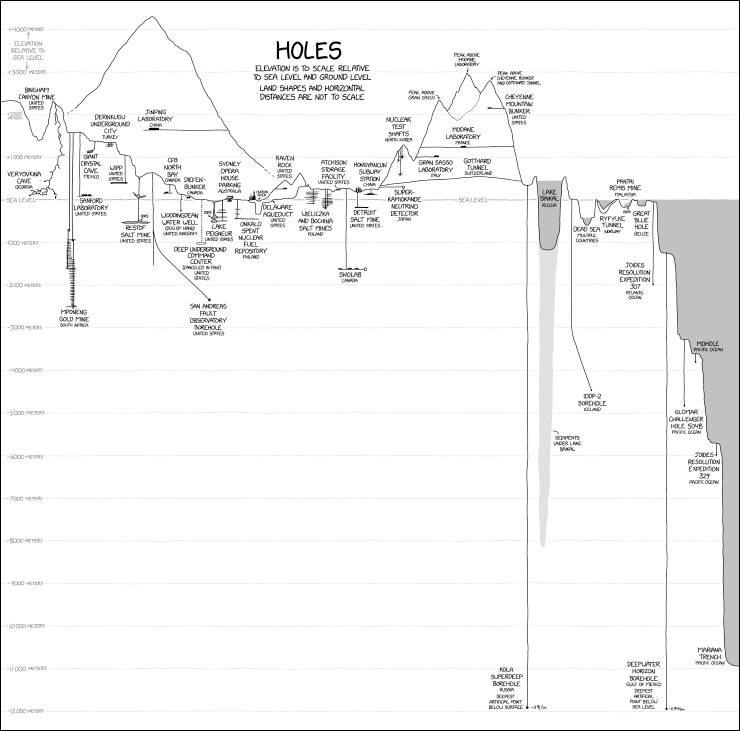
XKCD, from a couple days ago: Holes
I’ll let it speak for itself. And here’s a large version of the image
\\
And here’s the first in a series of a new column at The Atlantic, apparently.
The Atlantic, Ian Bogost, 7 Jul 2026: The Wonder of Everyday Life, subtitled “Welcome to Ordinary Extraordinary, our new, eight-week newsletter series.”
This doesn’t seem to be about science, but more about being aware of everyday life. Like the pleasure of driving a stick-shift car. The writer published this book. I’ll follow up on later installments.
\\
This one’s more speculative, and I haven’t listened to the entire thing yet.
Facebook video, Star Talk, Neil de Grasse Tyson and guest, Are We Intelligent Enough?
This goes to ideas of humanity’s cognitive limitations, and whether there are ideas about the universe we may never be able to understand. And, for that matter, why so many humans deny knowledge and prefer myths.