
Subtitled: How America Went Haywire: A 500-Year History
(Random House, 2017, 462pp, including 22pp acknowledgements and index)
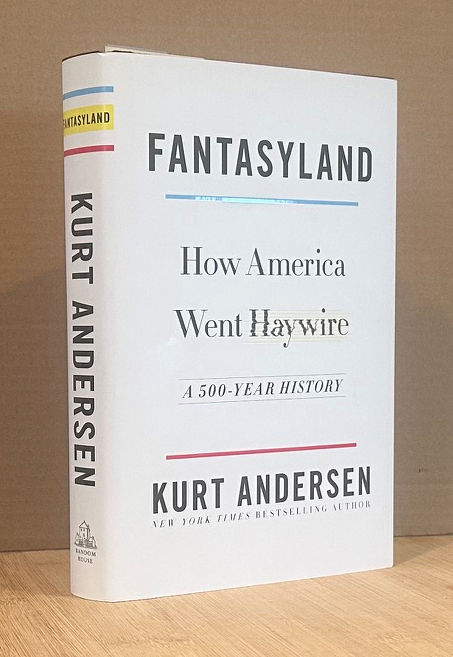
Here is a book by a writer who doesn’t generally write this type of book. Andersen (https://en.wikipedia.org/wiki/Kurt_Andersen) writes mostly novels and TV, and he did write one other nonfiction book of the same nature as this one, EVIL GENIUSES (https://en.wikipedia.org/wiki/Evil_Geniuses:_The_Unmaking_of_America) about the conservative influence on politics and the economy since the 1970s.
FANTASYLAND provides at least a partial answer to why Americans seem especially credulous compared to other nations, and overly religious. Is that premise even true? Hard to say given that I have no first-hand experience with politics or religiosity in other nations. Except for isolated stats, e.g. that by far the most UFO sightings in the world occur in the US. This book has a Wikipedia page too: https://en.wikipedia.org/wiki/Fantasyland:_How_America_Went_Haywire
This post covers only the first 53 pages, an introduction and Part I: The Conjuring of America: 1517-1789.
Key Points:
- Being American means we can believe anything we want to, never mind the experts.
- It began in the 1960s with “do your own thing” and then the era of the web, that allows crackpots to find each other.
- But it really began with the Protestants, who broke from the Church with beliefs that everything a Christian needed to know was in the Bible, and being a good Christian came through belief, not deeds.
- Then America was discovered and European hucksters pursued fantasies of a northwest passage and gold in what’s now Virginia and maybe even the Garden of Eden somewhere. And lured gullible investors to the new world.
- Protestants became the establishment in England in the 17th century, but there were numerous spin-offs, including the Puritans, all Calvinists, who considered themselves holier and godlier than others. Some of them, eager to split from the Church of England entirely, went to New England as Pilgrims. They were Biblical literalists, and expected the apocalypse would arrive in America at any moment. Example of Anne Hutchinson, so extreme she was thrown out of the colony. And Roger Williams, who founded Providence.
- Protestants felt the deaths of Indians from diseases brought from Europe were justified by divine providence. They believed in witches, and witch hunts. As science was being invented, Protestants searched the world for evidence of Satan.
- In the 18th century the Founders came along, rationalists and pragmatists, along with Jonathan Edwards, who entertained congregations with a Great Awakening, whose performative sermons were adopted by John Wesley and George Whitefield. Anyone could become a preacher.
- Benjamin Franklin heard Whitefield and published him. The Founders thought God vague and impersonal, and did not mention him in the Constitution. Jefferson cut up his own Bible. The Enlightenment thinkers liberated people to think for themselves too. But reason didn’t win; ironically it opened the door to other sorts of anything-goes, for astrology, alchemy, and all kinds of craziness.
In brief: the earliest settlers were religious zealots, and hucksters and their marks. Explains a lot.
*
Detailed Notes:
1, Now Entering Fantasyland, p3
Author has been thinking on these ideas since the late 1990s. Then came Bush in 2004 and 2005. The ‘reality-based community’ was denied by Karl Rove. [[ good to know where that phrase came from ]] Then Colbert and ‘truthiness’ a year later. And he claimed not to trust books. He realized how this American phenomenon had been around for decades and centuries. A weakness for fantasy of all kinds. All about the Enlightenment idea of intellectual freedom, spun out of control to allow belief in anything we wanted. 5.6: Much more than the other billion or two. P5.6:
Much more than the other billion or two people in the rich world, we Americans believe — really believe — in the supernatural and miraculous, in Satan on Earth now, reports of recent trips to and from Heaven, and a several-thousand-year-old story of life’s instantaneous creation several thousand years ago.
Now we have conspiracy theories about ETs, 9/11, vaccines… Now we have post-truth and post-factual. We’ve mutated into Fantasyland.
But how many people really? Roughly, the solid reality-based are perhaps a third. While two-thirds believe in Heaven, angels and demons, and a personal God. A third, that global warming is a hoax, and the government is suppressing certain information. A quarter, that vaccines cause autism, and that Trump won the popular election in 2016. A quarter believe Obama was the Antichrist. In witches. Of course these are different thirds or quarters; these beliefs overlap. And some of those groups hold each other in contempt. Evangelicals, Pentecostals, Mormons, Scientology, and so on. Why? Because being American means we can believe anything we want to, that our beliefs are superior, never mind the experts. Now ‘mainstream’ and the Establishment are hated. Lots of particular examples. If one crazy belief is allowed or normalized, so can lots of others.
And it’s not just about particular falsehoods, it’s about fictional ideas in everyday life. Fantasy football, virtual reality. They all began with two changes. In the 1960s: do your own thing. Then the era of information and communications. The web. Anything and everything is out there. Crackpots can find each other. Computers make fantasies seem real. Truth becomes flexible.
This isn’t unique to America, but we are uniquely immersed. This is our exceptionalism. But our uncertain grip on reality has turned us into a less-developed country. Trump wasn’t new. 11.6:
America was created by true believers and passionate dreamers, by hucksters and their suckers — which over the course of four centuries has made us susceptible to fantasy, as epitomized by everything from Salem hunting witches to Joseph Smith creating Mormonism, from P. T. Barnum to Henry David Thoreau to speaking in tongues, from Hollywood to Scientology to conspiracy theories, from Walt Disney to Billy Graham to Ronald Reason to Oprah Winfrey to Donald trump. In other words: mix epic individualism with extreme religion; mix show business with everything else; let all that steep and simmer for a few centuries; run it through the anything-goes 1960s and the Internet age; the result is the America we inhabit today, where reality and fantasy are weirdly and dangerously blurred and commingled.
Is this only temporary?
Part I: The Conjuring of America: 1517-1789
Quote by de Tocqueville about how the man is to be seen in the cradle of the child.
2, I Believe, Therefore I am Right: The Protestants, p15
America was imagined from scratch, created from nothing, by white people who abandoned their lives in England. It began with a theology professor who disagreed with certain Christian doctrine and practices, e.g. paying the church money for forgiveness of their sins. Merchandising of fake holy relics. He nailed a list of complaints to the door of the church. In 1517. Martin Luther. By which time printing presses spread it widely, throughout Europe. Launching Protestantism. An alternative to Roman Catholicism. Luther had two big ideas. Clergymen had no special access to God, or the truth; everything a Christian needed to know was in the Bible. And now Bibles were no longer rare and expensive. Second, that the only prerequisite for being a good Christian was belief in the Bible’s supernatural stories. Heaven came not through deeds. Only beliefs.
This system was no more rational than the former. “The disagreements… were about the internal consistency of the magical rules within their common fantasy scheme.” 17.8. But it meant that millions of people were given license to decide what was true or not, regardless of what experts said. The footings for Fantasyland.
3, All That Glitters: The Gold-Seekers, p18
Meanwhile, a new world had been discovered in 1492, and in the 1500s Europeans imagined that fantastic wealth might be found there. They searched for a Northwest Passage. Spaniards went southwest and discovered the Aztecs and Incas, and their gold. England looked for gold further north. This began a theme: “around some plausible bit of reality, Americans leap to concoct wishful (or terrified) fictions they ardently believe to be true.” 19m. In the late 1500s Richard Hakluyt spread such fantasies. Commissioned by Walter Raleigh, who sent three expeditions to find gold, and found none. And maybe the Garden of Eden was there! People sent as settlers died. Raleigh pushed the fantasy. In 1606 King James authorized two private enterprises to start colonies. To find gold. Two thirds of the first hundred settlers died. Haklyut never stopped believing. In Jamestown they found only iron pyrite, fool’s gold. Expeditions further north found nothing. More people came. A gold rush with no gold. Back in England investors kept people going. They were ‘desperately wishful’ and ‘believed in advertising.’ Dreamers and suckers. In Virginia, colonists were saved by a crop: tobacco. Francis Bacon understood the power of wishful belief, p23 [[ it’s what we call motivated reasoning ]] as with astrology, dreams, omens, and the like. People “mark the events where they are fulfilled, but where they fail, though this happen much oftener, neglect and pass them by.” While the colonists were all about “the export of their supernatural fantasies to the New World.”
4, Building Our Own Private Heaven on Earth: The Puritans, p24
By the 17th century in Virginia, wishful thinking gave way to tobacco growing. They hadn’t found gold, but supernatural religious beliefs aren’t falsifiable. Elizabeth was the first Protestant English monarch; after her came James, who ordered a new translation of the Bible. Now leader of the Church of England, his charter for British colonies included evangelism. Protestants became the Establishment in England, but it was fractious and unstable, invented by rebels. It was part of the tide of novelty along with the printing press, the Renaissance, the beginnings of modern science, and the Enlightenment. Anyone could decide what their new improved truth should be. So there were numerous sectarian spin-offs. The first spin-offs were English ultra-Protestants labeled “Puritans” for considering themselves holier and godlier than others. They were all Calvinists: only a minority of people go to Heaven, and those ‘elect’ were chosen by God before they were born. Puritans were also especially zealous. Some wanted separate churches. And so some of them went to the Netherlands, in 1609. But that seemed no better. So they decided to set off on their own. Virginia? No. They set off to create their New Jerusalem in New England. “In other words, America was founded by a nutty religious cult.” 27m. Author doesn’t recall much about them in the history he was taught as a child. That was mostly about the Pilgrims. They were the Puritan pioneers in America. The New World was what Israel had been for the ancient Jews, a promised land for God’s chosen people. But only a few hundred of them went to Plymouth in the first decade. The Massachusetts Bay Colony. Dedicated to a sort of fantasy. The Puritans were considered more moderate than the Pilgrims. But they passed laws to hang Quakers and Catholics. They took the Bible as literally as they could. Especially end-of-the-world prophecies. The apocalypse would come and God and Satan would battle it out—in America. They expected it to happen at any moment. Cotton Mather issues specific dates. Six years! 39! Etc. Of course they never happened. They were crazy, but also pragmatic. They were… literal-minded fantasists.
5, The God-Given Freedom to Believe in God, p32
One resident of the Bay Colony was Anne Hutchinson, who led her own services, and who was absolutely convinced that she would be among the elect to get into Heaven. She became so passionate she became problematic. She defamed other ministers. God spoke to her personally, she said. She was accused of being deluded by the Devil. She was thrown out of the colony. Some considered her a heroine. What a fanatic who just *knew* she was right—a prototypical Fantasyland American. [[ there are a lot of these to this day. ]] She resonates with Americans to this day, 35t. Matching her was Roger Williams, who founded Providence. While giants of intellect walked Europe, American was a primitive outlier.
6, Imaginary Friends and Enemies: The Early Satanic Panics, p37
Americans love implausible and impossible beliefs, both blissful and fearful. Obsessed with the devil. Identified with the native Americans. Just as Martin Luther demonized the Jews. Christians felt the deaths of Indians from diseases brought from Europe was justified. A Pequot War massacre of hundreds of natives was due to the wonderful Providence of God, according to Increase Mather. More bloodbaths in 1675 and 1676. Protestants, unlike Catholics, believed in witches, and witch hunts. 1640s. Despite an Act of Toleration, witches were suspected everywhere. Cotton Mather supported ‘spectral evidence’ to prosecute them, i.e. reports of dreams. Accusers were often girls. Our understanding of this period has been shaped by Arthur Miller’s 1953 play The Crucible, which shifts the blame away from magical beliefs to motivations for power. Author thinks they were sincere. It stopped in 1692, when Increase Mather simply disbanded the witchcraft court. While still believing in Satan being behind it all.
Science was being invented, while Protestantism searched the natural world for evidence of Satan everywhere.
7, The First Me Century: Religion Gets American, p43.
Two centuries later, in the 18th century, people started calling themselves Americans, and the Founders came along, rationalists and pragmatists, producing the Declaration and the Constitution. The march of progress included Franklin, Adams, Jefferson, Washington, Hamilton, and (the atheist) Thomas Paine. But another story was going on too. Jonathan Edwards was a renowned minister and thinker who avoided the superstitions of witches and signs of Satan, but retained a certainty in the existence of the God in the Bible. Famous sermon, all about fire and Hell. But he believed a perfect future awaited, eventually. But he had to entertain restless congregations. So he wound them up. His was the first Great Awakening. Especially the youth. Other preachers adopted similar methods: moaning, weeping, screaming, etc. As marks of supernatural presence. And evidence for the people. He went on the road. Similarly John Wesley. Who felt so much holier than ordinary folks. Then George Whitefield, co-founder of the Methodist movement. His sermons were performative. Theatrical. An evangelical marketer of himself. But Christians came to loathe such displays. That just reinforced Whitefield and his followers. They felt vindicated—persecuted! Anybody could become a preacher, however he liked. The more passionate, the better. Each one believing he possess *the* truth. This became American individualism: If I think it’s true, then it’s true.
8, Meanwhile, in Eighteenth-Century Reality-Based Community, p50
In one of Whitefield’s earliest crowds was Benjamin Franklin. 1739. Franklin published Whitefield’s journals and made a fortune. He and the other Founders considered God vague and impersonal. Quotes from them, p51. Jefferson cut up his own Bible. God was not mentioned in the Constitution. None of them called himself an atheist. Yet they were certainly blasphemers. They admired Bacon, Locke, Newton, Voltaire, Kant, Hume. Ironically, the Enlightenment, too, liberated people to believe anything whatsoever. Assuming reason would win. It didn’t. It enabled all kinds of craziness: astrology, alchemy, etc. People thought for themselves.
\\
Comment: American has always been multicultural. Even as some of these founds spread their dogma, people like the Founders were trying to establish institutions that would supersede them. And getting science going at the same time. The US has a huge share of Nobel Prize winners in the sciences, even as our religious conservatives keep battling to bring those institutions down.