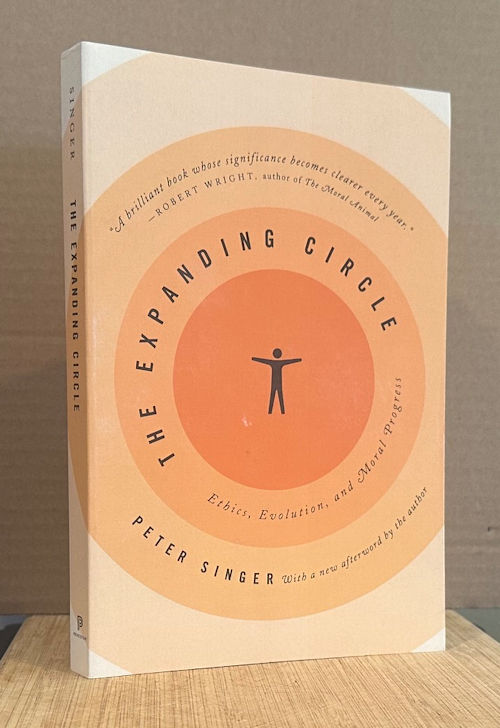
Subtitled: Ethics, Evolution, and Moral Progress.
(First published 1981. This edition, with a new preface and afterword: Princeton University Press, 2011, xviii + 208pp, including 35pp of notes on sources, afterword, and index.)
I had thought this book was about a particular famous idea attributed to Singer: that the ‘expanding circle’ of moral concern or empathy might extend even beyond fellow human beings to animals, at least to some degree. And maybe someday to AI. But the book is much more: in its extension of E.O. Wilson’s ideas in his 1975 book SOCIOBIOLOGY, and it’s a good sketch of how we understand human nature in light of evolution and the heredity environment.
And coincidentally, it’s a corrective to the simplistic theological thinking of C.S. Lewis. It’s a good primer into some of what we understand about the origins of human nature. And also coincidentally, it dovetails with some of the ideas in the Todd May book I read just before this.
Key Points
- Singer starts with the origins of altruism, which is a key idea in Wilson’s book. Humans are social animals, and altruism is one way this is possible. First with kin altruism, then with reciprocal altruism, then with group altruism.
- All human societies have codes of behavior, and these codes reflect the instincts for altruism at different degrees. They appear as reciprocity, concepts of fairness, ideas of gratitude and revenge and loyalty to one’s own group.
- At the same time different kinds of people (male/female, parent/child) have different, sometimes conflicting motivations, and these cannot easily be ignored. Wilson proposed three values for a biology of ethics: the survival of the pool of human genes, diversity, and universal human rights.
- Evolution isn’t about “progress”; Wilson showed how science can inform our ethics, by revealing new knowledge, e.g. about what is “natural.” But author thinks Wilson’s idea about the gene pool is a naturalistic fallacy.
- The rational component of ethics comes from the human ability to reason. Author describes examples from Euclid, Socrates, Kohlberg. To Adam Smith. The principle of equal consideration, of impartiality. This is how you expand the circle of ethics, gradually to a universal view, a change that is not yet complete, but which might in some way include all life.
- Still, people will always be selfish to some degree. But we can reason around these evolutionary drives, and create non-reciprocal altruism, e.g. as when people donate blood. There are ways to reduce the cognitive dissonance this entails.
- The new understanding of ethics involves accepting the idea of rules to avoid the task of having to think things through every time there is some dilemma. While understanding that there will always be exceptions to rules.
Detailed Summary [[ and comments ]]
1, The Origins of Altruism
Humans are social animals. Rousseau, who thought that individuals barely needed each other, was wrong. We can also reject the notion that a ‘social contract’ was at some point consciously established to create a human society. But we know that humans have lived in social groups for ages. Rousseau and those of his era had little to go on; the only things they knew about animals were from hunters, adventures, or zookeepers. Recently studies of animals have been tied together by E.O. Wilson in Sociobiology: The New Synthesis, in 1975. About social behavior, which would include ethics. Altruism has always been a problem.
P6, Animal Altruism. Examples: warning calls given by birds, at risks to themselves. Thomson’s gazelles, who do “stotting.” Food sharing. Help to insured animals, in dolphins and elephants. A restraint in combat, as in wolves.
P8, Evolution and Altruism. Evolution isn’t about competition between different species, or groups or individuals, but between genes. Details. How would altruistic genes survive? Darwin speculated on this. He was only partly right.
P11, Kin Altruism. Genes survive by reproduction. One way altruism might emerge is in concern of parents for their children. Parents will sacrifice themselves, one way or another, for their children. The same principle extends to siblings, who also have 50% of the individual’s genes. The proportion falls off with aunts/uncles and nephews/nieces. And again with first cousins. In close-knit groups most members are related to other members. Varying behaviors depend on how animals live in tribal groups, 15. Male langur donkeys, who, when they take over another male’s harem, kills all the infants in that group. [[ Biblical morality! ]] Also lions, and stepparents in fairy tales, and human conquests over centuries.
P16, Reciprocal Altruism. Not all altruism benefits relatives. Monkeys groom each other. Scratch my back and I’ll scratch yours. Or jumping into the water to save a stranger. The risk will be returned if the savior needs saving. How does this happen? Individuals remember who has helped them and who has not. Cheats, who take help but never give it, never prosper. This would happen in creatures living in small, stable groups. Intelligence helps. And so this is seen among birds and mammals. But how did get started?
P18, Group Altruism. Group selection, in a limited form, perhaps. Example of monkeys. Groups would have to remain distinct. Hostility to outsiders helps. Other species are hostile to foreigners too. Yet in many cases what may be going on is just kin selection, in small groups where everyone is related.
2, The Biological Basis of Ethics, p23
Every human society has a code of behavior for its members. Hobbes denies such natural ethics, thinking the natural condition was war. But his theory was never plausible. Some examples have been put forth; the Ik, in Uganda. But evidence was dicey. And they still had an ethical code. Details. Perhaps Soviet labor camps and Nazi death camps? Despite extreme dehumanization, survivors did help each other. A core of ethics runs deep in our species. Yet people like to think we are rational where only animals are instinctive. It is hard to distinguish humans from animals, e.g. on use of language. Everything is a matter of degree. Another objection is that ethics is a cultural phenomenon, radically different in different societies. But evidence collected shows remarkable uniformity. And differences are the result of learning and social conditioning. And some elements are observable in other social animals.
P29, Kin Selection in Human Ethics. Earlier example of the range of kin selection. These were taken as given in Victorian England. And they included racial distinctions. Which were and are real: consider how much we would donate to help a famine in Africa, to what we spend on everything else. We make excuses. Foreign aid? Help our own poor first. This makes a kind of sense. Yet society has tried to eliminate preferences for members of one’s own group. [i.e. affirmative action] Can this be extended to the family? [i.e. eliminate nepotism] [[not under conservatives!]] Such ideas go back to Plato. But tries at this, as in the kibbitz movement, have not worked out. Problems go away when an entire group is at stake, as in war. The Communist Manifesto called for the abolition of the family. The idea faded within 20 years. Some religious communities have tried too. Bias toward the family is a persistent human tendency. The society as a whole seems to benefit.
P37, Reciprocal Altruism and Human Ethics
Reciprocity is also widespread in human cultures. Like mutual grooming. You have to remember those who cheat. But how does it get started? A concept of fairness is needed. Rituals of gift-giving come with understanding of repayment. Gratitude and revenge go together. Plato, Cicero, Jesus. Humans have developed an aversion to being cheated. And will get revenge, even when it’s not worth it. In tribal societies revenge leads to blood feuds. Reputation. Reciprocal altruism can be seen as enlightened self-interest. Altruism is also about motivation. Which is seldom self-conscious. Consider the Prisoner’s Dilemma. The best outcome is when the prisoners are not motivated by self-interest. That is, genuinely altruistic. Similarly when two humans are attacked by a sabretooth cat.
P49, Group Altruism and Human Ethics
There are cases to be made for group selection, especially among isolated groups of early humans. Ethical codes of larger societies usually include elements of group altruism. With hostility toward other tribes. Ancient Greeks. [[ and Jesus – follow him, not your family! ]] Hitler. Mother Russia. Football fans. My country, right or wrong. Robert E. Lee’s loyalty to Virginia. Others go beyond the state, to citizenship of the world – Diogenes, Aurelius, Voltaire et al. Both cultural and biological factors play into these various sorts of ethics. Note that so far we haven’t discussed specific ethical conclusions…
3, From Evolution to Ethics?
Quotes by Einstein and Wilson.
P54, The Takeover Bid
First we review Wilson’s claims about sociobiology. And for a ‘biologicalization’ of ethics. He outlines an “innate moral pluralism” in which no single set of moral standards applies to all. He discusses three issues of the biology of sex: males v females, family life, and homosexuality. From these he criticizes the ‘natural law’ that sex is primarily about reproduction. But he warns that reforms that go against our biological tendencies will have costs. And he ends with three values for a proposed biology of ethics. The survival of the pool of human genes. Diversity. Universal human rights.
P60, The Relevance of Biology to Ethics: Three Possibilities
Recall how many thought Darwin had proved “might is right.” But now the Social Darwinists are in disrepute. Wilson is the latest to try to link ethics to evolutionary theory. Not that Wilson thinks evolution itself is good. It is not about “progress.” Wilson has offered three distinct thoughts about how scientific findings are relevant to ethics. Science can reveal new knowledge. It might undermine existing ethical beliefs, e.g. about what it “natural.” And, science may provide new ethical premises or reinterpret old ones.
P63, Ethical Theories and Biological Consequences
On the first point, Utilitarianism is an example. Or Rawls’s theory of justice. Examples from Kant, Nozick. Absolutionist theories may lead to disaster. Yes, philosophers should be aware of current biological theories, but such theories will not replace ethical philosophers.
P68, Debunking Ethics
Wilson’s second idea: biology can undermine existing ethical beliefs. By destroying the original justification for that belief. E.g. the claim that homosexuality is unnatural. Even if it were unnatural, that doesn’t make it wrong. P70 we can criticize one moral position at a time, but not all of them together [recalls Todd May]. Our intuition may or may not have biological origins. E.g. preference for “our own.” Or links the sanctity of human life to a particular Judeo-Christian worldview, which we may not accept. But where does this stop? Perhaps those that we can show are relics of our early history, tribal society rather than modern life. [[ key point about the bifurcation of human nature ]]
P72, A Biological Basis for Ultimate Values?
Can science lead us to ethical values themselves? This is the gulf between is and ought, between facts and values. Hume. As in Wilson’s idea about the common gene pool. Author thinks this is illegitimate. The naturalistic fallacy. Facts cannot compel any value. Example of donating to a poor tribe somewhere, or spending money at home. The facts alone do not settle the issue. Would additional facts about our evolutionary background help? No. We choose ethical premises. It’s not about explaining values; this is where Wilson goes wrong, in his concern for the human gene pool. Only science seeks to explain. Ethics consists of directives. P80 showing how Wilson went wrong. He assumes another ‘ought’ statement, with which many people might disagree.
P84, Ultimate Choices
So there is no scientific basis for ethical choice; we can choose whatever we like. How do we choose then? From our values? Is it all subjective? Wilson can’t escape this conclusion. But there is room for a rational component, as many have thought. Reason.
[[ Here he has reached where Todd May gave up, or paused – but May was concerned about ‘meaning,’ not ethics. ]]
4, Reason, p87
Quotes by Darwin and Socrates
Humans are capable of reasoning well, even if they don’t always.
P88, The Nature of Reason. Reason can lead to places we did not expect to go. We can be forced to change our mind. Example of Hobbes discovering the Euclidean method of reasoning. Each theorem based on a previous theorem. And, the capacity to count. Which leads to more advanced math. Measuring plots of land requires geometry. Math develops logically. Is there a relation here with ethics? Let’s try to do that.
P90, The First Step. Ethics starts with social animals prompted by their genes to help, or refrain from injuring, selected other animals. Now add the capacity to reason. Kin and reciprocal altruism. Language enabled us to refer to past and future events. Social practices became systems of rules. Thus ethics and morality. A gradual transition. Notions of judgment. We follow customs. But why this one or that one? Common Law. Depends on past decisions or precedents.
P96, Reason Progressing. Recall Socrates, who would question the conventional morality of his day. The unexamined life is not worth living, he said. It helps to have an outsider’s view of one’s own society. Different people have different customs. As chronicled by Herodotus, who seemed to think any local customs were fine. Socrates wanted a rational basis for ethics, like relativism. Kohlberg and his students, initially relativists, came to conclude that morality has some rational basis and is not arbitrary. Reasoning is expansionist. It will develop similar to biological evolution.
P100, The Rational Basis. What happens when we question customary standards? Is there some rational basis? We can insist that any ethical judgment should apply equally to everyone. Consider all the lives a decision might affect. Example. Balance all the options. This is a rational basis. Consider other stances we might take. Egoism. That everyone ought to do what is their own best interests. This is basically how Adam Smith’s free market would work. It boils down to much the same thing. But is there truth or falsity in ethics aside from human preferences? As when morals were thought to have been handed down from on high? We no longer need to believe this. … The principle of equal consideration. So for now we’ve concluded that ethics evolved out of our social instincts and our capacity to reason, with the idea of impartiality.
P111, Expanding the Circle of Ethics. How do we account for different societies? What’s OK within one’s tribe is not for others. Bible. Ancient Greece and laws of hospitality. There are many other examples. Romans and ‘barbarians.’ Europeans vs Africans and aborigines. A gradual shift to a universal view. A tremendous change, if not fully complete. [[ All part of the expansion of the human population and the necessity of adjusting human nature so everyone can get along. While MAGA retains the primitive thinking. ]] Is this the result of our capacity for reason? Yes, more or less. The escalator of reason. 114.2 “requirements of group living”. Historical examples: laws of inheritance prohibited foreigners from inheriting property. And the situation of American blacks before the civil rights movement. P115. The expansion of the moral sphere. A trend that’s gone on throughout human history. Marx noted it too. Summary of this reasoning p117-9. [[ put this on our chart ]] (Increasing perspective.) Where does this end? To the Enlightenment’s idea of fraternity, a brotherhood of man. Though it’s hardly reality, as extreme inequality among nations shows. The process can continue, beyond our own species. All beings with the capacity for pleasure or pain. This is just getting under way. It’s no more bizarre than equal consideration for blacks seemed 300 years ago. How much farther could it go? Plant life? All life. Land is still property, but so were Odysseus’ slave girls 3000 years ago. Still, author thinks the boundary of sentience is not arbitrary. Trees and rocks have no interests that we can consider.
5, Reason and Genes, p125
OK, we *can* reason, but we’re also subject to genetic favoritism for our own interests. Hume challenged the idea that reason and desires are in conflict. Reason is the slave of the passions. This is similar to the thinking of modern sociobiologists. [[ e.g. Haidt ]]
P126, Selfishness. Some have always thought that everything we do is ultimately selfish. Most philosophers now reject this, given understandings of what selfishness means. The weaker sense almost changes the meaning. But the doctrine remains. Yet sociobiology argues against it. 128. Dawkins and Wilson seem to support selfishness, but they mean that in terms of surviving offspring. Thus ‘selfish’ gene. We do many things that make no evolutionary sense. Sex and reproduction and contraception. We can reason around our evolutionary drives.
P133, Unselfishness. Donating blood. Non-reciprocal altruism. What accounts for this? The other kinds of altruism, extended by reason. Or is it just a response to the increasing size of the community? 135.3. Perhaps both. Some religions invoke impartial standards for ethics: Love your neighbor as yourself. Confucius, et al 136. Aurelius. Seneca. That the sentiment is so common is evidence of reason in ethics. This same expansion may occur at an individual level, Kohlberg and Piaget. 137b. Which evidence supports, mostly. Another matter: why hasn’t non-reciprocal altruism been eliminated by evolution? Perhaps because it is the result of reason, which evolution is unlikely to eliminate.
P140, Ambivalence. We can understand something and still prioritize one’s own interests. Casablanca. Why is this? Well, reason is the slave of the passions. But Hume wasn’t entirely right. Our feelings still remain even given a reasonable path. Thus cognitive dissonance. Festinger. [[ and Haidt explores all this ]] We try to eliminate the sense of inconsistency. Hypocrisy is one way. There’s also the paradox of hedonism. Pursuing happiness ruins it. Seek a purpose of life instead. [[ Here’s where May ended up, roughly. ]] This is what EO Wilson meant by ambivalence as a way of life in social creatures, in conflicting loyalties. …
6, A New Understanding of Ethics, p148
Sociobiology provides a basis for this new understanding. Reviewing earlier chapters. Example of saving two people from a fire…
P152, Individual Decisions and Social Codes. … Too much rational planning can go awry, as with efforts at town planning. Prejudice is not always a bad thing. Though all customs do not necessarily reveal some kind of latest wisdom.
P156, The Need for Rules. We may have a general love of mankind, but we are not rational about expressing it. We’ve come full circle; there’s no evidence of any absolute moral truth. We look to biology as a guide for what will work as a code of ethics. Ethics of rules. Prohibitions can be easier to comply with than positive injunctions. (Rules, rather than relying on reason and long-term thinking.) Other reasons.
[[ This boils down to: we may understand the subtle motivations of ethical behavior now, but we still need simple rules for most people to follow. ]]
And yet there will always be exceptions to rules. Like lying. Examples of Jesuit rationalization. Mental reservations. Just admit that rules can be broken. What we are actually doing is stating rules with this understanding; they’re just not spelled out.
P167, Beyond Biology? So has ethics progressed? There was talk of combating evolution, a process we didn’t understand until modern genetics. Reason is about changing the course of where blind forces have so far taken us. The aim should be advancing the impartial standpoint, the interests of all. And there has been progress in this way. The sphere of altruism. Yet we can’t institutionalize this if it frustrates our human desires. We can bypass those human desires, as with contraception. How else might this be applied? Create personal contacts when donating for famine relief. Encouraging generosity can be done without disadvantaging one’s personal prosperity. Finally, we can neutralize or reverse bad behaviors that may have had genetically advantages. Thus rape. Social institutions can affect the course of evolution. Culture shapes behavior. [[ Is this why conservatives hate institutions and the ‘deep state’? ]] As we get better at this, we will no longer be the slaves of our genes.
\\
Afterword to the 2011 edition, p187
There’s been progress since 1980. Frans de Waal has seen chimp behavior demonstrating a sense of fairness and justice. Studies by Paul Bloom and others show that infants prefer those who help and are hostile to those who hinder. [[ What Jesse Bering wrote about ]] Jonathan Haidt with his example of incest between and brother and sister. Moral dumbfounding. Gut reactions, as opposed to rationalization. Bloom is more open to rationally based moral progress. MRI, Joshua Greene. Trolley problems. Details and consequences. Author has changed his mind about one particular argument. Discussion of Sidgwick. Axioms. Logical positivism, p201. And Derek Parfit.