
Subtitle: “And other questions about science and the nature of reality”
(Norton, 2025, 254pp, including 12pp of bibliography and index)
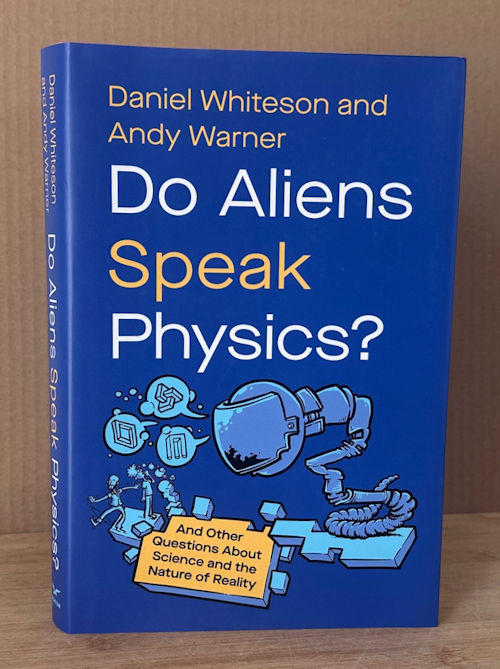
Here’s a book that’s remarkable in an unusual way: I didn’t hear about it from anywhere, not in a review, not referenced from somebody else’s book. And I had never heard of the authors. I saw it in a bookstore, and bought it on impulse. (Well the blurbs from Sean Carroll, Carlo Rovelli, Phil Plait, and Daniel Dennett helped.)
It was a good decision, because the book speaks to a profound issue, even if it’s a little too wiseacre and jokey for my taste. As if they didn’t expect a serious reader to be interested?
The question the book asks could be rephrased, would aliens perceive the universe the same way humans do?
It’s been asked before, and science fiction writers have certainly speculated in various directions in attempts to answer. (For example, the aliens in Ted Chiang’s “Story of Your life,” adapted into the film Arrival, perceive time differently than humans do.) Some have speculated that creatures that evolve in very different environments than humanity’s would perceive things differently, or at least prioritize certain observations and conclusions (e.g. as scientific laws or rules), differently than we do. Creatures that live in the sea, for example, or in continuous flight, or even in space, if that would be possible. On the other hand, it’s hard to imagine how mathematics would be different, especially basic arithmetic: one plus one equals two everywhere and for all time, right? Unless counting things is irrelevant to creatures who live in the sea.
I’m going to clean up the summary below, then return here and add a few bullets of interesting points they make, especially if any of those points challenge my thoughts just outlined.
Key Points
- The authors use the Drake equation as a framework, adding extra terms: whether aliens can be understood, whether we can communicate, etc.
- The deep question might be: would we understand to what extent humans perceive reality? Or would we discover that our entire science is unavoidably human-centric?
- Interesting observation that humans have had technology long before we had science; we used it without understanding why it worked.
- On math: even humans have discovered non-intuitive math, and it’s easy to imagine how math in different environments (e.g. near a black hole) might be quite different than ours. And our complex numbers are like 2-D numbers; are there other multi-D numbers? Whether aliens would use the same math as us is unresolved.
- We understand that humans perceive very little of reality… and only at certain scales of time. We understand that animals perception is very different than ours.
- Maybe our science is just a ‘story’ no better than that of aliens. Still, our stories are about real things. In other universes, perhaps relatively simple stories aren’t possible; would in turn preclude the development of intelligent life? [[ Ideas here recall Donald Hoffman… ]]. Our view of the universe is a nested set of layers of reality; perhaps aliens would perceive different layers. [[ These ideas recall Sean Carroll and others. ]]
- Could aliens reveal the deep secrets of reality? Or perhaps there is no secret, just mathematical hacking, an endless series of approximate truths. Still, aliens would likely help, in some sense.
- Or perhaps aliens discover some different truth or reality – that’s just as valid as what we perceive. Yet some would say if both describe the actual universe, they must in some sense be the same.
- Similarly, there may be fundamental truths, reached by different ways. E.g. the discoveries in human science would be the same even if they’d been made by others.
- Aliens may be too smart for us to understand them, just as dogs can’t understand what humans do.
- Bottom line: if there are lots of aliens out there, humans might fail to connect with most of them, for one or more of the above reasons. But we only need one.
The last point is key, and underscores the book’s message that there simply is no easy, obvious answer. If anything, it is to say that pop sci-fi’s portrayal of aliens, as very humanlike, is almost certain wrong; it’s simplistic and naive. Reality is more complex than most people imagine.
*
Detailed Notes
Each chapter begins with an “Alien Contact Hypothetical” over two or three pages. I’ll put these in italics. Also, there are lots of rather silly illustrations throughout the book, sometime depicting people whom they cite in the text.
Introduction
- Imagine the day they arrive. Would it be an exchange among scientists? Or would our questions not make sense to each other?
- How alien are aliens? Likely stranger than anything humans have dreamt up. Maybe they don’t even do science. Perhaps they smell photons. Maybe our science is more human than universal.
- P6, How to answer impossible questions. Humans have been surprised many times by our discoveries. We can try looking backward. Just as we can speculate how Earth might have evolved differently. Silicon. Ammonia. Counterfactual thinking.
- P8, Going outside the box on alien science. Break the problem into pieces. The Drake equation, p9. Fortunately most of the terms’ estimates are promising. Authors extend the equation to include whether aliens can be understood, and so on. Another term is about having our kind of science; chapter 1. Another term is about whether we can communicate; chapter 2. Including math, chapter 3. Are we asking the same questions? Chapter 4 about perceptions, chapter 5 about math. And about whether we’ve converged on similar answers, chapter 6. Or whether our perspectives are too different, chapter 7. Whether we take different paths, ch8. And would we be able to understand them, ch9. Ultimately: is our physics a mirror reflecting an objective truth about the universe, or is it a lens deeply colored by our humanity? P14.
1, Do Aliens Wonder Why? Alien science
- Hypothetical: Master navigators on a planet blanketed in clouds. They travel between islands among waterways, and learn to navigate. They learn to float into the sky. And finally above. They see a black hole. They develop an intuition that lets them build warp drives, and travel between the stars.
- How do we know that aliens even do science? On earth we’ve had technology long before we had science. Pyramids, swords, beer, etc etc. Following recipes. So we can’t assume that behind technology lies science.
- P22 Alien Science. What do we even mean by science? Human methodologies have changed. Philosophers just thought about things. Only later came experimentation. Aristotle. Now we need demonstration that ideas are true. In the ancient world no one thought testing was necessary. (Nice analogy about a cookbook, 23.4) It wasn’t until the 1500s and 1600s that Bacon, Galileo, and others thought to try out the ancient ideas. Just try it. E.g. dropping a rock. Of course history was more complex. Indus Valley, south Asia, China. Science evolved. The word scientist wasn’t used until the 1830s.
- P26, Is science inevitable? Would aliens develop *some* kind of evidence-based process? Perhaps they do but then move on. But it’s all about a desire to understand the universe. People have always had questions and told stories. So it’s really about whether we share the desire to understand nature. And looking for stories that explain.
2, How Do You Say “Nobel Prize” in Alien, p29
- Hypothetical: A signal came in decades before. Then a ship approaches. It lands, a hatch opens, two visitors emerge. With a cart. Holding a woven carpet. Then another. They don’t respond to human attempts to communicate. They retreat into their ship. Days pass, and they emerge with another rug, showing the message sent from Arecibo in 1973. P32. By gesturing, some communication is established. Why did humans send them a digital rug? The confusion is sorted out and communication proceeds.
- It will be a great challenge to learn to communicate with aliens. Even between human languages is difficult. E.g. the word hygge, which doesn’t translate directly into English. It’s about Danish winters. So an alien language might easily describe things outside our experience. Let’s review how humans have done trying.
- P36, Sagan talks to the aliens. Carl Sagan was the first. He felt that all technical civilization would have a common language in science and mathematics. Before him: von Littrow, digging trenches in the Sahara and setting them on fire. Sagan and others designed a message for a plaque on the Pioneer 10 and Pioneer 11 spacecraft. Pic p38. Sagan developed a visual language, hoping aliens would be able to decode it. A hydrogen atom. Which changes spin every .704 nanoseconds. Thus, a unit of time. Still, the idea of electrons orbiting protons is completely wrong. Ideas of what atoms look like have changed, p41. Will aliens realize what that’s supposed to be? The plaques also contained a map. And the map shows nine planets, not eight.
- P43, Practicing on the dead. Consider translating our ideas into dead languages. But translating those languages is difficult. We managed to decipher hieroglyphics, but partly by luck. People used to think they were little pictures. They were wrong. It was only the Rosetta Stone that provided the solution. And it took a while to realize that the symbols represented spoken sounds. Similar story with Mayan writing. And alien languages will be equally difficult. Most of Etruscan is still unknown. Similarly the language of Easter Island.
- P49, Learning to Speak Alien. So we have to be pessimistic about learning to translate alien languages. But we’ll have the aliens themselves, and their knowledge. And interact in person. There are still many potential difficulties.
3, Does 1 + 1 = 2 Everywhere? Alien math. P53
- Hypothetical: Humans visit Betelgeuse. They see plasma currents in the outer layers of the star, alive. But aware? They find a model of nearby stars, visit those stars, find similar models. Are the stars just nodes in a galactic network? Humans build a fusion reactor and switch it on; and Betelgeuse recognizes them and changes its map.
- Physics may be the deepest science, but underlying it is math. What about alien math?
- P58, Mathematical machinery of the cosmos. History is full of examples where pure math has led to breakthroughs in physics. Maxwell. Higgs. It would be unavoidable for aliens not to build their science on the same foundations.
- P60, Counting on alien counting. Surely aliens would learn to count. Think of the brain as a computer. Turing and his machine. Minsky implemented one, and found that those that worked, counted. It’s a fundamental element of thinking. In any brain. An ideal person to strip math of cultural embellishments would be Noam Chomsky. Unlike Sagan and hydrogen, Chomsky starts first with math. With basic arithmetic.
- P64, Arithmeticking with aliens. But we have to use symbols. Even on earth we have different ways of writing math.
- P66, Overcounting aliens. But can we be sure? Aliens might be really weird. One anthropologist thinks the arithmetic scenario isn’t as likely as we’d like to think. Look at the assumptions. Consider parallel lines, or arithmetic near a black hole. Maybe some things just aren’t countable. Mountains. Plasma environments. Or what counts as the same kind of thing. To some perhaps every item is unique. Or, one, two, three, many. Electrons.
- P70, Is math just a human game? Do we discover math or invent it? Is there a grammar of math? Peano tried. Frege focused on logic. Set logic. Until Russell found a mistake, a paradox. Russell and others patched it up. But they didn’t solve the core problem. Eventually Godel showed logic can’t prove everything in math. So what does all this mean about aliens? It seems that they would develop similar rules, even if we don’t know where they came from.
- P74, Are numbers universal? Are numbers really real? Do they have a location? Where are they? But you need them to do stuff. They line up with things in the universe. But consider complex numbers. They’re like two-D numbers. They’re crucial for describing quantum mechanics. There are other multi-D numbers. But only certain numbers work.
- P77, Could aliens do physics without numbers? For one, some math just isn’t pretty. Why would that be? Perhaps there are other ways to think about the universe. Some people have tried, e.g. to build Newton’s theory of gravity without numbers or equations. Hartry Field. Avoid the concept of fields.
- P79, Will aliens use math? We think it’s fundamental, but we can’t know if aliens might not use something similar but different.
- P80, What can we say about f sub communication? [a term in the extension of the Drake equation] Zero, or one? We can’t really say.
4, Can Aliens Taste Electrons? Alien Perception.
- Alien Contact Hypothetical. An alien ship enters the solar system, heading toward the sun, sending out a request for food using neutrinos. The come from a star heavy in neutrinos and use them to generate their food.
- P87, The James Webb Space Telescope can detect long-wavelength photos that we shift into ‘false color’ so that we can see them. Various animals see other wavelengths that humans can’t. Mechanical eyeballs.
- P88, How much are we missing? Our senses are limited, and incomplete. There’s matter out there that’s intangible to us. Neutrinos. The sun generates a lot of them. A neutrino eyeball can see the sun at night, through the Earth.
- P91, Big neutral actually-invisible particles. There’s lots of other invisible stuff. Only 20% of matter in the universe is made up of atoms. Most of the universe is made up of dark matter. ‘Discovered’ to account for the gravity holding everything together. It’s everywhere.
- P93, Space-timing out on reality. And we misunderstand space and time. There’s more to space than Newton thought. Its curvature makes matter move. We also can’t detect things very fast, and can’t imaging things happening for too long. Like continental drift, and so on. Alien minds might be comfortable with longer or shorter lengths of time. Our mental picture of the world isn’t just incomplete, it’s misleading.
- P96, What universe do aliens see? The aliens will make sense of the universe depending on what they experience intuitively. Evolution selects for *useful* senses, not for truth experience. [[ a very central point of course ]] Ref. Donald Hoffman here. What can we learn from our own planet? Hearing. A wide variety of ears. Hearing in vertebrates vs that in insects. But hearing is only about 500myo, in 3.5by of life on earth. Hearing developed likely while learning to hunt.
- P99, Uncommonly sensitive. And perception might be much deeper or shallower than our own. Whole books have been written about dogs and bats and sharks. Dogs have smell; spiders sense vibrations; etc.
- P101, Uncommon Senses. There are senses humans don’t have at all. Electric fields (fish). Magnetic fields (birds). Sensations as different from each other as from our own… [[ remember: a color the children did not know! ]]
- P102, Sensing on alien planets. What possible senses would aliens have? That would be useful. Which depends on the habitat. Which depends on where life would evolve. Underground oceans? Microscopic scales? How about sensing dark matter? Quantum properties? Other properties we haven’t discovered yet?
- P105, What’s it like to be an alien? We construct our sense of reality. (cf Anil Seth) How would aliens make sense of their senses? A difficult problem. Consider spiders, an octopus. We interpret things in terms of things we already know. E.g. photons.
- P107, Alien ideas of the universe. If our context is common, then f sub questions is close to 1. Humans are good at interpreting… Helen Keller.
5, Do Aliens Argue About Planets? Alien questions.
- P110, Alien Contact Hypothetical. Contact is easy with critters on Europa. But Europeans view the universe through a lens of oceans. They think in terms of eddies. And wonder why we think in terms of particles. The problems of each species don’t interest the other. Eventually contact breaks off.
- Aliens who are too alien? The issue here is what kind of questions we ask, and those aliens might ask.
- P114, The questions of human science. We ask lots of questions, but probably not all those that can be asked. There’s too much of everything. Humans have an amazing trick. We can capture a simple, essential story out of the chaos. A story that makes sense to us. [[ This is a slightly new angle on the idea of ‘story’ ]] Scientific explanations are kinds of stories. It’s how we make sense of the world. But this is where our humanity might be creeping into our science, 116.5
- P116, Zooming in and out, particles to planets. If we couldn’t ignore the details, our science wouldn’t be possible. But it works at many levels. But would aliens tell similar stories?
- P117, Why these stories emerge. Still, our scientific stories are about real things. Wouldn’t aliens do the same? Thinking so may be a trap. Consider planets. The more we found, the more categories we needed. We focus on the biggest; why not focus on the smallest, the elementary particles? Fundamental particles. But they’re hard to define, and hard to make sense of. Particles are part of the fabric of reality, and can’t be considered individually. Our science depends on considering some zoom setting and draw a line around it, ignoring all the rest.
- P122, The Tiniest Stories. Can’t we just zoom in all the way? But what are the basic bits? We can guess based on the physical constants. We can get the Planck length. But it’s a guess, for the smallest possible length in the universe. We may be combining the wrong units; donut example. Maybe there is no smallest piece, maybe the universe is gunky.
- P125, Alien questions. Consider a 3-D dolphin from its 2-D surface. How do universal rules emerge? Philosophers disagree. … Consider weather. Sometimes simplicity emerges, other times it does not. Why? Either way, we can’t assume we’d share our understanding with aliens.
- P128, Simplicity doesn’t emerge. Maybe there are independent laws at every level. This might make it more likely to share ideas with aliens.
- P129, Anthropic aliens. Perhaps we’re just lucky to live in a universe in which simple science stories emerge. Maybe in other universes they wouldn’t. But in such universes, would intelligent life evolve?
- P130, It’s all in our heads. Or maybe simple laws don’t emerge, maybe it’s all in our heads. We’re imposing our mental biases. We just make things up. Donald Hoffman. Like icons on our computer screen. We construct mental models. Aliens would have, in effect, different operating systems.
- P133, Our view of the universe. We perceive a nest set of layers of reality. Each layer glosses over the details of the lower. We really don’t understand how it’s possible. But the issue is whether aliens would see the same layers.
- P134, So what about f sub questions? As in the previous chapter, we can’t say. If might be almost 0, or close to 1.
6, Mad Max: Electron Road! Laws of alien science
- Alien Contact Hypothetical, p137. Scientists line up for the arrival of an alien ship. Even after several ever-bigger Colliders, questions remain. The aliens reveal there are no deep answers. It’s just number crunching. With which, they can do everything. The aliens show humans how to build their quantum computers, and everyone is happy… except for the physicists. [[ look up that old Effinger story ]]
- Physicists are lazy; they just want to find the big picture that explains everything. Can we just wait and find that out from the aliens? That depends whether such answers are possible. Perhaps it’s all just hacks, as in the hypothetical.
- P140, Revealing the full truth. Analogy with a murder mystery. Clues are gathered, suspects are eliminated. Sometimes it works that way: Maxwell, later Higgs. But can we always rely on this?
- P141, Approximate Truths. The problem is that some of the puzzle pieces have fuzzy edges and so are hard to fit together. Approximations in our calculations. Example of smooth quartz balls in a satellite. Not perfectly smooth. We can’t be perfect about everything. We never know exactly.
- P144, Approximating Meaning. So we deal with inconsistency and chaos. We try to keep inconsistencies to a minimum; we can’t keep track of every particle. So we average particles in a baseball. This informs the idea of phases, including those of the universe—quantum fields, the particle phase, etc. So maybe our partial stories can never be merged.
- P149, Impossible Understanding. Maybe aliens can do better? Perhaps the universe is following some underdiscovered physical laws we just can’t perceive. Or could the universe be lawless? How can we tell? So far, we can’t. Like what would happen to a paper airplane in a hurricane. Some philosophers believe we can never bridge the patches of understanding. If this is true, the aliens won’t help us.
- P153, The Good News. Still, the patches of science the aliens have found might be different than ours. So they aliens will help us in some sense.
7, What’s Behind the Alien Curtain? Alternative alien science.
- Hypothetical: A pair of twins cracks the Theory of Everything. Aliens show up and say it’s all wrong. Their theory is about bubbles. As years pass and they study each other’s theories, they discover both work.
- Rival teams worked to discover the Higgs boson, and jointly announced. Earlier example. Maybe the aliens will have the same science story that we do. But if not? What would we learn?
- P161, Relative Truth. Suppose there are two deep truths. It would be like relativity paradoxes. Examples. How time flows differently. Similarly with fields. Yet these aren’t conflicting theories.
- P163, Relative Reality. But are different theories possible? We know devices can be built with differing mechanisms… There are always gaps between data and an infinite number of ways to fill in the gaps. Descartes; The Matrix. Newton gave way to Einstein. Resolve alternate theories with more data. About that object, Oumuamua. It sped away before we could get much data.
- P170, Relative Skepticism. But some philosophers do think there is a unique set of rules that the universe is following. Or if there seem to be two that predict identical results, they’re really the same. How about quantum mechanics? Schrodinger and Heisenberg described it differently. Von Neumann showed they were equivalent. To some, science is just about predicting future data, never mind what’s inside the box. (This was a point from Deutsch? Or somebody else? About what ‘to explain’ means.)
- P174, Relative Importance. We’re searching for a single explanation of *why* things happen. Is it important that the aliens tell the same story? Whether they do may just indicate how much our two species have in common.
8, Do Aliens Drink Hot Cocoa? Alien science history.
- Hypothetical: Aliens arrive via a wormhole that scooped up a bunch of children when it first appeared. Humans follow the aliens to rescue the kids, and find descendants who have grown up with an intuitive understanding of complex numbers…
- Mountains—there’s not always one best path to the summit. Whether physical, or scientific.
- P183, Nonlinear science. So, assume that there *is* a single coherent theory of the universe. Think of falling apples and how our ‘explanations’ changed over time. And there are plenty of failures that never get into the history books. Human science is currently on a conceptual ledge. Would aliens find the same ledge? Look back at human history.
- P186, The many possible paths of science. Galileo somehow never realized he had seen Neptune. Similarly we might have discovered radiation a century earlier than we did. Details. We might have had a different understanding of relativity.
- P191, Alternative Earths. Suppose there’d been no Aristotle. We have alternate earth experiments in the histories of various ancient societies. Sumerians, Egyptians, etc etc 193t.
- P193, The sprouts of science in the fertile crescent. The Sumerians studied astronomy to manage the seasonal floods. And Venus especially. But they never developed a concept of ‘nature’ as separate from human beings. And others. The Greeks put everything in spheres. The Antikythera machine.
- P197, Astronomies of the Silk Road. Consider the ancient Chinese. Their calendar was standardized and accurate. Their math was based on tabulation and arithmetic. Not geometry. The Jesuits brought them telescopes in the 1600s.
- P200, Going west for chocolate. The Mayans – completely cut off from everyone else. The Catholics burned all their codices by 1600. The Maya focused on time. Which was cyclical. They used astronomy for calendars; they used base-20 number system; they invented the concept of zero. They weren’t geometric thinkers. They developed the cocoa bean and made chocolate.
- P204, A limited natural experiment. Limited because the itch for colonization wiped out some examples. But they all had mathematics. Advanced aliens might learn things in a different order. Either way we can benefit.
9, How Smart Are the Aliens? Alien intelligence.
- Anika is the first human at the Alien Physics Academy. To receive their “gift’ of knowledge. Using an AI assistant. An alien black cube. It’s dazzling. Then she stumbles. The concepts become a blur. The session ends. Her notebook has her notes. The aliens return and invite the notebook, but not her.
- Aliens might have been around for billions of years. Humans only a few tens of thousands of years. How could we understand everything they know? Perhaps we’re not up to the task.
- P216, Standing on alien giants. We know the brains of dogs and cats aren’t equal to our own. Even dolphins. Pinker: the mind evolved for survival, not for doing math. Maybe heads are already too big. Many philosophers of biology and the brain think there are concepts that lie beyond our understanding, 218.6. So would we be able to understand alien physics? And yet, we already understanding more math and physics than we need to survive…
- P218, What makes us special. Like group theory and complex numbers. Perhaps human intelligence is of a different kind. Chomsky suggested some evolutionary event rewired our brain, leading to language. And now kids know more than their grandparents, due to the plasticity of their brains. But no brain or computer or infinity can contain everything. Physicists could just add more axioms. Dennett points out that dogs and cats can’t understand relativity, they also don’t understand the questions. So perhaps the aliens can answer any question we might have.
- P225, Playing chess with your dog. Maybe science and math are like problems like free will and consciousness – they tease the limits of human cognition. There are no easy answers. …
- P227, Artificially intelligent physicists. Computers can already solve some games. Perhaps problems of particle physics. Neural networks have helped. But getting the answer isn’t the point; knowing the how and why are. The Haldane quote. There’s no guarantee we could understand it.
- P230, Quantum aliens. We’ve already come across ideas that work without us understanding why; quantum mechanics. Perhaps our cognitive abilities don’t conform to the nature of the universe. Perhaps we can relate new ideas to those we already understand.
- P231, Relative understanding. What would the ancients think of our current ideas? You’d have to get them before school age.
- P233, What can we say about f sub answers? So a lot of things have to go right for us to understand what aliens might tell us. Smry. So that value isn’t 1, but there’s hope it’s not absolute zero.
10, The Human-Alien Science Dating Pipeline. The big alien picture.
- Now consider *all* the alien species out there. Maybe there’s be some aliens compatible with us. As with the original Drake equation. We meet them all; we dismiss those who don’t do science the way we do, then those etc etc. How many are left? There might be very few. But we only need to find one.
- P239, The Good News. And just the time spent thinking about all these alternatives helps us spot alien ideas even without aliens. To keep open minds.