
Subtitled: Will Technology Force Us to Choose Between Privacy and Freedom?
(Addison Wesley, April 1998, 378pp, including 42pp of notes, follow-up, acknowledgements, index, and about the author.)
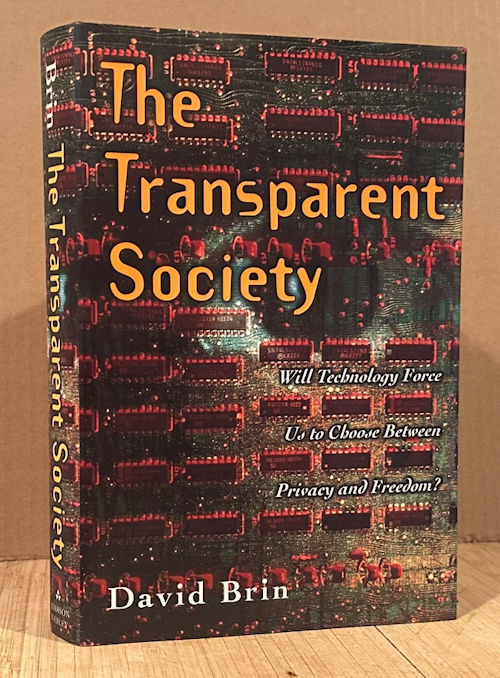
Here is a book that has sat my shelves for over a quarter century, unread. At the same time, I see enough of Brin’s commentaries on Facebook, and in his weekly blog posts, to know where he’s coming from. So for this book, I’ve given a sort of ‘inspectional’ or ‘summary’ reading, not a close reading of every chapter. This means I’m trying to spot the subjects he discusses, and focus in only on those I find especially pertinent to my own interests. And there were a couple of those. The most interesting core of the book is Chapter 5, about human nature and the maturity thesis. “We must choose it because it’s our only hope.”
Also, since this book is a quarter of a century old, would its themes still be relevant today? Actually, what struck me as I paged through the book was how familiar all the issues of 1998 still are of concern, in 2026. The information revolution happened in the 1990s, and all the issues then are still playing out today. (Simple example: license plate camera readers in Oakland are still under debate.)
The theme of the book is about the the idea of an open society.
*
Part I: A New World
Ch1, The Challenge of an Open Society. Brin imagines two cities. In both are multitudes of tiny cameras that monitor everything. In one only Police Central can see the camera feeds. In the other, everyone can see the camera feeds on their wristwatch TV. Which would you prefer to live in?
Details about other technologies: sound pickup, night vision goggles, drones, mail scanners, databases. Already underway; too late the stop it.
Some general principles: #1, in all of history, the only antidote for error is criticism. #2 Which is what leaders hate to hear. #3 People tend to demand accountability for others, privacy for themselves.
P15, outline of book. Pericles, 2500ya, had ideas about democracies, but they were not obvious to most people, and Plato advocated against them. It’s taken until the past couple centuries for the idea to emerge again. It’s partly about the flow of information. Recalling Megan’s Law vs ACLU; Popper, Dilbert, Soros, Kevin Kelly. [[ This is about what Harari’s latest book is about. ]]
Normal people’s concerns about whether their boss can see their emails at work, etc. A final thought: it’s hard for recent cave dwellers to transform themselves into smart, honest, and truly independent creatures of light. P26
Aside: about photography as no longer proof of anything.
Ch2, The Age of Knowledge. Space age, atomic era, now the Information Age. The Internet and its critics. Xenophobia, fear, abnormality, rates of violence. Animal rights, diversity. Never in history have eccentrics been as rewarded, 44b. Also, never have so many had not just hobbies, but are aficionados [[ aligns with Harari about replacing work ]] since they have time. Internet, Usenet; these are not escapes p47-8. Nothing in history will ever again be lost.
Aside: citizen truth squads. [[ like modern day private eyes / conspiracy theorists. ]]
Ch3, Privacy Under Siege. Examples of the IRS, spying in the workplace, credit ratings, ID theft, tracking cars…. Medical records, supermarket loyalty cards.
Was the past really better? No. Old newspapers, for example, gave the exact address of everyone mentioned in the news. There was no golden age of privacy. The 4th amendment doesn’t cover local matters.
Personal goal? A philosopher has described 4 kinds of privacy: solitude, anonymity, reserve, and intimacy. In all these, we’re better than before; these are benefits of freedom.
Reciprocal Transparency. The reflexive response to privacy threats is just to shut it down. Better is this idea: reveal about yourself exactly what you collect about others. Golden Rule. Sherry Turkle.
Aside: the accountability matrix, recalling Ralph Nader.
Ch 4: About who owns information. Because revenue. A discussion of the end of copyright, the idea of patents, intellectual property, micropayments, and so on.
Part II: Minefields
Ch 5: Human Nature and the Dilemma of Openness.
Brin surveys ancient sages and modern advice writers, and concludes they all advise basically the same thing: be nice. But it doesn’t work. In fact, most moral systems boil down to a set of proscriptions about what to do and *not* to do, which I’ll summarize from p118:
• If you’re a leader, take care of your followers
• If you’re a follower, be respectful to those above you
• Treat your immediate neighbors with courtesy
• Conform
• Propitiate unseen powers: bribe the sage or witch doctor
• By wary of strangers, and deviants in the tribe
• Work hard. Respect your elders.
• Try to be nice; cooperate, get along.
Sound familiar? Moderners would quibble about some of these; the paradox of the peacock, i.e. lying, and self-deceit. Also a general rule: A society is best served if leaders cannot suppress or evade criticism (120b). This requires free speech.
But, aren’t some ideas inherently dangerous? Examples. Thus many people would defend orthodoxy, insisting that some ideas *are* dangerous. Even if some of these ideas are fiction. While other people welcome new ideas.
Brin thus characterizes two stances. Those afraid of new ideas exhibit the “frailty thesis”. The opposite is the “maturity thesis”, p124b:
“It posits that we can learn from our mistakes (and those of our parents), growing wiser, in effect inoculating ourselves against the deleterious effects of bad ideas, while remaining open to good from any source.”
And he quotes Stefan Jones: “The flip side of living in tribes is living in the world – in the kosmos.”
Nice discussion, page 125. Here’s some more:
“Even in the neo-West, where the maturity thesis has gained belated prominence, large constituencies still hold to older views of human nature. A belief that information can be dangerous pervades all boundaries of class, ethnicity, or politics. While the “religious right” pushes to expurgate prurient or race content from the mass media in order to protect families and children, an equal devotion to censorship now burgeons from many radicals of the left… “
Later: “A major society has based its legal code, education system, and mass media on the maturity thesis. In particular, the essential protections of the United States Bill of Rights are rooted in a belief that free individuals can be trusted to weigh contrasting arguments and reach conclusions that, if imperfect, will at least be right often enough to justify governance by universal franchise.” (125b)
Brin then considers the dispute about whether evil manifests itself only in what people do, or in their thoughts as well. And then he observes how the media, including movies, almost always advise people to rebel, rather than conform. (My comment: That’s because art, in any form, is inherently open to the new and different, and this is why conservatives don’t like art that challenges their religious verities.)
He admits there’s no simple answer.
There is no satisfying conclusion. No encompassing generalization, except to reiterate that humans are complex. No smug ideology ever encompassed the range of our quirks – the highs some can reach, or the lows that others plumb. In an open society some vulnerable folks are sure to be traumatized. But if we choose paternalistic (or maternalistic) guidance, it will only guarantee that our brightest feel stifled and muzzled; and our culture will be much poorer for it.
After a paragraph of parental advice, he concludes:
And yet, despite our lack of a perfect answer, there can be no equivalence between those two ancient, conflicting worldviews. While compromise and flexibility may be called for on a daily basis, one basic assumption should underlie society’s approach to the information age. In the long run, defensive shrouds simply don’t protect us as well as agility, the capacity to appraise and reevaluate as we go along. People acquire good judgement through practice, even if a milieu of ongoing uncertainty makes citizens feel queasy at times.
We must choose the maturity thesis. Not because it is inherently right, or because it works for everyone. (It doesn’t.)
We must choose it because it is our only hope.
And he wants each of us to remind ourselves once in a while: “I am a member of a civilization.”
\\
The rest of the book, more briefly:
Ch6 is about “accountability” and covers “commons,” Garrett Hardin, and how commons compare to the internet.
Ch7 is about Secrecy.
Part III: Road Maps
Ch 8 is about Pragmatism, problems with ID, SSN, names and passwords, pseudonyms.
Ch9 is about Humility, about whether, mathematically, secrecy is even possible. First step toward wisdom: “I could be mistaken” (p294). There’s a nice passage, p307, too long to quote, describing the steps in the creation of an ideal world of individual sovereignty: from rising wealth, the desire to be special, the proliferation of avocations or hobbies, that since human nature will not change would-be oligarchs will always find ways to gain advantage by cheating the system, and how while poverty will never go away the increasing interconnectedness of the world will enable methods of ameliorating it.
Ch10 is about Global Transparency, about why it’s said that democracies never fight each other. About Netwar, cyberwar, hackers. A quote from Jacob Bronowski about the superiority of scientific empiricism over parochial rules that guide our governments.
And Ch 11 is about “The Road to Openness.” Free speech, accountability as the only defense, the contrast between and open world (good) and a closed one (bad). Brin asks, “What use is a civilization unless it gently helps us become smart, diverse, creative, and confident enough to choose, of our own free will, to be decent people?” And how the “three greatest, most successful endeavors of humanity [are]: science, free markets, and democracy.”