- Cultural norms changed about exercise, and maybe they can change to address the harms of social media — by reading more;
- How the faithful grasp at straws to find societal reassurance;
- More about JD Vance and demons;
- How the government is purging information about gender identity;
- Rufus Wainwright’s “Greek Song”.
Here’s another item that’s about, in part, reading.

NY Times, guest essay by Cal Newport, 27 Mar 2026: There’s a Good Reason You Can’t Concentrate [gift link]
The essay begins with a reminder that cultural norms change.
Today we take for granted that diet and exercise are vitally important for our health and well-being. But we didn’t always think this way. Much of this awareness emerged in a remarkably short time during the middle of the last century.
In 1955, President Dwight Eisenhower suffered a heart attack after playing golf in Denver. This event shocked the nation. The president was just 64 years old and projected American strength and vitality. The surgeon general at the time said that hearing the news about the heart attack was like learning about the bombing of Pearl Harbor.
Instead of retreating into secrecy, the White House flew in Dr. Paul Dudley White, a leading cardiologist who helped found the American Heart Association. He set a standard for transparency. When he spoke to the press, he went beyond explaining the president’s condition and sought to educate the public about cardiac events more generally.
“Heart attacks became less mysterious and less frightening to millions of Americans that day,” explains a New England Journal of Medicine article, “and White gave them the message that they could take steps to reduce their risk.” The idea that diet played a large role in mortality soon entered the national consciousness.
And then he comes to:
Some 10 years later, Dr. Kenneth Cooper, a military doctor who conducted fitness research for NASA, published a book titled “Aerobics.” He promoted a novel argument: Cardiovascular exercise was critical for health. In an era when people increasingly had sedentary jobs and lived a car-based lifestyle in the suburbs, he emphasized the need to specifically put aside time to exercise as a key component of longevity.
This was a radical idea in a culture in which voluntary exercise was associated primarily with the Army or sports. “Aerobics” became a best seller, and millions of people began exercising. According to Dr. Cooper, when his book was first published, less than 24 percent of the adult population engaged in regular physical activity, and there were fewer than 100,000 joggers. Within 16 years, close to 60 percent of the population exercised, including 34 million joggers.
I remember that book! I’m not sure I ever owned a copy, but by the time I was living by myself in the late 1970s, at first bicycling a lot and then taking up jogging, the cultural value of aerobic exercise was well in place.
The larger point is that transformations in understanding can unfold quickly. Just decades after Eisenhower and Dr. Cooper, we got the food pyramid, the term “low fat,” the running craze and Jane Fonda videos. Americans would never think about food and exercise the same way again.
So this initial point is another about how cultural norms change. The main point is that the writer thinks we need a similar revolution to address the declines in cognitive skills and attention spans that have come about due to social media.
Many of these declines in cognitive skills became notable starting in the mid-2010s, exactly the period when smartphones became ubiquitous and the digital attention economy exploded in size. An increasing amount of research implies that this timing is no coincidence. A meta-analysis released last fall showed that consuming short-form video content, as delivered by apps like TikTok and Instagram, is associated with poorer cognition and reduced attention, and the results of a clever experiment from 2023 found that the mere presence of participants’ smartphones in a room significantly reduced their ability to concentrate.
And now there’s AI, giving people an excuse not to think hard about anything. What are his prescriptions?
First, avoid TikTok (one of its videos is like a digital Dorito, he claims), Instagram, X. And asks,
What’s the equivalent of this cardio for our ailing brains? A good candidate is reading. Making sense of written text exercises our minds in important ways. We develop what the cognitive neuroscientist Maryanne Wolf calls “deep reading processes” that rewire and retrain neuronal regions in ways that increase the complexity and nuance of what we’re able to understand. “Deep reading is our species’ bridge to insight and novel thought,” she writes. Perhaps consuming a few dozen book pages a day should become the new 10,000 daily steps — a basic foundation of activity to maintain cognitive fitness.
And, put your phone out of reach, etc. And he concludes,
I think we’re finally ready for a similar burst of self-reinforcing action in defense of our cognitive fitness. What I’ve laid out here is not a complete program to reclaim our heritage as contemplative beings but instead a useful starting point. My intention is to spur a shift in understanding that can build into a larger revolution. I’m done ceding my brain — the core of all that makes me who I am — to the financial interests of a small number of technology billionaires or the shortsighted conveniences of hyperactive communication styles. It’s time to move past fretting about our slide into the cognitive shallows and decide to actually do something about it.
We did it before. We can do it again.
\\\
Grasping at straws. There have been conflicting reports in recent years about whether religion in the US is declining or re-surging.

NY Times, Ross Douthat, 28 Mar 2026: Is There a Religious Revival in America? [gift link]
My question in reading this is, why is this so important to him? (Douthat is NYT’s reliable defender of the value of faith.) And is he concerned only with Christianity, or religion in general? (Dumb question.)
In the early 2020s, secularization stopped: After rising for 15 years, the nonreligious share of the American population suddenly stopped growing. Ever since, there’s been a vigorous debate over whether this plateau is a precursor to religious revival or just a leveling off preceding a further fall from faith.
The revivalists tend to have vivid anecdotes — Bible sales climbing, young American men storming the doors of Eastern Orthodoxy, Catholic baptisms surging in France. The no-revivalists tend to have deflating data. No, Gen Z isn’t more religious than the millennials. No, evangelical churchgoing didn’t surge after Charlie Kirk’s murder. Yes, church attendance is ticking up in some traditions, but it might just be churches regaining people who stopped going during the pandemic.
He cites more evidence and squints to find some hopeful interpretation. Which ever way the evidence goes.
In such a moment, it’s entirely possible to have a spirit of revival or intensified belief among the restless and spiritually curious — yet also a continued decline in religious practice among cradle believers. (And as birthrates drop, a decline in the number of people born into a religion, period.)
This combination seems to fit with the broader spirit of the digital age, in which custom and inheritance are ever-weaker forces, and agency and intentionality determine whether people do the kinds of things (make friends, start families, go to church) their ancestors would have done more automatically.
Back and forth. Concluding:
Jesus did not say, “Blessed are the agentic.” Christianity is not supposed to be primarily a faith for educated strivers. And any revival that doesn’t give the drifting or disaffected a surer reason for belief, that doesn’t lift up the lowly or reach the poor in spirit, would be a revival unworthy of the name.
\\\
Another piece about this guy.
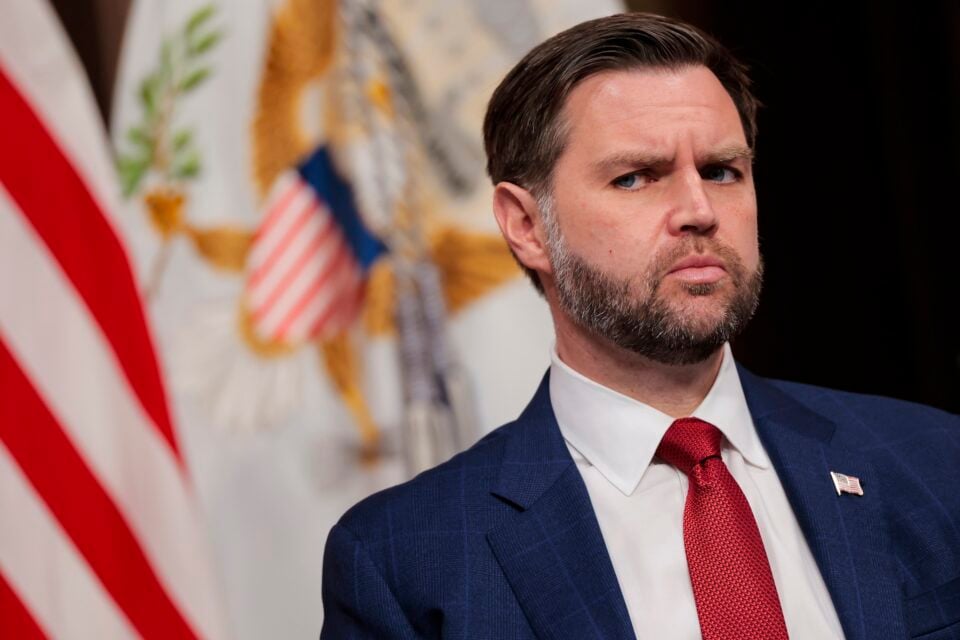
Gizmodo, Matt Novak, 28 Mar 2026: JD Vance Says UFOs Are Actually Demons, subtitled “I think that one of the Devil’s great tricks is to convince people he never existed.”
JD Vance says that UFOs aren’t aliens visiting Earth from distant planets. The Vice President thinks they’re actually demons.
Vance sat down with Benny Johnson, the right-wing influencer who was fired from two different media outlets in the 2010s for plagiarism. Johnson asked the vice president: “Are you going to release the UFO files?” a reference to President Donald Trump’s promise in February to release secret information on UAPs.
He fails reality-literacy. There are no demons. (Why do we have to keep humoring these people?)
“I mean, every great world religion including Christianity, the one that I believe in, has understood that there are weird things out there and there are things that are very difficult to explain,” said Vance. “And I naturally go, when I hear about sort of extra-natural phenomenon, that’s where I go to is the Christian understanding that, you know, there’s a lot of good out there, but there’s also some evil out there.”
A naive, childish view of the universe.
\\
An example of Brin’s discussion (see yesterday’s post) of how frail people are afraid of and would suppress knowledge they think is dangerous. (The Trump administration has been doing this over and over again.) (Also, Harari’s main point about how authoritarian administrations suppress the flow of knowledge.)

LGBTQNation, Anna Rogers, 26 Mar 2026: Trump’s minions have quietly disappeared most federal data on gender identity, subtitled “Some agencies went even beyond what the president ordered on day one.” (From Mother Jones)

Thus the concerns of MAGA and the Trump administration.
\\\
Before I take my Rufus Wainwright CDs back down to the garage and he falls away from immediate attention, let me note this song, my favorite of his for a long a time. (Except perhaps for “Go or Go Ahead.”) Motoring around in Greece on a Volta (not a Vespa, as I’d misremembered).
“All the pearls of China
Fade astride a Volta…”