Subtitled “What It Is, How to Find It, and Why It Still Matters”
(John Hopkins University Press, Jan. 2026, 370pp, including 50pp of acknowledgments, notes, and index)
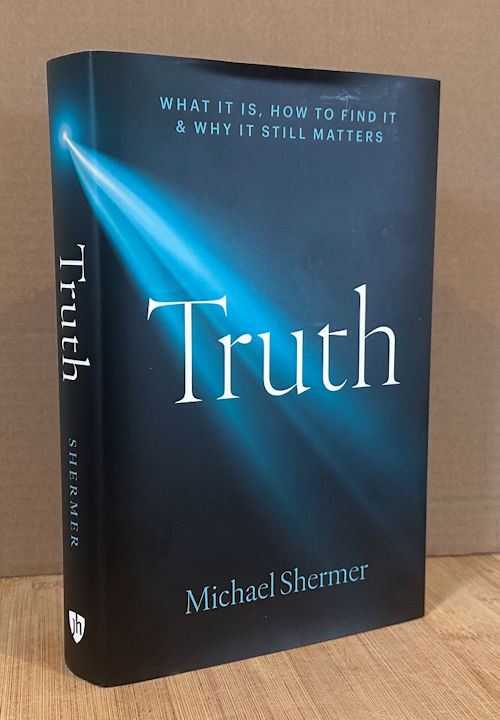
The title of this latest book by Michael Shermer, following CONSPIRACY (2022) (reviewed here), perhaps begs a question. Readers of Shermer will presume he’s talking about ‘truth’ as objective knowledge, what is verifiably true, and so on. And not what a religious believer, for example, would claim as ‘truth.’ But in fact Shermer discusses various kinds of truth, not just objective truth — but then shows how subjective truths, religious or personal or whatever, are not objective truths.
The book covers such a wide variety of topics, from those different kinds of truth, to religion and miracles, history and morality, aliens, consciousness, free will, God, and existence itself, that Shermer inevitably revisits some of the topics from his earlier books. At the same time, the scope is so broad, and surveys the opinions of numerous key thinkers on all of those topics, that it amounts to a compendium of current thought for readers who have not read a lot of those other books. I’ll note a lot of those thinkers and their books in the detailed summary.
Key Points:
- Author claims that science, reason, and empiricism are the best tools we have for assessing truth (any kind), and that the ways we reach a consensus about truth involve epistemology and ontology.
- He breaks the book into three sections, based on famous remarks by Donald Rumsfeld: Known Knowns; Known Unknowns; and Known Unknowables.
- In the first section he rejects claims that we live in a post-truth world, or that there are no objective facts. Truth is not about belief; it’s about accepting evidence about reality. He reviews principles for identifying such truths, and contrasts subjective truths from objective ones; how we can think around logical fallacies and cognitive biases; how to adopt a mindset that avoids such fallacies. Then he reviews correlation vs. causation, Bayesian reasoning, how to determine cause and effect, and then how to think about highly unlikely events, like coincidences and miracles.
- The second section concerns topics on which consensus may not seem to exist, but which the techniques just discussed have, the author claims, resolved any debate. These include religious and mythic truths; historical truths and the science of history; moral truths, claiming that objective universal values can be identified (others disagree, but this is Shermer taking his stand); and whether or not UFOs are ‘real’ and why people search for sky gods.
- The third section concerns matters about which, according to Shermer, doubts remain, or perhaps are simply unknowable. These include consciousness (including a discussion of the Donald Hoffman book I recently reviewed); free will (he rejects the hard-nose determinism of Harris and Sapolsky); God (revisiting and countering all the familiar arguments, from the ancients to the current intelligent designers); and about existence itself, why there is something rather than nothing.
- And the epilogue wonders, whether super-smart extra-terrestrial intelligences, or humanity itself as we continue to learn into the far future, whether, omniscience would be achieve virtually identical to gods.
Detailed notes:
Prologue
Author imagines getting a call at work from a neighbor about a break-in at his home. Police respond but say nothing’s going on. It’s analogous to the US Capitol on Jan 6, 2021, and the neighbor is the President, warning that the election is being stolen. Was Trump culpable? Probably. The rioters were acting on a certain kind of logic. Most of them actually believed the election was rigged. [[ Because, I think, many people don’t realize how difficult it would be to rig an election, given our infrastructure; they don’t know how the world works. ]]
But truth matters. This book makes the case that science, reason, and empiricism are the best tools we have for assessing truth. And it’s not true that everything is relative, that we live in a post-truth world, that all news is fake, or that there’s no standard for making such judgments.
This book examines many kinds of truth. It argues that there are ways to reach a consensus about the truth. Epistemology and ontology. Smry p4-7. …Ch7 will examine the foundation for an objective morality. Later, consciousness, free will, etc. The framing of these topics is from Donald Rumsfeld. Author adds ‘known unknowables.’ Things we may never know. Quotes Gould from author’s first book.
Part I: KNOWN KNOWNS
Quote by Alfred E. Mander about one has to learn to think…
1, The Truth About Post-Truth Truthiness: why we are not living in a post-truth, postmodern, fact-free world
About ‘truthiness’, introduced by Stephen Colbert in the first episode of his show in 2005. Then in 2017, ‘alternative facts.’ And ‘fake news’ later that year. Does this mean all our progress is being reversed? No.
- P12, What is post-truth? In 2019 author commissioned article by Steven Pinker about why we’re not living in a post-truth era. Lee McIntyre later challenged Pinker on a narrow definition of post-truth, concerning political power and propaganda. Similarly Tim Snyder in On Tyranny, and Hannah Arendt. But indeed there are people who can’t distinguish between fact and fiction, leading to all sorts of denials of reality. Or are they simply motivated toward such denials? Myside bias has been demonstrated across demographic groups. Even experts. Examples of ways we do that, 15t.
- P15, Postmodernism and its discontents, or why nature cannot be fooled. Challenger, the commission, Feynman, and how he demonstrated his thesis with a glass of ice water. Which NASA initially denied. F replied: reality must take precedence, for nature cannot be fooled. Then came postmodernism, and how the history of science was rewritten. 18t. The science wars. Alan Sokal. Later Peter Boghossian.
- P19, Countering postmodernism. There were critics of the critics, like Naomi Oreskes. (in Why Trust Science?) Concluding with the importance of diversity. You correct science with more and better science. One development was the rise of real-time fact-checking. …
- P22, How gullible are we? Maybe not as gullible as we think. Actually, we tend to reject messages that conflict with established views. Mass persuasion, like Jonestown and Heaven’s Gate, are rare. Most groups do not become cults. The various scams depend on only a small number being fooled. Most preachers and prophets fail too. Even Jesus was a disappointment; it took Paul to start the religion. And Hitler—most Germans did not fully accept him or his ideology. That’s why Nazi plans were kept secret. The regime was maintained via pluralistic ignorance, 25m. Also explains witch hunts. The first man who stopped clapping was sent to the gulag. Pinker doesn’t simply dismiss people as irrational; there must be other factors in play. He distinguishes between the reality mindset and the mythology mindset. [from Rationality ] With the latter, it’s not about them being true or false; they’re about a social reality to bind a tribe. Author’s shares Pinker’s notion of universal realism. p28.6:
- a mindset honored by most scientists, rationalists, and skeptics that the best approach toward understanding the real world and justifying true beliefs about it is to make a commitment to its existence and then apply the methods of science and rationalism to understand it. But for the vast sweep of human history, there were no tools for determining the difference between reality and mythology, between empirical truths and mythic truths. So, in accordance with our motivated reasoning toward our myside preferences, we default to believing whatever we want to be real and true.[Quoting one Daniel DeNicola] Such beliefs… are “not deliberately chosen; they are ‘inherited’ from parents and ‘acquired’ from peers, acquired inadvertently, inculcated by institutions and authorities, or assumed from hearsay.”
- P29, Factiness. Author coined this word in one of his SciAm columns. The quality of something seeming to be factual when it is not. We use science and reason to determine what is factual. It may seem Sisyphean, but we’ve been doing it for millennia.
Ch2, What Is Truth, Anyway? Justified true belief, the principle of universal realism, and why extraordinary claims require extraordinary evidence.
Beginning with a list of claims some dispute: global warming, germ theory, etc. Such as author is often asked. The error is asking about ‘belief.’ It’s about accepting evidence about reality. PKD quote.
- P32, Objective truths and justified true belief. Oxford’s definition of skeptic is too nihilistic; there are many things with adequate evidence for believing they are true. Examples. Other claims are so completely lacking in evidence that they can be dismissed. Assent for a scientific truth is always provisional; they are not like mathematical proofs, or logical inferences. Dennett distinguished between analytic truths and synthetic truths. Gould between fact and theory. We’re after knowledge, justified true beliefs. There are issues that philosophers debate. None of us is omniscient. Pinker Rationality. Mackay.
- P36, Subjective truths. These are about personal tastes, not external validation.
- P36, From subjective to objective truths. Subjective truths may become objective truths. E.g. meditation, where evaluating data can be difficult. But can be attempted.
- P38, Sagan’s Dragon. We need some form of external validation. Eg. The Sagan example. What can be asserted without evidence can also be dismissed without evidence. We need evidence, including what it would take to falsify a claim.
- P40, The ECREE Principle. Extraordinary claims require extraordinary evidence. Goes back to Hume; Sagan popularized it. Example of driving along Route 1 and being abducted by aliens. ECREE is all about confidence, not proof.
- P42, Negative truths and the burden of proof. These are where absence of evidence is evidence of absence. Asking for proof that something doesn’t exist is the wrong way about it. The burden of proof lies on the claimant. Examples of 9/11, Area 51, and so on.
- P43, Impediments to truth and how to overcome them. These are logical fallacies and cognitive biases, e.g. long lists 43b, 44. There are methods around these.
- P44, Practice active open-mindedness. How people commit motivated reasoning. Mentions Superforecasting. The worst forecasters are people with big ideas. The best practice active open-mindedness, e.g. 45b, including understanding how randomness is a factor, not believing that everything happens for a reason, etc. Guidance by evidence and not loyalty or refusal to change one’s mind. These correlate with skepticism of paranormal and supernatural claims, and trust in consensus science.
- P46, Valorize norms of reason and rationality. Pinker on this, especially for academia, and partisan media. And how norms change over time.
- P47, Avoid group polarization and echo chambers. Which reinforce irrational beliefs. Experiments by Cass Sunstein. The echo-chamber effect. Lee McIntyre on science deniers.
- P49, Develop a scout mindset. This is the opposite of the soldier mindset, in which deeply held beliefs must be defended. Realize that none of us is omniscient.
- P50, Protect and defend the constitution of knowledge. Jonathan Rauch. Who the reality-based community includes, 50b. [[ this is like the page of his book I photographed here ]] Features fallibilism, objectivity, disconfirmation, accountability, pluralism, and so on.
- P52, Accentuate norms of free speech and open dialogue. Why listen to those with whom we disagree? John Stuart Mill. Freedom of speech. Author’s reasons, p53, from an earlier book.
- P53, The search for truth is dogged as does it. Recalls trip to the Galapagos Islands, retracing Darwin. And five characteristics of Darwin’s cognitive style, p54. And Sulloway’s summary. A tension between tradition and change.
Ch3, The Truth About Why: causation, correlation, Bayesian reasoning, signal detection theory, and the determination of cause and effect.
Coffee, smoking, fossil fuels. Do they cause heart disease, lung cancer, global warming? Hume described constant conjunction. But conjunction does not always mean cause and effect; the rooster at dawn. Counterfactual causation.
- P57, Determining causality. Example of firewalking on TV. It’s not about new age energies. Similar to putting your hand into a 350 degree oven. It’s about conductivity. Dieting: there are many confounding variables. We can assess association first. We can experiment to isolate causes: the method is science, def. 59.4. Details. Testable and open to rejection or confirmation. Universal application. Some people accept evolution even as they misunderstand it. Definition from Feynman. And from Vincent Dethier. And from Lionel Ruby. Factual truths… Moynihan.
- P61, Science and the null hypothesis. Science begins by assuming something does not exist until proven otherwise. Anecdotes don’t help. There are statistical standards for rejecting the null hypothesis. Example of predicting black or red cards; how many needed to reject the null hypothesis? 35. Magicians can do it.
- P64, Correlation and Causation. Is a college degree worth the tuition price? Depends what worth means. Academics argue yes, just compare tuition to increased earnings. But is it really a correlation? Graph, p65. It’s not perfect; there are always confounding variables. Coefficient r goes from -1 to +1. Square it you get coefficient of determination. Example of twins and religion, and conflict with parents. Many factors influence the college education question, e.g. 68t. Consider also how long you will live. Randomized controlled trials. You can’t do such trials for some things; instead you do ‘natural experiments.’ Smoking. Blue zones where people live longer. Identical twins raised apart.
- P70, Bayesian reasoning toward the truth. Strength of evidence, etc etc. When the facts change, change your mind. Credence. Seesaw. Yet the same problem stated different ways can produce different results, 72-3. The bank teller. The representative fallacy. Lyme’s disease. Base rates; quote by Pinker.
- P75, Signal detection theory. About spooky events that really happened during the making of horror films. Examples, 75b. Put into proper perspective – 77t – there are no supernatural forces at work. There are many non-cursed horror films. The fallacy of excluded exceptions; confirmation bias. Psychics and astrologers. Cases where prayer doesn’t work. Signal detection theory is about looking beyond the examples that confirm your case. Examples about crime waves, abused children. Carol Travis. Metoo movement. Example tables of four cells. Hits, misses, false alarms, correct rejections. Criminal justice; covid lockdowns; marriage.
- P82, Why? The ultimate causality question. Judea Pearl book. Ladder of causation: association, intervention, counterfactuals. The last is the most sophisticated of the three, perhaps a turning point in evolution, 83.2. [[ Of course ‘counterfacturals’ are precisely what science fiction is all about ]] Thus much of culture, 83.5. Deutsch Beginning of Infinity. The source of our theories is conjecture. All knowledge is provisional. Quote by Deutsch. Knowledge-creation. Be the spark. [[ this echoes the knowledge creation theme of Azarian… ]]
Ch4, The Truth About Coincidences and Miracles: how to think about highly unlikely events., p85
About car license plates, odds, and survivor bias.
- P86, How to think about coincidences. Randomness is clusters of events. There’s no even distribution. Stars in the sky. Gould and glowworms. Book publishing. Qualities of successful companies. The biography of Steve Jobs; similar to survivor bias.
- P89, The sum of all coincidences equals certainty. Example from Martin Gardner. Anthony Hopkins. Humans like to infuse such events with meaning. But that is not how the universe works. What would be unusual is if nothing unusual happens. We notice coincidences after the fact – the Texas sharpshooter fallacy. Calculations.
- P92, Monty Hall’s mathematical misunderstanding. Etc. It’s always better to switch doors. Pinker and Kahneman. How our senses evolved for a midway land, or Middle Land. [[ <== A useful term. See also the new Oluseyi book. And Tong’s term ‘scale-blindness’ ]] Size, speed, time scales.
- P95, Hot hands and gambler’s fallacies. Hot hands are an illusion. Analyses were done. Runs of dice. Etc. If people with lucky streaks existed, the casinos would know. Loss aversion.
- P99, Miracles as highly improbably events. The hockey game: miracle on ice. We think ourselves lucky and don’t concern those who weren’t. Feelings and intuitions are not reliable methods. You have to calculate the odds. Similar with death premonition dreams. Given the number of dreams, etc etc. Non-events don’t make the news. We’re all susceptible to magical thinking. Article by Dyson. He was susceptible too.
- P103, Miracles as divine events. Christian apologists like Lee Strobel, The Case for Miracles. Then Loftus, The Case Against Miracles. Consider the concept of miracle. In prescientific times, virtually everything was a miracle. David Hume, 1758. Hume’s maxim. Today we realize even better how people are deceived. 105.3. Later, David Kyle Johnson. Author agrees with Loftus: a miracle is something impossible by means of natural processes alone. Recall the null hypothesis. Indian gurus. Fatima Portugal; all the issues with that. 1917. Other mass visions. So why believe Jesus and not the folks at Fatima? Lists of others, 110.4. And Muhammed is nearly as popular as Jesus: list of his miracles, 110b. Better to assume that none of them are real. ECREE.
Part II: KNOWN UNKNOWNS
Thomas Jefferson quote.
Ch5, Religious and Mythic Truths: how to think about the resurrection and other myths, p115
About a man born 2000 years ago… not Jesus, but Apollonius of Tyana, whose story was very similar. There were others. [[ Asimov points this out in his Guide the Bible. ]] Nothing about Jesus was unique. Osiris was resurrected too. Two and a half millennia earlier. Similar for flood myths.
- P117, Religious beliefs as mythic truths. Consider religion itself, def. Purposes: stories and myths that answer the deep questions; and the production of moral systems suitable for social primates. Here we focus on myths and their truth value. They’re not literal, but mythic truths. We should consider the deeper meaning of what a myth represents about the world itself that is true. We don’t worry if characters in a novel are real, but what they represent. Literary truths. A belief in the Trinity is a signal to group solidarity. The confusion of mythical and empirical truth is a problem for religious skeptics. Examples of ‘explanations’ for apparently supernatural phenomena. Joseph Campbell’s book. A later book outlines four functions of myth, 121m. Author expanded on this in How We Believe. Myths in all cultures share certain themes. Catalogue of human universals. Science of Good &Evil bk. Consider monsters and beasts; snakes. Rustle in the grass. Myths are ways of encoding such lessons. Dragons. Many cultures, along with dragon slayers. EO Wilson explained it. Author’s explanation for myths, 125b.
- P126, Oppression-redemption myths. The Ghost Dance, which led to the massacre at Wounded Knee. The story behind it was a myth. Similar in 1934, the Maori. Cargo Cults. [[ Newitz discussed these. ]]
- P129, The messiah myth. The Jesus story is a type of oppression-redemption myth. Jesus’ ministry from CD 27 to 30 codified some of the same ideas. A perfect society as a kingdom of God. To which anyone could belong. The idea of messiah; Paul, etc. So the central myth of Christianity, about living forever with God, isn’t literal, but refers to heaven within ourselves, or in the communities we build.
- P132, Myths as pragmatic truths. Bryan, Jesus, Martin Gardner. Gardner called himself a fideist, and believed in God and the afterlife for emotional reasons [[ I remember reading that book, decades ago ]]. But he didn’t apply the same reasoning to belief in the paranormal. Quotes. Theological questions are meaningless…
- P135, The resurrection as an empirical truth. Christians believe the resurrection to be literally true. Many believe someone called Jesus of Nazareth was indeed crucified. Now apply the principle of proportionality. There’s no evidence of anyone coming back from the dead, ever. Eyewitnesses can be superstitious or credulous—much more likely than Jesus literally returning to life. Compare Mormon evidence, or claims of black magic. Quote from Bart Ehrman. Gospel inconsistencies. 139t. How they were written decades later. Loftus. No corroborating evidence. Jesus was more likely a spiritual teacher who had a profound effect on many people. Lance Grande. Miracles were only reported decades later. Tests of faith. Told over and over until they were taken as historical facts. Why have Orthodox Jews never accepted the resurrection? They have their reasons. And Ehrman on three models of ‘divine men’. And many stories in ancient myths.
Ch6, Historical Truths: the noble dream of pursuing objective truth about the past., p144
Recalling the 1619 project and objections. Can we know what happened in the past? Quote from Karl Popper.
- P145, Toward a science of history. Author is trained in social science and history. Some of the sciences are historical. Some biblical stories seem to have basis in fact, others none at all. Similar for Atlantis. Plato invented it as a mythic place. Pseudohistory is the denial or distortion of the past for political or ideological reasons. Using techniques 147t. E.g. who preceded Columbus in the Americas. With similar bad methods, 147b. A major example is Holocaust denial. Their claims, 148. And answers. The deniers don’t play by the rules. [[ Shermer wrote a whole book about that. ]]
- P150, The convergence of evidence method of historical science. The Holocaust happened due to a convergence of evidence. Documents, eyewitness testimony, etc. Eisenhower began collecting evidence immediately, anticipating future deniers.
- P152, The rape of history. Of Nanking, in 1937. In China, by the Japanese. Another holocaust of World War II. Why did so few people know about it? The Japanese government won’t acknowledge it. It was news at the time, then faded with denials. Which continue to this day. Blame is on the West. Textbooks omit the topic. Or claim that atrocities happen in all wars on both sides. A section of the film The Last Emperor was excised without the director’s approval. Many similarities with the Holocaust. We know it happened because of a convergence of evidence. Today we see similar denialism from Putin about Ukraine.
- P160, The comparative method of historical science. As employed by Jared Diamond. …
- P161, Natural experiments in history. Diamond did a book on this subject too. Haiti and Dominican Republic.
- P164, Real revisionism versus dogmatic denial. Example of an Afrocentrist claim that Aristotle stole ideas from the Library of Alexandria – which was built after his death – and got criticism for being racist. Not all views of history are equally valid. This example is outright denial. Another example of Martin Bernal and Black Athena.
- P166, Romanticizing the past. Ken Feder and pseudohistory and five motives: money, fame, nationalism, religion, and romanticizing the past. Examples. The chalice and the blade. Yet that author seems to have a feminist agenda. Native American revisionists too. Custer Died for Your Sins. That author went from revisionism to denial, relying on Native American myths. Other examples. Graham Hancock. There are lots of rogues like him. Reasons why mainstream scientists reject them, 172-3. One is anomaly hunting; etc.
Ch7, Moral Truths: science and the search for objective universal values.
The author challenged Dennis Prager, who says that without God, anything goes. Author says there can be objective moral facts without divine command.
- P177, The naturalism fallacy fallacy. One problem is there’s no good reason to believe in a deity; another is Plato’s Euthyphro. Philosophers have built moral systems for millennia. Now scientists are joining them. Objections include the naturalistic fallacy, the is-ought problem. Author’s previous book The Science of Good and Evil addressed this. Later, The Moral Arc. Others: de Waal, DS Wilson, Joshua Greene, Haidt, Gray, Harris, Pinker. Critics say they are assuming what they seek to prove. But we can observe that people prefer some states to some other states.
- P180, From Is to Ought. Morality is about the survival and flourishing of sentient beings. A starting point would be the reduction of suffering. And with the individual. Thus definition of morality, 181.6. It counters liberal notions of identity politics. And conservative collectives. How do we quantify human flourishing? Measures of poverty. People who get out of poverty agree they are better off… Disease reduction. Pinker’s Better Angels.
- P183, From My Perspective to Yours: the principle of interchangeable perspectives. [[ This was in The Moral Arc too. ]] Philosopher Robert Pennock about factual premises… Pinker on abstract Platonic truths and how they drive us to some conclusions but not others. Desiring to flourish implies cooperation with others rather than living in a zero-sum world. Cf Wright, Nonzero. The transition from competition to cooperation has happened due to natural selection. Pinker on interchangeability .. The Golden Rule. Reciprocal altruism. Rawls. Lincoln, 1854, on ranking people. Spinoza.
- P188, Testing moral truths. Several of the founding fathers were trained in science and knew about gathering data and doing tests. That the 50 states have different laws means they are tests we can use to test different policies. Women voting; abstinence, abortion. North and South Korea. Ferris, The Science of Liberty. Still there are issues with competing concerns. Social spending. Most moral progress has been the result of using science and rationality to solve problems and increase the flourishing of more people. Scientific naturalism, or universal realism. Enlightenment humanism. 193.3.
- P193, Moral truths and enlightenment humanism. Lincoln on slavery: if it’s not wrong, nothing is wrong. Many at the time disagreed. How did things change? Author responded to physicist George Ellis about this. Author responds about the deepest purpose of life: to push back against entropy. That’s the ‘purpose’ of evolution. About avoid by surviving and flourishing. The outcomes of different social system demonstrate which of them support those goals. Do others disagree? Author doubts it.
Ch8, Alien Truths: UFOS and the search for sky gods, p198
Reports go back to the 1890s, with sighting of dirigibles. There’s always a small residue of unexplained sightings.
- P199, The Residue Problem. For every theory there’s such a residue. Some writers insist unexplained sightings must be extraterrestrial or interdimensional… But there are illusions that can explain apparent evidence. P201. Some evidence is fake. And the language becomes exaggerated.
- P202, Pilots, astronauts, and eyewitness accuracy. Surely they would recognize a deliberately piloted craft? No, actually not. Long quote from Scott Kelly. Example of Travis Walton abduction.
- P204, What does “real” mean? How NYT and 60 Minutes covered the latest wave of UAP sightings. “Real” means something different to believers. Author has three categories of hypotheses:
- P206, Ordinary terrestrial. Sightings of ordinary objects, even reflections on a window. Example from 2004. Analyses.
- P214, Extraordinary terrestrial. Meaning drones, spy planes, or new technology. Russian or Chinese. But this is highly unlikely, given the history of technology. Matt Ridley How Innovation Works. Lone individuals don’t invent new things.
- P217, Extraordinary extraterrestrial. That is, they’re visits from extraterrestrial intelligences. First, are there aliens out there? Author thinks it likely. But author thinks they have not come here. Details. Number of stars, etc. ref Druyan Cosmos bk. Drake equation. Is the most uncertain term L, how long technological civilizations last? Author’s estimate is some three or four hundred years. (See table p220-1) Of course new ones don’t start from scratch. Anyway, the probability of contacting such an alien civilization is still very low.
- P222, Bayesian reasoning about UFOs. The many sightings actually argue against them being ETIs. None of those sightings turned out to be ‘real’. And government conspiracies would require more competence than the government seems to have. Someone would have leaked.
- P223, Sky Gods for Skeptics. The search for ETIs fills a void; it’s a sort of religious quest. Carl Sagan and others. Psychological factors. Inverse relationship between religiosity and ETI beliefs. [[ Humphrey proposed that belief in ETs and the supernatural filled in for religions discredited by science. ]] They both serve to promote meaning in life. Smry 225b.
Part III: KNOWN UNKNOWABLES
Ch9, The Truth about Consciousness: what is it like to be you? P229
Author has been with dolphins, wonders what it’s like to be them. Like Nagel’s paper about bats. The hard problem of consciousness. Qualia. You can’t both be human and dolphin. That implies a sort of dualism. Which isn’t true. Examples of movies, stories. Paul Bloom on survival of the soul. As opposed to monism. Yet dualism is intuitive. There are at least 22 theories of consciousness. Similar to interpretations of quantum mechanics. There are the Eastern Wisdom traditions that claim consciousness is a fundamental property of the universe. Chopra, Penrose, Heisenberg, Dyson. Koch and ‘toad’. The idea that things don’t exist if we don’t perceive them, 237t, are simply two different levels of analysis.
- P237, Mystical experiences and external reality. Author recalls debate about spiritual experiences. Claims that spiritual experiences themselves prove something. But it’s circular reasoning. People’s experiences can be entirely inside their skulls. Author responds to claims. …
- P240, The weak consciousness principle versus the strong consciousness principle. Chopra’s argument is the latter. But most evidence supports the neural correlates of consciousness. Hoffman and conscious realism. And his 2019 book [which I reviewed here] , p242. User interfaces. Evolution designed us to want to have more babies, not to determine Truth. Example of beetles. Author is skeptical of all this, citing a correspondence theory of truth, or ontological realism, which is widely held. Hoffman thinks the tide is turning against this. Etc. author thinks is not an either-or issue. Cites Pinker 245b. Ultimately, it’s an unknowable.
Ch10, The Truth About Free Will: determinism, self-determinism, and your future self, p247
That experiment showing the brain activated ‘before’ a decision was consciously made. Sam Harris Free Will. Sapolsky Determined.
- P248, Determinism. That everything has a prior cause. ‘Libertarian’ free will would say something apart from the machinery of the brain breaks the chain of causes; but that’s dualism. Mini-mes on and on. Similar for souls. Quote Sapolsky. All the way down, to adolescence, to inherited genes, and on and on. Yet we feel free. Even Sapolsky doesn’t completely buy in to determinism. Yet he rejects compatibilism.
- P251, Compatibilism. What do philosophers think? A survey showed only 12% accept no free will. But it’s evidence that should guide our conclusions. This may be an unknowable. Perhaps we can consider that the universe is determined but not predetermined. Call it..
- P253, Self-Determinism: a self-organized emergent property. How would someone explain a one-night stand to their partner? Argue that he couldn’t help himself, he was determined? What does ‘could you have done otherwise’ mean? We can change the future, but not the past. Author will make the case that free will is real through the concept of self-determination, considering a 2022 Kennon Sheldon book. Quote 255b. M/w Dennett defended compatibilism. He sees errors in others’ reasoning. Similarly Kevin Mitchell. Determinists fall into the trap of pure reductionism. … consider various levels, from water, to life, complex life, etc etc. Just as inflation is not in the laws of physics, biology, or neuroscience; it’s an emergent property.
- P259, Free will, free won’t, and degrees of freedom. We also have the capacity to veto one impulse in favor of another. Consider degrees of freedom, as explored by Dennett in Freedom Evolves. 261. Exceptions prove the principle. Reflected in degrees of murder.
- P262, Your future self: self-determination through willpower and won’t power. Your future is not predetermined. Small wins. Make your bed. Distinguish between past, present, and future self. Odyssean self-control. The marshmallow test. Kids who delayed gratification were smarter and had better careers. There were variables. Cooling your hot system. Willpower. Why religious people live longer happier lives: because religions often require self-discipline. And the feeling of being watched over. Theory of emotion, 268. The problem of future discounting. Because the world we evolved in – 268b.
- P269, Sacred self-control and your two selves. And there were no ways to resolve conflict or enforce trust in the paleolithic; times were uncertain. So now we fail to save for retirement, each too much, etc etc. To avoid temptations, find a sacred task. 270m. People sometimes behave as if they had two selves, one who gives in to temptation and another who does not.
Ch11, The Truth About God: arguments for and against the divine, p272
The God that the vast majority of people believe in, 272m: omnipotent, omniscient, omnibenevolent. Various positions and terms. Author is an atheist in the weak sense. Close to an agnostic, in that he thinks the God question may be insoluble as scientific truth.
- P273, Debating God. Bayesian thinking. There are historical and geographic facts that suggest humans created God rather than vice versa. E.g., 10,000 years ago no one was Jewish, Christian, or Muslim. Many people now, in India or China, aren’t either. And even today there are thousands of religions and tens of thousands of Christian denominations. They can’t all be right, so any particular claim is unlikely to be true. God exists in the minds of believers. Belief is not knowledge. Yet most people give what they think are coherent arguments and evidence for why they believe in God.
- P274, Philosophical arguments for God. What follow are the nine most common arguments, with counter-arguments. The first five are from Aquinas. 1, Prime Mover Argument. 2, First Cause Argument. 3, Possibility and Necessity Argument. Quotes Sagan on the many other possibilities. [[ Sagan’s is a good example of how traditional arguments reveal a simple failure of imagination. ]] 4, Perfection/Ontological Argument, which Hume refuted two centuries ago. Author’s rendering of this, and the same argument for Satan’s existence. And similar syllogisms that prove God does *not* exist. 5, Design/Teleological Argument. Precursor to ID. The argument is tautological, says Dan Barker.
- Arguments since Aquinas: 6, Pascal’s Wager, not strictly a proof, you still need faith. And suppose you wager on the wrong religion? 7, Mystical experience argument. These are all subjective, and prove nothing objective. 8, Fideism, or belief for consolation. 9, Moral argument. The counterargument is secular morality. See the Goldstein 2010 book about 36 arguments; examples. [[ That these arguments still persuade many people is evidence of the limitations of human cognition. ]]
- P285, Scientific Arguments for God. The religious rely on faith, but still appeal to science to bolster their faith. Stephen Meyer’s three arguments. The universe had a beginning; it’s fine-tuned; the biosphere shows evidence of design. Consider these.
- Design inference. Author argues that such inference is subjective.
- Irreducible complexity. Citing Behe. The eye. Counterargument: his is a bait-and-switch argument. Coyne’s examples. The idea of exaptation to all of these examples.
- Microevolution and macroevolution. Evo-devo.
- Undone by entropy; the second law… First: it’s not about simplex to complex; closed systems; complexity and order.
- Belied by chance. Evolution is random. No, it isn’t; that’s the point.
- Bayesian God. Stephen D. Unwin. He makes the assumptions (priors) he wants, and gets 67%; author chooses different ones, and gets 2%.
- Author concludes the God question is scientifically insoluble. These arguments are persuasive only to those who already believe. “Religious belief depends on a host of social, psychological, and emotional factors that have little or nothing to do with probabilities, evidence, and log.”
- [[ At base is that these are all wish-arguments, not conclusions derived from reason or evidence. And second, even if these were valid, they say nothing about a man in the sky who (sometimes) grants prayers. ]]
- P297, Who designed the designer? Can’t we infer that therefore the intelligent designer must have been designed? And so on. Paul Tillich.
Ch12, The Truth About Existence: why there is something rather than nothing, p298.
We can’t imagine nothing. But why is there something rather than nothing? A compendium of explanations…
- P299, Many answers to the existence question. “Nothing” is something. Nothing would include God’s nonexistence. God did it ex nihilo. This implies that God existed before the universe, and brought it into existence. That’s not what Genesis says. Maybe something got lost in the translation. Yet, who created the creator?
- P302, Nothing is unstable, “something” is stable. Stenger. Krauss.
- P303, Why this universe? With its apparent fine-tuning. Hawking. Barrow/Tipler Anthropic principle. Rees and his six numbers. Perhaps we’re in the only possible world.
- P305, Counterarguments. The vast majority of the universe is empty space, or inhospitable planets. The constants may be inconstant. We don’t have a grant unified theory. Perhaps there are boom-and-bust cycles. Time is eternal. Maybe universes are Darwinian; Lee Smolin. Multiple creations cosmology; Alan Gutt and inflation. Many worlds. Brane and string universes. Quantum foam universe creations. M-Theory grand design—Hawking/Mlodinow. The multiverse. Theists don’t like these ideas. But all this universe can’t just be about us.
- P312, A sense of awe out of nothing. Cites book that advises: follow the science and embrace uncertainty. Sagan quote: look up on a clear night.
Epilogue: Like Gods: the expanding sphere of knowledge and my god gambit, p315
1st paragraph:
The history of science has been one long and steady replacement of unjustified false belief with justified true belief, most notably the displacement of the supernatural with the natural, the paranormal with the normal, and bad explanations with good explanations. Weather events once attributed to the supernatural scheming of demons and deities are now understood to be the product of natural forces of temperature and pressure. [… other examples]
If we follow this trend to encompass all phenomena, what place is there for supernatural agents and paranormal forces? Do we know enough to know that they cannot exist?
- With a quote from Sean Carroll’s The Big Picture. Understand all this, and the likelihood of God, the soul, and afterlife is very low. But haven’t older scientific theories been overtaken? Will our current theories come to seem outdated? Not likely. Asimov’s axiom. Science is an expanding sphere of knowledge. The more you know, the more of the unknown becomes known. Efforts to inject the supernatural can never succeed, not even in principle. Reconsider the definitions of God.
- P317. Suppose we adopt methodological supernaturalism. How could we measure something that by definition is outside of nature? How would we distinguish God from some smart ETI? Shermer’s last law, or his God gambit:
- Any sufficiently advanced extraterrestrial intelligence or far-future human is indistinguishable from God.
- Then three observations derived from this. The odds of discovering such an ETI are vanishingly small; and therefore are likely to be more advanced than we are; and therefore would be indistinguishable from omniscience. As our ancestors would think about our technologies. Thus author’s gambit, p320: that we’d consider such an intelligence God, and might even become gods ourselves.