
(UK: Hypathia Press, 2024, 111pp, including References but no index)
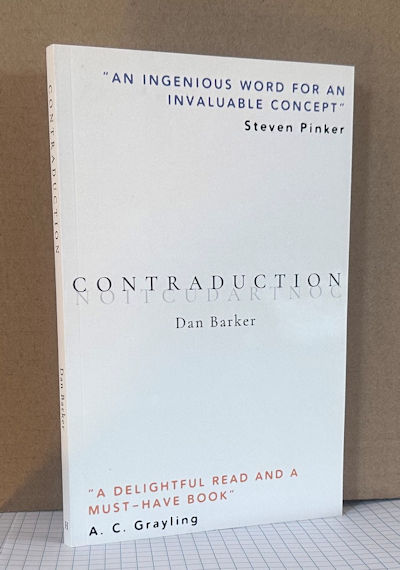
Dan Barker (Wikipedia) is an atheist writer who was once an evangelical Christian pastor. I read one of his earlier books, LIFE DRIVEN PURPOSE (review here), which challenged Rick Warren’s idea that the purpose of life is to serve God, and entertained more productive ideas of ‘meaning’ and ‘purpose’.
This book is shorter, and is about providing a word for a concept most people haven’t considered. It relates to my recurring theme that humans tend to project the protocols of their own lives, given relationships among themselves and the need to reproduce and survive, onto the universe at large, to the point where they simply can’t imagine that any other order could possibly exist. Even as issues in science and philosophy suggest that other orders do exist.
I commented about this just three days ago, at the bottom of this post: “I suspect that many of these unresolved issues in science derive from human intuitions, which evolved in local circumstances over hundreds of thousands of years, now encountering a reality of the cosmos that exists at larger scales and so does not conform to those intuitions.” This is also why “common sense” is a poor guide to anything beyond immediate, familiar circumstances.
Key Points
- The word is “contraduction,” and it’s a type of fallacy that results from a self-centric or self-selected point of view.
- Examples include how we think the sun ‘rises,’ the time ‘travels by,’ how we ‘have’ a life force rather than being a life force, how our morality is imposed from without, that somehow prophecy and free will are compatible, that somehow God is “outside of time.”
- A key example, since it’s come up in a couple recent books, is the so-called ‘fine-tuning’ argument for the existence of God. Rather, it’s humans who have evolved to be ‘fine-tuned’ to their environment, which happens to be an extremely thin layer of a single planet in an immensely vast, and otherwise uninhabitable, universe.
- The writer, like Michael Shermer and E.O. Wilson, was saturated by religion as a child, and dismissed evolution because his religion told him to, until he read up on it himself, and discovered he’d been misled, even lied to.
- The way to escape these fallacies is to be systematic in finding correct perspectives. That is, do science.
Full Notes
Introduction, p1
Author recalls a debate with Adam Lloyd Johnson about whether God exists, and how Johnson used fine-tuning and ‘abductive’ (i.e. ‘best guess’ or ‘mostly likely’ logic) reasoning to say yes. Which seemed backward to the author. On a trip to Santa Barbara he wrote up his thoughts about what he decided to call ‘contraduction.’ Too long for an article, it became a short book. Later, another debate, three against three. This book is author’s rebuttal to design arguments. The book is about our brains—the default self-reflexive arguments we make when looking at the world. Backward thinking. Author was once an ordained Christian minister who thought his way out of faith. This book is about how we fool ourselves, reversing reality to fit our preconceptions…
(Theology, he says, is a subject with no object; indeed, it can be seen as a demonstration of how humans think, since every premise in theology must reflect human biases and assumption.)
1, Backward, p7
Quotes Alice about believing six impossible things before breakfast.
It’s like sitting on a train, seeing another train start to move, and realize it’s you who are moving (or vice versa). Or the idea that rivers were built along state borders. Or that noses exist to hold eyeglasses. Contraductive thinking is not a form of reasoning; it’s a fallacy that happens before reasoning begins. As with the fine-tuning argument. A contraduction is a hidden fallacy. With Kalam, it’s that everything that exists has a cause. Who says? Like assuming the sun ‘rises’ when actually the Earth is turning. More specifically, 11t, a contraduction “is a 180-degree mirroring of reality that can be blamed on a self-centric or self-selected point of view.” A swap of cause and effect; cf Shermer, Conspiracy. Correlations where cause and effect might go either way. Post hoc fallacies. Rooster and sunrise. Author says: a contraduction is a fallacy. To contraduce means to flip around. Instead of “Rube Goldberg machine” use the word “waldo,” from Heinlein. Contraductions are invisible; not deliberate deceptions.
2, Time, p16
Author quotes song he wrote. We think that time ‘travels by’, something that flows. But perhaps *we* are flowing. Wells talked of consciousness moving along it. We don’t refer to other measures that way. There are cases where 2+2 is not four; examples involving the speed of light. Perhaps past + future = now, and time doesn’t ‘flow’. Growing older is the definition of time. Time is not something we’re ‘in’, it’s a dimension. Sequence of photographs… Time travel is incoherent. Time is not something you can travel. The idea is contraductory. Quote from 2002 movie The Time Machine.
3, The Universe, p27
Analogy with boiling water… singularity. Nothing comes from something. Kalam: the universe began *not* to exist. A year begins by a dating convention, not because it had a cause.
4, Sleep, p32
Now, why do we sleep? But, what is the purpose of being awake? Are plants sleeping? It’s meaningless to ask. Wakefulness is not modified by sleep; but rather vice versa.
[[ The whole book is a series of reversals of standard human thinking – a valuable exercise, but which teeters on being obvious. At the same time, the group of all these examples amounts to how the worldview of humans is off-kilter, and biased toward the limitations of human existence, which are not obvious to most people. ]]
5, Reflection, p36
We recognize ourselves in the mirror, but what we see is a contraduction. The mirror actually swaps front to back. Top and bottom are not reversed. As long as the mirror is vertical. Gaudi’s buildings in Barcelona.
6, Life, p43
Spiritual explanations are waldos; spirit and soul are contraductions. Nothing comes into a body from the outside. Similarly with brain and mind. We don’t ‘have’ a life force; we are the life force. If a soul is implanted from the outside, then what’s the point of fine-tuning the universe?
7, Morality, p47
Recalling the Golden Rule, which appears in most societies throughout history. Could call it the Bronze Principle. CS Lewis. But morality doesn’t come from outside nature. It’s all about harm. “If you are acting with the intention of minimizing overall harm, you are acting morally.” 50.2. Consequences can be measured in the real world. Ought is not a thing. The contraduction fallacy is to see morality as top-down, from without. Pinker says our brain came about by evolution. Some think both can be true, or ‘theistic evolution’. Prescriptive laws don’t have sources; they have ancestors. They evolve. Laws come not to, but from, humans.
8, Free Will, p53
Perhaps the ongoing debates put the issue wrong way around. Author thinks free will is an illusion; he is a determinist. It’s a useful fiction, like sunrise and future. Does it have an adaptive purpose, or is it just a byproduct? Footnote re Daniel Dennett. A compatibilist. There is no universal definition of “free will.” Commonly: the ability to have done otherwise. But you didn’t choose to exist, choose your DNA, your strengths, etc. (cf Pinker) Sapolsky, Determined. We *feel* we are free. And ‘free’ is?
Is there a waldo here? … We can’t predict the future; if we could, we wouldn’t have free will. Or feel that we do. This allows us to make decisions. Is this adaptive? Contraduction: looking forward feels like free will; looking backward, it’s obvious we don’t. The same would be true of God. Prophecy and free will are incompatible. Some imagine God exists “outside of time.” But how would that work? It doesn’t really mean anything. (Anyway the God of the Bible doesn’t behave as if he’s “outside time.”) see 62.5 – exactly: “an artifact of how things appear from the human point of view.” Still, the phrase is handy. Contraduction inverts reality.
9, Design, p66
Quotes Dawkins, River Out of Eden.
About the presumption that appearance of design requires a designer. [[ This might be the most fundamental contraduction of all ]] Anyway, it’s a category error to assume that ‘the universe’ can inherit properties of its elements. Examples. What does ‘design’ mean? Of, say, a snowflake? Sand dunes? We understand how those derive simply from the laws of physics. So we *have* seen apparent design without a designer. Further, life came about through natural selection. Perhaps creationists mean *functional* design. By an intelligence. That turns the argument into a tautology, 70.7. It’s like the illusions of free will. We look at nature and see ourselves. So we created intelligent design, not vice versa.
10, Fine Tuning, 73
Rupert Brooke, Heaven.
So, is the fine tuning argument the best argument for God? Hitchens, Shermer, Weinberg, McGrath, Collins. So must there be a fine-tuner? Arguments on both sides are waldos. These include matters of probability. But how do you estimate that? Example of a firing squad. The implication is that the universe is extremely unlikely. Or: we live in a multiverse. What would that do to the ideas of coincidence and miracles? Or we live in a simulated reality. That’s just another waldo. We don’t need the multiverse. Maybe if the constants were different, there would be some other kind of life. Stenger. Krauss. Ellenberg. We have no basis for comparison. Raindrops on windshields. The anthropic principle. We evolved to be fine-tuned to the universe, not vice versa. Like thinking the rhythm of plants fits that of the seasons. Creationists have it backwards. Anyway, why is the universe so hostile? Tyson: the universe is trying to kill us. By the original design logic, we could deduce that God evolved, p85. And there’s no designer to confront. But why tuning in the first place? How about angels? Is the universe fine-tuned for them? The real question is, what are the chances some kind of life would evolve to fit *this* universe. Answer: pretty good.
[[ The most persuasive argument is that the universe as a whole is *not* amendable to life, and that we evolved to exist only in the tiniest sliver… ]] [[ I do like the book’s repeated emphasis that humans are simply asking the wrong questions… ]]
11, Evolution, p89
Darwin’s theory of evolution reversed a contraduction. Species were not fixed; species flow. Similarly, from Dawkins, genes do not benefit the organism, but the other way around. It’s not about selfishness. Evolution is well-established, but many people deny it for religious reasons. Author recalls his early beliefs; he rejected evolution simply because it contradicted the Bible. Eventually he read up about it, and was shocked by how much he didn’t know. It’s not a force, but a filter. Natural selection subtracts, it doesn’t add. It prunes. We evolved to fit the planet. The shape of mountains might be a good analogy. Natural selection as erosion. We are part of the world, not something apart from it, or passing through. The gospel songs are wrong.
12, Where’s Waldo?, p97
So what’s the point? It’s that we need our premises to be true, and we need a perspective that is not tethered to our own point of view. I.e., we need to do science. Human values are not the only values. It’s not all about ‘me’. Thinking we are the point of it all leads to many contraductions, 98.4. We need to be continuity supervisors, looking for mistakes and inconsistencies. Now you should be able to spot contraductions of your own. Examples. Phil Zuckerman uses the word ‘projection’ to describe these things. Examples. Like black skin vs white skin; Europeans thought white skin was the pure state, black skin degenerate. Similarly: asking about the purpose of life assumes it has a purpose. Thinking life has no purpose if there is no God is like asking, if there is no Master, whose slave will I be?
Don’t be the wrong-way driver, who thinks it’s everyone else.
\\
A couple final notes. This book has more high-end endorsements than any book I’ve seen in recent years: Steven Pinker, A.C. Grayling, Phil Zuckerman, Ann Druyan, Ron Reagan, Robert Sapolsky, Michael Shermer, aside from a dozen others by people I don’t know. Is this because the author has built connections with all these people? That’s my guess. And the book is short, so it was easy for them to read.
Also, this is clearly a print-on-demand publisher. The very back page says “Made in the USA / Las Vegas NV / 16 December 2024” This isn’t unusual; the publisher keeping Robert Silverberg’s books in print is also print-on-demand.