- How the US is sliding back into the Middle Ages: demons, teleportation, religious practice; re-enchantment or cognitive limitations?
- Where real enchantment lies;
- About the prayer festival on the National Mall;
- The “universe” of Christianity;
- Two items about St. Paul.
This is about the religious rally in Washington DC this weekend. And the limitations of human nature.

NY Times, guest essay by Katya Underman, today: We Are Sliding Back Into the Middle Ages
My comments before reading the essay: One irony is that humanity as a whole knows more about the world and the cosmos, and wields more power, than it ever has in its history. Yet a minority pretends that nothing has been learned, or don’t believe anything has been learned, or is simply more comfortable believing childish fictions about their personal god being the center of the entire cosmos. I’ve been characterizing this as evidence of potential limitations of human cognition. Some people reject complexity and defend childish simplicity. Part of this irony is that such childish fantasies and conspiracy theories are spread ever more easily by the technological infrastructure that has been built up, over the centuries, by the minority of the population that has outgrown such fantasies and theories.
To the essay:
In 2024, Tucker Carlson revealed that he had been physically attacked in his bed by a demon — “or by something unseen.” The entity left four claw marks on each of his sides and on his left shoulder, he said. He was bleeding when he woke. Catholic and Orthodox clergy weighed in publicly, with an Orthodox priest lamenting that Mr. Carlson’s Episcopalian faith left him ill-equipped to respond to such an attack.
More recently, Gregg Phillips, the head of FEMA’s Office of Response and Recovery, made news for claiming that he had once been teleported, by forces beyond his control, to a Waffle House 50 miles away in Rome, Ga. The Times sent a reporter to track down the workers and regulars at all three of Rome’s Waffle House locations, but nobody remembered Mr. Phillips.
In a less esoteric vein, this past Easter, Catholic priests in dioceses across the country welcomed the largest classes of converts they had seen in 15 or more years. Eastern Orthodox parishes are also reporting a surge in growth, particularly among young men.
…
Demonic vexation, teleportation, increased interest in religious practice — those phenomena are all signs that life feels, to many, increasingly charged with unseen forces. You might say it has been re-enchanted. There’s a widespread feeling that the material explanation is no longer sufficient; that something uncanny, maybe even numinous, is diffused into the texture of ordinary American life.
My comment: Put another way, maybe these are simply signs of the increasing complexity of modern existence. Thus, when MAGA or DOGE or conservatives in general don’t understand something, they assume it’s useless and cut government funding for it. Soon, ignoramuses will rule the world. Moving on with the essay:
What is going on? Why is the world re-enchanting itself now?
In 1917, the sociologist Max Weber argued that a long process of rationalization, culminating in modernity, was eliminating “mysterious incalculable forces” from the world. Science would explain; technology would master; and magic would disappear. For a brief stretch of modern history, he seemed right: The enduring human instinct to believe in the otherworldly declined as empiricism, common evidentiary standards and, for the shortest period of all, mass media produced a rough consensus about what was real. Now we seem to be sliding back.
Three changes in both the kind of information we receive and the way we receive it may help explain what’s going on.
The first echoes my comments about cognitive limitations.
The first is that, in the era of digital technology and the endless scroll, the mind is being asked to do more than it comfortably can. The brain is a pattern-matching machine. Most of the time, it’s like a piece of software running in the background, synthesizing information without your noticing. You walk into a room and instantly read the mood; you glance at a friend’s face and know something is wrong before they tell you. Today, there’s just too much information — and we’re noticing patterns that don’t exist.
This mental overload is how you get from “that’s an odd coincidence” to “nothing is a coincidence.” It’s the same type of thinking that produces QAnon and other conspiracy theories. …
The second echoes repeated observations that most people don’t understand science, or the idea of the burden of proof.
The second change has to do with proof and evidence. Doctored photographs predate A.I. and even the digital camera. But fabricating proof used to take work.
A.I. has removed that friction — any claim can now be furnished with evidence on demand, evidence increasingly indistinguishable from the real thing. And since so much evidence can now be fabricated, any piece of evidence can be dismissed. When nothing is verifiable, then everything is permitted.
And third seems to align with my observations that many people don’t have the kind of basic education, or experience, that would allow them to distinguish between the plausible and the nonsensical. All claims seem equally likely to them. (And this may result from peoples’ childhood inculcation with religion, where evidence and plausibility don’t matter, or are dismissed as irrelevant.)
Finally, there’s institutional decay. The paranoid explanation keeps turning out to be partly right. To give just one high-profile example, Purdue Pharma, the maker of OxyContin, spent decades downplaying how addictive its product was, even as it fueled an overdose epidemic that has killed hundreds of thousands of Americans.
When events like that one happen often enough, people lose confidence in institutional authority. There goes “the science,” or “the church,” or “the official story.” Demonology, astrology or conspiracy theories about satanic pedophile cabals ruling the world fill the gap.
It’s been noted that actual conspiracy theories, by drug-makers or car-makers, are discovered and uprooted through rational investigative processes, like those of science.
The result of all of those conditions is that life has begun to feel governed by forces beyond our understanding, by knowledge that is unverifiable and by authority that is distant and suspect. It is, in a word, beginning to feel medieval.
While I’m sympathetic to this essay, it’s important to realize that it discusses a minority of people in the US, or the world. If very many people actually felt this way, society would fall apart, as no one cares about actual technology or the ‘constitution of knowledge’ anymore. We’re not there yet.
I do not believe that re-enchantment, in itself, is the main problem. After all, re-enchantment doesn’t mean “irrational,” or “untrue,” or “conspiracy,” though it can lead there. Rather, it’s the re-emergence of one of the oldest and most durable features of human experience, the sense that the world is bigger than what human knowledge can, at a particular moment, measure. It’s not a coincidence that many of our most famous scientists were obsessed with ideas that we’d now find crazy. Thomas Edison, for example, claimed to be working on a device that would try to receive the voices of the dead.
But enchantment mutates when it’s untethered from a foundation, from a community that acts as a check on the most wild and destructive instincts.
I agree: there is “the sense that the world is bigger than what human knowledge can, at a particular moment, measure.”
But enchantment mutates when it’s untethered from a foundation, from a community that acts as a check on the most wild and destructive instincts.
The enchantment is in understanding that the world, the cosmos, is bigger than what we understand, and far outscales the parochial stories we tell ourselves about the centrality of human existence. Get over yourselves. (See the passage from Tyson at the bottom of this post from two days ago.) Humanity is like a child who’s never left his hometown but is absolute certain his hometown is the best town ever.
\\\
For example.

Washington Post, today: Trump-backed prayer festival on National Mall draws thousands: ‘We welcome Jesus!’
Subtitled: Critics of Sunday’s “Rededicate 250” event said it portrayed the United States inaccurately as a Christian nation and sought to erase the line between church and state.
A crowd of thousands transformed a block of the National Mall into an evangelical-style worship service Sunday at an event backed by President Donald Trump and funded with millions of taxpayer dollars.
In an eight-hour lineup, speakers including top government officials framed America as a country founded to be explicitly Christian — and in danger if its population turns from their version of that religious faith.
Sitting, standing, dancing and praising with hands raised toward a blazing sun, attendees appeared riveted as speakers took the stage during “Rededicate 250: A National Jubilee of Prayer, Praise & Thanksgiving.” Many said they were thrilled to see an event that tied the nation and its government so overtly to Christianity.
“We welcome Jesus into this place!” worship leader Andy Frank said at the start of the event, belting from a stage with ivory-colored pillars that evoked the neoclassical architecture of the capital’s federal buildings.
\
A comment about this today on Facebook, from prolific poster Jim Wright.
Jim Wright, today: Oh. Huh.
See, I looked at that image and thought, wow, those must the good bible waving Christians come to Washington to demand full unredacted release of the Epstein files and prosecution of everyone involved. I thought maybe they were chanting the orders of their prophet to feed the hungry, clothe the poor, heal the sick, love your brother as yourself, welcome the stranger, reserve judgement for their lord, and, of course, pray only in private and not in public like the hypocrites do.
\
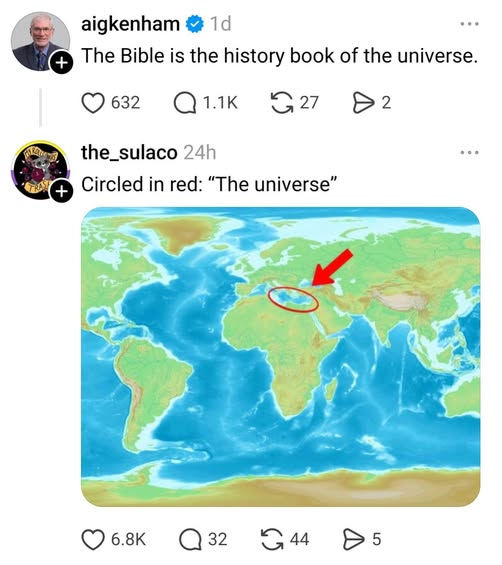
Something seen literally just now on Facebook, yet relevant. From a post by Ken Ham. Thus the arrogant insularity and parochialism of human religion, Christianity in particular.
\\\
These are related. Two items seen recently about St. Paul, the founder of Christianity. I’ll explore these later. These are articles by intellectuals for intellectuals (meaning only the kind who read magazines like The New Yorker) about topics that are completely unknown to the multitude attending Christian rallies, who take the Bible at face value and think it was literally written by God.
The New Yorker, Adam Gopnik, 13 Apr 2026: St. Paul Remade Human History. How Did He Do It?, subtitled “New scholarship reconsiders the apostle who turned a Jewish sect into a world religion—and whose legacy remains contested two millennia later.”
The Jesus Movement on Substack, Andrew Springer, 12 Apr 2026: Why I Hate Paul (And The Religion He Made Up), subtitled “And what most liberals completely miss”
\
Closing comment: religion is like childhood, believing the world is simple, and centered around you.