
- National Review is offended by the film’s presumption to redefine “the Judeo-Christian ethic that formerly ruled Hollywood — making it a global, cultural superpower…”;
- Vox on how faith and UFOs go hand in hand;
- Slate on how Spielberg’s films are about “high strangeness”;
- My take: road trips and action sequences, with a sprinkling of old spice.
Let’s revisit some of those items I saved about Steven Spielberg’s latest film, Disclosure Day, and see if we can figure out why some religious folks have taken such offense. The ones I posted earlier were on June 13th, followed by my quick take after seeing the movie on June 20th.
Meanwhile, I should say, I re-watched most of Close Encounters of the Third Kind over the past week, in sections, trying to lure my reluctant partner into watching it. What impresses me about that film are the visuals. The skies filled with spooky lightening-like lights. The bright lights of the little alien ships pursing the cop cars, and the ones luring the boy Barry outside his house. I still don’t buy the appearance of the mothership from behind(?) Devil’s Tower, when it should have been seen descending from above. But let’s move on.
Let’s start with this item from a conservative publication.

National Review, Armond White, 12 Jun: Disclosure Day: An Unequal Sequel, subtitled “Spielberg betrays the movies — and himself”
It opens:
In Disclosure Day, Steven Spielberg attempts nothing less than a redefinition of the Judeo-Christian ethic that formerly ruled Hollywood — making it a global, cultural superpower — since the days its Jewish immigrant founders realized what author Neal Gabler called “An Empire of Their Own” (in his 1988 book retelling the history of the American film industry). This is Spielberg’s most explicitly religious film, although its story exchanges religion for speculative political fiction: Emotionally troubled military-data analyst Daniel Kellner (Josh O’Connor) steals classified government secrets about UFOs; the info is so shocking that he feels compelled to release it to the public. Daniel aligns with an underground government sect that has tracked Unidentified Anomalous Phenomena (UAP) intelligence while also monitoring TV weather girl Margaret Fairchild (Emily Blunt), a conduit for unbidden messages from outer space. Both Daniel and Margaret are shown to be disciples/prophets chosen to present a message that will alter human consciousness. Margaret’s announcement: “Don’t be afraid of what you don’t know.”
I find this reviewer’s alarm shocking, and telling. Spielberg is “redefin[ing] the Judeo-Christian ethic”?? No, he’s speculating, very mildly compared to any number of other science fiction movies and novels and short stories.
The writer criticizes the movie as trashy. And he is obsessed about how this movie relates to religion. His religion.
But just as Spielberg raises Millennial doubts, the film goes for quasi-mystic, quasi-political claptrap. He seems to have forgotten that the third kind of close encounter was contact, not suspicion of religion but its confirmation of something bigger, greater than the mundane. Instead of confronting the dread influence affecting Daniel, Margaret, Jane, and Noah, Spielberg diminishes their only glimmer of hope. He misunderstands religion and myth as the explanation of what puzzles us and instead posits politicized alternatives: untrustworthy government and childhood sentimentality. (Margaret’s first awakening to the appearance of a cardinal floating in on a breeze is oddly disconnected from that symbol’s folkloric meaning.)
Sure, there something bigger, greater than the mundane. That’s what science has been revealing, for hundreds of years. It’s not all about your religion.
And here’s his final point:
But Disclosure Day challenges religious orthodoxy for being the foremost alternative to secular political power — a pop culture outrage considering Spielberg’s earlier adherence to Hollywood’s once careful regard for ecumenical consciousness. The general, all-inclusive spirituality of Close Encounters showed that Spielberg understood the universality of personal aspiration and found extraordinary, relatable means to express it visually. (Here, scenes of Margaret’s psychic intuition of other people’s thoughts just seem like drab imitations of what was fresh in Close Encounters and Always.) The wondrous evocation of the Supreme Being or a supreme intelligence in Close Encounters answered mankind’s awe and made it magnificent. Having achieved that almost 50 years ago, the “revelation” of aliens in Disclosure Day is truly anticlimactic — it’s an unequal sequel.
It’s not about religious orthodoxy. The universe exists; there is no supreme being or intelligence. It just is.
\\\
Another about religious leaders and aliens.

Vox, Dylan Scott, 11 Jun 2026: Religious leaders are surprisingly chill about aliens, subtitled “Faith and UFOs go hand in hand.”
I definitely agree, if perhaps not in the way the writer meant.
But his movie also focuses on a second topic that has long preoccupied Spielberg and other sci-fi directors: faith. It’s a story about believing in something — whether it’s religious doctrine or UFO brain downloads — and the tensions that could arise between different kinds of prophecy.
“The movie takes the position of the believers, or the curious, the ones that have been deeply affected by this,” Spielberg said in an interview with CBS News. “And the movie also takes the position of the church. What does this do to the fundamental beliefs that many of us have? Is God our God only on this planet? Or is God a god for every system where there’s civilization and intelligent life, and even developing life?”
These are *obvious* questions that science fiction writers and readers have dealt with for decades. Sometimes naively (Ray Bradbury’s “The Man,” from 1949, which imagined Jesus appearing on planet after planet), and sometimes profoundly, with many examples I’ll save for later.
\\
One more, from two weeks ago.
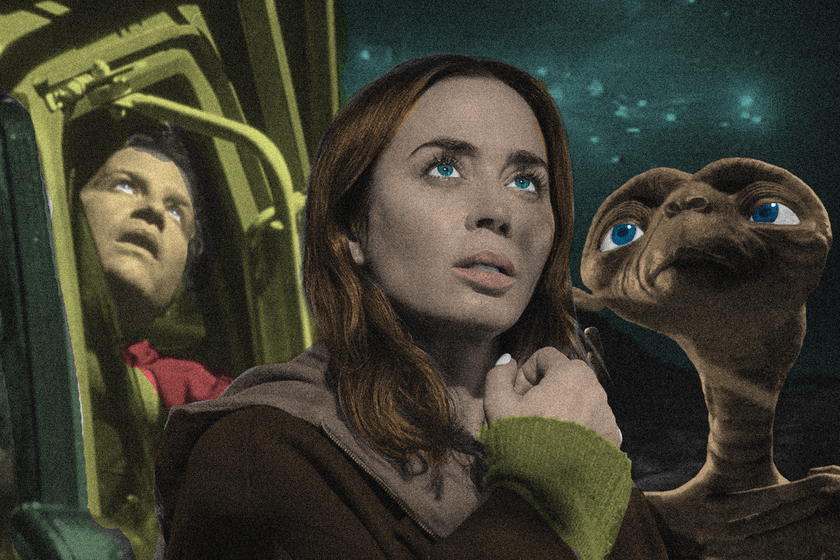
Slate, Matthew Bowman, 10 Jun 2026: To Understand Disclosure Day, You Have to Understand “High Strangeness”, subtitled “Steven Spielberg’s many movies about aliens have always, really, been about something deeper. His latest is no exception.”
This refers to Spielberg’s very first film, Firelight.
The earliest U.S. government investigations into the late-1940s wave of flying-saucer reports assumed that, if they were real, these things must be nuts-and-bolts, better versions of human spaceships, probably piloted by aliens who wore spacesuits just like John Glenn and the cosmonauts did. Spielberg thought so too. At the time of Firelight’s release, an Arizona journalist said it was—to a degree that was impressive, given that it came from a teenager—conventional 1950s UFO fare, right in line with the wave of recent “science fiction movies seen by the late-late television viewers.”
But today, an easy way to show that you’re a newbie at a UFO convention is to start speculating about how many light-years away the aliens’ home planet is. By the late 1960s, UFO investigators realized the assumption that these things were spaceships was in fact an assumption. They started taking other possibilities seriously. By 1972, J. Allen Hynek, an astronomer and Air Force consultant who was probably the leading UFO researcher of his time, coined a phrase to articulate the point: high strangeness. In his more than a decade of research, Hynek found that UFO witnesses often encountered more than just strange craft. He gathered stories of telepathic communication, missing time, objects moving themselves, and strange visions. Eventually Hynek concluded UFOs had more in common with psychic manifestations, premodern myths, and everyday glitches like déjà vu than they did with jetliners.
\\\
What strikes me, after re-watching most of Close Encounters, is how Spielberg’s mode of making his big movies is about doing road trips and action sequences, with a sprinkling of sense-of-wonder woo along side, or as spice. And in Disclosure Day, it’s an old spice.