
Conservatives have been trying to preserve the past forever. They’re probably successful more often than we realize. Those of us who do realize this do so by recognizing that their stories are full of holes, or don’t make sense. On the other hand, when attempts to rewrite history are this blatant, they’re not likely to succeed. The cultural weight of documented history has too much momentum to be easily altered.

NY Times, guest essay David W. Blight, yesterday (but in today’s print paper): Trump Is Bending History to His Will. He Will Fail.
On July 4, the White House Domestic Policy Council issued a long-awaited and lengthy report, “Saving America’s Story: How Ideological Capture at the Smithsonian Institution’s National Museum of American History Erases Our Heritage,” a frontal assault on the work of the Smithsonian’s National Museum of American History in particular and on the entire Smithsonian Institution. The report asserts that the museum’s leadership has “traded settled truths and basic history for political activism and division.” It condemns the museum for engaging in “anti-white activism,” supporting “illegal aliens” and embracing transgender people.
Historians employ time-honored methods in the use of evidence but, by instinct and training, never accept determined “settled truths.” The Trump White House and its history police want us all to live in their chosen bubble, immune from instability or perceived disorder in their take on American greatness. They have a right to their bubble as individual citizens, but to impose it on the rest of us as policy egregiously breaks the public trust.
The report is not a document about history; it is the product of a racial and political ideology in search of a history that no longer bears scrutiny. People often joke about how Trumpism would like to return us to some version of the 1950s, when America supposedly was “great.” In this report, the administration has done just that. The report would prefer that nothing had ever happened since the ’50s to mar the White House’s polished, superficial, puerile version of America’s past.
(I going to use a font color, rather than bold, to highlight what I think are key passages.)
Later:
Triumphalist history, which is exactly what the Trump White House demands, cannot tolerate nuance, ambiguity, complexity. These elements of real history — dare we say truths about human experience — always spoil the party and the military flyovers. President Trump and his supporters have instincts for history, but far too little knowledge.
Of course this all aligns with my take of conservatives as generally simple-minded, black-and-white thinkers. Slightly immature. A tad short of true human potential.
\\\
This is interesting not just for its immediate point, but in its discussion of how the military, being essentially a conservative institution, time and again rejects change, even as technological advancements happens around them.
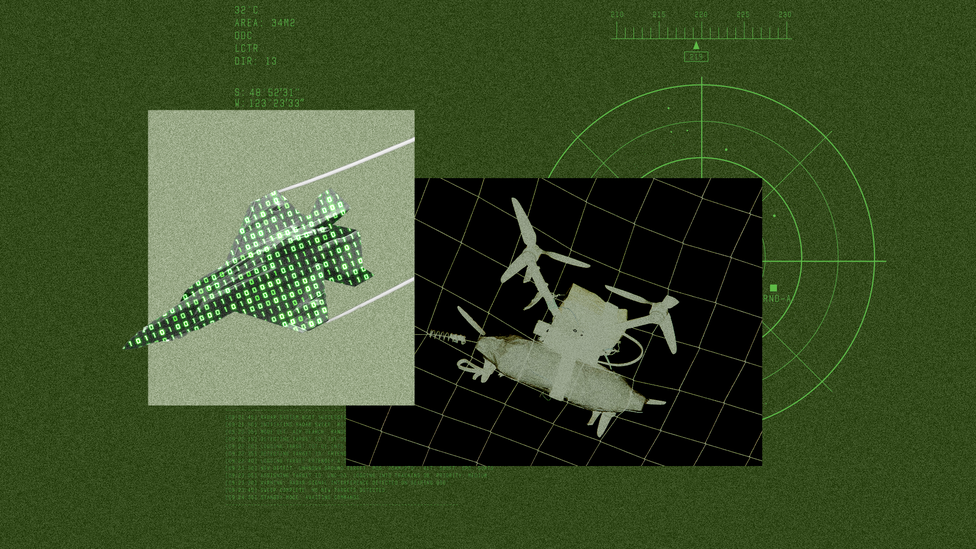
The Atlantic, Phillips Payson O’Brien (a professor of strategic studies at the University of St Andrews, in Scotland), today: Fighter Jets Are Passé, subtitled “The future of warfare is drones, clearly.”
Beginning:
In the interwar period, some military officers did not believe the combustion-engine vehicle would replace the horse for combat operations. Cavalry officers from around the world, including the United States and United Kingdom, argued strongly against trading their lovely mounts for new tanks. Many insisted that heavy armored vehicles could never conquer the hilly terrains in which horses thrived.
More of this, for two para’s. Then:
The world’s biggest militaries, most notably that of the United States, are now at a similar turning point. The deployment of cheap unmanned vehicles on a mass scale, in the war between Russia and Ukraine and more recently in the U.S. war with Iran, has revealed the vulnerability of hugely expensive tanks, aircraft, and ships and the near impossibility of making major advances by infantry on the ground. Yet Western militaries have failed to reckon with these innovations in warfare, planning and spending as if nothing new is afoot.
And it goes on, with many examples that illustrate one of science fiction’s recurring themes: things are changing faster than you realize. (“In 2024, Brigadier General Douglas Wickert, the U.S. Air Force official in charge of AI piloting technology, insisted that robotized warfare was still “centuries” away.” Centuries? Nonsense.) Yet militaries are still heavily invested in building combat aircraft, tanks, and aircraft carriers.
Yet the lessons of the wars before us are that cheaper, nonhuman piloted systems are changing the balance of fighting. The future will be dominated by weapons of war that do not have a human onboard. These include cruise and ballistic missiles, a long-familiar category of weapons that can effectively attack targets anywhere in the air, on land, or in water. More and more, warfare will also include unmanned ground vehicles, which can fight, deliver goods, and evacuate the wounded; sea drones, which threaten ships and containers around the world; and unmanned aerial vehicles, or drones, which Ukraine, Russia, China, Israel, and the U.S. are making by the millions.
The writer notes,
The growing role of machines that are operated by a human at a distance—or programmed to operate autonomously—represents a fundamental “de-humanizing” of war.
The “de-humanizing” of war began when soldiers could fire guns, and kill at a distance, instead of stabbing or lancing their opponents in the chest at close hand. Which is apparently where Pete Hegseth is focusing his attention.
As always, science fiction has thought way ahead. Even in the popular context of Star Trek, 60 years ago: the 1967 episode “A Taste for Armageddon,” from TOS’s first season, was about two planets whose war has been completely computerized, with no damage to property, to the point where the “victims” would voluntarily report to disintegration stations to be killed.
\\\
Conservatives have a weird kind of common sense, that makes it all about themselves, and personal ‘freedom’. Again, this confuses advice (based on what the species has learned) with orders.

Media Matters, yesterday: Some right-wing media figures blast commonsense health advice that limits exposure to dangerous wildfire smoke
Subtitled: Millions of Americans as far south as the mid-Atlantic are experiencing the “worst air quality in the world” due to Canadian wildfire smoke
As American cities across the Midwest and Northeast suffer from the “worst air quality in the world” due to the spread of smoke from Canadian wildfires as far south as the mid-Atlantic, several right-wing media figures are railing against health recommendations for staying safe.
…
Despite this, several right-wing media figures are taking an absurd stand against such health advice and mocking those taking steps to protect themselves from wildfire smoke.
\\\
This is so, so, so telling.

Washington Post, opinion by David Desteno, yesterday: People of faith are finding a new moral guide in AI, subtitled “Are you there, Claude? It’s me, Margaret.”
Today, millions are seeking moral guidance from AI chatbots. It might seem reasonable to assume that those who reject religion as a source of wisdom would be more inclined to turn to AI for a seemingly comprehensive and objective analysis of the moral consequences of any action. But this isn’t the case. It’s actually people of faith who more regularly turn to AI for moral guidance and spiritual advice. With its appearance of omniscience and objectivity, AI poses a threat to the authority of traditional religious bodies.
AI is telling people what they want to hear.
\\\
This captures the core idea.

Free Inquiry, Ronald A. Lindsay, 16 Jul 2026: Placating the Gods: The Core of Religion
Gods, sacrifice, prayer, prostration. The key:
But logic and religion are cut from entirely different cloths. The latter is an atavistic hangover from our past, when our lack of understanding of how the world works, as well as our instinctive concern for our survival, caused us to resort to supernatural explanations for storms, floods, drought, disease, and unexpected deaths. This was combined with the modeling of our gods on how humans react: you want a powerful person’s favor, you provide a gift and beg.
No, there is no call to sneer at the ancients. They represent the infancy of humanity—an infancy that most inhabitants of Earth have not yet outgrown. Whether they ever will remains an open question.
\\
This afternoon: Bruckner 3, Wand