- Further thoughts on the evolutionary forces behind the expansion of human morality;
- Thought while reading Stephen King’s THE STAND;
- And further thoughts about human morality, and how conservative and progressive stances have been appropriate at different times;
- Heather Digby Parton on the roots of science denial: fundamentalist faith and Big Business;
- And now Trump wants to redesign aircraft carriers, because he knows best.

Following up on yesterday’s post. (Updated 15aug26)
The idea is that human morality has changed, and we can chart those changes chronologically, and see how it has evolved from a single tribal morality into the spectrum we see today. Sketch:
Humans have existed in their present form for two or three hundred thousand years. As social, tribal creatures, mostly on the African Savannah. That ‘morality’ was hierarchical, primed for reproduction against constant threats of starvation and disease, hostile toward other tribes for resources, bound by common stories that combined with intuitive perceptions of the natural world’s agency to become religions, and so on.
About 25,000 years ago, perhaps triggered by declining ice ages in the north, African tribes began a diaspora, gradually spreading out across the globe, to Asia, Europe, eventually the Americas. Around 8,000 years ago, agriculture was invented, or discovered, in several places around the world (perhaps a consequence of the warming since the last ice age). This caused a rift in human behavior. Some people retained the traditional tribal life of hunter-gatherers, which did not require long-term planning, or knowledge of anything outside the immediate environment. While to pursue agriculture required settling down in permanent settlements. This latter behavior required new skills: not just how to plant crops and herd animals, but how to allocate land, how individuals in a settlement would perform various roles, and so. This riff comes down to us in many ways, from the Cain and Abel story, to the musical Oklahoma.
The traditional tribalists are the ur-conservatives, preferring no change, resenting imposed ideas from without. The settlers were necessarily progressives: settlements came with problems of disease, etc, which had to be solved. As settlements got larger and larger, new things required invention: trigonometry to allocate property, writing to keep track of ownership, arithmetical skills for collecting taxes to maintain governments, and bureaucracies to keep track of all the paperwork. (Don’t like bureaucracies? Stay a hunter-gatherer.)
Progressives had the motivation to discover new things that would give them advantage over others. The key idea, coming only a few hundred years ago, was science: from understanding the natural world came control of the natural world and the construction of modern societies. The conservatives, just wanting nothing to change and to be left alone, resented all of it, and took comfort in their traditions and religions.
Arguably the split at the agricultural revolution led an evolution of human nature — not a wholesale change, so much as a broadening, as humans came to live in different environments. There really are different ways of understanding the world and dealing with other people. Examples abound…
One might argue about which ‘side’ is more intelligent, the change-nothings or the build-everythings? That’s not a good question to ask; both ‘sides’ are very intelligent in their own realms. But the two sides have built very different worlds.
/
These thoughts were on my mind the other days as I am reading my way, for the first time, through Stephen King’s THE STAND, a very long book published in 1980. (I have the Doubleday 1st edition.) What starts as a worldwide plague deci-decimating the Earth’s population shifts, about half way through, into a battle, either supernaturally real or by proxy, between good and evil.
Page 407.7:
“She guessed that behind the conscious evil there was an unconscious blankness. That was what distinguished the earth’s children of darkness; they couldn’t make things but only break them.”
How often have I described modern American conservatives, Trump and MAGA in particular, as out to break everything that they don’t understand, or just because smarter people than they made them?
/
Morality is not constant, or fixed. It’s circumstantial. I’ve given examples. Here’s another. Which side, left or right, is good, and which is evil? It depends.
Revising: it’s reductive, almost nonsense, to talk about good or evil; those are childish terms, that ignore the complexities of reality. Let’s ask, which side is productive or counter-productive?
Compared to what goal? Let’s stipulate that the goal is keeping the human race alive indefinitely. Not just one’s particular tribe, but the whole race.
Conservatives would say liberals are counter-productive because they confuse the natural roles of human existence, especially sexual ones, that are necessary for racial survival. And liberals are counter-productive in a tribal sense in that science undermines the religious stories that are necessary to be believed for social cohesion. (Or, some think, literally true.) Better to live with tribal fantasies than understand the real world. And so on.
They may have been right, 10,000 years ago. They are not right, now. This is because humanity has spread itself across the globe, is actively despoiling the planet, and now understands, in a way it never did, the existential threats that it faces, threats that can only be addressed by cooperation among members of the entire race. To the extent that conservatives are hindering and even destroying humanity’s ability to do that, they are now counter-productive.
More examples from today’s news.
\\\
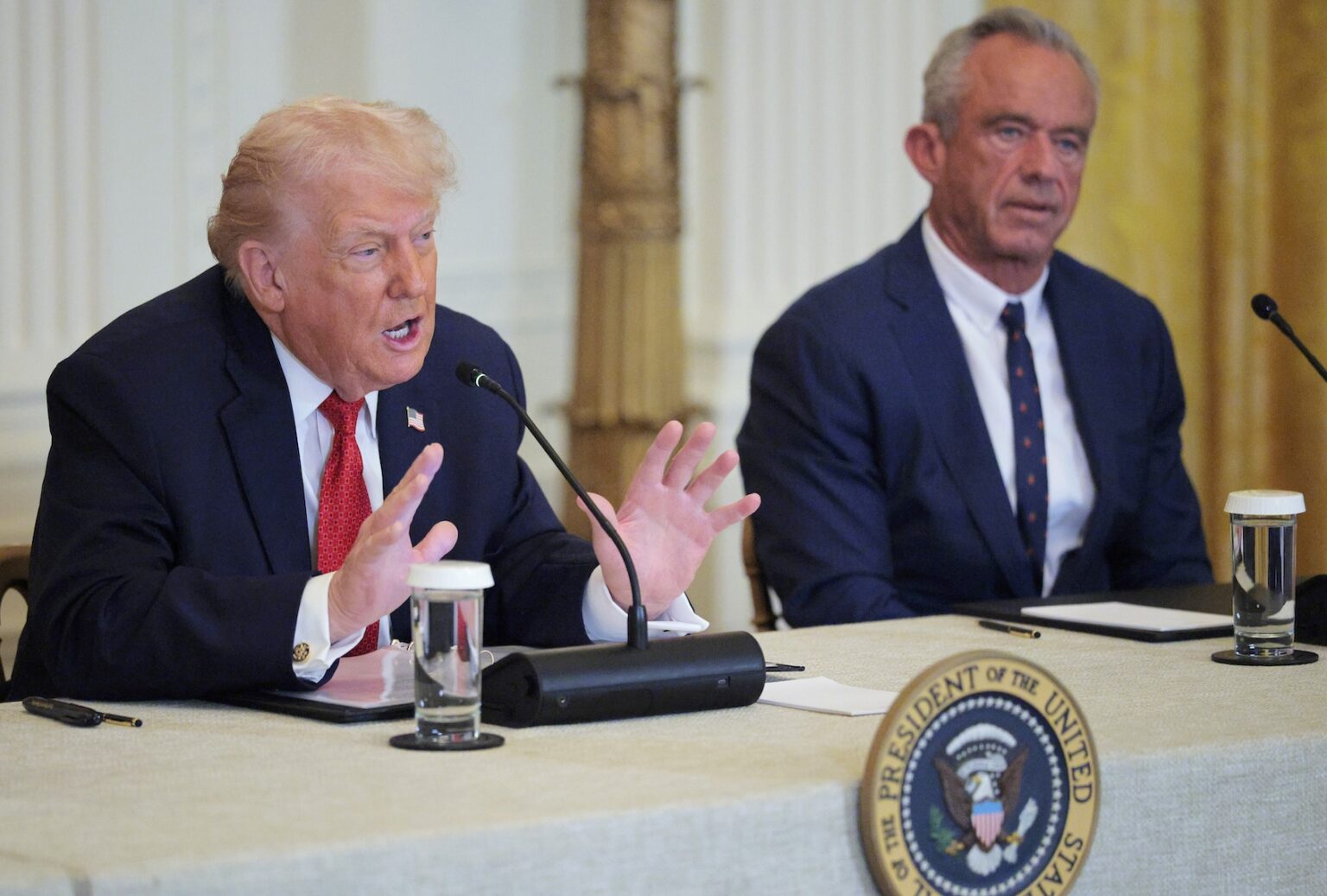
Salon, Heather Digby Parton, yesterday: The gospel of science denial, from Galileo to RFK Jr., subtitled “Donald Trump and RFK Jr.’s anti-vax agenda has deep roots in fundamentalist faith and Big Business”
This goes to Robert Reich’s piece noted two days ago: why is MAGA doing this? Follow the money, and understand the culture war.
The most notorious press conference Donald Trump ever held was the one in which he told a scientist in attendance to look into the possibility of using household disinfectant inside the human body to kill the Covid-19 virus. He had watched a demonstration of how the product worked on surfaces, you see, and he thought they hadn’t considered the possibility that humans could ingest it and achieve similar effects. That day, April 23, 2020, marked the last of Trump’s daily televised pandemic press briefings, and it may very well have been the last straw for many of those who voted against him just a few months later.
Trump has never gotten over his delusions of expertise. Then to the point:
Two groups have long been especially successful in challenging the public’s confidence in science: Christian fundamentalists, a religious force that grew into a political juggernaut, and Big Business. While neither has openly colluded with the other, they have both furthered each other’s goals and ended up in a political alliance. One wouldn’t think these two disparate institutions would have much in common. But they share similar tactics: lying to their followers and customers for power and profit. And both have their reasons for rejecting science that interferes with their own interests.
Here’s a bit of history I was unaware of:
Christianity and science have been in tension ever since the Catholic Church placed Galileo under house arrest for suggesting that the earth wasn’t the center of the universe. But for the most part, the tension was at least somewhat manageable, and both carried on in their own spheres. In the early 20th century, however, a new Christian movement formed that took direct aim at science on the grounds it constituted a threat to the belief in the Bible’s inerrancy, and the modern war began.
In the beginning, this new movement was largely financed by a pair of Los Angeles oil magnates. Milton and Lyman Stewart were religious zealots who were horrified by the encroachment of modernist ideas on society. The Stewarts published a book called “The Fundamentals,” giving the movement its name, and shipped copies all over North America at their own expense, literally spreading the fundamentalist gospel and influencing massive numbers of Americans to reject scientific knowledge wherever it conflicted with literal biblical interpretations.
And then the 1980s, and the Koch brothers and their rejection of science.
Science denialism comes from many directions, and unfortunately we are in a period where it’s flourishing. There have always been hustlers and snake oil salesmen, but today the internet provides endless opportunities for people to “do their own research” and find whatever feels right to them, so conspiracy theories have become the lingua franca of our society. Delusional narcissists like Trump and Kennedy, occupying powerful positions and spreading nutty medical advice, are now just par for the course.
\
And this is the other apropos story of the day. Ignorance imposing itself on expertise. To the cheers from MAGA, no doubt.

The Guardian, yesterday: Trump orders Pentagon to redesign US aircraft carrier to use steam catapults to launch jets, subtitled “President has suggested steam catapults every year since 2017, saying digital systems are too ‘complicated’
That means Trump doesn’t understand them. Yet he thinks he knows better than anyone.
“You know the catapult is quite important,” Trump told Time magazine in 2017 before recounting a conversation he said he had with an unnamed navy officer.
“So I said, ‘What is this?’ ‘Sir, this is our digital catapult system,’”, Trump went on. “It sounded bad to me. Digital. They have digital. What is digital? And it’s very complicated, you have to be Albert Einstein to figure it out. And I said – and now they want to buy more aircraft carriers – I said, ‘What system are you going to be’– ‘Sir, we’re staying with digital.’ I said, ‘No you’re not. You[’re] going to goddamned steam, the digital costs hundreds of millions of dollars more money and it’s no good.’”
A Guardian review of Trump’s public remarks shows that he has retold that story, with variations, every year since 2017.