- Is humanity suffering information overload?
- Why people hate data centers;
- Why people hate the government;
- Is this all about the increasing complexity of the world, and the limits of human cognition?
- Comments about Trump and Canada from Robert Charles Wilson and Jim Wright;
- And evidence from The Good Liars about those who believe Trump is God.
Another running theme here, alongside the aspects of reality the lie outside human intuition and human understanding, is that the increasing complexity of the modern world has gone past those same limitations of intuition and understanding. For some.
OnlySky, Susan Fourtané, yesterday: The cost of information overload, subtitled “Our brains’ ability to process information hasn’t kept pace with the tools that deliver it.”
Every day, we consume more information than any previous generation in history. News alerts arrive by the minute. Social media feeds refresh endlessly. Emails pile up; if we dare to not check email for one day, we fear the results could be catastrophic. Podcasts compete for our attention during our commute. An AI assistant can fill up our agenda with meetings and tasks which become overwhelming in their own right; we feel bad if we want to cancel them to take the afternoon off because we feel mentally exhausted.
Paradoxically, despite having unprecedented access to knowledge and information, many people feel less informed than ever. How many times do you scroll on your phone, read the titles, perhaps even start reading an article, but move on to the next one after three seconds? There are so many things you want to read that you end up reading none of them. There is simply too much information. The world is producing more news than ever before.
And,
The information we receive is so abundant that our brains struggle to process it all. Our cognitive abilities have not evolved nearly as quickly as our technology.
Well, no one would expect our cognitive abilities to “evolve” over just a couple centuries. My take: there’s a range within human nature of ability to take in new information, and accept change, and some people are better at it than others.
But this is apt:
Faced with an overwhelming volume of information, our brains naturally simplify.
We gravitate towards familiar voices, emotionally engaging stories, headlines that confirm our existing beliefs, or content that appears popular because it has accumulated thousands of likes or shares—which are often paid ads, astroturf, or created by bots. These shortcuts save mental effort, but also make us more vulnerable to misinformation and sensationalism.
Thus the attraction of conspiracy theories. And religion.
Concluding:
The hidden cost of information overload is not simply having too much to read; it is having too little time to think. Perhaps we must take the time to pause, become aware of the amount of information we are consuming, and make space for reflection, because knowledge grows from information, but understanding grows from thought.
(For myself, I spend an hour every morning visiting my standard set of sites, and collecting links, then return 7 hours or so later to think about them and decide which to discuss here.)
\\

Vox, Astead Herndon, today: The real reason voters hate data centers so much, subtitled “How the tech buildout became a defining midterm issue.”
Not because they’re an aesthetic blight. (Well, it is somewhat.)
This week, OpenAI CEO Sam Altman acknowledged a small hurdle in his quest to integrate artificial intelligence into all parts of human life and the economy: the rest of us.
Four main points:
The thing that comes through loudest on the ground isn’t a technical objection to server farms, or even a concern with their potential impact on the environment. It’s the feeling that this change was done to communities — not in consultation with them.
And
People weren’t rejecting the tools altogether — there were plenty of ChatGPT users in that room. They were rejecting the pace, and the secrecy, of a project reshaping their community.
And
Once the construction jobs leave, the noise, the water draw, the rising electricity bills, the fear about home values, and the sheer brutalist ugliness of the structure all stay. One homeowner told us: “I can’t sell my house — it’s been for sale since February. …”
And
People don’t want to feel like they’re guinea pigs in an experiment, and it’s not just Sam Altman who has contributed to that feeling. It’s also the politicians who have treated technological change as something they retroactively legislate after a crisis arrives, whether it’s in the economy, or the environment, or society. You can’t govern a revolution you refuse to understand.
Pace of change, is the big picture.
\\
One more.
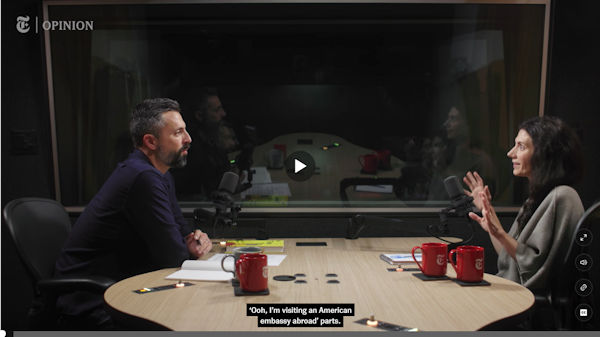
NY Times, Ezra Klein, today: This Is Why People Hate the Government
An interview with Annie Lowrey.
One of the big problems in left-wing politics is that the very people who Democrats, liberals and socialists think should be the most excited about the big, new government programs intended to help them are often the least excited — and are often voting for the party that wants to cut government.
One reason for this, a reason I think we don’t talk about nearly enough, is that oftentimes their experience with the government has been horrible. Their experience with government programs meant to help them is not just inefficient, it’s punitive, it’s humiliating, it’s controlling.
That’s because sometimes those programs are built to humiliate, punish and control them.
But why would that be? Lowrey refers to a “time tax” with this quote from her book:
Poverty is a social construct, not just a material state of being, and the time tax is part of its construction. With forms, summonses, and sanctions, the government impresses upon poor people that it is their fault they are poor. It applies skepticism to the needy, the overwhelmed, and the unlucky that it does not apply to the powerful and wealthy.
Now, I was going in to see if this was about my premise that rising complexity has hit that cognitive limitation of many people, who simply don’t understand it, or can’t think around it. Maybe something else is going on.
But it’s a very long piece, and I cannot do it justice. But the flavor emerges that some people in government don’t believe that recipients of government services actually deserve them. Surely these are conservatives.
\\\\
Quotes about Trump today, given his recent belligerence against Canada, e.g. about how Trump wants to rename Lake Ontario Lake America. (Why not Lake Trump?)
Robert Charles Wilson, Facebook, today: post
Here sits a living amalgam of narcissism, fascism, and dementia, at the head of what was once the most respected nation on Earth…
…and, well, you know, civilization had an interesting run, and there was much to like about it, and we should try it again sometime, if we can figure out how to keep this sort of thing from happening.
\
Jim Wright, Facebook, today: post
It’s real. He posted this at 5:58AM this morning. You can go look at Truth Social for yourself. This the President of the United States, and even if it was written and posted by one of his flunkies, these are still Trump’s words. Moreover: these are AMERICA’s words. This is how our country, all of us Americans, you and me, this is how we appear to the rest of the world, a bunch of ignorant, belligerent, childish, spoiled, violent dangerous insane children lashing out in a daily tantrum.
\\
At the same time, I see Facebook posts from The Good Liars whose two hosts interview people at Trump rallies, people who swear Trump is the best president ever, that he’s ordained by God, and so on. Yet when asked what his greatest achievement has been, they hem and haw.
This is why I think there is increasingly some fundamental cognitive split among modern human beings. We evolved for survival, not for understanding.