
Subtitled: A Non-believer’s Guide to the Uses of Religion
(Pantheon, March 2012, 320pp, including 8pp acknowledgements, picture credits, and index.)
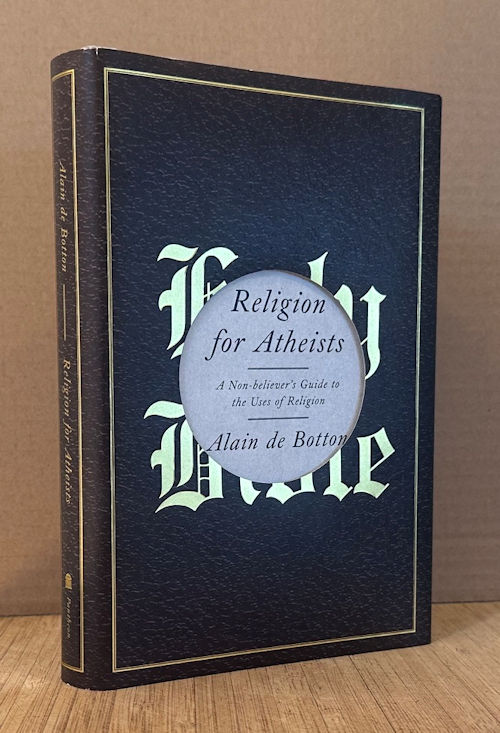
This is a book by the pop-philosopher (I don’t think that’s an unfair term) and writer best know for HOW PROUST CAN CHANGE YOUR LIFE in 1997 and THE CONSOLATIONS OF PHILOSOPHY in 2000. This book has its own Wikipedia entry, which summarizes its mixed reviews. I’m not so much concerned as whether reviewers found it incomplete or facile, as whether there are any good ideas. And more broadly, to suggest how religion is just a variation on theme of human nature sometimes put toward other ends.
I’ll come back later with some general comments.
Key Points
- He states upfront his premise, that no religions are “true” in any supernatural sense.
- The two needs religion addresses are the need to live together in communities, despite our selfish and violent impulses, and to cope with pain and death, both of which are overlooked by modern atheism. (Is this de Botton’s response to the “new atheists” of the 2000s? He doesn’t mention any of those authors.)
- The book addresses how various social matters are dealt with by religion, and how they are dealt with in the modern world. The implication is that the latter might adopt some of the former, to improve our sense of community and appreciation for other things in life, though I find many of these implausible. But there are worth thinking about.
- For example, in the modern world it’s difficult meeting strangers. Religion brings people together in regular ceremonies. Perhaps modern restaurants could encourage interaction via communal tables.
- A running theme is the importance of religious rituals, to mark significant events in life and bind communities together.
- Western society is relatively libertarian, compared to religions, that tell people how to behave. Some modern practices do serve to encourage people to behave well.
- Secular education arose as teaching of scripture declined in the 19th century. Religion thinks of education as a kind of therapy, and endlessly repeats its lessons as a sort of ritual. Modern education expects lessons to be learned after one or two repetitions. And religion employs rituals. Religion thinks it’s teaching wisdom; education is teaching the lessons centuries of our ancestors have worked out. [[ And indeed, religion thinks it’s teaching some eternal, unchangeable truth, while the essence of education is to understand that new knowledge arises and our understandings change. ]]
- Religion ignores problems in the real world, placing its hopes in the next one. Secularists are devoted to improvements in science, technology, and commerce, at the risk of pessimism.
- Religion offers us perspectives beyond everyday life, while actual astronomers are austere and indifferent. [[ No, I think he has this completely backwards. It’s the latter who offer perspectives on the nature of the real universe, and the faithful who presume humans are the center of all creation. ]]
- Religion considers art as variations on eternal themes; modern art museums present art works as abstract objects to be admired, always valuing originality. [[ The problem with religion’s take is that it presumes everything is about humanity and its myths, that new things should be rejected. ]]
- Similarly with architecture, with the author claiming that Protestants deliberately put up ugly buildings.
- The assault on religion began in the 18th century with books. But religions have been successful creating grand institutions that extend their brands.
- Finally the author recalls Auguste Comte, who tried to create a secular religion, a Religion of Humanity, which did not work out well; he died a crank. (Because secular churches, saints, and festivals are not needed any more than what we already have.)
- Author admits none of these ideas are new, but they have not successfully becomes dislodged from the supernatural structure where they were first conceived.
Detailed Notes [[ with comments ]]
I, Wisdom without Doctrine, p9
- Premise: no religions are true in any God-given sense. It’s boring to ask if any religion is true.
- The issue is where to take the argument once the premise is settled. It is to nevertheless finds religions sporadically useful, interesting, and consoling. Religions serve two central needs: the need to live together in communities, despite our selfish and violent impulses [[ this places religion on the side of a progressive human nature, oddly ]], and to cope with pain and death. Modern atheism errs in overlooking those.
- Author was brought up in a secular Jewish atheistic household. Parents would regard believers with pity. Then author had a crisis in his 20s. He didn’t become a believer, but aspects of religion attracted him. The music, buildings, shrines, etc. Secular society has lost all these. We allow religion to claim all of them. Note how religions often appropriate the practices of earlier religions, as early Christianity did. What follows will examine Christianity, and also Judaism and Buddhism, for insights.
- This strategy might cause annoyance on both sides. … Religions have changed the world.
- This will not be an apology for religions. Rather, “It hopes to rescue some of what is beautiful, touching and wise from all that no longer seems true.”
II, Community, p21
i, Meeting Strangers
- We seem to have lost a sense of community. From casual conversations with strangers, to making new friends. Was this sense based on religious foundations?
- Part of this is about numbers: density of population. And the ways in which we meet. Neighbors used to be our colleagues. We’re charitable toward each other, but mostly via taxes. We experience other people via media—which features murderers and other bad guys. When disaster in real life strikes, we’re surprised that most actual people are quite helpful. We value love, but only romantic love. Our social encounters are framed around ‘what do you do?’.
- Religions seem to understand our loneliness. Consider the Catholic Mass. Its space defines different rules. Something beyond family ties, or status as monarch or street sweeper. Status doesn’t matter. The Mass encourages recognition of common needs, and discourages pride.
- The lessons of the Mass include gathering into a group. Of recognizing rules for interacting with others. And recalling how the service was once a meal. [[ Of course this attraction to losing one’s identity in a group is what I’ve warned about. ]]
- The modern way we eat, even in restaurants, does not encourage meeting new people.
- So imagine an ideal restaurant of the future: Agape Restaurant. People would sit at communal tables. Religions are aware of the effect. There would be a guidebook with rules for how to behave. To speak with others on predefined topics. About desires and regrets. Even prayers. We would overcome our fear of strangers. Morally engage with the community.
ii, Apologies
- Another theme is what goes wrong inside groups once they are formed. The Jewish Day of Atonement. Yom Kippur. Review the preceding year to reflect on who has been hurt. How people have sinned. Be contrite. Have discussions.
- Both parties are comforted.
- Perhaps the day should be more than once a year. The secular world could adopt it without fear of excess.
iii, Our Hatred of Community
- Some people are just anti-social, or worse. Religions try to purge these tendencies rather than simply repress them. Thus religious rituals.
- Example of Jewish rituals on the death of a family member. Seven days of shiva, and so on, to allow the survivor a gradual recovery. For a full year.
- Most religious rituals are more joyous. With a kernel of sadness. For the giving up of some personal freedoms. Bar Mitzvah. It’s for the parents too. P63.4: do religions ‘understand’ these things, or did they evolve to do so?
- Medieval Christianity understood these things. Solemn most of the year, they a feast on New Year’s Eve. Feast of Fools. More than a joke, it was a sacred parody, to support the rest of the year. Communities cannot be naïve about human nature. [[ like Trek’s “Festival” ]] [[ Or the masked ritual in Eyes Wide Shut ]]
- A good community accepts how much there is in us that doesn’t really want community.
[[ so here’s an irony; according to the author, some aspects of religion exist precisely to acknowledge that human nature isn’t as pristine humans like to think. In obvious ways sure (sin, etc) but also in subtler ways. ]]
III, Kindness, p69
i, Libertarianism and Paternalism
- Western society lets people alone; it’s libertarian in that sense. It’s the opposite of a ‘nanny state’.
- Religion is far more directive in telling people how to behave. When to eat, how to treat one’s spouse, etc.
- Libertarians might agree with many of those ideas, but wouldn’t want them in the law. Out of skepticism that anyone can know what’s best for others. People disagree about what is right and wrong. Who are you to tell me what to do?
- Except for the business of raising children. Parents are fairly sure how they want their children to behave. In ‘star charts’ (i.e. task lists with star-shaped stickers for those accomplished).
- Rules for behavior are fairly simple. Seldom an issue of freedom. More about resisting temptation. Modern marriage is an example. We need friends to nudge us toward proper behavior. Religions understand that it helps to have an audience. Thus witnesses to the wedding. And oversight by deities. [[ a point earlier made ]]
- Why don’t we know anymore what’s good and bad? Because God is dead? We can assume he once existed and extrapolate from there. Religious ethics began pragmatically. To maintain society. And pretended they came from the sky. Now we must recognize that we are the authors of our own commandments.
- The lessons depend on how they’re delivered. Thus the idea of Original Sin, which affects everyone. We’re all guilty. We recognize that our faults are inevitable features of the species. It didn’t help for Enlightenment thinkers to declare man naturally good. Better to assume we’re sinful. [[ another wisdom distinction; it’s pragmatic to behave one way, wise to understand what is actually true. ]]
- We’ll never find cast-iron rules of good conduct. We can still have ideas about such conduct. Focus on the small scale. Pride. The state intervenes after it’s too late.
ii, A Moral Atmosphere
- Thus religion creates an atmosphere where people can point out each other’s flaws. Example of a chapel in Padua, where Giotto painted illustrations of vices and virtues. P85. P86.
- Libertarians would say keep the public square neutral. Though they are not neutral; they are filled with advertisements. Which we like to think don’t really work.
- Atheists overlook the propaganda from both sides. Better reminders of how to flourish.
iii, Role Models
- Christianity also knows how much we’re influenced by other people. But most people we know aren’t paragons of virtue.
- So Catholicism has a gallery of saints. Each with his own quality. A calendar of their deathdays.
- And icons of the saints, adult versions of teddy bears [[ a canny insight ]], whom we can talk with.
- A secular society might have its role models as well. More than film stars and singers. People who embody other virtues.
- So we should not object too much to being treated like a child. We need constraint and guidance, despite the libertarians.
IV, Education, p99
i, What We Get Taught
- About a university in north London. Education as teaching ‘the best that has been said and thought in the world.’ Some of it is practical. Some is to turn us into better, wiser, and happier people. John Stuart Mill.
- Education is ambitious in a vague way. How will it make us better people? Usually the province of the humanities. Examples of classes at that university. The classes seem abstract. Little about wisdom and self-knowledge, per se.
- Why do we care? Because this all arose as teaching of scripture declined in the early 19th century. What would replace it? Culture. New curricula emerged. Literature, p108.
- We would find lessons in novels that we used to find in holy texts. This still seems peculiar. Why haven’t atheists pursued this? Universities are good at imparting factual information, but uninterested in using it to find wisdom to live our lives. We’re unwilling to use secular culture religiously enough.
- What is learning for? Why bother? Humanities are unable to justify themselves in the way technical and scientific departments can.
- Christianity sees education as a way to address people as sinful creatures and in need of god. So education as a kind of therapy. To nurture the soul. Their idea of the soul, a soul-baby. Lectures vs sermons. Sermons assume their audiences are in some way lost. We don’t search for practical advice in reading literature; but parables are what Christian teaching is about. It simplified things down as much as possible.
- Thus secular education does not address the themes that most torment and attract our souls. A future university might teach the familiar subject with an eye on illuminating students’ lives. Teach about relationships and self-knowledge…
[[ consider these ideas in the context of my projects – which is more of a grand vision of understanding reality (and meaning and purpose) rather than a collection of facts about particular topics. ]] [[ to begin with, the modern understanding of human nature is nothing like the fallen aspect of Christianity. Do Jews believe in sin? Or is that a Christian/Jesus thing? ]]
ii, How We Are Taught
- Christianity recognizes how easily we forget things. So its lessons combine both reason, logos, and emotion, pathos. And Cicero’s advice…
- Whereas secular education assumes people will remember lessons heard in a monotone just once or twice. Speaking eloquently is held in suspicion. [[ like science popularizers ]] Unlike Anthony of Padua.
- Other Christian orators included John Donne. The oratorical tradition continues in modern preachers in their Sunday sermons. Believers chanting “amen.” Examples. No one chants at lectures about Montaigne.
- Ideas have to be repeated constantly. Thus religious practices and schedules and holidays. Secular people see moving films but forget them within a few days. Same for secular books. The faithful have rituals of reading their holy books.
- Secular life loves schedules, but not for revisiting ideas. News goes by. There’s always more to pay attention to. Religions don’t update themselves from the news. There’s been no news for thousands of years.
- Similar with the manufacture and sale of books. There’s always more than we can manage. A family in 1250 might have three books. Now we have lots of books, and they’re inexpensive. There are psychological advantages in rarity.
iii, Spiritual Exercises
- Religion also combines education with other activities: doing things. Even tea drinking. Ceremonies. Jews have atonement rituals of bathing.
- There are also rituals to train the mind, along with training the body. Thus the religious have retreats. Secular equivalents are country hotels and spas, but they emphasize physical satiation. Religious retreats focus on body, mind, and spirit in balance. Author went through a course of spiritual exercise. In Suffolk. Buddhist. Sitting in a special posture. Breathing. Our awareness shifts. They go for a walk. Notice the violets.
- About imposing greater discipline on our inner lives. Our ‘monkey minds.’
iv, Teaching Wisdom
- Education is to save us time and spare us errors, via the efforts of centuries of our ancestors to work out. This is fine for scientific and technical knowledge. But not about wisdom. Wisdom is assumed not to be taught. Religions don’t presume this. They address the big questions. Secular culture has plenty to draw on to answer such questions. They’re just not used. Religion has ideas for correctives. Many such ideas predate the birth of Jesus. Greeks and Romans. Religions are limited by time or place.
v, Tenderness, p165
- A man, dejected, enters a chapel. He falls to his knees and gazes at a painting of a woman, who seems to care. And prays.
- This can happen anywhere in the world. Marian devotion. Does this seem infantile and soft-headed? What does it mean that so many Christians have felt the need to invent her. The needs of childhood endure within us. There is such a figure in many religions. Reflecting a universal human need. Guan Yin, in China.
- Whereas atheists can seem impatient with neediness. Yet they are neglecting a part of human frailty.
- Christianity’s approach has been too successful. It recognizes this eternal need. Perhaps secular artists could acknowledge this… People remain vulnerable.
VI, Pessimism, p179
- Blaise Pascal especially focused on mankind’s pitiful nature. Pensées. At the same time it can be consoling. We experience hope and pessimism. We should honor Pascal.
- While optimism is a great flaw. The secular age is devoted to improvement via science, technology, and commerce. And material improvements have been remarkable since the mid-18th. Yet we’re still subject to accident and death.
- Christianity locates its hopes in the next life. Therefore it’s unsentimental about earthly reality. The secular are now more optimistic than the religious.
- Perhaps the most ambitious of us need the darkness that religions explore.
- Consider marriage, in which we are constantly disappointed. Christian and Jewish marriages are more modest, practical. The religious place their ideals in the divine.
- Pessimists have a greater capacity for appreciating things. While the religious have specific prayers for eating certain things…
- Religions emphasize that we are flawed creatures. While believing in a deity who might help us. The Wailing Wall. Shared suffering. Perhaps we need electronic versions of Wailing Walls. We could all share each other’s problems; we are not the only one.
VII, Perspective, p195
- Atheists should be consoled by the Book of Job. That offers no simple faith-based answer. Summary. God responds. Humans know little of anything. Job is reminded of the scale of space.
- Millennia later Spinoza consider this more secularly. He considered God the ‘cause of itself’. He advised a cosmic perspective. Secular life deprives us of this perspective and leaves us on center stage.
- Religion has sympathies for what lies beyond us. [[ I don’t know, I don’t see this humility among the religious, who presume that humans lie at the center of all creation. ]] In prayer and services. Both Job and Spinoza mention the stars. While actual astronomers are austere and indifferent to their therapeutic function. [[ no we aren’t. look up… ]] Science shows us things we will never master. Examples of astronomical objects. [[ These are what the faithful are indifferent to, or even deny. Author has it backwards here. ]] So perhaps broadcast such images daily…
VIII, Art, p207
- Atheists can find it hard to give up on religious art. Or is it sentimental nostalgia? And secular art aspires toward the same things. Art galleries. Like churches. Similar psychological benefits.
- But this thesis has problems. Museums don’t handle their content the same way, without linking to the needs of our souls. Why should art matter? It does matter, but doesn’t explain how. Historically, many big museums were put up to replace the cathedrals. Louvre. We’re encouraged to know the facts behind each item. Examples. How it was made, who made it. Without relating to it. Modern art. No one is transformed. We’re not encouraged to ask.
- While Christianity is certain about what art is for and why it matters. We need art because we are so forgetful. Good art presents ideas that matter most to our souls. Christian art aspires to propaganda. Images shown the condemned.
- One idea is the notion of suffering. Art helps us understand it. Images of the cross. Jesus in agony. The greatest agony. The Seven Sorrows of Mary. The Stations of the Cross. Now we have secular cycles with labels, like adolescent angst. Or disability, p226.
- Images can generate compassion. A kind of (empathy) upon which civilization itself is founded, 227.3. We all suffer. Pictures of babyhood. Knowing what will happen as they grow up. [[ life is a series of conceptual breakthroughs, about death, about sex. ]]
- We need art because our native imaginative powers are unreliable. Compassion is mediate by angle of vision, by perspective. Examples.
- To Christians a good artist is one who successfully animates the moral and psychological truths of the subject. Despite the cliches. 236.
- Yet Christian art ignores a lot of themes. It wasn’t their job to communicate moral insights. The priests did that. Nor did Christian art care about originality. A set roster of topics.
- Even modern abstract art can communicate broad themes. Courage, strength. Buddhism suggests topics. Mantras. Perhaps modern art could do the same.
- Religions also considers how works are arranged. Modern galleries might group art by their concerns for our souls. Simplicity, nature, etc. Example of a Venetian parish church. Secular museums are comparatively disordered. Diagram of a new Tate, p245.
- And so on.
[[ The problem with this is that it makes everything mean anything only to the extent that it’s about us. Which is exactly the presumption of religion. ]]
IX, Architecture, p247
- Does it matter how buildings look? No. In this sense the modern world is Protestant. To them only the word mattered. They smashed statues and paintings… The Catholics doubled down.
- Catholicism said it does matter what the buildings look like. Beauty goes with goodness. Ugliness is evil. And so Protestant countries built ugly buildings. Industrial England. Example of a Catholic village v a Protestant one.
- It’s common in the secular world to regret the passing of religious architecture. Religion may have passed, but we still retain values that might be celebrated. Religious buildings all had strict plans. No such laws apply to secular temples. We could consider some ideas:
–A Temple to Perspective. Religious architecture often performs this function. Cathedrals are huge. To be made to feel small, as a kind of wisdom. [[ well certain science museums do this. ]] Huge towers. Representing the age of the earth. P262. Awe, rather than minutia about geological ages.
–A Temple to Reflection. Places of solitude. Away from our devices. Religions have always recommended periods of solitude.
–A Temple for the Genius Loci. The local gods. Of various regions. Romans did this, Christianity adopted it. Via the saints. One would visit various shrines or basilicas. Handkerchiefs and vials of dust. This entire structure is missing from modern life. No one guides to helpful destinations. And we have no shrines. It would be nice if each location could have a local shrine to center our visit upon. Imagine a psycho-therapeutic travel agency.
4. There are many themes such temples might take up.
X, Institutions, p277
i, Books vs. Institutions
- The assaults on religion in the 18th century began in books. But their enemies relied on institutions. Plato recognized the limits of the lone intellectual. Thus his philosopher kings. Secular intellectuals are skeptical of institutions. Their ideas didn’t roll out in institutions. How can we create such secular entities?
- The importance of scale. As opposed to singular heroes. (Chart compares church, consumer goods, and a best-selling writer.) Income is pooled. Consider Aquinas vs Nietzsche. Only religions have turned ideas into large quantities of money.
- And institutions create a shared visual vocabulary. Branding. Crosses. Deviations are the enemy. Training manuals. Rule for clerics. The modern world manages trivial brands but not say psychotherapy.
- Corporations then do brand extension. But only at the base of Maslow’s pyramid of needs. Only religions extend their brands to all sorts of mundane products.
- Religions use ritual to assign fixed dates to certain spiritual observations, like observing the moon, or reading prayers outside. Religion provides scale. 296m. The secular still need ritualized encounters with transcendental concepts. 298.3 [[ We do? This is about human nature, not acknowledgement of reality. ]]
- Thus Plato thought philosophers would be kings, and vice versa.
ii, Auguste Comte
- This isn’t the first such book. Recall the French sociologist Auguste Comte. He concluded, given science, one could no longer believe in God, and so faith would be limited to the uneducated, the fanatical, and children. And yet a secular society would fall prey to maladies. His solution was a new religion, a Religion of Humanity, tailored to modern man, not any particular ancient religious order. The old ones were obsolete. He chose the best bits of the old ones, and tried to avoid the dangers facing modern atheists. Capitalism, mass media, and so on. He planned an enormous priesthood of 100,000 just in France, integrated into society. Secular churches. With secular saints. Seasonal festivals. Months and days devoted to particular endeavours.
- But he faced many practical obstacles. He turned into something of a crank. He died at 51.
- It was a good try. Perhaps his biggest mistake was to label his scheme as a religion. Which did not appeal. Yet he recognized that good ideas must spread beyond books.
iii, Conclusion
- A central idea in all this is novelty. While we embrace new technology, we’re deeply invested in traditional ways of living, especially if they are a single person’s idea. Religions have the advantage of being around for a long time.
- But none of the concepts examined here are new. They may have been forgotten by Reason and secular minds. Such lessons 311m: community, kindness, and so on. “… how better to acknowledge our own childlike needs…” Achieve perspective [[ which is what science offers ]]
- A book cannot achieve much on its own. Yet solutions exist, if they can be dislodged from the supernatural structure where they were first conceived.
\\