Not many say this, but a few always have, especially when passing through the airport security checks involving magnetometers, physical carry-on bag searches, removal of belts and shoes. “The terrorists won.” Look what they’ve made us do. Look how they’ve degraded our society.
It’s not so much the inconvenience and tedium of these procedures; it’s the entire air of suspicion and paranoia, the feeling that at any moment some new evildoer (to use Bush’s simplistic term) is waiting in the wings to set off a bomb or hijack a plane, and the need therefore for eternal vigilance and mistrust of everyone not in your immediate circle. You can cite any number of statistics about the ineffectiveness of terrorism — e.g. how the number of people they kill is actually a tiny fraction of deaths by violence in any given year, and how terrorist movements generally dissolve without achieving any of their goals (Pinker makes these points) — but that doesn’t remove the social impact of their terrorists attacks.
It occurs to me that this was likely a key issue in the rise of conservative paranoia in the 21st century, and to the rise of MAGA and Trump, with their deep hatred of immigrants and Islam, quite exceeding any rational calculation of costs and risks, or self-awareness (about their own religious goals).
Ironically, the 9/11 terrorists managed to energize the forces of Christian nationalism, a rival religion, in the United States.
Let’s look at this.
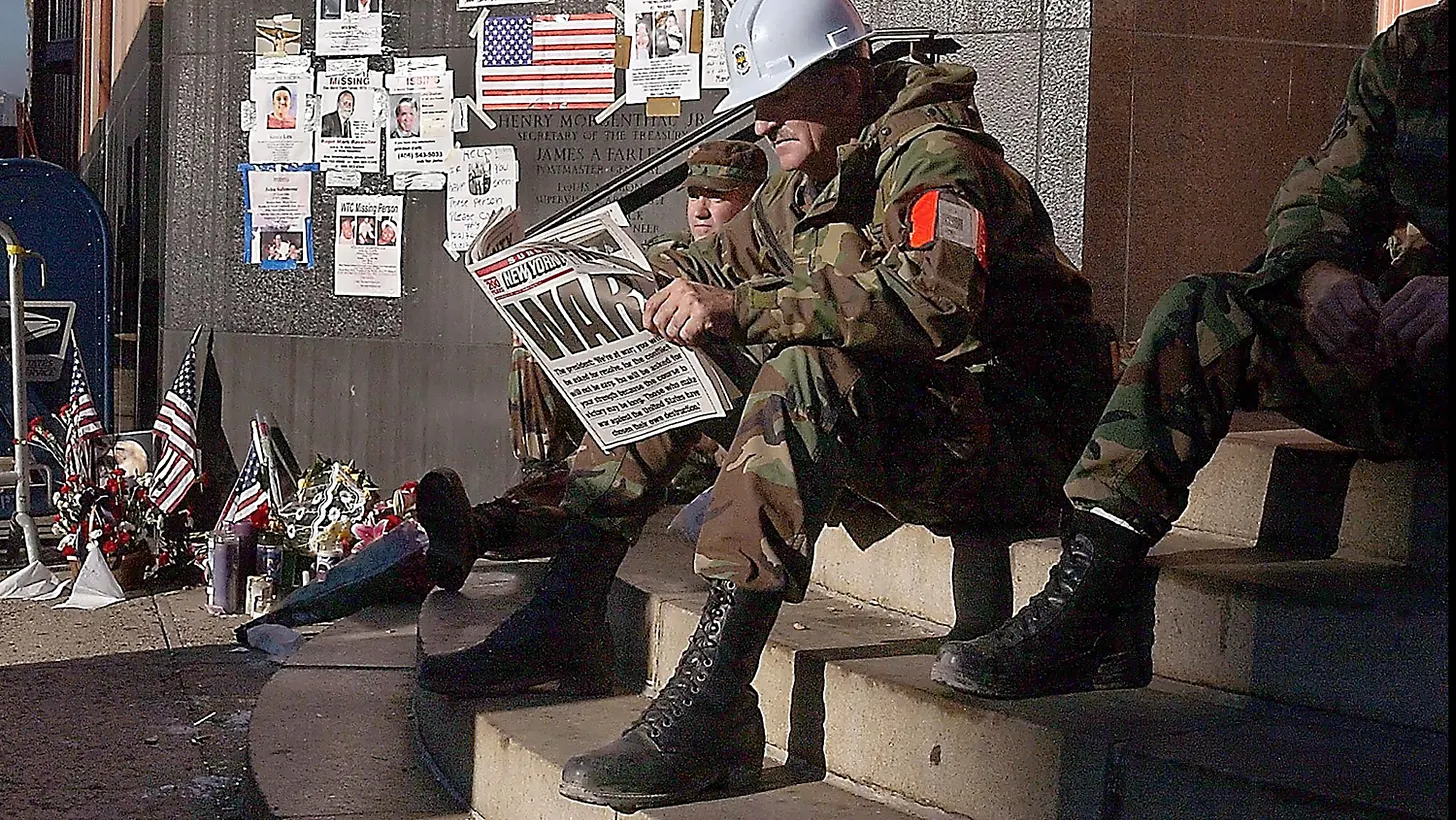
The Bulwark, Jonathan V. Last, yesterday: Sometimes Terrorism Works, subtitled “The hardest lesson of 9/11.”
The United States is on the verge of being chased out of the Middle East. Israel, which had been close to normalizing relations with its neighbors, is an international pariah state. The Islamic Republic of Iran now controls the Strait of Hormuz and will soon be the dominant power in the region.
In a fashion, these outcomes match some of al Qaeda’s goals from twenty-five years ago. Today I want to talk about an idea that isn’t very nice: Sometimes terrorism works.
Two big caveats before we start:
Correlation is not causation. Just because B follows A does not mean that A caused B.
Complex systems are ultimately opaque. A complex system has so many inputs that even if you can say that A contributed to causing B, there are always many other factors at play—some known and some unknown.
Keep those in mind as we talk.
What were Osama bin Laden’s goals?
- Weaken the U.S. financial system.
- Resulting in the American military being driven out of the Middle East.
- Thus causing the collapse of the American-aligned regimes in Saudi Arabia, Oman, Kuwait, the UAE, Qatar, and Bahrain.
- To be replaced with regimes friendly to al Qaeda.
- And eventually leading to the destruction of Israel and a unified Muslim ummah.
I’m going to mention again that these goals are largely or entirely driven by *religion*, and in terms of social control are not that much different from the goals of Christian nationalists. (Google AI: “Ummah is an Arabic word that means ‘community’ or ‘nation’ and refers to the worldwide family of Muslims united by their shared Islamic faith.”) Islam and Christianity, it seems to me, are just two different flavors of the same tribal instinct to conquer or impose one’s own (religious) culture on other tribes. There is nothing rational about either one. It’s not about truth, or reality. It’s about tribal domination.
The writer goes on in some detail about how bin Laden did not get what he wanted. The US is still in the Middle East. The entire world has not become Muslim. And so on. And yet.
What are the lessons here?
In part, there’s a cautionary tale for liberal societies about how they respond to terrorism. Terrorism cannot be countenanced and must be opposed. But the nature of the response carries its own dangers.
I don’t have a grand unified theory of what a wise response to terrorism looks like. Every case is different. And while you might be able to draw some sort of line from, say, 9/11 to Iran’s defeat of America, it’s not a straight line. The election of Trump was due in part to disillusionment about the wars in Iraq and Afghanistan, which were responses to 9/11.
But we’re talking about a complex system and there were many, many off-ramps for America. It didn’t have to be this way.
In the end I can only offer one big lesson: Terrorism is intensely destabilizing.
They succeeded in destabilizing the American order, by causing so much panic in the American right that they would elect someone like Donald Trump.
If you have a stable order—especially a stable liberal order—terrorism can throw it into chaos. And once chaos happens, many outcomes that were previously closed become possible.
That’s what terrorism is: a chaos button. And when terrorists press it they know that they may not get what they want, but that the existing order will be destabilized, and in that maelstrom there will be opportunities.
That’s why, as I’ve said, progress is fragile, and easily overturned by primal forces of human nature.
\\\
For the record.

NY Times, yesterday: Contractor Blames Its Own Repairs, Not Vandals, for Reflecting Pool Failure
Subtitled: The contractor said the pool’s new blue liner peeled and tore because of “human oversight” and a flawed plan that involved layering two incompatible chemicals, documents show.
Of course there were no vandals. Who believed that for a moment?
\
Similarly.
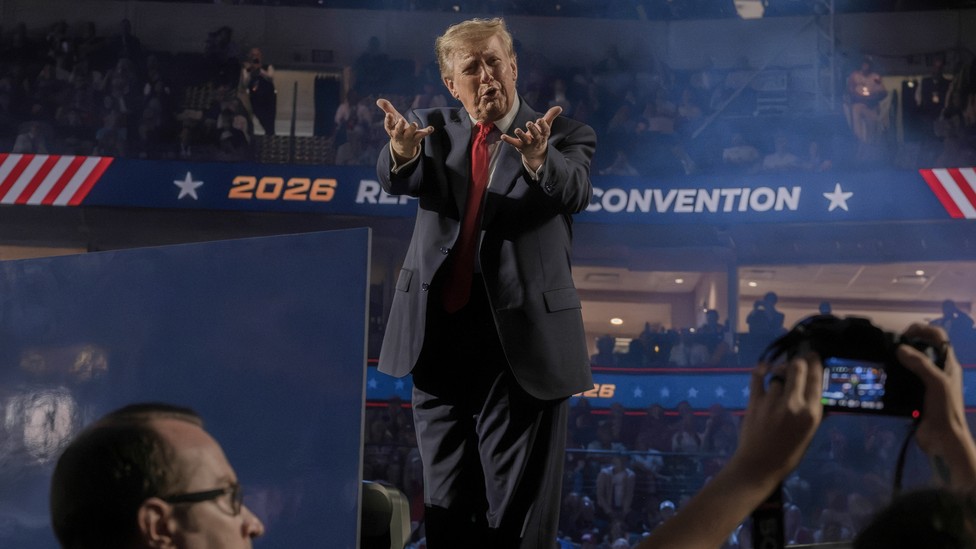
NY Times, Jonathan Chait, today: Trump Will Never Mail the $5,000 Checks, subtitled “Deconstructing a policy proposal that makes no sense on any level”
Fool me once, shame on you; fool me twice, shame on me. MAGA doesn’t seem to be aware of getting fooled over and over and over.
\
And this. Trump and MAGA live in a fantasy world.
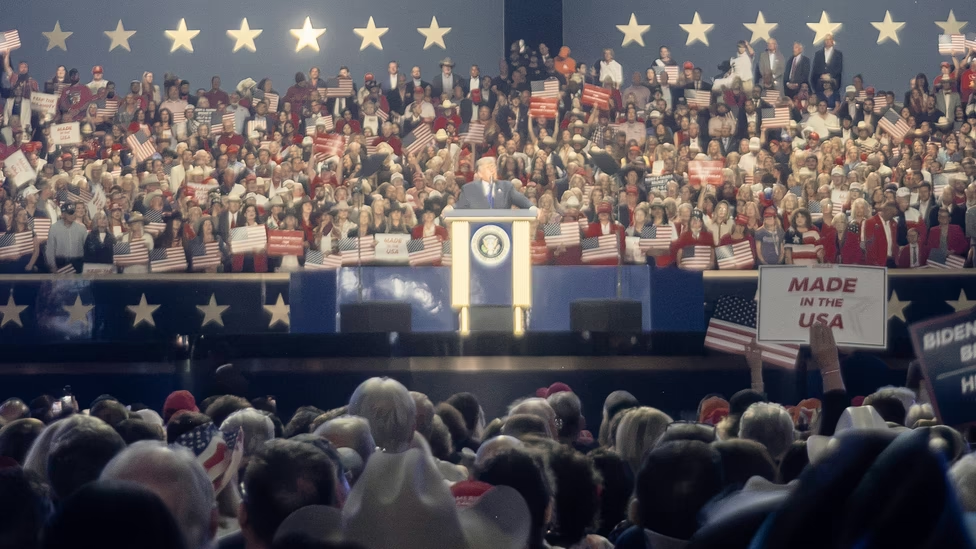
The Atlantic, David Graham, yesterday: Everything Trump Wants to Do Causes Inflation, subtitled “Does he not understand, or does he just not care?”
My answer: he doesn’t understand, and he doesn’t care. Nor does MAGA, who will believe anything Trump claims to the contrary.
\\\
Capturing this one because there are no ads, it’s a close-up view of the conductor and orchestral performers, and it’s Bruckner’s most popular symphony. It has many beautiful moments. Thought I ultimately prefer the 8th and 9th.