Subtitled: Imagining a Future Without Us
(Columbia Global Reports, 2023, 100pp, including 2pp of further reading.)
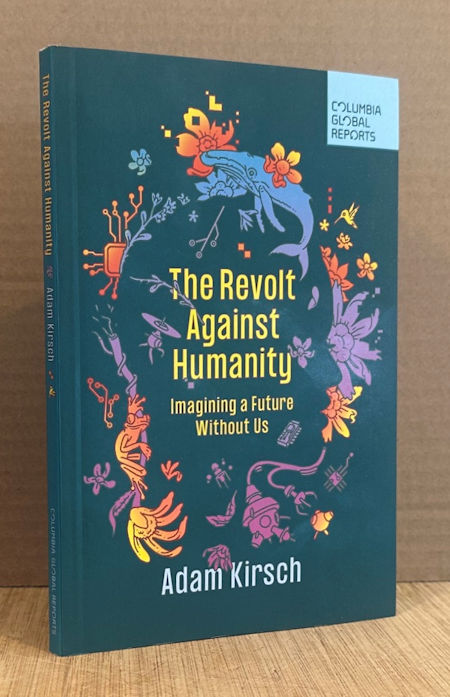
Here’s a small book with some provocative ideas I didn’t anticipate from the title. It’s from a publishing imprint of Columbia University called Columbia Global Reports, and indeed it reads like a survey of ideas, citing many particular writers and books, more than it reads like a thesis by the writer. And he’s read a lot more books than I have, and he’s summarizing them. The author is described as a poet and literary critic.
The gist is the conflict between two visions of humanity that both entail the coming nonexistence of the race as we know it: Anthropocene antihumanism, that says our climate is doomed and humanity should welcome its own extinction, and Transhumanism, that looks forward to how genetic engineering and AI will lead to new forms of life superior to humans. Obviously these aren’t the only possible fates of humanity, but both of these are increasingly plausible.
*
Key Points
- He defines the two positions I described above.
- Discusses how these ideas have emerged, citing books and films.
- This is the marshmallow test; can we reign in our impulses to save ourselves? Some would have us return to a agrarian past. But even that past destroyed the large animals on the planet. How can we ever stop?
- So consider the idea that humans are not at the center of everything. Try to connect with other creatures. The disappearance of humanity won’t be noticed by the universe at large; to think otherwise is metaphysical arrogance. The humanist era is already passing away.
- Discussion of Toby Ord, Nick Bostrum, Michio Kaku, Ray Kurzweil, et al. Some of their ideas are deeply conservative, resulting from revulsion.
- Transhumanists are serene about humanity’s disappearance, as long as it doesn’t happen too soon. They’re concerned about existential risks, but hope minds might transfer to computers, or a ‘connectome,’ or virtual reality. The metaverse. We could create minds more complex than ours. AI. The singularity. The risk is such AI might take over. Perhaps we shouldn’t mind.
- We’ve had such long-term perspectives ever since the 19th century, with discoveries in geology and evolution. The answers of religion no longer suffice. Some would retreat to them anyway, sacrificing the rationalist worldview in return for meaning. Otherwise some kind of human self-limitation is necessary. Thus our culture war, between liberalism and populism, traditionalists and posthumanists. It’s the traditional humanists who will lose.
Comments
- The lesson I take from this is that change happens, and neither the traditionalists (who deny reality) or the liberals/humanists will have their way. If we don’t extinguish ourselves, technology will happen and replace us anyway. It’s only a matter of time.
- Bigger: there is no ‘external’ meaning to humanity’s existence, nothing or nobody to care whether the species continues or not. Why are humans better than trees? Only because *we* are humans.
- And this goes to the underlying problem with the idea of “humanism,” as in “secular humanism,” as the alternative to religious deference to supernatural beings. Humanism is self-referential, implying only humans matter in the cosmos. Really? That’s it? What might a greater meaning or purpose be, that humans might facilitate? Here’s where the philosophers, and some science fiction writers, speculate.
*
Detailed Description
Introduction
Quotes Foucault about how our modern ideas are inventions, e.g. “man” in the 18th century. And that one day “man who be erased.” Ideas aren’t fixed; they can be reconfigured. Postmodernism. But such thinkers never thought of actual extinction. Until recent years. That man’s reign may end, and perhaps we should welcome it. This book aims to outline those key ideas. By people who are not all aligned. There seem to be two ways of thinking. One is Anthropocene antihumanism. We’re out of tune with nature, and are destroying it. Our self-destruction has been brought on ourselves. Another is transhumanism, with the potential to create new forms of intelligent life. New creatures, or AI. In both cases humans will disappear. It’s a spiritual development. Informed by poets, novelists, and philosophers.
How could we drink up the sea?, p14
Recalls the 2006 film Children of Men and the idea of imminent extinction. In 2019 such an activist group did disrupt London. XR. Warning the world of climate change. Al Gore’s An Inconvenient Truth was also 2006. Roger Hallam of XR updated Common Sense for the 21st century. David Wallace-Wells in 2019. Their warnings can sound apocalyptic, complete with target dates. The idea of mass extinction, and Elizabeth Kolbert, The Sixth Extinction. The idea of extinction by nuclear war has already been around for a while. Humans are motivated by a sort of zero-sum competition: be fruitful and multiply, but don’t kill the planet. Now we have the concept of the Anthropocene. Humans are now taking center stage, away from the natural world. Jedediah Purdy, After Nature. We could redefine evolution. The survival of what are useful to humans. (Humans as a selection force.) The sublime, vs the beautiful. Edward Burke. 21.7 [[ yes here’s the idea of awe again ]] Terror. [[ thus the connection to horror ]] The ocean. Darwin spoke of it. Now we pity what we are destroying. Bill McKibben. The idea of killing off nature. Like Nietzsche and God. His idea of the superman, beyond good and evil. The death of nature now required the creation of the posthuman. We have the power to remake ourselves.
Now it’s too late to change, p25
This is a species-level marshmallow test. We try to set numerical limits. But they were nonbinding. Such goals tie environmental degradation to economic inequality. Naomi Klein. Purdy. Do we renounce growth? How do we give up bad habits? Cast it as a sacrifice. Wilson, Biophilia. Nature is comprehensible, the opposite of as in myth, 28t. Later, Half-Earth. But our desire to know isn’t pure. And we’d need even more technology to achieve such goals. Paul Kingsnorth stopped thinking of himself as an environmentalist, and thinks humans are the problem. He published a book with Dougald Hine [sic]. They want a return to the unpopulated landscapes of their childhood. Their views recall those of Ted Kaczynski, the Unabomber. Others have found human wanting. Wordsworth. Whiteman. Robinson Jeffers. Anticipating Greta Thunberg.
[[ Hold on – the Bible of course endorses human’s dominion of the earth. Surely that’s part of the problem. But what’s the solution? Something besides extinction? How would other intelligent species handle this? Some current big thinkers propose: reverse entropy. ]]
The most committed antihumanists include Michael Boulter, in his book Extinction. Even herding damaged the natural world. Large animals were hunted to extinction, by about 21,000ya. Then in North America after 11,000ya. Given this behavior, why should we stop now? We can’t change. Roy Scranton, an Iraq War vet, came to the same conclusion. We need to prepare for death. Or do they just want humanity to start over? Noah’s ark again. Maybe it’s culture we need to destroy. Protagoras, 5th c bc.
[[ This echoes the problem with the ‘humanist’ movement. The target has to be something greater than just our particular race, or we’ll destroy ourselves and some other race will get to try. ]]
P37, Humans are not the point
We need to revoke the Bible’s injunction for humans to have dominion over everything. How then do we think about the world. Start with the philosophers and storytellers. But we can’t think outside of human cognition. Timothy Morton, Humankind. No pronouns. A solidarity with nonhuman people. There are no sharp boundaries between us and other kinds of being. Many creatures live within us. Alienation; the Severing. Overthrow the assumption that human thought is unique. Kant. How do ever know the things themselves? Object-oriented ontology, Graham Harman. Similar themes in Jane Bennett, vibrant matter. These ideas support environmental goals: we are less likely destroy other matter. Still, it’s natural to value life over nonlife, humans over other living things. Then there’s Patricia MacCormack, The Ahuman Manifesto. Stop reproducing, allow suicide and euthanasia. Humanity as a “parasitic, detrimental species.” She would welcome human annihilation, to liberate the natural world from oppression. Then there’s David Benatar, Better Never to Have Been in 2006. Leaven unborn humans that way.
The intuition is that the disappearance of humanity wouldn’t deprive the universe of anything unique or valuable. [[ It occurs to me that white supremacy is analogous to human supremacy, the idea that only humans matter. ]] This is a metaphysical arrogance, that only humans can create meaning or value. Yet a gradual winding down would be tragic for the last generation. As in Children of Men. The real horror is existential. We do know that humanity is going to disappear. We only doubt the time frame. Claire Colebrook. The humanist era is already passing away. We’re increasingly aware of human brutality and life-destructiveness. Or perhaps it will be due to population decline. The rate of growth is already slowing. The prediction is the population will peak at about 10 billion in 2064, and then fall. That will be good for the planet. And it will be self-reinforcing. Part of the reason is fear about the future. Powers’ The Overstory was about the idea that trees are morally superior to humans. Ecological activists seek to stop logging in Oregon.
Fashion yourself in the form you may prefer, p52
Do we turn back to a simpler age? Toby Ord, The Precipice. About the odds of destroying ourselves in the 21st century: about 1 in 6. He’s a transhumanist, who believes we can keep going forward. The future is immense. The problem is our ability to keep progressing. Transhumanism agrees that our race will disappear, but that it will be placed by something else. They issued a Declaration in 1998. Technology can overcome ‘involuntary suffering’, increasing our lifespan, our senses, our intellects. Nick Bostrum. Aspirations. Silicon Valley—Peter Thiel, et al. Tegmark, Life 3.0. Kaku, The Future of Humanity. Nanotech. Effective immortality. Kurzweil. All in parallel with recognition of the Anthropocene. Yet everything is two decades away. CRISPR. It was used to design a baby, and the designer was sentenced to prison. Then there’s Leon Kass, with a 2002 book. Conservative. Defends revulsion as a valid response. “The wisdom of repugnance.” Which was applied to racial mixing and homosexuality too. But Kass would decline rational scrutiny. He fears a loss of ‘human dignity.’ He’s defending the value of striving. Transhumanists would defend personal choice. Those who decline such enhancements are free to do so. Anders Sandberg emphasizes rights and bodily autonomy. Recalling ‘cyborg’ and a 1985 essay by Donna Haraway. Now they’ve become banal. Like IVF. And GNR technology. Bodily modification might extend to adornment and self-expression. Transhumanism rejects the very idea of fixed human nature. Beyond evolution. Harari in Homo Deus. We have the power to change ourselves. A 1496 Oration. Our need to change. Perhaps an authentic human thing.
A throwing away of all the human rules, p66
Transhumanists anticipate humanity’s disappearance with serenity, as long as it doesn’t happen too soon. Yet they’re skeptical about ETI (extraterrestrial intelligence). They worry about existential risks: Bostrom in 2002, Ord in The Precipice, looking forward to vast potential. Harari calls this Dataism. Kurzweil too, for whom a ‘patternist’ views patterns of information as the fundamental reality. Bostrom does some calculations. The universe as a giant mind. Yet we’re limited by our human bodies. But disembodiment may be coming soon. The mind is materialist. A computer made of organic tissue. Moore’s Law. Eventually we can upload a human mind into a ‘connectome.’ Living in virtual reality. Hans Moravec, Mark Zuckerberg. The metaverse. Themes in science fiction: Black Mirror. Upload. Substrate-independent minds, SIMs. Kaku: translate SIMs to photos and you conquer space. Laser porting. Bostrom is more concerned about AI. Chalmers’ The Conscious Mind from 1996 aligns consciousness with information states. Perhaps experience is ubiquitous. Then could we create a mind more complex than ours? If AIs are better than us at everything, why should we continue to exist? The goal is AGI, artificial general intelligence. It would keep improving itself. This prospect is the ‘singularity’, after Vernor Vinge. Unlike perpetual motion, this is not an impossible fantasy. Estimates range from 2040 to 2075. The problem is that such an AI might think for itself. Examples. Paper clips. Bostrom, Tegmark. Keep it boxed; but it might ‘break out.’ The problem of other minds. The Turing test. Would boxing an AI be immoral? Ian McEwan imagined this in Machines Like Me, 2019. Description. We need to ask why humanity deserves to prevail. Ideas about meaning, 82m: is existence without consciousness meaningful? Tegmark thinks not. Yet the consciousness doesn’t have to be human. McEwan suggests that AI minds might bring even more meaning.
The sphere of spiritual warfare, p84
These ideas are hard to contemplate. What if all these prophecies never come to pass? But they get us to thinking. These modern ideas suggest that the extinction of humanity will change nothing. Such thinking began in the 19th century, with geology and evolution. Wells. The final vision of the time traveler. Nietzsche saw this new knowledge as the advent of nihilism. We no longer have the answers of religion. All we know is how we came to exist. The religious resist this conclusion. Increasingly. They need something to live for. In the last decade conservatives have concluded the modern order is incapable of offering such a purpose, and is therefore doomed to fail. 2018, Why Liberalism Failed. (88t) The Catholic idea of natural law. [[ We need to account for all these; are they wrong? If so why? A vestige of a primitive past? ]] [[ Well, the trouble is, it’s based on supernatural claims that aren’t true. It might still be a remnant of base human nature. ]] Many belief systems require sacrifice. Enlightenment deprives us of the motive for sacrifice. What are the rewards for sacrifice in the rationalist worldview? Conservatives see a retreat to a religious past to restore purpose, 89b. This revolt against humanity might be such a sacrifice. The sacrifice of humanity in order to move the universe in the direction of good. That would be the meaning of human existence. Those opposing worldviews have something in common: human self-limitation. Recall Foucault, History of Sexuality. These ideas will affect biopolitical debates, e.g. about falling birthrates. Climate change. Maybe incentives to grow and have children will change. And so on. Both sides might support reducing the population. How this revolt maps onto the division between liberalism and populism, 93.6. The former more likely to accept limits. The latter to resist them. The culture war between traditionalists and posthumanists. It’s the traditional humanists who will lose. They gave us liberal democracy, and humanistic culture. What do humanists do? The traditional art forms are in crisis. Last line: “We can only hope that we don’t have the bad luck to be born into the last generation, the one that sees humanity as we have known it disappear.”
\\