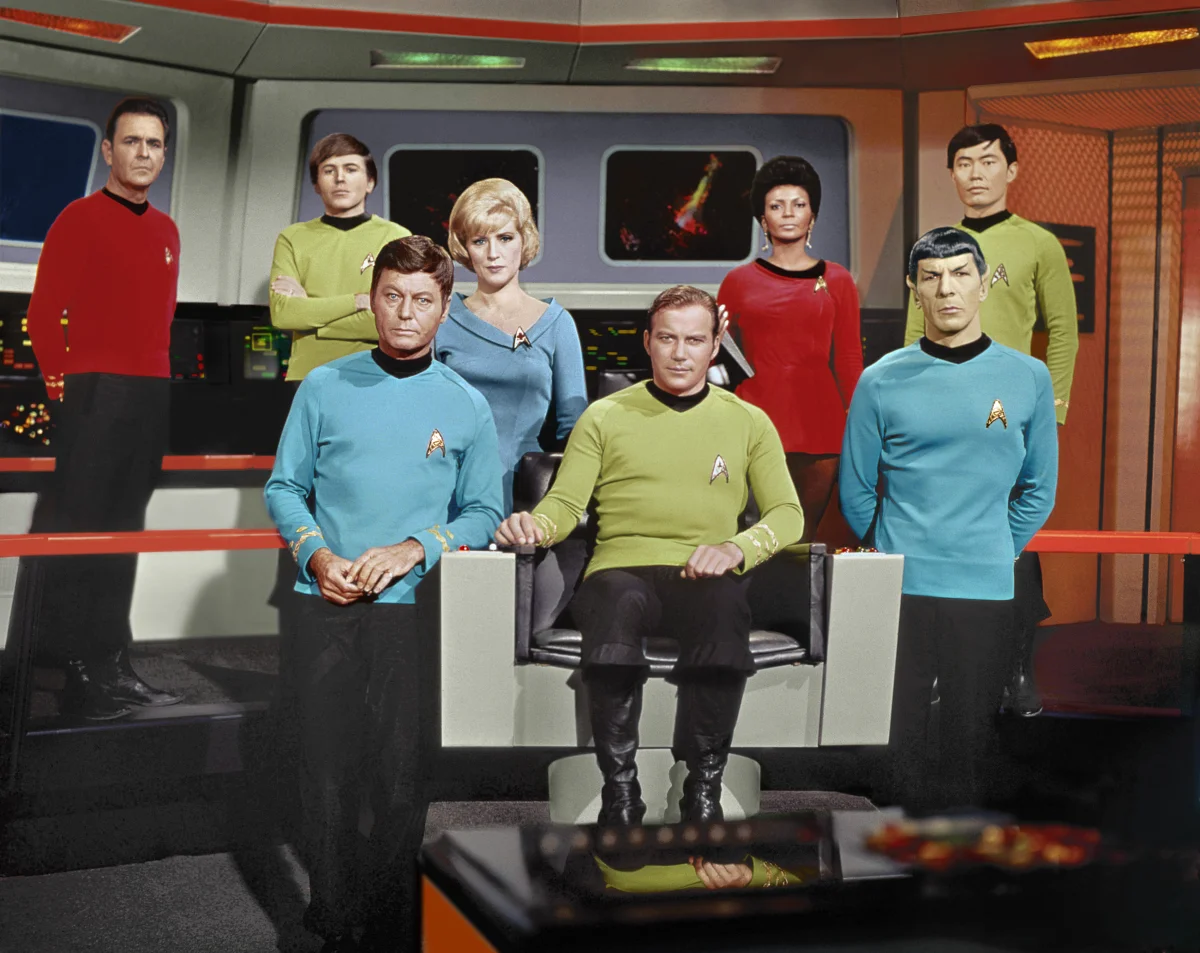
NPR, today: 60 years later, ‘Star Trek’ continues to ‘live long and prosper’
and
LA Times, today: ‘Star Trek’ is celebrating its 60th anniversary. Why its optimistic vision of the future endures
- As “Star Trek” marks 60 years, the creatives, stars and fans of the franchise reflect on its lasting influence and enduring legacy.
- The original series used diverse crews and allegorical storytelling to champion inclusion, collaboration and optimism — tenents that continue today.
I see today is the 60th anniversary of the premiere of the original Star Trek show, back in 1966. While I’ve no doubt discussed Trek from time to time on this blog, (and have an entire section from some 9 years ago when I rewatched the first season in some detail) I see that I did not note the anniversary 10 years ago, in 2016, nor 20 years ago, in 2006. So perhaps I’ll note a few things about watching the original show, and later ones.
- I’m fairly certain I saw the premiere episode, “The Man Trap” (in retrospect not a very good episode) when it first aired. The show had gotten a lot of publicity, particularly to contrast it from “kiddie” shows like Lost in Space, which had debuted the year before. “The first adult science fiction show,” I think the ads ran.
- Though I don’t think anyone else in my family much cared for it, I managed to watch the majority of the 79 original episodes when first aired. (I specifically recall watching “The Cloud Minders” in early 1969 while I was in the hospital recovering from an appendectomy.) After the first run the show immediately went into syndication, which means it became available to local TV stations in various cities to rerun as often as they liked, which typically meant five times a week, e.g. weekdays at 5pm. It was a thrill to finally see the eight or ten episodes I’d missed on original broadcast, even though I’d already read the adaptations by James Blish of some of them. (See that section.)
- But we only had a black & white TV. It was years later before I saw any of the episodes in color.
- As I’ve noted in that section, the syndicated episodes were trimmed by the local stations to allow for added commercial time. Typically some 5 minutes per episode. No rule against doing so. At the same time, when some 16 weeks had passed and the series cycled back to the beginning, the station editors would often take out a *different* 5 minutes. For some years I kept notes while watching these reruns, trying to piece together the entire stories. Yet, oddly, to this day, even though I watched the first season on DVD nine years ago (but not yet the second and third seasons), I’m not certain I’ve seen every scene in every episode. There might be scenes in those second and third season episodes that were cut every time, and so which I’ve never seen.
- Stepping out. I was 11 years old when Trek debuted, and though I’d already read a few science fiction books, Trek established the foundation of what science fiction meant to me. I came to understand, soon enough, that Trek was derivative of many earlier works of written science fiction, and Trek indulged in many science fiction fantasies (warp speed, the transporter, a human/alien hybrid) that did not stand up to scientific scrutiny.
- At the same time — there was an idealism to Trek that has not widely survived to this day. The early stories were about encountering genuinely alien races, and not simply destroying them as monsters (as in most of the 1950s skiffy flix); they involved a multi-racial crew, a meritocracy; and they involved an openness to exploration and expanding knowledge. This was its lasting legacy.
- Compare that to where we are today.
- After the original series, I did watch Star Trek: The Next Generation devotedly, from 1987 to 1994. I saw the movies as they came out, beginning with Star Trek The Motion Picture in 1979, and the later ones. But I never rewatched them; I’d moved on.
- I think Star Trek, in the later movies and shows, turned into a cultural phenomenon that steadily played to audience tastes, and played down to them. As I’ve said, the later series were more often about military battles with Klingons and Romulans and other villains, than encountering strange aliens or weird phenomena and trying to understand them. The movies increasingly valued spectacle (how many times was the Enterprise destroyed?). This kind of diminution from an original idea to an idea better accepted by mass audience has happened throughout the history of popular culture, from Frankenstein to Tarzan to Trek. The originals have been watered down to be more popular. That’s how they survive.
- (That’s why true “classics,” whether books or movies, seem odd to contemporary sensibilities. They were classics not because they did something familiar better than anything prior; they were classics because they did something completely new. Same applies to music.)
\\\
Quick takes.
- Scientific American, today: AI may have just solved a million-dollar math problem. The field will never be the same
- Subtitled: A mathematician compared the feat to the history-making chess competition in which IBM’s Deep Blue computer beat Garry Kasparov in 1997
- So many people are worried about AI, while many others anticipate it.
- My comment: I’ve been discussing the limits of human cognition lately. AI seems poised to surpass the limits of human cognition.
\
Trump is dumb as a rock. He doesn’t understand what “trade” means. He thinks spending money on trade means losing money. That he’s being taken advantage of. Trump and his MAGA supporters are an example of what I just said above about the limits of human cognition.
- NY Times, today: Trump Hits Back as Canada Imposes New Tariffs on U.S. Goods, subtitled “Canada’s decision to retaliate against President Trump’s recent tariffs has triggered another front in the trade war.”
\
And, he’s insane. More maps. Also, he claimed the Moon.

- JMG, today (from Reuters): Iceland Summons US Ambassador Over Trump’s Map
- JMG, today (from Arctic Today): Demented Senior Depicts US Owning North America, Central America, The Caribbean, Greenland, Iceland
\
- JMG, today (from NBC News): Trump: “No More Selling Bombardier In The US”
- The last position I had before I was laid off from Rocketdyne almost 14 years ago was supporting the manufacture of jet engines for Bombardier planes.
\
- Bless your hearts.
- JMG, today (from NOTUS): Hegseth: US Base Guards Can Use Christian Greetings
- Like “Have a blessed day” or “God bless you”.
- If I visited a store or facility that spoke to me that way, I wouldn’t go back. What kind of creepy fantasy world do they think they’re living in? Grow up.