Two Essays About Current Events: by Connie Willis and Heather Cox Richardson

Connie Willis is one of the most beloved science fiction writers of the past 40 years. As a writer she’s won many awards, for works often humorous but at times tragic, at times building human stories based on the weirdness of modern physics. She’s popular at conventions, excellent as a master of ceremonies (she does this for the Locus Awards every years, e.g. here), and obsessive about the news. She’s said that at conventions she keeps the TV in her room tuned to CNN all day. Continue reading

Posted in Meaning, Politics | Comments Off on Two Essays About Current Events: by Connie Willis and Heather Cox Richardson

George Gamow: One Two Three… Infinity

Here’s an oldie, not just for first being published in 1947 (see Wikipedia) but also for being one of the first science nonfiction books I ever read, back when I bought this copy in 1969.

(Seen here is the Bantam edition of April 1967, a reprint of the revised Viking edition of May 1961. Bantam’s is 340 pages.)

So I would have read this about the time I was in 9th grade and taking, what, high school algebra or geometry? This book doesn’t assume knowledge of those, and largely (but not entirely except in footnotes) avoids equations — just as Isaac Asimov’s popular science fiction, and essays in F&SF, did.

Continue reading

Posted in Book Notes, Mathematics, Personal history, Physics, Psychology | Comments Off on George Gamow: One Two Three… Infinity

Links and Comments: Some Good News, and the FBI

Some recent news is actually quite good.

Continue reading

Posted in Links & Comments, Politics, Social Progress | Comments Off on Links and Comments: Some Good News, and the FBI

Longtermism

A key aspect of (good) science fiction is that it takes a long term view, of the species, of the universe, as so few individual people do.

Continue reading

Posted in Human Progress, science fiction | Comments Off on Longtermism

Paperback Sets: Asimov’s Foundation Novels

I’m going to begin a series of posts capturing photos of some of the many sets of matching paperbacks that appeared in the late 1960s and early 1970s, when I began buying books, that I have acquired (some when published and some over time).

Continue reading

Posted in Paperback Sets, science fiction | Comments Off on Paperback Sets: Asimov’s Foundation Novels

Walter Jon Williams: “Surfacing” + 2

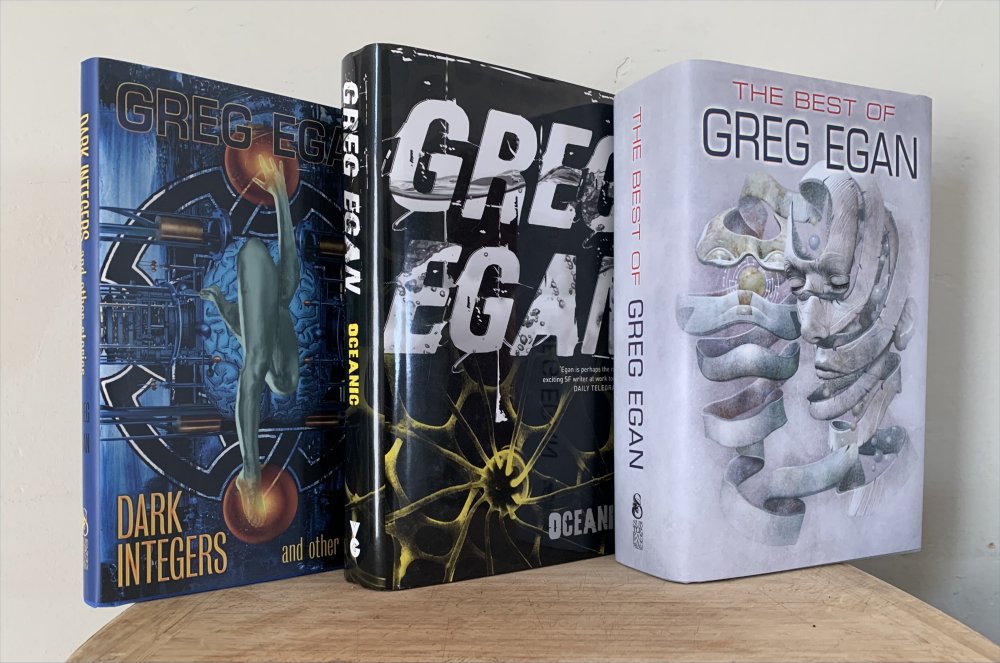
This week’s story being consider by the Facebook Best Science Fiction and Fantasy Short Fiction group, for its reading of the big Gardner Dozois book shown here, is the second story in that book, a 1988 novella by Walter Jon Williams called “Surfacing.” It’s about 60 pages in a typical book, fewer pages in this anthology with its tiny print. In this post I’m also reviewing two other notable stories by Williams, from 1999 and 2003.

Continue reading

Posted in science fiction, Short Fiction | Comments Off on Walter Jon Williams: “Surfacing” + 2

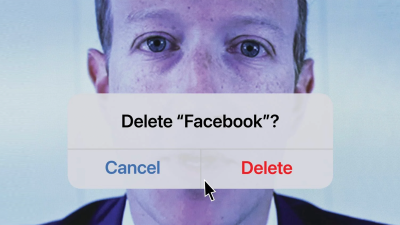
Facebook Memes: Conspiracy Theories; Ignorant People

Quick post for this afternoon; I’m working a long post about the next story my Facebook reading group will address on Sunday, concerning a novella by Walter Jon Williams, and I’m taking the opportunity while revisiting these older stories by also rereading additional stories by the same authors. So tomorrow I’ll have a post about three stories by Walter Jon Williams.

For today, two Facebook memes. I’ve seen both before; they’re still apt. The first is about conspiracy theories.

Continue reading

Posted in Culture | Comments Off on Facebook Memes: Conspiracy Theories; Ignorant People

David McRaney, HOW MINDS CHANGE

How Minds Change: The Surprising Science of Belief, Opinion, and Persuasion (Portfolio/Penguin, June 2022, 330pp)

Almost a decade ago I discovered two books by David McRaney, YOU ARE NOT SO SMART (2011) and YOU ARE NOW LESS DUMB (2013) that were popularizations of the discoveries of psychology over the previous decade or two. All about cognitive biases, how people commit logical fallacies, how they use heuristics. From his books, and others of the past two decades by Dan Ariely, Tom Gilovich, Daniel Kahneman, Jonathan Haidt, and others, I’ve learned a great about the difference between what people believe is true and what actually is true – a theme that dovetails with the notions of science fiction that suggest humans do not or cannot perceive more than our immediate experience, that a larger reality is out there for us to discover, if we can just think our way to it.

Continue reading

Posted in Book Notes, Psychology | Comments Off on David McRaney, HOW MINDS CHANGE

Abortion Votes and Republicans on Parenting

When I opened Facebook this morning the first 10 items were all about the election results in Kansas (from news sources or friends citing them), in which an attempt to remove protections for abortion *failed* rather dramatically — by 60% over 37% or thereabouts. And here I just quoted this para from that Slate article about the New York Times, yesterday:

But most Americans—57 percent, according to Pew Research and 63 percent according to a more recent CNN poll—disapprove of the repeal of Roe. Treating the minority that embraces it with more curiosity and empathy than the majority who opposes it will lead it to skewed perceptions of the reality on the ground.

Thus, all today:
Continue reading

Posted in Conservative Resistance, Evolution, Politics | Comments Off on Abortion Votes and Republicans on Parenting

Bothsidesism and Media Bias

Here’s an odd headline. What could this be about?

Slate, Savannah Jacobson, 1 Aug 2022: Why the New York Times’ Post-Roe Abortion Coverage Has Felt a Little Off, subtitled, “It’s the same problem that always plagues the Times.”

Continue reading

Posted in Politics, Psychology | Comments Off on Bothsidesism and Media Bias