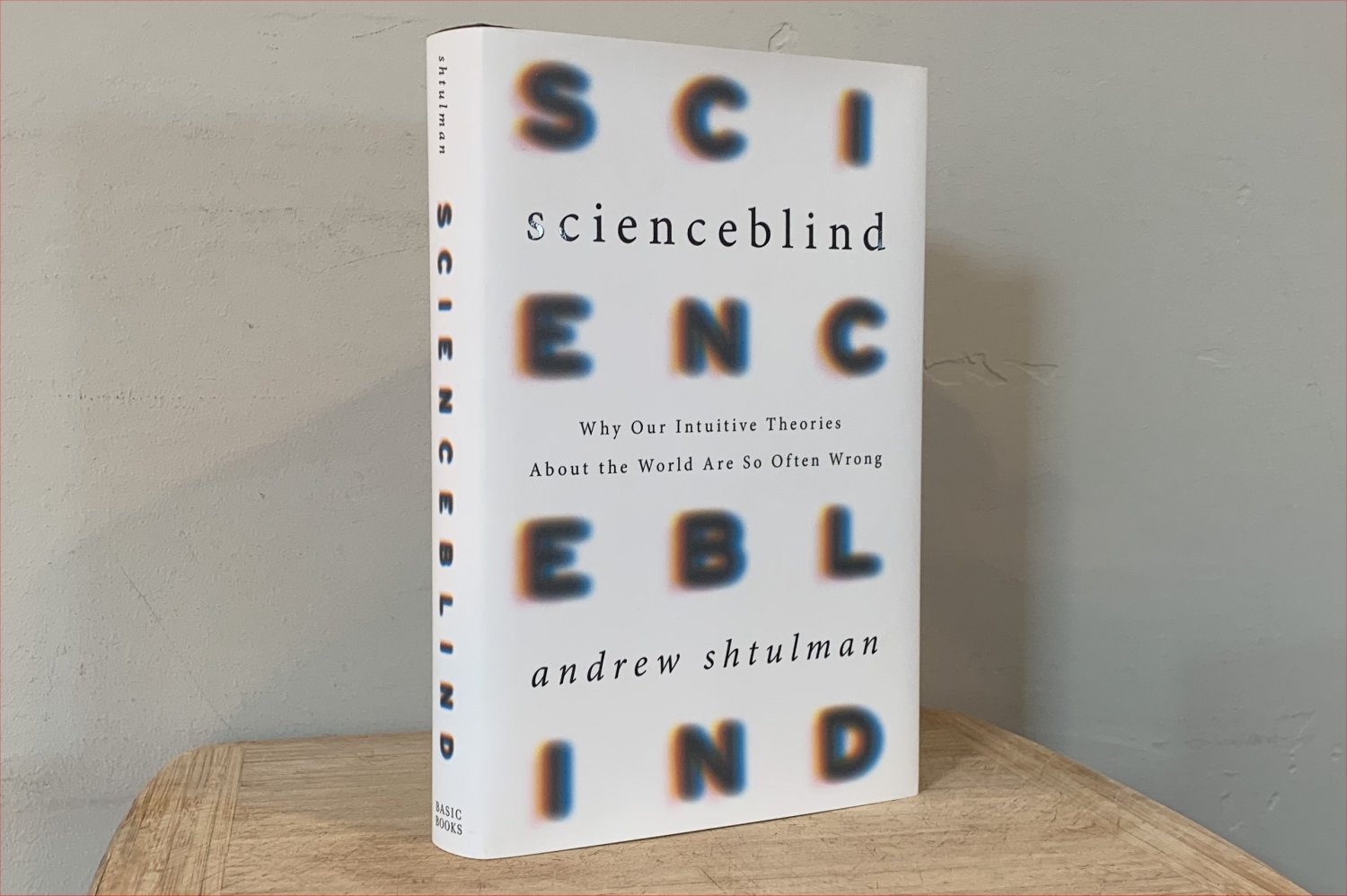
Andrew Shtulman: SCIENCEBLIND: Why Our Intuitive Theories About the World Are So Often Wrong

(Basic Books, 2017)

Here’s a book I read earlier this year and am only just now boiling my notes down into a coherent summary. (Well actually I started boiling my notes down but ended up just cleaning up the remainder, and added a summary at the top.) The subject here is supplemental to, not quite the same as, various books about cognitive errors, perceptual illusions, and so on; but it does align with those in examining ways our naïve “common sense” takes on the world are so frequently wrong. The focus in this book is how we come up with “theories” of how the world works in the first place.

The baby-faced (judging from the jacket photo) author is a professor of psychology at Occidental College (in LA), and the book has blurbs from Steven Pinker and Michael Shermer.

Going into this, I thought about the most common examples of how intuitive thinking is wrong. First, the notion that heavier objects fall faster than lighter ones. Trials would be foiled if lighter objects are subject to friction with the air, so you can see how people would think this. (Didn’t the Apollo astronauts on one trip do this demonstration in the vacuum on the Moon?) The second example is the notion that something that slides off a table, or that’s shot into the air and reaches a high point, falls straight down. We don’t take into account the object’s sideways momentum….

So to the book. Shtulman has handily provided summaries to each section capturing each chapter’s theme. Some of these intuitive theories, or misunderstanding about the real world, are features of childhood development that can be overcome; others are persistent even in adults.

Overview:

  • Matter: substances are viewed as holistic and discrete, rather than particulate and divisible
  • Energy: heat, light, and sound are viewed as material substances rather than emergent properties
  • Gravity: weight is viewed as an intrinsic property rather than a relation between mass and gravity
  • Motion: viewed as a something transferred between objects, rather than an external factor that change’s an object’s motion
  • Cosmos: earth is viewed as a motionless plane orbited by the sun, rather than a sphere in orbit around the sun
  • Earth: geological features are viewed as eternal and unchanging, rather than transient and dynamic
  • Life: animals are viewed as psychological agents rather than organic machines
  • Growth: eating is viewed as a means of satiation, rather than nourishment; aging as a series of discrete changes, rather than a continuous change
  • Inheritance: parent-offspring resemblance is viewed as a consequence of nurture, rather than by a transmission of genetic information
  • Illness: disease is viewed as a consequence of imprudent or immoral behavior, rather than due to microscopic organisms
  • Adaptation: evolution is viewed as a transformation of an entire population, rather than the selective survival of subsets of a population
  • Ancestry: speciation is viewed as a linear process of direct ancestry, rather than a branching process of common ancestry

Key quote, page 126:

We form these theories because we are built to perceive the environment in ways that are useful for daily living, but these ways to not map onto the true workings of nature. … Only scientific theories draw the right distinctions and thus only scientific theories can furnish us with beliefs that are consistently accurate and broadly applicable.

The first chapter is “Why We Get the World Wrong”; the last is “How to Get the World Right.” Key points:

  • Intuitive theories are untutored explanations for how the world works. They’re often wrong. To get things right, we need to dismantle our intuitive theories and rebuild them.
  • These theories are coherent, widespread, and robust; they’re better than nothing. But scientific theories, that get the world right, help us thrive.
  • Intuitive theories “are anthropocentric, grounded in a human timescale, a human perspective, and a human sense of value and purpose.” They have common themes: they are grounded in perception; they are thing-based (whereas science carves the world into processes); they focus on objects rather than contexts. And they are narrower and shallower than their scientific counterparts.
  • Does it matter if your neighbor misunderstands science as long as they have a sense of moral virtue? Maybe it does, if clinging to intuitive theories causes you neighbor to reject vaccines (or other health advice.)
  • Science denial is unavoidable – “there is a fundamental disconnect between the cognitive abilities of individual humans and the cognitive demands of modern society.” We must take intuitive theories seriously, becoming aware of them, and overcoming them.

Now what he doesn’t address are the way these ideas affect storytelling, especially in Hollywood movies (about how car crashes always end in explosions) and especially in almost all science fiction (why the Enterprise swooshes audibly as it streaks past the camera). Perhaps this is a separate subject, but this is where I see his subject overlapping with my study of SF.

\\

Detailed Notes:

Chapter 1: Why We Get the World Wrong

  • Milk used to be a problem; it became dangerous once carried long distances and stored for periods of time. This was solved in 1860s by pasteurization. And yet there are people now who are opting for unpasteurized milk, as if being more “natural” is automatically better. And because the idea of heat to kill germs is counterintuitive. This entails the rejection of immunology, geology, and genetics–science denial, coupled with political and religious ideologies. But at the root are intuitive theories, our untutored explanations for how the world works. And they’re often wrong. Our intuitive theory of illness, e.g., is about behavior, not microbes.
  • Intuitive theories are better than no theory at all. But they close our minds to ideas inconsistent with them.
  • This book addresses two ideas: First, we get the world wrong. Second, to get the world right, we must dismantle our intuitive theories (not just refine them) and rebuild them. Many truths are not easy to understand.
  • We learn such theories—about cause and effects—through experience. Some intuitions about motion and matter are innate; ideas about cosmology, etc., are acquired through culture. They vary in assumptions about causality. Supernatural explanations are just as substantive than natural ones.
  • They are not a dying breed; they’re a permanent fixture of human cognition—of children. E.g. concept of heat. Conceptual change; analogy with legos.
  • Some misconceptions are simply errors. Intuitive theories are coherent, widespread, and robust, 10t. Examples: dropping a bullet and shooting a gun; dropped a cannonball from a ship’s crow’s nest. Most people guess wrong about what happens to both. Our intuition about motion involves impetus, not momentum.
  • Another example: what it means to be alive…animals and plants.
  • Scientific theories never completely override intuitive ones; it’s more like a palimpsest, p14.
  • Example of a mother who thinks science is great, it’s just not right for her or her family (!). Science deniers are often skeptical of science where it seems to conflict with political or religious beliefs.
  • Intuitive theories help us get by. Scientific ones help us thrive.

Part 1: Intuitive Theories of the Physical World

Ch 2, Matter, p19

  • Humans innately perceive heft and bulk, and must be instructed in the atomic nature of matter to understand weight and volume, and therefore density.
  • Children identify matter with tangibility, so that air isn’t seen as matter.
  • Many examples of various experiment with children, even experiences with adults.

Ch 3, Energy

  • Heat was studied beginning in the mid-1600s, but experimenters thought that cold was something that moved, not a transfer of heat. This was the source-recipient theory of heat. Joseph Black in 1761 developed the “caloric” theory; a century later came the kinetic idea.
  • Intuitive theories of heat parallel historical theories. We still talk about heat as a substance that moves. We confuse heat and temperature, e.g. in situations of heat transfer: metal feels warmer that cloth even when their temperatures are the same.
  • Things are easier to think about than processes, especially emergent processes such as heat, pressure, traffic, stock prices.
  • Sound is energy; it travels through matter but it not matter. People think of it as a substance. “Extramissionist” beliefs imagine that ears send out sound waves, or eyes emit some kind of ray. Many adults hold such beliefs, even after given correct explanations. [[ Really? Never heard this before. ]]

Ch 4, Gravity

  • Infants seem to have no expectations of gravity, or of one thing supporting another, until 4 to 6 months.
  • Children expect objects to fall straight down, despite sideways motion or obstructions.
  • The simple heuristic for looking for a fallen object is to look straight down.
  • Some 7% of Americans think the moon landings were faked, and have various explanations for how it was done. But they overlook the dust in the film, dust which could hardly be rigged on wires. There are many odd questions about mass and gravity. Why don’t things on the other side of the earth fall off? Children imagine they would. What about a stone dropped down a hole through the earth? Learning about the shape of the earth has to go with learning how gravity works. Learning several new concepts at once is like building a ship at sea; you have to use what you have to start with.

Ch5, Motion

  • Medieval physicists had various theories about objects in motion, momentum or impetus, and so on. They got nowhere because impetus is not real; it’s the wrong question. Newton clarified this with his three laws. But these laws describe motion differently than how we intuit it on our own. We tend to find force and motion inseparable. We think motion requires an explanation, while rest does not. But they are two sides of the same coin.
  • Thus we imagine a marble rolled off a table will fall straight down, p76. Or that a whirled ball released from its string will still move in a curved path. All this affects how we deal with everyday objects—except, e.g., hockey players, baseball catchers, who have to learn how things actually move. And yet we find Wile E. Coyote cartoons funny because he *doesn’t* immediately drop down.
  • Impetus theory is constructed early in life. Even physics students use impetus-based reasoning, even though they can solve equations well.
  • How about simulated microworlds, as in video games? Helps only a bit. A tutorial on Newtonian principles works better. Anyway, most video games do *not* incorporate Newtonian principles.
  • Yet even hands-on experience is ineffective in teaching such abstract ideas, e.g. watching balls of different mass roll down a ramp. It takes instruction for these lessons to sink in. One way that works is via ‘bridging’ examples, e.g. to relate pressing your hand on a spring compared to a book sitting on a table. These work quite well. Preconceptions are not necessarily misconceptions. Yet some really are (like that heavy objects fall faster than lighter ones). Both sidestepping and bridging are useful strategies.

Ch6, Cosmos (i.e., what is the shape of our world? What is its place in the cosmos?)

  • Consider that many ancient people spent their entire lives within a day’s travel from home. So what ideas would they have about the world? Exmples from Egypt to Hebrew. No one considered the world might be a sphere. Even today most children have not understood this. Children learn it, but don’t readily understand it. Children drawing a picture of the earth make odd mistakes, 93m. We call theirs ‘models’ rather than theories. Some of their ideas are ‘hollow sphere’ models. There are also the flattened sphere and the dual earth models. See diagrams p96. These models are remarkable for their consistency; children devise them on their own. Or are they swayed by interviewers’ questions?
  • Understanding the earth is a sphere requires understanding why it *looks* flat. And how a person can be on the other side without falling off. Tutorials on these subjects helped children abandon their earlier models.
  • There are cultural variations in children’s models, depending on cultural myths. Australian children are aware of being on the ‘underside’ and so are anxious about the question of why they don’t fall off.
  • Other ideas require explanation: day/night, the seasons, tides, changing constellations. Children’s ideas of these depend on the models of the earth, p102. By adolescence most understand the day, the year, etc. [[ of course I suspect many adults *can’t* explain these things just because they’ve never had occasion to think about them. And now there are some actively pushing back, prioritizing their intuitive sensations of the flat earth. ]]
  • What about other ideas, like tides or lunar phases? Most think the season are due to closeness to the sun. Videos don’t seem to help. Adult misconceptions run deep. … “I never knew that Mars had a sun.”

Ch7, Earth (i.e., why do continents drift? Why do climates change?)

  • We know that the earth is molten, that the continents drift.
  • Wegener amassed much evidence for continental drift—it was a triumph of evidence over intuition, 110.2. At one point lost continents were postulated—Lemuria! Yet geologists were skeptical; what mechanism could move continents? Nongeologists still find the idea baffling. Even modern students retain their naïve understanding of the earth (as fixed and unchangeable).
  • Why? First, the data is not plain to the naked eye. They are not obvious like volcanoes are. Students with better visuospatial skills did better.
  • Second, immense amounts of time are involved. ‘Deep time’ geologists call it. Darwin wrote of this, p117. Consider order of major events in evolution of life, p118t. (Mammals appeared long before the dinosaurs went extinct, of course.) Some people think dinosaurs and humans lived at the same time—recall pop culture tv and movies. Creationists require no evidence, of course. They at first denied dinosaurs ever existed, then had to reinterpret the evidence, e.g. to suggest that Jesus rode a T.rex (!) p119.7.
  • You also need to see earth as a dynamic system to understand its climate. Most people conflate climate with weather, and with hot weather. People are more apt to accept climate change on hot days than on cold. Such misconceptions breed naïve solutions.
  • There are ‘six Americas’ in terms of how climate change concerns people. Those more dismissive are also more politically conservative. Perhaps those who dismiss it simply don’t understand what it is. Providing information about how it works helps only a little. Info on how many scientists accept it helps somewhat. That’s the consensus effect, analogous to popular fashion and peer pressure. Yet the default strategy is the guilt trip—how we’re harming the earth. Such emotional appeal often fails against our notion that the earth is eternal and indifferent to humans. It’s more correct to say that Gaia will survive, it’s humans that are killing themselves. P126.
  • Recap of these chapters, p126b. and “We form these theories because we are built to perceive the environment in ways that are useful for daily living, but these ways to not map onto the true workings of nature.” …And: “Only scientific theories draw the right distinctions and thus only scientific theories can furnish us with beliefs that are consistently accurate and broadly applicable.”
  • Well, yes, this is the bottom line.

Part 2: Intuitive Theories of the Biological World

Ch8, Life (what makes us alive? What causes us to die?)

  • Children are unaware of mortality. Author recalls taking his 4 ½ year old son to see mummies. When children aren’t told answers about biological events, they invent answers based on things they know, like sleep and travel.
  • Begin alive is about a metabolic state—extracting energy from the environment, and so on. Children simplify this to self-directed motion. Children are attentive to organic movement over mechanical or random movement. (Because those are the ones that interact with the child.) Preschoolers don’t think plants, etc., are alive. They’re also confused about which biological activities various animals engage in. Children will attribute qualities of humans to some animals, but never qualities of animals to humans. They think things like the sun is alive. Gollum’s riddle. Rural children understand these things earlier than urban children. Except urban children who have pets.
  • So children gradually understand that death is a termination, not a journey somewhere. Five principles of death, p140m, learned at different stages. Children don’t hear much about death; more about grieving, or confusing talk about surviving as angels. This is confusing because children don’t understand the distinction between the physical body and the ‘soul’. Eventually they focus on the concept of a body. Teaching about parts of the body, e.g. with body aprons, helps. Did it make them fear death more? No, less.
  • Adults are conflicted about death. E.g., why exhume remains of soldiers who died at Pearl Harbor for identification and reburial? Further, we speak less of plants being alive than of animals. And even adults don’t completely escape the motion-based conception of life. People with Alzheimer’s revert to childlike conceptions.
  • So: children think living entities are animate, and have to learn it’s about them being metabolic.

Ch9, Growth (why do we grow bigger? Why do we grow older?)

  • Children don’t understand that a birthday indicates a passage of time since they were born; but they know older children are bigger, smarter, etc. Some young children think the birthday party *makes* you a year older. This hearkens to the vitalistic theory of biology, that some inner energy or life force is what keeps us going. Young children provide vitalistic explanations for how the body works. It takes a while to understand that being alive and growing go together. Growth is seen as a separate phenomenon, the way clouds grow.
  • A key step is whether children understand the nutritional value of food. Some get hung up on particular aspects. They get confusing directions on what they should or should not eat. Vitalistic instructions work best, emphasizing which components are healthy or not.
  • Examples of people with Williams syndrome, that combines low intelligence with normal language skills. Do they acquire vitalistic ideas of biology? E.g. not understanding why a vampire would bite a lady’s neck.
  • People can learn which foods are healthy, etc., but they still think exercise is the key to losing weight, not eating less.
  • Other beliefs are shaped by essentialism—that outward appearance is a product of an inner nature or essence. As in familiar stories in which a person or animal’s true nature comes through in the end. Children believe an animal, or person, raised by others will grow up to be like their parents. This has sociological consequences, in terms of categories of people, e.g. rich vs poor. Or issues with organ donation, even blood transfusions.
  • Children don’t realize that children grow into adults. And they have difficulty realizing that aging goes through phases. 20 and 30 year olds think their preferences will change less often in the future than they have in the past. Adults think they’ve arrived at the final phase of their identity, unable to imagine that we might change in the future.

Ch10, Inheritance (why do we resemble our parents? Where did we get our traits?)

  • Cloning and genetic engineering are scarier in pop magazines than in real life. There’s great misunderstanding about genetics and modified food, e.g. GMOs. Some of this is due to poor education, but it’s also due to essentialism. Adults associate essences with genes. But this leads to many maladaptive attitudes and behaviors, 170. Children can be tested with thought experiments. Children younger than 7 confuse inherited traits between a king and an adopted prince. Or thinking shirt color was inheritable.
  • Also, children think kinship refers only to social relations. E.g. that a close friend of a boy is a brother. Of course, adults speak in such terms, but children don’t realize those are metaphorical.
  • A third context is cross-species transformation, as in Wells. It doesn’t work because each animal retains its ‘essence’. Children think this should be possible. They think surgery turns one animal into another.
  • How to children acquire a biological understanding of inheritance? By learning where babies come from. …articles in NYT assume a certain knowledge of biochemical facts, 182b. And our beliefs about genes can influence our behavior…

Ch11 Illness (what makes us ill? How does illness spread?)

  • Humans around the world express the same reactions to things that contain pathogens and parasites. The disgust face. The insular cortex. It triggers even by seeing someone else look disgusted. Some things are disgusting only by association, 187t. [[ This is the same kind of better-safe-than-sorry overreaction as the perception of agency. ]] At the same time, we fail to be disgusted by some things that should be disgusting—agencies that spread infectious diseases.
  • Children differ in same ways in their disgust responses. The confuse disgust with anger. They don’t react to things like dead animals. They have to be trained to be wary of objects that might be contaminated, like urinals. Or glasses of milk a grasshopper had fallen into. Perhaps because some degrees of disgust are a luxury, for living in a modern society; early, one couldn’t afford to be too picky. E.g. food that’s fallen on the ground. People are sometimes disgusted by things they did not eat in their childhood; so attitudes about certain foods vary from culture to culture. Crabs, termites.
  • There are other reasons people fall ill rather than infectious diseases; genetic, nutrition. For most of history these have been blamed on internal fluids, or ‘humors’. Hippocrates. Imbalanced. To relieve them could involve bloodletting. A universal practice. Bad air, or miasma, was another popular explanation. It wasn’t until the 17th century that ‘animalcules’ were observed, and not until 1857 that Pasteur made the link to diseases. Thus germ theory and microbiology.
  • So now children are told about germs all the time. Yet they don’t always understand and react appropriately. And young children don’t distinguish between germs and poison. And the connection between germs and disease is fuzzy.
  • Same is true among adults; thus people who think you catch a cold from being cold. But this is just a folk belief. Such beliefs generally prescribe preventative measures, but sometimes these are maladaptive. A Think Biology course for children helped.
  • Other folk beliefs have supernatural flavors. Some pray to god. Some cultures attribute illness to sorcery, spirits, or witchcraft. Some Africans know how AIDS is transmitted but still blame witchcraft. And it takes adults to teach such things to children. Some people believe illness is moral; bad things happen to bad people, as if they deserve it. Knowing how we get sick isn’t the same as knowing why we get sick.

Ch12 Adaptation (why are there so many life-forms? How do they change over time?)

  • Newton and Darwin didn’t discover gravity and evolution—they discovered the principles and mechanisms behind them. Darwin had five insights. … summary 204b. Other ideas had floated around, e.g. Lamarck’s inheritance of acquired characteristics. Darwin realized that both mutation and selection are involved. Even after Darwin there were other theories, for 50 years. Eventually understanding of genetics came down in favor of Darwin.
  • Still today, students don’t appreciate its importance; they deny it utterly, or misunderstand it. Most answer incorrectly a question about woodpeckers, 206b. Intuitive theories of evolution are similar to pre-Darwinian theories. Another: about changes in moth coloration, 208t.
  • [[ well this is interesting; I didn’t realize there are so many *wrong* ideas about how evolution worked. ]]
  • Similarly, most people see extinction and speciation as rare events. 209. The common thread is that people seem to believe that adaptation occurs uniformly across all members of a species in accordance with the species’ needs.
  • Most people misunderstand variation as deviations from some ‘true’ form, recalling Plato, and essentialism. Essentialism makes sense in understanding why a swan is born of two other swans. But every population is full of variation. Yet people still think in terms of categories of identical members. People deny traits might vary—at least, children and adults who didn’t understand evolution do.
  • Even people who know about variation don’t always appreciate its role in evolution. Many people believe in a non-Malthusian, harmonious view of nature. They underestimate competitive behavior and overestimate cooperative behavior. They underestimate how many organisms die without leaving offspring. These correlate with understanding of evolution. Competition within a species was a key idea. The less informed react to video feeds of animals eating, etc.
  • Summary: two deep-seated misconceptions: that all members of a species are the same; that all members have plenty of resources at their disposal.
  • And yet in the US evolution is excluded from biology courses sometimes even in high school. And teleology infects its teaching. One source of confusion is how evolution is portrayed in pop media.

Ch13 Ancestry (where did species come from? How are they related?)

  • Most people think humans are related to monkeys through direct ancestry—actually it’s shared ancestry. Ancestry isn’t a simple line, but a nested hierarchy. Curious George looks like an ape but is called a monkey. Speciation occurs when populations have been split apart by some barrier. Yet naïve notions of an essentialist views can’t account for one species split into two becoming two different species. They imagine a kind of metamorphosis. (Which is why Creationists they ask why apes still exist if they evolved into humans; they misunderstand evolution.)
  • All life is interconnected. Everything from humans to algae is similar at a cellular level. Educators use cladograms to illustrate relationships, p225. They diagram actual relationships even when superficial similarities are misleading. Yet these are confusing to nonbiologists. The order in the diagram doesn’t matter. And some versions include ‘chart junk’ that has no meaning, 229t.
  • Also, cladograms typically leave out extinct species, which leave behind no DNA. And they often misrepresent the number of species in a group, leaving out the diversity of some groups. Omissions lead to misunderstanding, e.g. about bonobos p232. As in the famous ‘tree of life’.
  • And some people think such diagrams fictions, or lies, preferring creationist accounts. A much simpler explanation. Children use such explanations instinctively. Religion is the highest indicator of skepticism toward evolution. Creationists are often fervent in their denial, as in hate mail to Richard Dawkins, 235b. Thus hesitancy of teaching evolution. And 12% even teach creationism.
  • Even Darwin was conflicted, at first, as his studies revealed the unlikelihood of creationism. And now, many feel religion and evolution as complementary. While in some areas endorsement of evolution marks one as immoral, disloyal, lawless, and godless 237.8. Of course, many other scientific ideas were once rejected by religion as well, and now accepted even by the religious (e.g. that the earth moves, etc.). Yet the problem with the middle ground is understanding why a God would use such a process, and end up with so many poorly designed creatures? 238m. Finally, acceptance of evolution can be inspiring and motivating, 239.

14, How to Get the World Right

  • How a stone with birdlike footprints found in 1802 was interpreted intuitively: it must be Noah’s raven! (He relied on his very limited knowledge of the world.) This “highlights how intuitive theories are anthropocentric, grounded in a human timescale, a human perspective, and a human sense of value and purpose.” And are elaborated by culture—without the Bible, the idea of Noah’s raven would obviously never have occurred to him. Now with science having expanded human thought, any child could identify a dinosaur fossil.
  • These are not the only intuitive theories. The 12 here have common themes: they are grounded in perception. They are thing-based (whereas science carves the world into processes). And they focus on objects rather than contexts (e.g. volume varies by temperature, color by viewing conditions). Each theme applies to some but not all. Furthermore: they are narrower and shallower than their scientific counterparts. Intuitive theories deal with the here and now; scientific with the full causal story.
  • So how do we restructure our knowledge? We can’t start from scratch; we have to repurpose knowledge we already have. We have to get our hands dirty in the details of the knowledge itself. Example about sexing chickens. Targeted training. Another example is teaching children about = signs. Specific tutorials work well; experimentation not so much, nor does critical analysis or quantitative reasoning help with problems of intuitive theories. Science is domain specific; so must science learning.
  • A problem is that intuitive theories seem sufficient, so we don’t realize they don’t explain everything. Example of rainbows. Most people think they understand more than they do. This is the illusion of explanatory depth. We have limited ability to recognize our limited ability.
  • And our intuitive theories are resilient. We tend to fall back on them. Science actually complicates our understanding of the world, adding a new layer on top of the old. It doesn’t overwrite intuitive theories. We need to actively think like scientists.
  • It matters more whether your neighbor has a sense of moral virtue, than whether they accurately understand science. Or does it? Maybe understanding science is more important than that. There are many scientific issues with social equations that everyone should understand. Vaccinations! Intuitive theories don’t help here. Even if science denial is unavoidable – “there is a fundamental disconnect between the cognitive abilities of individual humans and the cognitive demands of modern society.” 255.7. So we must take intuitive theories serious—by becoming aware of them, and overcoming them.

\\
Posted in Book Notes, Psychology, Science | Comments Off on Andrew Shtulman: SCIENCEBLIND: Why Our Intuitive Theories About the World Are So Often Wrong

Links and Comments: Dishonest Republicans; Covid-19 Skepticism; Carl Sagan’s prediction of a charlatan leader

Why are Republicans so routinely dishonest? Do they think they cannot win without cheating? Or do they think they have some ‘higher purpose’ that excuses cheating (my provisional conclusion, which alas applies to every group of zealots throughout history, who can’t count on their supposed truths to will out).

The Hill: New York City tenants say they unwittingly appeared in GOP convention video: report

NYT: How did the party get low-income New Yorkers to praise Trump? They simply tricked them into participating. N.Y.C. Tenants Say They Were Tricked Into Appearing in R.N.C. Video. Subtitle: “I am not a Trump supporter,” one of the tenants said, adding that she was furious that her interview with a government official was used for the convention.

Washington Post: I speak with a computerized voice. Republicans used it to put words in my mouth.

Do Democrats commit shenanigans like this? The only thing I’ve seen lately impugning a Democrat is that story about Nancy Pelosi getting her hair done, via security footage from a disgruntled hair salon owner who immediately ran to Fox News with the tape. But that was Republican driven, not any kind of fraud committed by a Democrat.

\\

A deeper look into Covid-19 death skepticism;, at Vox, “explained by a cognitive scientist,” subtitled: Faulty causal thinking may be driving death toll doubt.

With sections about counterfactual thinking, how we prefer simpler explanations, and the role of motivated reasoning.

\\

Let’s step back. Via a Facebook post: Upworthy: In his last interview, Carl Sagan warned that America will be taken over by ‘charlatan’ political leader.

Shortly before his death in 1996, he appeared on “Charlie Rose” and made a dire warning about how the average Americans’ lack of skeptical, scientific thinking could lead to disastrous consequences.

Today, we can see the problems that are happening due to America’s anti-science streak whether it’s anti-vaxxers, conspiracy theories or climate change deniers.

“We’ve arranged a society on science and technology in which nobody understands anything about science and technology, and this combustible mixture of ignorance and power sooner or later is going to blow up in our faces,” he told Rose. “I mean, who is running the science and technology in a democracy if the people don’t know anything about it?”

He then warned that our lack of critical thinking leaves us vulnerable to those who wish to exploit our ignorance.

“Science is more than a body of knowledge, it’s a way of thinking,” he says. “If we are not able to ask skeptical questions to interrogate those who tell us something is true to be skeptical of those in authority, then we’re up for grabs for the next charlatan political or religious who comes ambling along.”

Sagan believes that a democracy cannot function without an educated populace.

\\

More in the next few days.

Posted in Lunacy, Politics, Psychology | Comments Off on Links and Comments: Dishonest Republicans; Covid-19 Skepticism; Carl Sagan’s prediction of a charlatan leader

Status; Links and Comments: Conservative Willful Misunderstanding of Coronavirus Deaths

I’m behind on commenting on newspaper and magazine articles; it’s been almost two weeks!

This is because, as I’ve detailed on Facebook (though I realize some readers of this blog might not see my Facebook posts), I’ve been busy finishing a year-long project expansion of my sfadb.com site, creating a history of sf/f/h anthologies (http://www.sfadb.com/Anthologies_Directory), which I posted a week ago today; and keeping up on my biweekly reviews for Black Gate, the latest one about Philip K. Dick is here.

Also, I’ve spent some time this week answering email interview questions from James Patrick Kelly, a fiction writer who also does a column about the Internet in every bimonthly issue of Asimov’s magazine (he’s been doing these since… 1998! — per http://www.isfdb.org/cgi-bin/ea.cgi?236), about my http://sfadb.com site, which he feels, along with the Science Fiction Encyclopedia (http://www.sf-encyclopedia.com/) and the Internet Speculative Fiction Database (http://www.isfdb.org/), are three essential science fiction sites on the web. (I’m flattered, and gratified.)

Let’s go back to some links from the end of August. Here’s a couple about willful misunderstanding, on the right, about the coronavirus pandemic.

\\

NYT: ‘But I Saw It on Facebook’: Hoaxes Are Making Doctors’ Jobs Harder. Subtitle: Without the support of social platforms, our efforts to stamp out viral misinformation feel futile..

It ends:

Purveyors of false news will always exist; for as long as there have been epidemics there have been snake oil salespeople exploiting fear and peddling false hope. But Facebook enables these charlatans to thrive. Absent a concerted effort from Facebook to rework its algorithm in the best interests of public health — and not profit — we will continue to throw water on little fires of misinformation while an inferno blazes around us.

I keep saying this: Don’t get your news from Facebook.

\\

Nature: How many people has the coronavirus killed? Subtitle: Researchers are struggling to tally mortality statistics as the pandemic rages. Here’s how they gauge the true toll of the coronavirus outbreak.

People who want to think the pandemic does not exist, or isn’t an issue (because big government, conspiracy theories by scientists to take control of the world, or whatever), willfully misunderstand statistics.

This is about deaths directly attributable to Covid-19, and the actual “excess” deaths this past year, compared to previous years. If the substantial number of excess deaths aren’t attributable to Covid-19, then what have they been caused by? Trumpists haven’t thought it through this far. They are not very smart.

\\

Salon drills down the theme: Why the “6%” meme stating COVID-19 deaths are exaggerated is wrong. Subtitle: Trump and other conservatives seized on a misunderstood CDC statement as “proof” that coronavirus isn’t that deadly.

Yet the viral spread of the “6%” meme seems to speak to both a larger scientific illiteracy and the rapidity with which the conspiratorial right jumps on misinformation that appears convenient to their political narrative.

Dr. Eric Feigl-Ding, senior fellow at the Federation of American Scientists, called the “6%” meme “a ludicrous misunderstanding and misinformation.” “Basically, [they are] arguing that if you die with COVID and have any risk factors, then it somehow doesn’t count as COVID,” he told Salon. Feigl-Ding compared the situation to that of cancer patients, who frequently have compounding conditions that increase their risk of dying of cancer.

\\

I’ve begun reading Ezra Klein’s Why We’re Polarized, and will report about it soon.

Posted in Culture, Lunacy, Personal history | Comments Off on Status; Links and Comments: Conservative Willful Misunderstanding of Coronavirus Deaths

Links and Comments: Tell Them What They Want to Hear

One more set, just a few, then we’ll try to think of other things and hope that Trump and his minions will just magically disappear, as Trumps said, months ago, the virus would do over the summer. (It didn’t; he won’t.)

New York Times, Frank Bruni: Is There Nothing Trump Won’t Say?. Subtitle: Shamelessness meets illogic in a memorable (and endless) speech.

How to reconcile that with the vicious tone and vitriolic content of much of his remarks, which were as grounded in reality as a Tolkien novel and about as long? I’m stumped.

But I’m impressed: that he claimed such big-heartedness while showing such small-mindedness; that he twisted facts with such abandon and in such abundance; that he again trotted out that nonsense about having done more for Black Americans than any president since Abraham Lincoln; that he disparaged Joe Biden for not “following the science” about Covid-19 when he, Trump, mused about injections of bleach and vouched recklessly for hydroxychloroquine; that he characterized Biden’s positions as a “death sentence for the U.S. auto industry” when the Obama administration helped to save American carmakers.

He later taunted Democrats by gesturing at [The White House] and saying, “We’re here and they’re not.”

This wasn’t patriotism. It was puerility. He was rubbing his rebellion against tradition and presidential etiquette in his critics’ faces.

\\

The New Yorker: The Malign Fantasy of Donald Trump’s Convention. Subtitle: Using the White House as his prop, the President makes war on Joe Biden, and pretends the pandemic is all but defeated.

For four years, Donald Trump has been asking us to believe the unbelievable, to accept the unthinkable, to replace harsh realities with simple fantasies. On Thursday night, using the White House as a gaudy backdrop, the President made his case to the American people for four more years. His speech capping the Republican National Convention was long, acerbic, untruthful, and surprisingly muted in comparison to the grandeur of the setting, which no chief executive before him has dared to appropriate in such a partisan way. “We will make America greater than ever before,” he promised.

The problem, of course, is that America as we know it is currently in the midst of a mess not of Biden’s making but of Trump’s. Suffice it to say that, by the time Trump’s speech was over and the red, white, and blue fireworks spelling out “2020” had been set off over the National Mall, late Thursday night, more than three thousand seven hundred Americans had died of the coronavirus since the start of the Convention—more than perished on 9/11—and a hundred and eighty thousand Americans total had succumbed to the disease, a disease that Trump repeatedly denied was even a threat. His botched handling of the pandemic was the very reason that his Convention was taking place on the White House lawn in the first place.

But the real message of the evening was that nothing, not even a deadly plague or a cratering economy, can stop Trump from being Trump. He bragged. He lied. He even ad-libbed a taunt at his critics, using the White House as his prop. “We’re here,” he said, pointing to the flood-lit mansion behind him, “and they’re not.”

\\

UK perspective: Guardian: Trump unleashes diatribe of falsehoods and baseless attacks in RNC finale. Subtitle: Trump portrayed Biden as a creature of the Washington swamp, beat the drum of law and order and said little about racial injustice.

Yet while Biden rose to the occasion last week, Trump proceeded to deliver a somewhat flat 70-minute diatribe full of lies and falsehoods, red meat for the base and little to persuade the wavering voter. He even fluffed his big line by saying “profoundly” instead of “proudly”: “My fellow Americans, tonight with a heart full of gratitude and boundless optimism, I profoundly accept this nomination for president of the United States.”

\\

Vox, Ezra Klein: The 3 charts that disprove Donald Trump’s convention speech. Subtitle: Trump wants to take credit for something he didn’t do, and dodge blame for something he did do.

Gist: 1) the economic recovery began under Obama, long before Trump came into office; 2) the US has –still– by far the highest rate of new Covid-19 cases per million people, compared to “peer developed nations”; 3) and far more deaths per capita.

It is not Trump’s fault that the coronavirus reached our shores. It is Trump’s fault that we’ve responded so fecklessly. There is no reason that, say Germany, should’ve been so much more capable in its response. The difference was political leadership — a difference that was viscerally, visually on display during Trump’s speech, which packed 1,500 people onto the white House lawn, with barely a face mask in sight.

The grim truth is that, even today, we still don’t have a plan to control the coronavirus, save to hope for a vaccine. Vice President Mike Pence admitted as much on Wednesday. “Last week, Joe Biden said ‘no miracle is coming,’ What Joe doesn’t seem to understand is that America is a nation of miracles and we’re on track to have the world’s first safe, effective coronavirus vaccine by the end of this year.” So that’s the plan, then. A miracle. And how many Americans will die between now and then? How many will die if we don’t have an effective vaccine, produced and delivered at scale, by the end of the year?

So this is the core of Trump’s reelection message: You should give him credit for the economic recovery he inherited from Obama. And you should blame someone else for the disastrous response to the coronavirus. Inspiring stuff.

Posted in Politics | Comments Off on Links and Comments: Tell Them What They Want to Hear

Links and Comments: Republican Gaslighting

All of these links just today.

Slate: Republicans Are Gaslighting America. Will It Work?. Subtitle: Night three of the RNC was more revisionist history.

\\

Salon: Mike Pence’s contemptible convention speech: A fable of failure, culture war and corruption. Subtitle: Is this the guy who’s supposed to bring the Republican Party back to reality after Trump? Because he’s a joke.

\\

CNN: Pence reinvents Trump’s presidency on a disorienting night of crises.

So at the shape-shifting Republican National Convention on Wednesday, Trump’s most loyal subordinate Vice President Mike Pence had little option but to do what he does best. He twisted the facts, spun a more pleasing alternative national reality and showered his boss with praise.

\\

NYT, Nicholas Kristoff: ‘We Did the Exact Right Thing,’ Says Our Glorious Leader. Subtitle: So why does the United States have 4 percent of the world’s population and 22 percent of coronavirus deaths?

\\

The New Yorker: Mike Pence’s Big Lie About Trump and the Coronavirus at the Republican National Convention

Wednesday’s address will go down in history as a memorable example of how establishment Republicans like Pence have utterly capitulated to Trump, debasing themselves and their party in the process, and, ultimately, betraying the country, which, in its hour of crisis, deserved honesty rather than pro-Trump spin.

\\

Washington Post: What country does Mike Pence live in?

\\

Vox, Ezra Klein: Those who like government least govern worst. Subtitle: From the Iraq War to the coronavirus: why Republicans fail at governance.

Mostly about the Bush administration’s wilful ignoring of evidence and expertise in its determination to go to war with Iraq, but drawing parallels to the current handling of the coronavirus pandemic.

There are many differences between Bush and Trump as individuals, and many differences between their administrations. But both of them represent a Republican Party soaked in contempt for, and mistrust of, the federal government. When you don’t respect, or even like, the institution you lead, you lead it poorly. When that institution is incredibly, globally important — as the US government is — leading it poorly can invite global catastrophe. And sure enough, under the last two Republican administrations, it has. There is continuity here, of the most consequential sort: a continuity of terrible outcomes.

\\

NYT, Charlie Warzel: Welcome to the R.N.C.’s Alternate Universe. Subtitle: A meaningful percentage of Americans are living in a collaborative fiction, built one conspiracy theory at a time.

One of the biggest lessons I’ve learned covering the daily information wars of the Trump era is that a meaningful percentage of Americans live in an alternate reality powered by a completely separate universe of news and information.

Some are armed with their own completely fabricated facts about the world while others, as the journalist Joshua Green wrote in this section in 2017, rearrange our shared facts “to compose an entirely different narrative.” There is little consensus on the top story of the day or the major threats facing the country. You will have noticed this if you’ve ever watched a congressional hearing and flipped between CNN or MSNBC and Fox News. The video feed is the same but the interpretation of events is radically different.

…Fox News has been extremely successful in crafting and selling an alternate reality to its viewers each night for well over a decade. The trick is to evoke two dueling emotions — fear and devotion — one conspiracy theory at a time. Fox News has mastered this and so has the R.N.C.

\\

There’s a parallel between all these examples on the one hand, and on the other hand my musings a few posts ago about how no matter how much humanity learns about the extent and complexity of the real universe, most people won’t care, or will deny it in favor of religious fantasies of one sort or another. Will expand these thoughts soon.

Posted in Lunacy, Politics, Psychology | Comments Off on Links and Comments: Republican Gaslighting

Links and Comments: In the Political Air Tonight

Salon, Heather Digby Parton: The 2020 RNC isn’t a political convention — it’s a celebration of the Trump cult. Subtitle: Fear-mongering and corruption are nothing new in Republican politics. But Donald Trump has gone far beyond that.

\\

Washington Post: These 7 cultish moments at Trump’s convention add up to one Big Lie.

The seven are:

  • Trump’s awe-inspiring ability to rise above opponents.
  • The need to let Trump into your hearts.
  • Trump as the most empathetic person in America.
  • Trump as the heroic defender of Western civilization.
  • The greatest economy in the history of the universe.
  • Trump’s uniformly perfect handling of the virus.
  • Trump as a glorious and benevolent savior.

Again: this is a cult, divorced from reality.

\\

CNN: At Fox News, ‘the inmates are running the asylum’

Excerpt from a book. Opening lines of the article:

“Everything I know about the Constitution, I learned from you on ‘Fox & Friends,'” President Donald Trump once told Judge Andrew Napolitano.

Again, is this the best Republicans can do?

\\

Mother Jones: Why Are Right-Wing Conspiracies so Obsessed With Pedophilia?. Subtitle: The story is the same, from the day-care panics to QAnon: It’s not really about the kids. It’s about fears of a changing social order.

These conspiracy theories go back centuries: the McMartin preschool scandal of the 1980s; “Wild claims of Jews killing Christian children and using their blood in rituals—the “blood libel”—date back to at least the 12th century and have popped up every so often since then, and long before that Christians were suspected of performing similar rites.”

The continuities between the McMartin case and Pizzagate suggest a broader explanation for pedophile conspiracies: They aren’t the residue of malfunctions in our media culture. They’re an outgrowth of the normal workings of reactionary politics.

\\

The New Yorker: The Stunning Predictability of Steve Bannon’s “We Build the Wall” Scam.

Posted in Politics | Comments Off on Links and Comments: In the Political Air Tonight

Links and Comments: Republicans are Now the Cult of Trump

It’s official.

Washington Post: The Republican Party announces that it stands for nothing.

There is no Republican Party platform announced for its convention this year. No platform; no principles, no standards, no ideals. It’s all about supporting Trump. Virtually the definition of a cult. Whatever Fearless Leader wants.

\\

And Slate: Republicans Announce Their 2020 Platform Consists of Supporting Whatever Trump Wants.

Republicans have no ideals anymore; they just want to follow an authoritarian leader.

\\

And yet, at The Atlantic, David Frum (a former speechwriter for George W. Bush!), perceives The Platform the GOP Is Too Scared to Publish, subtitled, What the Republican Party actually stands for, in 13 points.

These include (of course) tax cuts for the rich; denial of the science behind the coronavirus and climate change, and so on. Frum does a good job about characterizing these in the terms Republicans would use, e.g.

3) Climate change is a much-overhyped problem. It’s probably not happening. If it is happening, it’s not worth worrying about. If it’s worth worrying about, it’s certainly not worth paying trillions of dollars to amend. To the extent it is real, it will be dealt with in the fullness of time by the technologies of tomorrow. Regulations to protect the environment unnecessarily impede economic growth.

The one point Frum misses, it seems to me, is Republicans’ undying support for the military. We can never spend too much on the military, they think, despite that the US spends more on its military than the next dozen or so nations combined. This reveals the overriding motivating factor of conservatives, and Republicans: fear.

\\

The overwhelming impression of Republican talking points, and their convention so far, is of *fear*. Paranoid fear. Their convention so far has been, not about the promise of American, as they said, but about stoking fear. And lying.

Washington Post: These 7 cultish moments at Trump’s convention add up to one Big Lie

Slate: The Republican Coronavirus Strategy: Lie About Everything, subtitled, The party is following Trump’s pattern of deceit.

Slate’s William Saletan identifies the points about lies, with many links to documented examples: about 1, Travel Bans; 2, Emergency Declartions; 3, Testing; 4, Medical Supplies, 5, Vaccines, and 6, Speed. For example, keeping links:

Trump has lied about the virus all along. He’s still lying. “We just have to make this China virus go away. And it’s happening,” he declared in a convention video, even as thousands of Americans continue to die. But the president is no longer alone in his fictional universe. He’s backed by a party that glorifies him with fabrications: that he stood up to North Korea, that his impeachment was “fake,” and that he “ended once and for all the policy of incarceration of Black people.” The tale of his struggle against the virus is just another heroic myth. Trump “is a visionary,” Rep. Matt Gaetz explained to the audience. What’s “built in the mind is even more powerful” than reality, said Gaetz. That’s the message from the first night of the convention: This is no longer a party of limited government, national security, or the rule of law. It’s a party of lies.

\\

Finally, for perspective, Business Insider compiles a list of Who’s not at the RNC?.

There have been respectable Republicans before the party turned into a Trump cult. Remember… Mitt Romney, George W. Bush, Dick Cheney, Paul Ryan, John Boehner, Condoleeza Rice, Colin Powell? None of them welcome at this year’s convention.

\\

And of course, this current political theme dovetails with some of my other recent blog posts.

Posted in Lunacy, Politics | Comments Off on Links and Comments: Republicans are Now the Cult of Trump

Notes for the Book: The Future of Enlightenment

More thoughts coming together. A famous quote is this from SF author William Gibson: “The future is already here – it’s just not evenly distributed.” (There are variants of this phrase around the web also.)

Then there was a video I saw on YouTube that presented legitimate and dumb-ass reasons for not wearing masks. Here it is: https://www.facebook.com/brittlestar/videos/639264403614751. (For some reason it plays twice. It’s less than 90 seconds long.) The former reasons include rare skin conditions, being a small child, etc.; the latter are the familiar knee-jerk reactions against science or expertise, the fetishization of personal freedom, just being a jerk, and so on.

The specific reasons aren’t the point; it’s that in general these attitudes will never go away. They are part of human nature; they are manifestations of group identities, tribal identities, the priority for most to conform rather think independently, which risks mistrust or ostracization from one’s community or social group.

And my thought from these extends some of my earlier posts, some tagged “notes for the book,” about hierarchies of knowledge and awareness, how we are living in a modern in world in which most of the answers to most of the big questions are now *known*… yet most people don’t care, or actively reject them. So this could be formulated, let’s see…

No matter how far science advances, no matter how fully the big questions about the universe and human existence are known, this knowledge will extend to only a tiny fraction of the human race. It will never be evenly distributed. There will never be a future enlightened state of humanity in which all the old superstitions and prejudices have been overcome or set aside in favor of a common, mature understanding of humanity’s place in the universe. Rather, most people will be happy, thank you very much, to live lives that prioritize their own group’s place and status (inside a bubble, so to speak), and outside of that, consider everything else as irrelevant, or to be explicitly rejected as threatening that privileged status.

It’s those who have so little grip on actual reality, as revealed by millennia and centuries of systematic investigation, who are most attracted to various outrageous ideologies, it seems, whether it’s Scientology, Christianity, or QAnon, that have (quite apparently) superficial naive appeal but that fall apart into incoherency on close examination.

Posted in Lunacy, Science, The Book | Comments Off on Notes for the Book: The Future of Enlightenment

Links and Comments: Thinking, or Not

Scientific American: Nine COVID-19 Myths That Just Won’t Go Away. Subtitle: From a human-made virus to vaccine conspiracy theories, we rounded up the most persistent false claims about the pandemic.

I’m beginning to think that many, perhaps most, people, do not truly *think* and draw conclusions in the way rationalists and scientists — including all those who have built the modern technological world (which ironically allows the conspiracy theorists to spread their ideas) — do. How is it all these religious loonies claims to *know* this or that, with no evidence or rationale? (QAnon.) They clearly can’t *know* these things, because they are demonstrably not true. My take, for the moment, is that these people are — like Trump — transactional. They imagine what they would like to be true, and say it to the world, because many of their listeners will believe them. They can get away with it, because day to day life for virtually everyone does not depend on the truth or falsity of bizarre conspiracy theories about the actual world.

Posted in Psychology, Thinking | Comments Off on Links and Comments: Thinking, or Not

Links and Comments: Benedictine Option; Pandemic Spread; Economic Stabilizers; Ed Yong; Evangelicals and Trump

The Atlantic: The Christian Withdrawal Experiment. Subtitle: Feeling out of step with the mores of contemporary life, members of a conservative-Catholic group have built a thriving community in rural Kansas. Could their flight from mainstream society be a harbinger for the nation?

An example of the Benedictine Option that I mentioned earlier: a religious community sealing itself into a self-sustaining bubble that rejects the reality and influence of the outside world.

I’m sure it works! It sustains the community! (As in that M. Night Shyamalon film The Village, which worked to a point.) It’s analogous to how virtually every other animal species on the planet, engaged with its environment only to the extent it needs to survive, does survive, with no understanding of the bigger world, of the universe. Humans *can* perceive the bigger world and universe, and to me it seems a shame to renounce that ability… a renunciation of the supposedly God-given ability to think, reason, perceive. (If you believe God gave humans those powers of reason and perception, why deny them and seal yourself into a reality-denying bubble?)

Still, science fiction writers have speculated that such insular societies might survive a global catastrophe when globalist elitist city-dwellers might not. (A mixed case is presented in a book I recently re-read, John Wyndham’s 1955 novel The Chrysalids.)

\\

A few more with fewer comments (but more quotes perhaps).

Salon, 31 July: The year of dark magical thinking: Trump’s petty revenge fantasies have killed thousands. Subtitle: Trump believed the virus would only hit blue states, which would work out great. So he let tens of thousands die.

Partly about Jared Kushner, who advised Trump that, since the virus was hitting the big cities [because of population density], and big cities tend to be Democratic [because they are not sealed into small-town bubbles], and since the Democrats didn’t vote for Trump… it wasn’t a problem. Let them die. This is contemptible, of course, but seemingly routine for the Trump administration.

Of course this administration are all idiots with no understanding of how pandemics spread. Currently, the areas of highest new outbreaks in the US is in the rural areas of California and in the southern states, those initially relatively unaffected.

\\

Slate, 31 July: The Extremely Boring Idea That Could Save the Economy. Subtitle: They’re called automatic stabilizers — and we need them to stop Republicans from screwing up another recovery.

About ways to manage the economy a bit more complex that the Republicans’ go-to strategy of cutting taxes for the rich, no matter the state of the economy.

\\

The Atlantic: here’s Ed Yong’s long article about How the Pandemic Defeated America. Subtitle: A virus has brought the world’s most powerful country to its knees.

Despite ample warning, the U.S. squandered every possible opportunity to control the coronavirus. And despite its considerable advantages—immense resources, biomedical might, scientific expertise—it floundered. While countries as different as South Korea, Thailand, Iceland, Slovakia, and Australia acted decisively to bend the curve of infections downward, the U.S. achieved merely a plateau in the spring, which changed to an appalling upward slope in the summer. “The U.S. fundamentally failed in ways that were worse than I ever could have imagined,” Julia Marcus, an infectious-disease epidemiologist at Harvard Medical School, told me.

A couple final paragraphs:

It is hard to stare directly at the biggest problems of our age. Pandemics, climate change, the sixth extinction of wildlife, food and water shortages—their scope is planetary, and their stakes are overwhelming. We have no choice, though, but to grapple with them. It is now abundantly clear what happens when global disasters collide with historical negligence.

COVID‑19 is an assault on America’s body, and a referendum on the ideas that animate its culture. Recovery is possible, but it demands radical introspection. America would be wise to help reverse the ruination of the natural world, a process that continues to shunt animal diseases into human bodies. It should strive to prevent sickness instead of profiting from it. It should build a health-care system that prizes resilience over brittle efficiency, and an information system that favors light over heat. It should rebuild its international alliances, its social safety net, and its trust in empiricism. It should address the health inequities that flow from its history. Not least, it should elect leaders with sound judgment, high character, and respect for science, logic, and reason.

\\

Alternet: Neuroscientist explains why Christian evangelicals are wired to believe Donald Trump’s lies.

For Christian fundamentalists, being taught to suppress critical thinking begins at a very early age. It is the combination of the brain’s vulnerability to believing unsupported facts and aggressive indoctrination that create the perfect storm for gullibility. Due to the brain’s neuroplasticity, or ability to be sculpted by lived experiences, evangelicals literally become hardwired to believe far-fetched statements.

This wiring begins when they are first taught to accept Biblical stories not as metaphors for living life practically and purposefully, but as objective truth. Mystical explanations for natural events train young minds to not demand evidence for beliefs. As a result, the neural pathways that promote healthy skepticism and rational thought are not properly developed. This inevitably leads to a greater susceptibility to lying and gaslighting by manipulative politicians, and greater suggestibility in general.

Posted in Culture, Lunacy, Religion | Comments Off on Links and Comments: Benedictine Option; Pandemic Spread; Economic Stabilizers; Ed Yong; Evangelicals and Trump