
Links and Comments: Living in History

People have a tendency to feel pleased they are living in history, experiencing the thrill of witnessing grand, momentous events. This partly explains I think the ever-recurring belief by some that they are living in the “end times.” How special one must be to witness the end of history! Instead of just one among another generation of humanity, a million-year old species of hundreds of thousands of generations who’ve lived and died and who are mostly forgotten. As most of us will be.

Of course people have been thinking the end is near (that aliens will arrive to save us; that someone who promised his followers that he would return in their lifetimes, 2000 years ago, might eventually reappear), forever, perhaps. Prophecies of doom, often tagged to specific dates, get explained away when the date passes and we’re all still here.

But one can make a case, on two or three counts, that we are now living in very unusual times. First, that the United States has never had a worse president, and the concern about whether enough people will realize this, without slavishly behaving like a cult whose leader can do no wrong, when the election comes in 10 weeks or so. Second, the global threat of climate change, the perfect example of the frog-boiling-in-water slow motion change that human nature isn’t equipped to perceive or understand, except by the minority who have been educated to understand the implications of slow-moving, long-term trends…

CNN: Greenland’s ice sheet has melted to a point of no return, according to new study

And third, the relatively near-term threat of the current pandemic, a global plague such as occurs every century or two, and will happen more and more often as humanity expands into previously untouched wilderness — a collateral effect of the “sixth extinction.”

Thinking big, my take is to realize that, should some existential threat really occur, most people won’t notice. Or care. Some who notice will deny it’s happening, or refute the claims from smarty-pants who think themselves better. Human nature.

The communities who deny the virus will die at higher rates. Evolution in action.

So just a few links on this theme today.

\\

Rolling Stone, Wade Davis: The Unraveling of America. Subtitle: Anthropologist Wade Davis on how COVID-19 signals the end of the American era.

The COVID pandemic will be remembered as such a moment in history, a seminal event whose significance will unfold only in the wake of the crisis. It will mark this era much as the 1914 assassination of Archduke Ferdinand, the stock market crash of 1929, and the 1933 ascent of Adolf Hitler became fundamental benchmarks of the last century, all harbingers of greater and more consequential outcomes.

In a dark season of pestilence, COVID has reduced to tatters the illusion of American exceptionalism. At the height of the crisis, with more than 2,000 dying each day, Americans found themselves members of a failed state, ruled by a dysfunctional and incompetent government largely responsible for death rates that added a tragic coda to America’s claim to supremacy in the world.

\\

The New Yorker, Howard Markel: America’s Coronavirus Endurance Test. Subtitle: To defeat the virus, we will have to start thinking in years, not months.

\\

The Atlantic, Sarah Zhang: The Coronavirus Is Never Going Away. Subtitle: No matter what happens now, the virus will continue to circulate around the world.

\\

The Atlantic, Ed Yong (author of the well-received I Contain Multitudes): How the Pandemic Defeated America. Subtitle: A virus has brought the world’s most powerful country to its knees.

Slate’s Mike Pesca comments about this: “We Should Absolutely Expect More Pandemics”. Subtitle: The Atlantic’s Ed Yong on what we need to learn from the coronavirus to prepare for the next global health crisis.

\\

And here’s a bottom line. Contrary to those (conservatives) thinking the coronavirus deaths overstated, indirect evidence – the typical death rate month to month, year to year – suggests they’re vastly understated.

NYT: The True Coronavirus Toll in the U.S. Has Already Surpassed 200,000.

You just have to look at the counts of *all* deaths, over the past few months, compared to similar months over the past few years. If the increase in deaths isn’t due to Coronavirus, what else could it be?

Posted in Culture, Lunacy | Comments Off on Links and Comments: Living in History

Links and Comments: Republicans Embracing QAnon

Salon, Amanda Marcotte: Is QAnon the new Christian right? With evangelicals fading, a new insanity rises. Subtitle: “Right-wingers desperately need a myth that turns them into the good guys. With QAnon, they’ve outdone themselves”

Amanda Marcotte pulls no punches.

White evangelicalism is in decline, but another movement is rising to take its place, a movement that scratches that same right-wing itch towards false piety and elaborate tribalist mythologies that are incomprehensible to outsiders: QAnon.

Yes, QAnon, the bizarre paranoid conspiracy theory that holds (more or less) that behind the scenes of observable reality lies a shadowy worldwide pedophile ring run by Democrats and prominent celebrities, and that Trump’s bizarre and self-serving authoritarian behavior is actually an elaborate ruse to hide his secret fight to destroy this elite child-abuse conspiracy.

Seriously? How in the 21st century, hundreds of years since the Enlightenment, hundreds of years of building a global civilization based on science and technology (which incidentally enables no-nothings like QAnon followers, and religious fundamentalists, to spread their conspiracies and theological fantasies), that has led to so many incredible discoveries about the age and extent of our universe, are so many people still so ignorant and uninformed and credulous? Well, I have no quick easy answer. I need to account for such a phenomenon, in the big scheme of things. Partly it’s my observation that ordinary people don’t need to understand reality in order to live their lives, raise their children, and provide the next generation; communities and tribes are built on shared theories about the world, no matter how outlandish. It seems to be only a tiny fraction of the entire population that is smart enough, or cares enough, to try to understand how the universe actually works. (This is perhaps a luxury of mature cultures.)

\\

Slate: House Republicans Get Cranked Up, subtitle, “QAnon is headed for Capitol Hill.”

After winning a runoff for the Republican nomination in Georgia’s 14th Congressional District Tuesday night, Marjorie Taylor Greene delivered a message for her soon-to-be colleague in the House, Speaker Nancy Pelosi.

“She’s a hypocrite,” Greene said. “She’s anti-American. And we’re going to kick that bitch out of Congress!”

Where Greene has broken new ground, though, is in her support for QAnon, a vast and ever-morphing conspiracy that holds that Donald Trump is secretly combating a cabal of globalist and Democratic elites who run a pedophile ring and worship Satan. “I’m very excited about that now there’s a once-in-a-lifetime opportunity to take this global cabal of Satan-worshipping pedophiles out,” Greene—who, again, will almost certainly serve in the United States House of Representatives next year—said in 2017. “And I think we have the president to do it.”

My take: she’s insane. Or slightly better: she’s a Trump cultist. Or at best, severely uneducated about the real world works.

I’m always trying to understand these issues in the bigger picture. There have been crackpots throughout history. How is it crackpots are becoming significant political forces now? Because internet?

Posted in Lunacy, Politics | Comments Off on Links and Comments: Republicans Embracing QAnon

Links and Comments: Kamala Harris

So Biden chose a non-white, non-male Vice Presidential candidate. Cue the Republican misogyny and racism. It’s everywhere.

NY Times: I Hope This Is Not Another Lie About the Republican Party. Subtitle: But it might be lost forever.

I saw the warning signs but ignored them and chose to believe what I wanted to believe: The party wasn’t just a white grievance party; there was still a big tent; the others guys were worse. Many of us in the party saw this dark side and told ourselves it was a recessive gene. We were wrong. It turned out to be the dominant gene.

NY Times: Trump Encourages Racist Conspiracy Theory About Kamala Harris “President Trump said he heard that Ms. Harris, the presumptive Democratic vice-presidential nominee born in California, was not eligible for the ticket, repeating a theory that is rampant among his followers. Constitutional scholars quickly called his words false and irresponsible.”

NY Times: Kamala Harris Crystallizes Trump’s View of Women: They’re ‘Nasty’ or Housewives. “As Ms. Harris joined the Democratic ticket, the president wasted no time calling her ‘nasty’ and praising the ‘suburban housewife’ he says will vote for him. His views are out of step with reality.”

NY Times: Her Voice? Her Name? G.O.P.’s Raw Personal Attacks on Kamala Harris. “‘Radical leftist’ or not progressive enough? In the hours after Ms. Harris’s announcement as Joe Biden’s vice president, the Trump campaign struggled to launch a clear attack on the Biden-Harris ticket.” Quote from the article, stating things very politely:

One right-wing commentator, Dinesh D’Souza, appeared on Fox News to question whether Ms. Harris, the junior senator from California and a child of immigrants from Jamaica and India, could truly claim she was Black. And on Tuesday night, Tucker Carlson, the Fox News host, mispronounced her first name, even growing angry when corrected.

“So what?” he said, when a guest told him it was pronounced “Comma-la.” (Fox News declined to comment on the exchange.)

On Twitter, Eric Trump, one of the president’s sons, favorited a tweet, which was later deleted, that referred to Ms. Harris as a “whorendous pick.”

Republicans, classy as always.

My provisional conclusion about why conservatives, right-wingers, Republicans, whatever set of overlapping Venn circles are appropriate, so often resort to ad hominem attacks is because they know they don’t have a case for their political policies based on any kind of merit. All they can do is scare their cultish base into fearing the opposition.

Posted in Politics | Comments Off on Links and Comments: Kamala Harris

Links and Comments: Recent links, August 2020

Too many recently for detailed comments. Here are a bunch.

\\

CNN: Tucker Carlson upset that he’s told how to correctly pronounce Kamala Harris’ name. Why are conservatives upset by being asked to observe simple standards of decency and respect?

\\

NYT: A Bible Burning, a Russian News Agency and a Story Too Good to Check Out. Conservatives are quick to assume the worst about their supposed political foes, in this case Black Lives Matter protestors, and only show themselves to be dupes for Russian propaganda.

\\

Washington Post: brilliant (sarcastic) op-ed by George T. Conway III (Kellyanne Conways’s husband!): I believe the president, and in the president. Random excerpt:

I believe the president didn’t know Michael Cohen was paying off porn star Stormy Daniels, and that Cohen did it on his own, because the president had no reason to pay her off. I believe the president was reimbursing Cohen for his legal expertise.

I believe the president is a good Christian, because TV pastors say so, and that it’s okay he doesn’t ask for God’s forgiveness, because he doesn’t need to, since he’s the Chosen One. I believe the president knows the Bible, and that two Corinthians are better than one.

\\

Alternet: Experts explain the 4 main psychological factors that drive Trump’s rabid fan base. Rebelliousness and Chaos; Shared Irrationality; Fear; and Safety and Order.

\\

Salon: Man-baby smashes democracy: Daniel Drezner on our “Toddler in Chief”. “Tantrums, poor impulse control, short attention span, oppositional behavior — unfortunately, it all fits.”

\\

Washington Post: Sally Yates blows up Republican conspiracies and falsehoods.

\\

Washington Post: Republicans don’t seem to grasp cause and effect.

\\

Washington Post: The spread of covid-19 in the South shows the risks of anti-intellectualism. Subtitle: “Skepticism about science and expertise has long permeated the Bible Belt”

Where did this anti-science bias come from? It became rooted in Southern culture and politics with the Scopes Trial, popularly known as the Monkey Trial, in 1925 in Dayton, Tenn.

The trial stemmed from the modernism rising in the post-World War I era. Southern whites felt that these changes challenged their way of life, including seeing the teaching of evolution as an attack on traditional values. They moved aggressively to retain socio-cultural control in a time of transformative change by limiting modern influences.

Following the trial, anti-intellectualism became more acceptable. This was solidified with the establishment in Dayton of William Jennings Bryan College in 1930, where students and faculty must annually affirm their belief in the story of Genesis. Anti-intellectualism drew strength from the gathering of religious fundamentalists whose mission to spread their beliefs became more public as southern Whites responded to changes that occurred as the result of the civil rights movement.

When Southern conservatives lost the battle for civil rights, with the 1964 Civil Rights Act, they turned their attention to abortion, previously virtually a non-issue even in the Catholic Church, as a new issue to unite conservatives. But that’s a topic for another post.

\\

And if you believe in one conspiracy theory, why not believe them all?!! (Because — shh — they’re all connected, you know. Just ask Q.)

Vice: The Conspiracy Singularity Has Arrived.

Posted in Culture, Lunacy, Politics | Comments Off on Links and Comments: Recent links, August 2020

Favorite Film: Magnolia

Sunday night we caught, on one of the cable channels, the 1999 film by Paul Thomas Anderson, Magnolia (all but the first few minutes; we caught up on those the next night, since I have the DVD). It’s one of my favorite films of all time. I like the interwoven plot lines, the connections between them (that take a couple viewings to entirely perceive), and especially the film score by Jon Brion, propulsive and delicate and tad minimalistic, that does as much work as the writing and directing to indicate that all those plot lines are in some way similar and connected.

On the other hand, I reject the explicit message, suggested by the documentary-like prologue in the first few minutes, that mysterious coincidental events have some kind of deep intended meaning or intent; I on the other hand see all these interwoven plot threads as about the kinds of problems most people have in their lives, what some may characterize as sins and redemption, others simply as mistakes and attempts to do better and reform (since I think that all people think they are being good, in their different ways), that are all, ultimately, overwhelmed by random events of the universe that cannot be anticipated. Like frogs falling from the sky. The gun falls from the sky. We don’t notice the many similar events that might have happened; the random one that does happen is taken to mean something deep. That’s human nature.

Anderson’s idea is indicated by the the Aimee Mann song “Save Me”; the many characters are all broken (or see themselves as broken) in some way and need saving. It’s a different take on the same issue.

Wikipedia

The score is beautiful and one of my favorite things about the film. Start here and let it autoplay through the entire soundtrack.

Posted in Movies | Comments Off on Favorite Film: Magnolia

Link and Comments: Challenge to Conventional Wisdom: About the Nuclear Family

That long NYT news story about the religious heartland that I posted a couple days ago included this quote from a Mr. Driesen, a utility company worker:

“Unfortunately, there’s just more divorce than there used to be,” he said. “There’s more cohabitating. I think it is detrimental to the family. I just think kids do better in a two-parent home, with a mom and a dad.”

This is an example not so much of conservative myopia, but of general myopia, thinking that the way things have been, in one’s life, represent the default best way to live. (Aside from the fact that, why do conservatives presume to tell other people how to live? If more people get divorced, so what? What business is it of theirs?)

In fact, I gather, the nuclear family with two parents and their kids in a home isolated from other relatives is a relatively recent social development of the past century or two. Throughout most of human history, people lived in multi-generational, extended families, and so arguably *they* are better for kids than households with a single mom and dad.

(As an aside, the conservative insistence that children are better off with a mother (female) and father (male), as opposed to two females or two males, is bogus. Young children don’t care or understand about sex or gender; much more important to the development of children is to *how many* caregivers they are raised by, how many different adults and role-models they learn from.

On the other hand, *family* connections matter, which is why the Israeli Kibbutzes of the ’60s failed.

And even then, there isn’t actually any evidence that children raised by single parents are in any way socially or intellectually disabled.

This recalls an article in The Atlantic, that I don’t think I’ve linked to before, by David Brooks, an op-ed writer for the New York Times (this piece is longer than a NYT op-ed).

The Nuclear Family Was a Mistake. Subtitle: “The family structure we’ve held up as the cultural ideal for the past half century has been a catastrophe for many. It’s time to figure out better ways to live together.”

Now, the subject of the dissolution of social networks, of extended families and communities, is something of a hobby horse of Brooks; he writes about variations on this theme many times. I think he has a limited point, but that point doesn’t account for how people have gotten along, for millennia, in big cities, where such networks are looser than they are in small towns. But let’s just quote a bit from this Atlantic essay.

This is the story of our times—the story of the family, once a dense cluster of many siblings and extended kin, fragmenting into ever smaller and more fragile forms. The initial result of that fragmentation, the nuclear family, didn’t seem so bad. But then, because the nuclear family is so brittle, the fragmentation continued. In many sectors of society, nuclear families fragmented into single-parent families, single-parent families into chaotic families or no families.

If you want to summarize the changes in family structure over the past century, the truest thing to say is this: We’ve made life freer for individuals and more unstable for families. We’ve made life better for adults but worse for children. We’ve moved from big, interconnected, and extended families, which helped protect the most vulnerable people in society from the shocks of life, to smaller, detached nuclear families (a married couple and their children), which give the most privileged people in society room to maximize their talents and expand their options. The shift from bigger and interconnected extended families to smaller and detached nuclear families ultimately led to a familial system that liberates the rich and ravages the working-class and the poor.

It’s a long article — about 50 screens. With sections about “The Era of Extended Clans”; “The Short, Happy Life of the Nuclear Family” in the 1950s, presumably the era MAGA cultists revere; “Disintegration”; and then “Redefining Kinship” and “From Nuclear Families to Forged Families”. I’ll quote his final paragraphs.

When we discuss the problems confronting the country, we don’t talk about family enough. It feels too judgmental. Too uncomfortable. Maybe even too religious. But the blunt fact is that the nuclear family has been crumbling in slow motion for decades, and many of our other problems—with education, mental health, addiction, the quality of the labor force—stem from that crumbling. We’ve left behind the nuclear-family paradigm of 1955. For most people it’s not coming back. Americans are hungering to live in extended and forged families, in ways that are new and ancient at the same time. This is a significant opportunity, a chance to thicken and broaden family relationships, a chance to allow more adults and children to live and grow under the loving gaze of a dozen pairs of eyes, and be caught, when they fall, by a dozen pairs of arms. For decades we have been eating at smaller and smaller tables, with fewer and fewer kin.

It’s time to find ways to bring back the big tables.

The bottom line, I think, is that, despite David Brooks, despite the converatives, there is no single, right, best way to live. (Conservatives always default to what they know, thinking it the best.) There are many ways to live; it’s a feature of the resilience of our species. Let it be. Let people live their own lives, as they see fit.

Posted in Conservative Resistance, Social Progress | Comments Off on Link and Comments: Challenge to Conventional Wisdom: About the Nuclear Family

Link and Comments: The View from Down Under

Several of my Facebook friends occasionally post the entire text of this or that article or editorial in their post, or in a comment to their post, for the sake of those others who don’t have subscriptions to, say, the New York Times, or Washington Post. (Since I keep seeing this, I gather there is no coordinated copyright issue that these posts violate.) Here’s an opinion piece in the Canberra Times — that’s Canberra, not the largest city in Australia, but its capital, as Washington DC is in the US — that was linked and copied by one of my Fb friends, though it doesn’t seem to be behind a paywall.

What does the rest of the world think about Trump and the sad state of American politics, in particular its response the pandemic?

(And, are there any foreign news sources that *support* the Trump administration? …Except for perhaps the Russian ones? I’ll try to check this out.)

This dovetails with my previous post. Think about it. We’re living in history, indeed, on more than one count. But as the essay points out, it’s more than Trump, or about Repulicans; it’s about partisan politics in America, where separate bubbles, driven I think by the ease with which social media spreads lies and conspiracy theories, enable people, mostly (religious) conservatives, to live in fantasy realities and deny real solutions to problems like the pandemic. Problems that other advanced nations have solved.

The Canberra Times: We are witnessing the fall of a great power

Just how rotten is the United States’ political system? The answer is rotten, as in it will only take a small kick for the whole edifice to fall in, let alone a big kick like COVID-19.

The idea is about as fanciful as the collapse of the Soviet empire seemed in 1987, when President Ronald Reagan famously demanded: “Mr Gorbachev, tear down this wall.” Yet, a short time later, a little chink in the Iron Curtain at the Hungary-Austria border saw the whole rotten regime collapse.

Almost nobody predicted it, with the notable exception of Soviet dissident Andrei Amalrik. Amalrik is not as well known as dissidents like Andrei Sakharov and Alexander Solzhenitsyn because he was killed in a car crash in 1980 – but not before his writings had been smuggled out to the West. Amalrik was unlike other dissidents, who sought East-West accommodation and a little softening of the Soviet hard line while still under a communist regime (because the end of the regime seemed a hopeless cause).

Instead, Amalrik pointed out in detail the inherent rottenness of the Soviet communist system, which he said would be gone by 1984. He was not far out. He pointed out the circumstances in which a great power succumbs to self-delusion because it imagines itself to be indestructible.

Charles King, Professor of International Affairs and Government at Georgetown University in Washington, D.C., wrote an essay in the most recent Foreign Affairs magazine outlining Amalrik’s theory of great power decay, very cleverly avoiding directly applying it to the US.

King wrote: “The ‘comfort cult’, as Amalrik called it – the tendency in seemingly stable societies to believe “that ‘reason will prevail’ and that ‘everything will be all right'” – is seductive. As a result, when a terminal crisis comes, it is likely to be unexpected, confusing, and catastrophic, with the causes so seemingly trivial, the consequences so easily reparable if political leaders would only do the right thing, that no one can quite believe it has come to this …

“Viewed from 2020, exactly 50 years since it was published, Amalrik’s work has an eerie timeliness. He was concerned with how a great power handles multiple internal crises – the faltering of the institutions of domestic order, the craftiness of unmoored and venal politicians, the first tremors of systemic illegitimacy. He wanted to understand the dark logic of social dissolution and how discrete political choices sum up to apocalyptic outcomes.”

Tragically, American exceptionalism – ‘we are the first and best democracy on Earth’ – contributes to the self-delusion of indestructibility. There is nothing automatically self-correcting in US democracy.

Look at the US now. Its president is so psychiatrically disordered with narcissism that he is incapable of dealing with the COVID-19 crisis in a coherent, empathetic way. Everything he says and does is through a prism of himself. He has now turned his whole re-election campaign into one of race hate, law and order and a bizarre invention of a threat from “left-wing fascists”.

But worse, the US seems to have a national self-delusion that once Trump loses and is gone, everything will return to normal. The delusion extends to a belief that the COVID-19-stricken economy will bounce back to normal in a V shape.

Trump is as much just a symptom of the underlying rottenness as an integral part of it, even if his sucking up to authoritarian leaders in Russia, China and North Korea is unprecedented.

The underlying weakness in present US democracy is that partisanship has become so extreme that the nation is incapable of dealing with the major issues that face it. COVID-19 has illustrated that starkly, with every word and act predicated on party allegiance. Meanwhile, other problems like race, police violence, gun control, inequality, the health system, climate change and energy policy go unattended.

The motives of “the other side” are routinely vilified without evidence. The Democrats are blamed for everything. The Republicans can do no wrong. And to a lesser extent, vice versa. My side of politics, right or wrong.

In a vicious cause-and-effect circle, the imperative of winning at all costs corrodes the political process, and the corroded political process makes winning at all costs even more imperative.

The Trump presidency has made all this worse, but the seeds were there long before. He has appointed incompetent ignorant toadies to the most senior positions in his cabinet and the bureaucracy. He has undermined the Supreme Court with appointments based on politics, not law.

For a long time, the electoral process has been corrupted by state governors drawing unfair electoral boundaries so that the Republican Party is grossly over-represented in Congress compared to its vote, and has won the presidency twice this century with a minority of the vote.

The electoral process has also been corrupted by runaway bribery through political donations.

Another vicious circle has emerged. The politicised Supreme Court from 2010 on has refused to control corporate and individual political donations – thus favouring the Republicans.

Donations from billionaires, mainly to the Republicans, consequently boomed from just $17 million in 2008 to $611 million in 2018 – and rising. This results in policies more skewed to the wealthy and conservatives, and therefore greater inequality. These policies include engaging in wars in remote places where the only real US interests are those of war profiteers. In turn, these policies result in more donations from billionaires, who get repaid manyfold, and who now have as much if not more control of the process than voters.

Tragically, American exceptionalism – “we are the first and best democracy on Earth” – contributes to the self-delusion of indestructibility. There is nothing automatically self-correcting in US democracy. Even the so-called checks and balances are not working – they are causing gridlock, rather than adding a bit of mild caution to a system that is overall supposed to be geared to problem-solving, not political point-scoring.

The system has become so warped that those disenfranchised, disempowered and disenchanted are taking to the streets, questioning the legitimacy of the whole system.

The only question is whether the taking to the streets can break these vicious circles, or whether it is just another step in the decline and fall of a great power.

Whatever happens, Australia must not go any further in the direction the US has gone in the past few decades.

Posted in Conservative Resistance, Lunacy, Politics | Comments Off on Link and Comments: The View from Down Under

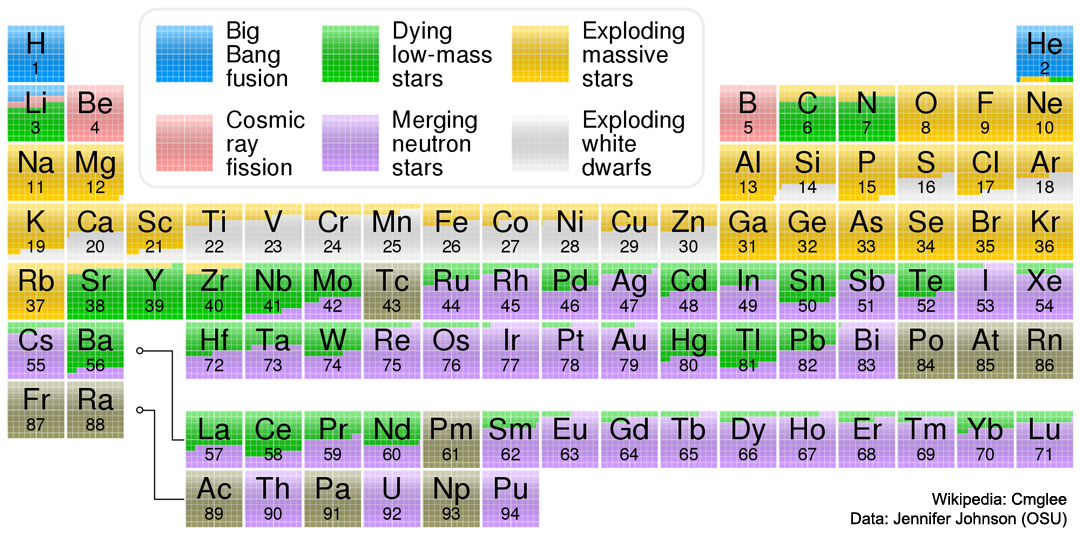
APOD: This is Reality: The Origin of the Elements

Click for a text description, with many explanatory links (some technical, some funny).

Posted in Astronomy, Science | Comments Off on APOD: This is Reality: The Origin of the Elements

Links and Comments: Trump, Evangelicals, Persecution, Fear, Withdrawal

The front page of today’s New York Times has an aerial photo of a house in Sioux Center, Iowa, with the words “In God We Trust” on the roof. The article, a long one, is ‘Christianity Will Have Power’ with the subtitle “Donald Trump made a promise to white evangelical Christians, whose support can seem mystifying to the outside observer.”

A familiar topic. I skimmed it. It begins by recalling a 2016 speech he made in that town:

“I will tell you, Christianity is under tremendous siege, whether we want to talk about it or we don’t want to talk about it,” Mr. Trump said.

Christians make up the overwhelming majority of the country, he said. And then he slowed slightly to stress each next word: “And yet we don’t exert the power that we should have.”

If he were elected president, he promised, that would change. He raised a finger.

“Christianity will have power,” he said. “If I’m there, you’re going to have plenty of power, you don’t need anybody else. You’re going to have somebody representing you very, very well. Remember that.”

What is the power he thinks Christians are deprived of? Is he not familiar with the First Amendment? Why do Christians, by far the most dominant religious group in the nation, feel so persecuted? Why do they feel so underprivileged? Why does it seem as if they need to define themselves as people who cannot civilly get along with people who are not like them? Is it just that persecution complex?

Theories, and rationalizations, abound:

That evangelical support was purely transactional.

That they saw him as their best chance in decades to end legalized abortion.

That the opportunity to nominate conservative justices to the Supreme Court was paramount.

That they hated Hillary Clinton, or felt torn to pick the lesser of two evils.

That they held their noses and voted, hoping he would advance their policy priorities and accomplish their goals.

But beneath all this, there is another explanation. One that is more raw and fundamental.

Which is

He is their protector, the bully who is on their side, the one who offered safety amid their fears that their country as they know it, and their place in it, is changing, and changing quickly. White straight married couples with children who go to church regularly are no longer the American mainstream. An entire way of life, one in which their values were dominant, could be headed for extinction. And Mr. Trump offered to restore them to power, as though they have not been in power all along.

“You are always only one generation away from losing Christianity,” said Micah Schouten, who was born and raised in Sioux Center, recalling something a former pastor used to say. “If you don’t teach it to your children it ends. It stops right there.”

Well yes, precisely. Cf. A.C. Grayling, the paragraph quoted at the middle of this post, To put matters at their simplest. Because once forgotten, any particular religion would never be rediscovered. No religion is detectable from the real world, except as a matter of circumstance, and circumstances change.

“There’s fear in the people,” he said. “The fear, the fear of losing everything —” His unfinished sentence hung in the air. The lights in the main fellowship hall were off.

Fear — exactly. Fear of losing privilege; fear of change.

**

This morning Hemant Mehta posted his take on the article: White Evangelicals Love Trump Because He Feeds Their Persecution Complex.

I would phrase that differently: White evangelicals have always lied to themselves about being persecuted. Trump gives them a chance to be the persecutors. They don’t want religious freedom. They want religious supremacy. Trump gives it to them. And if a bunch of people have to die or suffer because of Trump’s malice, those evangelicals don’t give a damn.

That’s what Christianity has come to represent in the age of Trump: The people who constantly claim to be morally superior would rather have the trophy than earn the title.

If Biden wins the election, no one will show up in Sioux Falls, Iowa to force residents to give up their churches or beliefs, just as no such thing happened under Obama. All that might happen under progressive policies is that everyone, including Christians, would be obliged to get along, where civil laws apply, with people unlike themselves. Instead of insisting they know the one true way, and enforcing that upon everyone else (via, for example, the Supreme Court). Why is that so difficult for them?

**

This recalls the idea of the “Benedict Option,” proposed by the conservative Christian writer Rod Dreher some years ago. The idea is for Christians to withdraw from a multicultural society and form their own isolated communities, in order to practice their faith without interference. Here’s an article in The Atlantic from 2017:

The Christian Retreat From Public Life. Subtitle – note the second sentence – “Rod Dreher makes a powerful argument for communal religious life in his book, The Benedict Option. But he has not wrestled with how to live side by side with people unlike him.”

This means deliberately sealing yourself into a bubble and ignoring any of kind of reality outside it. (As in practice many small towns like that one in Iowa are effectively already doing.)

The problem with religions is that they entail imaginary, inconsistent realities. If such a reality becomes so important that it’s necessary to block out all the others, then it’s a fantasy universe, like living in a video game. The ultimate life in a bubble. This has been possible for most of human history, when tribes lived in isolation of one another. It’s become less possible in recent centuries, as humanity has spread around the planet and previously isolated tribes (communities, nations) have come into contact with each other, and realized the advantage of doing business with each other. The only way to sustain such a global society – which cannot be undone, despite the current nationalistic authoritarians like Trump and others – is to realize that there really is a single, coherent reality, and it’s not based on anyone’s religion.

Posted in Culture, Human Progress, Lunacy, Religion | Comments Off on Links and Comments: Trump, Evangelicals, Persecution, Fear, Withdrawal

Skiffy Flix: Destination Moon

This 1951 film was the first prestigious science fiction film, its script inspired or perhaps partially written, by Robert A. Heinlein. The credits say “from a novel by” Heinlein but that’s not accurate. Heinlein had written a juvenile novel about a rocket to the moon, Rocketship Galileo, and he’d written a novella, “The Man Who Sold the Moon,” concerning a single rich inventor who builds a rocket to the moon all by himself… but neither of those correspond to the plot of this movie. (Heinlein did, however, write a prose version of this movie’s script, published in one of the science fiction magazines several months after the movie premiered.)

It’s a George Pal production, though directed by Irving Pichel; Pal later did When Worlds Collide, the 1953 The War of the Worlds, and the 1960 The Time Machine among others. https://en.wikipedia.org/wiki/George_Pal. He was arguably the greatest director of science fiction films in the 1950s and 1960s.

This film stands in contrast with Rocketship X-M (http://www.markrkelly.com/Blog/2020/07/23/skiffy-flix-rocketship-x-m/), a cheaper film released a month earlier; this one is much more scientifically accurate, if nevertheless a tad less melodramatic.

Gist

The first rocket to the Moon is hastily launched in the face of legal challenges and public fears. A repair en route requires spacewalks, during which one of the men becomes untethered and is rescued. They land on the moon but use too much fuel doing so, and to return to Earth have to lighten their weight by jettisoning non-essential parts from the rocket’s interior.

Take

This is a sober, mostly scientifically-accurate depiction of how the best 1950-era writers and filmmakers imagined how the first rocket to the moon would happen.

Summary

  • Opening scenes show a desert military base, where a V-2-like rocket, with black and white fins, is launched–and quickly crashes into the ground. Watchers inside wonder, what went wrong? Could it be sabotage?
  • Later at plane factory, a General Thayer arrives to talk with Jim Barnes, head of the corporation. Acknowledging the failure of Cargraves’ rocket, Thayer appeals for Barnes’ help; Barnes is reluctant, he’s just a manufacturer. Thayer says the matter is bigger: the next rocket will go to the moon, with a new atomic energy engine. Soon there’s a presentation to a roomful of entrepreneurs. The themes in these scenes are two: only industry can do the job, not the government, and it’s urgent to establish a base on the moon to prevent other countries from doing so, because they would launch missiles from the moon.
  • A highlight of these scenes is a five-minute Woody Woodpecker cartoon showing how rockets work: how they launch, how they reach escape velocity, how they keep “falling.”
  • The story proceeds straightforwardly. We see a montage of draftsmen and engineers working. We see the ship under construction. The decision to launch is pushed up, as a commission denies their request, and public opinion about the risk of an atomic explosion. At the last minute one of the crew of four has a “bellyache” and so radio operator Joe, with a broad (New York? New Jersey?) accent, and skeptical that the rocket will even take off, is substituted. (The others in the crew aren’t trained astronauts; they’re the main characters we’ve already met! The general, the manufacturer, the rocket designer.)
  • The ship launches. They discover their antenna is locked in place and need to make an excursion outside to fix it. All four of them end up outside, as one at the far end of the ship, his anchor line not long enough, comes loose from the hull despite his magnetic boots. He hangs out in space until rescue can be arranged. (Much as in the first two episodes of Lost in Space.)
  • Soon they land on the moon, the rocket descending onto its tail, but — much like the real Apollo 11 in 1969 — the pilot overshoots their target and uses too much fuel before setting down.
  • Emerging onto the moon, Cargraves speaks: “By the grace of God, and in the name of the United States of America, I take possession of this planet on behalf of and for the benefit of all mankind.” Thus accomplishing a primary goal of the mission. Subsequent scenes show the four men breaking out equipment, large cameras, a Geiger counter, to do some rudimentary exploration.
  • The whole final quarter or third of the film, though, is dominated by the problem of launching back toward Earth. Their landing used so much fuel, they don’t have enough for their planned launch. So they need to strip the rocket of every possible nonessential part–the acceleration couches, half the ladder, some control panels, all the exploration equipment. it’s still not enough. Does on of them stay behind? They debate it, each offering to be the one. Joe escapes the ship to be the sacrifice, but at the last moment Barnes gets an idea that involves dumping all four spacesuits, the last one pulled out of the ship by the weight of an oxygen tank on a tether.
  • And so they launch off the moon, and see the Earth ahead. The end. Or actually, as the credits read, “The End… of the beginning.”

Comments

  • The theme here of private enterprise building a rocket to the moon is reflected in Heinlein’s two prose stories on the first rocket to the Moon: the novel Rocket Ship Galileo, and the novella “The Man Who Sold the Moon.”
  • The technical advisor, listed in the opening credits, is (famous astronomical artist) Chesley Bonestell. And indeed, the moon’s surface is depicted here with high craggy mountains, as astronomical art of the time commonly showed.
  • There’s a modicum of futuristic set design in Dr. Barnes’ office, with sliding metal doors for the entrance and to the restroom.
  • As in most books and films from this era, everyone smokes, especially cigars.
  • In general the film is highly accurate scientifically, especially compared to its contemporary Rocketship X-M, but there are a couple scenes that aren’t quite right.
  • First, as did some other movies from this era, it presumes that magnetic boots would be needed to anchor oneself to the floor, or to the outside of the ship, in the absence of gravity or acceleration. For that matter, so did 2001, in 1968, except by then they were Velcro slippers rather than big clunky boots. It didn’t occur to anyone that there really wouldn’t be any problem just floating around, inside the ship, or even outside once secure by line or with maneuvering jets.
  • The exterior space walk scene is OK up to a point; once the one astronaut gets loose, though, he just sorta hangs out there a few dozen feet from the rocket without actually moving farther away, as he would once he began moving away from the ship at all. (Same issue in those Lost in Space scenes.)
  • For that matter, as Heinlein’s other stories did (but Rocketship X-M did not), it depicts a large single-staged rocket launching from Earth, landing on the moon, and returning—no multiple stages that dropped away when no longer needed, no separate lunar lander. (Clarke more correctly anticipated staged launches in his novel Prelude to Space.)
  • Both this film, and Rocketship X-M, have jokes about Texas and harmonicas.
  • The last-minute addition of the radio jock Joe to the crew serves two purposes: he provides some broad comic relief, especially with that accent (“the ship won’t woik!”) and he serves a narrative purpose giving reason for the three professionals aboard to explain things (to the audience), e.g., why exiting the rocket in a spaceship won’t result in falling away or being swept away.
  • The film’s trailer, shown after the movie proper, indicates that there was much publicity for this film in all the major magazines of the day.
Posted in Movies, Skiffy Flix | Comments Off on Skiffy Flix: Destination Moon