About Dreams

Keying off the previous post, I was fascinated by Gottschall’s comments about dreams, how they often focus on important or threatening things in life. I’ve noticed certain themes in my own dreams, in that they invariably involve some problem, a few kinds of problems repeated in different settings. That they’re hardly life-threatening problems indicates, I suppose, the relative security of modern life, or at least my own life situation. Here are some of my recurring themes:

  • I’ve come out of my office building, or perhaps a shopping mall, and can’t find my car, in the lot or the structure. Has it been stolen? Did I park it in a different lot?
  • I’m in a large office building, or manufacturing plant, and I know I’ve been here before but now I can’t find my way to the exit.
    • Moreover, such searches for the exit usually involve bizarre interior constructions: ramps where steps should be, steps that lead to blank walls, mazes of corridors.
  • I’m in some family setting, in a house with various family members bustling about, myself typically off in a corner doing my own thing, until someone arrives, or needs to leave, or there is some commotion outside that everyone responds to.

The distinctive thing about these dreams, like those about office buildings and parking lots, is that the settings are never exactly places I’ve never been before, but are instead loose replicas of such places, variations on their themes. I can realize as I wake up (when I remember the dream at all, of course), that, oh, that was at a version of the Apple Valley house, albeit surrounded by taller buildings and along a gully; or that shopping mall was vaguely like the one in Illinois we went to often. Yet, paradoxically, sometimes the exact same dream location turns up in a later dream. Inside the dream I even realize, here we are back at that shopping mall again, or it that same used bookshop in the enormous dusty attic. Or is my dream memory fooling itself?

I don’t think I’ve discussed my dreams before and am not inclined to expand on it, except to note that I find Gottschall’s speculations about them plausible. On the other hand, frankly I worry about my house burning down in a huge California fire, not so much because I’d lose my house, but because I’d lose the 10,000 books I’ve gathered and carefully tended over five decades, which would be irreplaceable. But I *never* dream about house fires. (I do dream about bookstores, though, especially large used bookstores full of aisles of dusty books… One in particular, the one in the dusty attic, seems like an extrapolation of the tiny narrow attic in my grandfather’s house in Cambridge, Illinois.)

I confess I find dream scenes in fiction, or by Facebook friends recounting their dreams, boring, and pass over them. Because they seems completely arbitrary. Knowing from my own case that the subject matter of my dreams is tangent at best to my wide-awake values and interests, I can’t work up much interest in other people’s dreams.

In my own dreams I do find two significant these things. First, that I’m highly sensitive to *place*, houses I’ve lived in and large structures (office buildings, malls) I’ve explored; and this is why I yearn for those places, especially the houses where I grew up. And second, that my affinity for family life is mixed: in dreams I imagine myself in a house-full of relatives, perhaps extended family or perhaps cousins (but never, again, never any precisely recognizable individuals) – I want to belong and feel I’m at home with them — while at the same time conscious and concerned about getting my own work done, pursuing the interests none of the rest of them understand, which are just as important.

…Actually, I’ve kept a text file log of especially memorable dreams for the past 5 years, and an older log going back farther, back to 2006, and a quick glance at that first shows another recurrent theme:

  • Being at science fiction conventions. Typically in big hotels; milling in the lobby; trying to find the dealers’ room, looking for the elevator, looking for someone to have dinner with, and so on. Again, in any particular dream, some kind of problem.

So perhaps I will review those logs more closely and see if I can come to any other conclusions about my nocturnal preoccupations, though I doubt they would be of interest to anyone but me. Yet perhaps I could learn from myself.

Posted in Personal history, Psychology | Comments Off on About Dreams

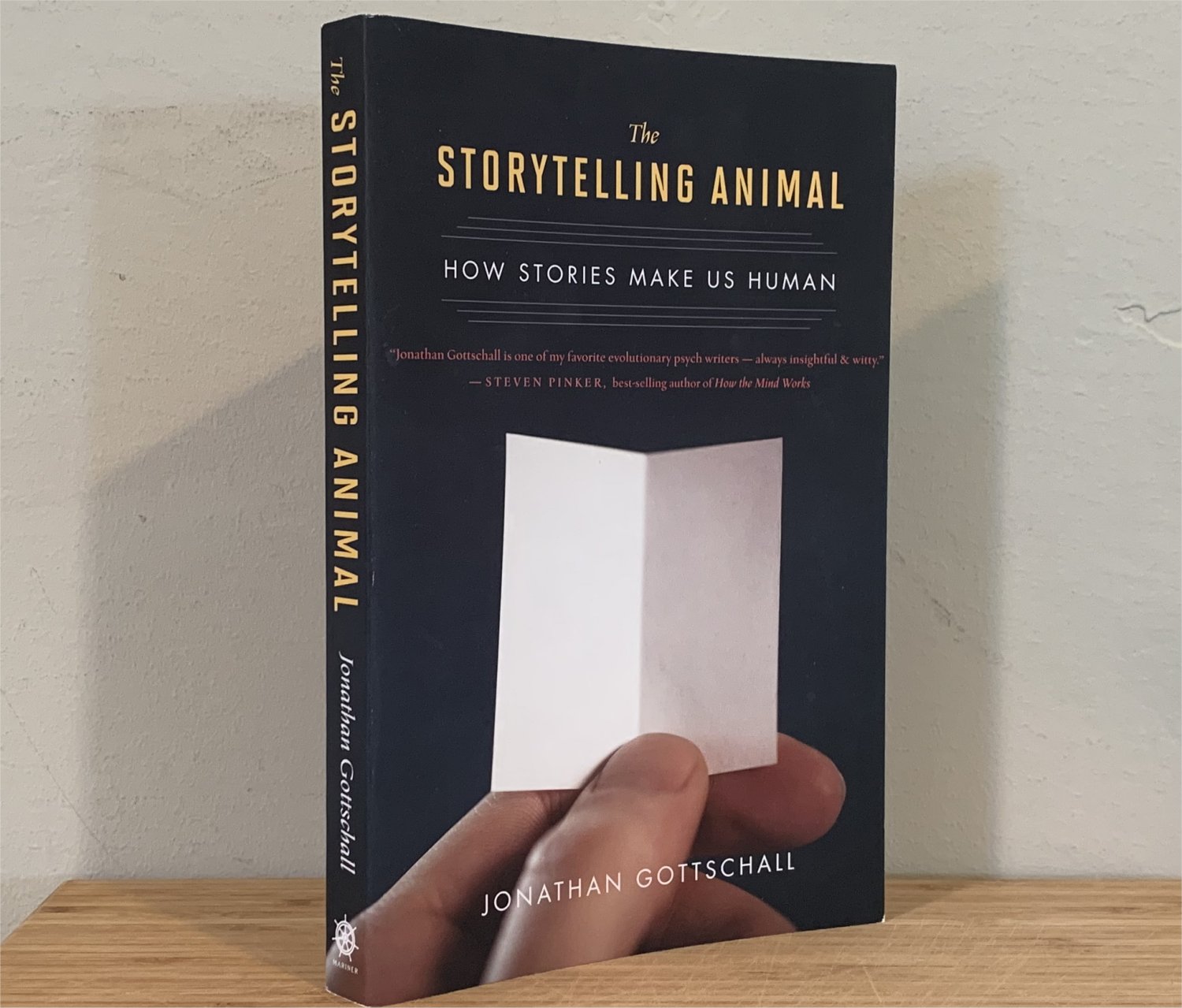
Jonathan Gottschall: THE STORYTELLING ANIMAL: How Stories Make Us Human

Here’s a nonfiction book from 2012 that I just read this past month. It’s one of three or four books I have (another is called HOUSTON, WE HAVE A NARRATIVE: WHY SCIENCE NEEDS STORY) that are about the idea of *narrative*, how humans think of everything in terms of story, of which the most basic example is cause and effect, and why we do so. Despite the fact that deep scientific theories about space and time reveal a cosmos that does not, in fundamental ways, behave in cause and effect ways. Thus the discomfort and dismissal of many to such theories, however validated they may be.

This is of particular interest to me because I’ve been sketching hierarchies of various themes about the understanding of reality, including one of science fiction, and science fiction is of course a bunch of stories, narratives. If it’s a mistake to simplify everything about reality into narratives, how is science fiction useful for this understanding? Well, that’s a paradox to explore, but one way will be to consider the range of different types of science fiction stories, and why some are so much more popular than others, and why some that challenge that presumption are also popular, or notorious, because of anyone, science fiction readers are alert to challenges to common sense.

Summary with a few comments (with more comments at the end):

Ch1, “The Witchery of Story”. Children are creatures of story; they are always in Neverland. But story pervades adult concerns too, from pop music, dreams, daydreams, pro wrestling, opera, TV commercials. Trials are often matters of which side tells the better story. Gossip. Religious traditions. If there were two tribes, one practical, one story-telling, imagine how they spend their time, and which would win.

Ch2, “The Riddle of Fiction”. How children play pretend until a certain age. What are stories *for*? It’s an evolutionary riddle; like the human hand, it serves many purposes. Children’s play is deadly serious — always about trouble, about problems. The differences between boys’ and girls’ play is constant, despite attempts to disprove it. Among both humans and animals, play helps youngsters rehearse for adult life. That so many “children’s stories” (like those of the Brothers Grimm) focus on violence should ameliorate concerns about the violence in modern video games.

Ch3, “Hell Is Story-Friendly.” Stories about dangerous situations are more compelling than ordinary situations. Aristotle noticed this. Writers who’ve tried hyper-realistic stories in which no problems occur discover few readers are interested. Fiction is about conflict; this limits the skeleton structure of a story. The modernists (Joyce, Proust) tried to transcend the conventional story, but there’s a universal grammar in stories around the world, on a handful of master themes. Mirror neurons, discovered in the 1990s, show mental states are contagious. Pinker has suggested that stories equip us with a mental file of dilemmas we may one day face; or do their merely train an inner problem simulator?

Ch4, “Night Story.” About dreams. Why do we dream? Old ideas: messages from the spirit world; from the id. Do dreams sort memories, keeping some and discarding others? Or perhaps they are brain waste, with no purpose at all. In the 1950s it was discovered that kitties dream too. As in stories there are common themes in dreams; they involve important or threatening things in life. Yet, that we forget most of them suggests they are not worth much; as simulations they are seldom realistic.

Ch5, “The Mind Is a Storyteller.” Anecdote about Bill the King, in 1796, who lived an elaborate fantasy involving everywhere he knew and something called an air loom. He was a patient, a lunatic, and Bedlam. Such cases involve bizarre beliefs, outside forces, conspiracies. There is suggestive evidence of a connection between madness and creativity.

  • When the corpus callosum is cut, splitting the two halves of the brain, each side perceives different things; and so, experiments show, patients will *invent* explanations when needed. E.g., the right brain sees something the left cannot; the left brain fabricates the gap; the left brain is a classic know-it-all that can’t bear not to have an answer.
  • Sherlock Holmes Syndrome—your storytelling mind is like a homunculus behind your left eye, explaining everything like Sherlock Holmes. His trains of reasoning. Actually his method is ridiculous; examples. He reasons backward from the conclusion he prefers. The storytelling animal is addicted to meaning, allergic to uncertainly, randomness, and coincidence.
  • Geometric Rape—the human mind is tuned to detect patterns, and is biased toward false positive rathr than false negatives. Human faces; animals in clouds, 104t. thus a hunger for stories. It makes up stories to relate unrelated events. Example of an animated film. Another example of adjacent photos, the Kuleshov effect.
  • A Cursed Rage for Order—those examples are tame; worse are conspiracy theories, that connect real data points into coherent, emotionally satisfying versions of reality. Examples of novels, films. Alex Jones. The guy about lizard people, 113m. There are millions of conspiracy theories about every prominent person and event. They’re not strange, but ordinary. They would be funny if they did not have consequences. and many people believe them, p115. And they’re not the product of backwardness or ignorance; many are promoted by the educated class. Everyone is subject to the compulsive need for meaning; why are things so bad in the world? They are consoling in their simplicity. P116.

Ch 6, “The Moral of the Story.” About the Holy Books. Lots of stories. All religions in history rely on stories to convey messages. (Note 118b about how staunch believers would call the narratives of *other* religions are stories, but not their own scriptures.) “Religion is the ultimate expression of story’s dominion over our minds.” 119.3. Religion isn’t going away. The roots of spirituality must lie deep in human nature. How did this evolve? “How did dogmatic faith in imaginary beings not diminish our ability to survive and reproduce?” 120.3 The standard explanation is that we invent gods to give meaning to existence; we abhor explanatory vacuums. Some, like Dawkins and Dennett, consider religion a mental parasite best lived without. Others think religion is not useless or worse. David Sloan Wilson (in Darwin’s Cathedral, 2002) speculates that religion makes societies work better. It defines the group. It binds people together and puts the group’s interests ahead of their own (Nicholas Wade, The Faith Instinct). What seems irrational in religion makes sense given what such beliefs cause people to do. Assert their group’s interest against competitors. [[ basically, group selection ]] Yet—it also drives people apart.

  • Sacred Histories—National myths serve similar functions. E.g. what’s taught about Columbus—is mostly fiction. cf Howard Zinn, airbrushed history. Others [Diamond?] say the difference was technological. Yet most of history is myths in which we’re the good guys.
  • Imagining the Unimaginable—About a romance between a 22yo man and a 45yo woman. People glared, objected, but who were they harming? Think about what happened as you picture the story in your head…right up to the end, when you discover they’re actually son and mother. Haidt’s moral logic. We can imagine virtually anything in a story. Except when we hit moral problems. Stories have to resolve in certain ways, or readers rebel.
  • [[ He might have mentioned Shirley Jackson’s famous story “The Lottery,” which had such a shocking, seeming amoral ending that many readers of The New Yorker, where it first appeared, cancelled their subscriptions. ]]
  • [[ This is a good point and might be one of those subversive things science fiction does to challenge assumptions. ]] Examples 129b: Lolita; Clockwork Orange. But storytellers assure us how wrong these things are.
  • Virtue Rewarded—Plato banished poets and storytellers. But fiction is intensely moralistic. In most stories villains die and heroes are rewarded; violence is acceptable only in clearly define circumstances. Yes, there’s moral ambiguity in sophisticated fiction, 133, but pop story forms are structured on poetic justice, 134. Thus stories reinforce norms and values derived from human nature. Evidence fiction has positive effects on moral development. People need to believe in justice for society to function, even though it’s not true; bad things happen to good people all the time. Fiction reinforces the “just-world” belief [[ or fallacy ]]. For most of human history, story has been communal. Even now stories are shared by many people… Story binds society.

Ch 7, Ink People Change the World

  • About two boys, an opera, Adolfus, who fails in art school and becomes Adolf Hitler. Inspired by the opera Rienzi. Wagner was a German nationalist and anti-Semite.
  • Ink People—characters in fiction are just ink people, yet they pervade into our world and change societies. Rienzi was first a novel. Yet some think story useless; people understand fiction vs reality. Yet—the story that became Uncle Tom’s Cabin. Its influence on the civil war. It kept Britain out of the war. Many other examples, 147-8. But are these just anecdotes? Research has been done: fiction does mold our minds [[ Another point to keep in mind when discussing SF. 148b. ]] Fiction teaches you about the world, e.g. police work in TV shows. People are traumatized by scary fiction, more than by articles or speeches. Fiction seems to change beliefs more than nonfiction, 150m. Seeing violence makes people more aggressive. Also attitudes about different races. Becoming absorbed in a story, we drop are critical guard. ß extrapolate to how SF “opens” the mind…
  • Holocuast, 1933—Hitler, in fact, was motivated by art, even as the Nazis burned books by un-Germans. And he was a consummate actor.

Ch 8, Life Stories

About David and Donald, drunk and on drugs… 20 years later he writes his memoir and the two disagree on a key event. People remember what they can live with. James Frey. Other examples. Most memoirs have clear story grammar, 161t. Problem structure, good/bad guy dynamics. Our own life stories are personal myths about who we are, how we got that way, what it means. A life story is a useful fiction.

  • “Memory, of course, is never true”—Example of girl in 1889 reporting a crime in great detail. Flashbulb memories—we do remember traumatic moments in our lives, but the details can’t be trusted. E.g. Challenger, or 9/11. E.g. Bush thinking he saw the first plane hit. Some of these memories are just made up. The girl is 1889 was subject of a doctor’s attempts to implant false memories. Later, the 1990s, the great sex panic. Repressed memories. Elizabeth Loftus. Memory is much less trustworthy than previously suspected. Planting false memories. So, how can we trust our memories about anything? Memories conflate in our brains. The past is a fantasy created in our mind.
  • Heroes of our own epics—Memory may be faulty by design; perhaps to allow us to live better lives. Ego-enhancing bias. Even awful people don’t think they’re bad guys. Examples. Even John Wayne Gacy. We want to be the heroes of our lives—but most of us aren’t heroic. Photos vs. mirrors. We cite our positive qualities, not our negative. Lake Woebegone effect. The things that are important are the things we’re good at. Depressed people are more accurate about their personal qualities. Positive illusions keep us from recognizing that the truth is depressing, 175t. Psychotherapy helps gives people a story they can live with. Until we die, we live the story of our life. A story more truthy than true.

Ch 9, The Future of Story, p177

Are we leaving Neverland behind? Is fiction losing its central place in our culture? Theatre, poetry? Scripted TV? Is gaming taking over? Some think so. Yet tens of thousands of novels are published every year. JK Rowling. Left Behind. Et al, 179t. Literary novels have always had a harder time of it. Even if novels fade, the story would not end. Poetry has given way to song, rap, hip-hop. Video games are intensely story driven.

  • True Lies—On TV, even reality shows turn events into classic story lines. Example of The Ultimate Fighter. SuperNanny. Fiction will always be: character + predicament + attempted extrication.
  • Back to Neverland—About kids playing in a state park, in outfits—a LARP called Forest of Doors. Grown-up make-believe. Derived from RPGs like Dungeons and Dragons.
  • Brave New World!—Storytelling will evolve. Recall feelies and the holodeck. Now there are MMORPGs. World of Warcraft.
  • Exodus—We’re migrating to a virtual world, perhaps. Consider people with no sense of community in ‘real’ life. They find it in the mmorpgs, whose world are meaningful. They resurrect myths about gods. …we evolved to crave story, but could they be a weakness, just as craving for food now makes us obese? The real threat is that story will take over completely. [[ Recall Harari’s prediction that the unemployed will occupy themselves with drugs and games. ]]

Or: we can make nutritious choices, p198-9, summarized:

  • Read and watch fiction;
  • Fiction doesn’t degrade society’s moral fabric;
  • We’re suckers for story and so are easily molded and manipulated;
  • Recognize stories can change the world, for the good or the worse;
  • Allow time in your child’s schedule for time in Neverland;
  • Allow yourself to daydream;
  • Beware your inner storyteller locking into the overdrive of conspiracy theories;
  • By tolerant of national and religious myths;
  • Novels are dying;
  • They way we experience stories will change, but they won’t go away;
  • Rejoice in the power of storytelling; get lost in a novel.

//

Again, the most abstract SF (Olaf Stapledon? Some of Egan and Chiang?) is unsatisfying to some because it *doesn’t* provide the emotional payoff of the traditional story… note 199.2: “People don’t go to story land because they want something startlingly new; they go because they want the old comforts of the universal story grammar.” –Well, I’d say, you find the entire range among science fiction readers. There are the conservative ones who want plain stories with beginnings, middle, and ends; and at the other extreme (e.g. in the 1960s “New Wave”) you had writers and readers utterly bored with all that, looking for something new and exciting.

I didn’t anticipate that the narrative drive (sometimes considered a fallacy) would lead to conspiracy theories, but I should have: in this context, conspiracy theories are the tendency to make sense of the world by perceiving cause and effect gone carcinogenic. I hadn’t appreciated how there are conspiracy theories about virtually every well-known person and event, but am not inclined to speculate why. Not worth the trouble.

Posted in Book Notes, Narrative | Comments Off on Jonathan Gottschall: THE STORYTELLING ANIMAL: How Stories Make Us Human

Notes for the Book? Certainly Excerpt from the Memoirs. Hierarchy of Process Management: CMMI

I’m frequently fascinated by trying to recreate my train of thought — or perhaps I should say, I occasionally realize how my train of thought came about and am fascinated by the realization. For five or six weeks now I’ve been summarizing various themes that might inform my book about how science fiction relates to human understanding of the cosmos. Now I’ve realized there perhaps three sources that have inspired my idea of building these hierarchies, that run from simple and intuitive, to sophisticated and complex (and generally, the most like reality).

The trigger for the first one, on awareness (22 May) was inspired by a book I read back in February, Scienceblind by Andrew Shtulman. The book came out three years ago, and I finally got around to it earlier this year. Its premise interested me because I’ve long been fascinated by the idea of “intuitive physics,” e.g. why people assume heavy objects fall faster than light ones, why seeing space fighters swoosh through space and bank like in-atmosphere jet fighters doesn’t bother the so many people who watch Star Wars. (Both because they don’t realize ships in space don’t work like that, and also because story is so much more important than correct physical details, I think.) And why most people never get past these intuitive notions, or care.

I’ll post notes on Shtulman eventually, but he expands on my notion of intuitive physics through psychological experiments, and interviews, of infants, children, and adults, to see how naive assumptions about how the universe work initialize (as base human nature), and are modified with age.

That became the first step of that hierarchy. Some people, fewer and fewer at each level of the hierarchy, learn better how the cosmos actually works. Very few reach the higher levels.

And then several later hierarchies.

More recently, in the past week, I’ve recalled that hierarchy of morality, from one Lawrence Kohlberg, as cited in prominent books by E.O. Wilson and Steven Pinker.

And finally, in writing pieces of my memoir — with one long section, not yet posted, about my work at Rocketdyne for 30 years, which I think might be of interest to even people who don’t especially like me as a person — I discussed a process management model that was the focus of most of the last 20 years of my career. And have only just realized — I’m a bit dim at times — that its structure bears remarkable similarity to the ones I’ve been constructing. Shtulman, Kohlberg, CMMI; surely all of these in the back of my mind inspired my recent hierarchical themes.

So, after that lengthy prelude, I will excerpt discussion of CMMI from that as-yet unposted memoir page:

>>

In the early 1990s NASA and the DoD (Department of Defense) adopted a newly developed standard for assessing potential software contractors. This standard was called the Capability Maturity Model, CMM, and it was developed by the Software Engineering Institute (SEI) at Carnegie Mellon University in Pittsburgh. The CMM was an attempt to capture, in abstract terms, the best practices of successful software development organizations in the past.

The context is that software projects had a history of coming in late and over-budget. (Perhaps more so than other kinds of engineering projects, like building bridges.) If there were root causes for that history, they may have in the tendency for the occasional software genius to do everything by himself, or at least take charge and tell everyone else what to do. The problem then would be what the team would do when this “hero” left, or retired. All that expertise existed only in his head, and went with him. Or there was a tendency to apply the methods of the previous project to a new project, no matter how different.

In any case, the CMM established a series of best practices for software development, arranged in five “maturity levels,” to be used both as a guide for companies to manage their projects, and also as a standard whereby external assessors would assess a company for consideration when applying for government contracts.

The five levels, I now realize, are analogous to the various hierarchies I’ve identified as themes for consideration for knowledge and awareness of world, from the simplest and most intuitive, to the more sophisticated and disciplined.

  1. Level 1, Initial, is the default, where projects are managed from experience and by intuition.
  2. Level 2, Managed, requires that each project’s processes be documented and followed.
  3. Level 3, Defined, requires that the organization have a single set of standard processes that are in turn adapted for each project’s use (rather than each project creating new processes from scratch).
  4. Level 4, Quantitatively Managed, requires that each project, and the organization collectively, collect data on process performance and use it to manage the projects. (Trivial example: keep track of how many widgets are finished each month and thereby estimating when they will all be done.)
  5. Level 5, Optimizing, requires that the process performance data be analyzed and used to steadily implement process improvements.

Boiled even further down: processes are documented and reliably followed; data is collected on how the processes are executed, and then used to improve them, steadily, forever.

Examples of “improvements” might be the addition of a checklist for peer reviews, to reduce the number of errors and defects, or the acquisition of a new software tool to automate what had been a manual procedure. They are almost always incremental, not revolutionary.

The directions of those improvements can change, depending on changing business goals. For example, for products like the space shuttle, aerospace companies like Rocketdyne placed the highest premium on quality—there must be no defects that might cause a launch to fail, because astronaut’s lives are at stake. But software for an expendable booster might relax this priority in favor of, say, project completion time.

And software companies with different kinds of products, like Apple and Microsoft, place higher premiums on time-to-market and customer appeal, which is why initial releases of their products are often buggy, and don’t get fixed until a version or three later. But both domains could, in principle, use the same framework for process management and improvement.

Again, projects are run by processes, and in principle all the people executing those processes are interchangeable and replaceable. That’s not to say especially brilliant engineers won’t have a chance to perform, but it has to be done in a context in which their work can be taken over by others if necessary.

… [skipping some of the memoir]

The software CMM was successful from both the government’s and industry’s points of view, in the sense that its basic structure made sense in so many other domains. And so CMMs were written for other contexts: software engineering; acquisitions (about contractors and tool acquisitions), and others. After some years the wise folks at Carnegie Mellon abstracted even further and consolidated all these models into an integrated CMM: CMMI (https://en.wikipedia.org/wiki/Capability_Maturity_Model_Integration). And so my company’s goals became satisfying this model.

Time went on, and the SEI kept refining and improving the CMMI, both the model and the assessment criteria; Rocketdyne’s later CMMI assessments would not get by on the bare bones examples for Level 5 that were used in 2004. I’ve been impressed by the revisions of the CMMI over the years: a version 1.1, then 1.2, then 1.3, each time refining terminology and examples and sometimes revising complete process areas, merging some and eliminating others. They did this, of course, by inviting feedback from the entire affected industry, and holding colloquia to discuss potential changes. The resulting models were written in straightforward language as precise as any legal document but without the obfuscation. This process of steadily refining and revising the model is analogous to science at its best: all conclusions are provisional and subject to refinement based on evidence. (A long-awaited version 2.0 of CMMI has apparently been released in the past year, so I haven’t seen it.)

<<

Here end excerpts from the not-yet posted memoir of my software engineering career. I mean to emphasize the beauty and precision of the CMMI’s language, refined over decades. The memoir has some reflections:

>>

Looking back at these engineering activities, it now occurs to me there’s a strong correlation between them and both science and critical thinking. When beginning a new engineering project, you use the best possible practices available, the result of years of refinement and experience. You don’t rely on the guy who led the last project because you trust him. The processes are independent of the individuals using them; there is no dependence on “heroes” or “authorities.” There is no deference to ancient wisdom, there is no avoiding conclusions because someone’s feelings might be hurt or their vanity offended. Things never go perfectly, but you evaluate your progress and adjust your methods and conclusions as you go. That’s engineering, and that’s also science.

Things never go perfectly… because you can’t predict the future, and because engineers are still human. Even with the best management estimates and tracking of progress, it’s rare for any large project to finish on-time and on-schedule. But you do the best you can, and you try to do it better than your competitors. This is a core reason why virtually all conspiracy theories are bunk: for them to have been executed, everything would have had to have been planned and executed perfectly, and without any of the many people involved leaking the scheme. Such perfection never happens in the real world.

<<

I think this last paragraph is very important.

Posted in Personal history, The Book | Comments Off on Notes for the Book? Certainly Excerpt from the Memoirs. Hierarchy of Process Management: CMMI

About Motivated Reasoning

(rev. 8jul20)

This isn’t so much a Notes for the Book post, as a refinement of a portion of my Principles page, which compiles what I think are crucial guidelines for understanding the world, in particular how to evaluate claims made in politics, by advertising and the news media, and by religion, science, and pseudo-science (as it says there).

A couple of things came to mind recently, one about the distinction between “can I believe” as opposed to “must I believe.” This was highlighted by Jonathan Haidt (here, http://www.markrkelly.com/Blog/2015/12/09/jonathan-haidts-the-righteous-mind-why-good-people-are-divided-by-politics-and-religion-3/) citing earlier work by Thomas Gilovich. I’ll quote a passage from that link, summarizing my take on a portion of his book The Righteous Mind:

When we *want* to believe something, we ask, *Can* I believe it? For this you need only a single piece of pseudo-evidence. Whereas if you’re not inclined to believe something, you ask *Must* I believe it? And then no matter how much supporting evidence you find, if you find a single reason to doubt the claim, you dismiss it. This is the essence of motivated reasoning, and Haidt illustrates it by observing that conspiracy theories operate on the former strategy (*can* I believe it? give me one example) while science operates on the latter (if all the evidence supports an idea, you must believe), and non-scientists are adept at finding some reason to quibble. p85.6:

Whatever you want to believe about the causes of global warming or whether a fetus can feel pain, just Google your belief. You’ll find partisan websites summarizing and sometimes distorting relevant scientific studies. Science is a smorgasbord, and Google will guide you to the study that’s right for you.

(Don’t get your news, or do your research, from social media, or Google!)

This recalls various takes on the idea of “motivated reasoning.” The simplex take is that people pay attention to evidence that supports their per-determined views, and ignore evidence that doesn’t. A complex take is that people rationalize these two positions; they find reasons to dismiss evidence that doesn’t support their position (mostly invalid, e.g. by ad hominem attacks) and reasons to accept reasons that support their position (by ignoring any counter-evidence). The multiplex take is described above; your standards for belief change depending on whether you want to believe, or not.

(I’ll resist describing examples, for now.)

Another thing that came to mind is the idea that a rational person should be able to evaluate their beliefs and be able to, if only in principle, imagine possible evidence that would cause them to change their minds. If there’s *nothing* that could possibly change your mind about some commitment, then you are not being rational and there’s no reason to hold a conversation with you on this subject. (Other subjects sure; humans are masters at compartmentalizing.) Scientific theories, almost by definition, involve statements that are, in principle, subject to disproof. Religious and political positions do not. That’s why these subjects famously cannot be discussed over dinner; people’s opinions on these matters are seldom (politics) or never (religion) based on rational arguments.

And, a famous quote by Christopher Hitchens: “That which can be claimed without evidence can be dismissed without evidence.”


Posted in Psychology | Comments Off on About Motivated Reasoning

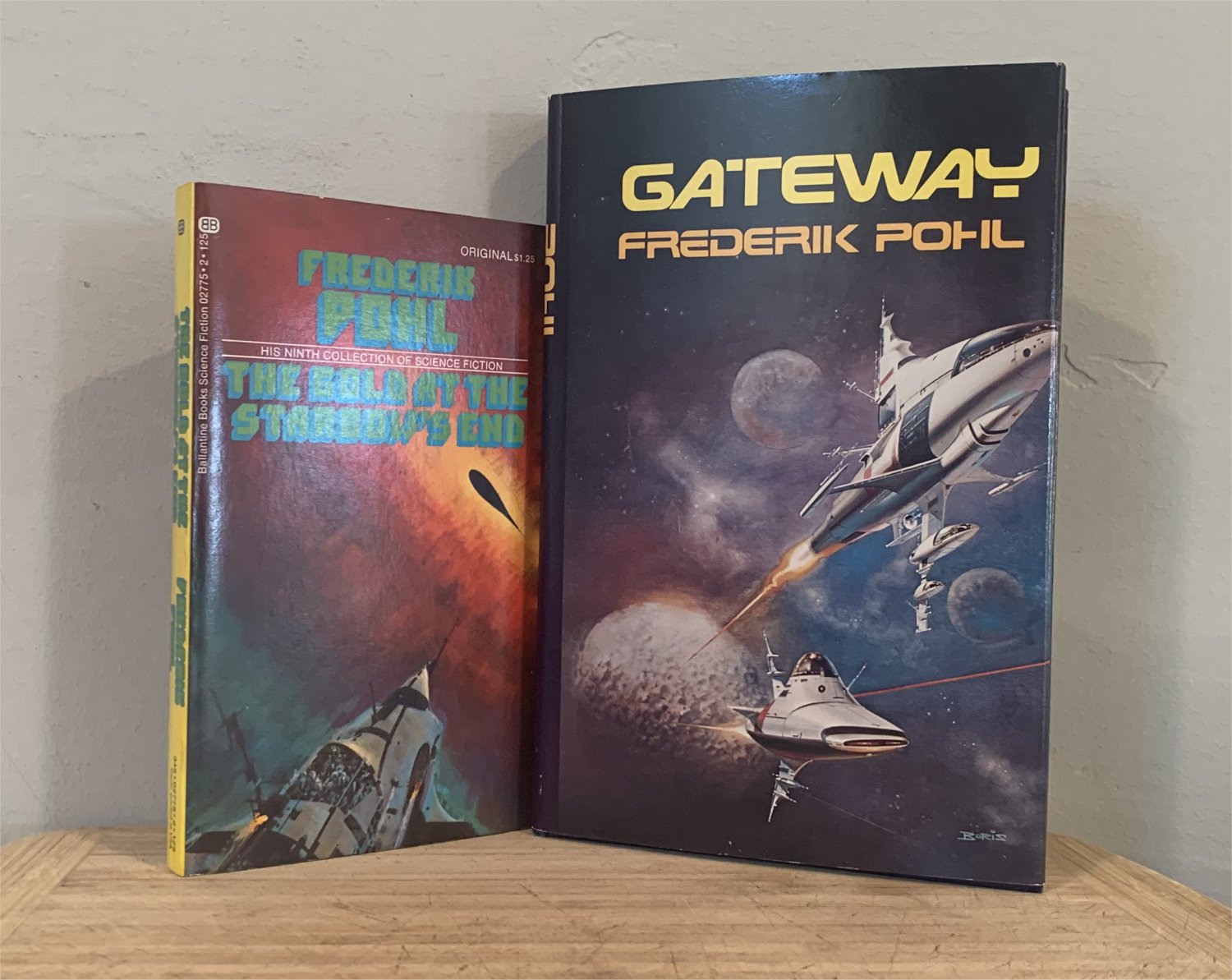
Frederik Pohl, THE GOLD AT THE STARBOW’S END (1972)

This is a nice companion book to Pohl’s novel GATEWAY, because one of the five stories here is a prelude that novel. That story and three of the others were all published in various magazines in 1972; the fifth was published two years earlier. These were the first signs that Pohl was rebooting himself from steady editor and occasional writer, to major writer.


The title story, “The Gold at the Starbow’s End,” is one of those science fiction stories that speculates what humans might do should they become very smart. There are two alternating narratives, six chapters in each, over the 70-page story. The primary narrative, told in messenges being recorded for back home, describes the 8 astronauts of the starship Constitution, the first starship, on its way to the newly discovered planet of Alpha Centauri. It’s a 10-year trip, and they will be awake the whole time, so they occupy themselves with abstruse mathematical problems…

The second narrative is set in Washington DC, where Dr. Dieter von Knefhausen, the mastermind behind the mission, is summoned to the White House to address Russian claims that the planet around Alpha Centauri cannot exist. Dr vK initially insists the mission is valid, but then — spoiler!– is forced to admit the truth: that he sent 8 hand-picked astronauts on a 10 year trip to a planet that doesn’t exist. Why? It’s not a fraud, exactly, but camouflage. The real reason is the war against ignorance; these 8 brilliant people will have nothing to do for years but work their minds.

Meanwhile, strange and amazing things do seem to be happened aboard the starship. One of them proves [the still unproven] Goldbach’s conjecture. They observe the “starbow” effects of light dilation as they get close to the speed of light. They investigate unlikely subjects like acupuncture and the I Ching (when he hears this, Dr. vK gets livid). They Godelize things; they modify their bodies; their language becomes clipped, more efficient; they modify their drive; they have children.

On Earth things get worse with civil unrest and climate change. The US falls apart, a new president takes over in a besieged White House threatened by flood, and Dr vK is jailed, writing his memories. Then a new message comes in from the astronauts…

(I won’t reveal the finale, except to say the mission succeeds beyond Dr vK’s wildest expectations, and in an unexpected way.)

This is a dazzling story, even if it’s not really plausible. Isolation creates supermen? Then why not just isolate them in Antarctica? But it’s a good illustration of how abstruse topics can be understood by some, and are impenetrable to others. The story reflects the civic turmoil of its time. And it’s a bit cheeky of Pohl to suggest that things like I Ching and hexagrams are valid ideas that lead to great new truths.

Interesting aside: one of the astronauts reports, page 48:

I think it was Stanley Weinbaum that said that from three facts a truly superior mind should be able to deduce the whole universe. … We are so far from being from being truly superior minds by those standards, or even by our own. Yet we have a much larger number of facts to work with than three, or even three thousand, and so we have deduced a good deal.

There are three short stories in the middle of the book. “Sad Solarian Screenwriter Sam” is a mordant look at how the human race, we’re told, has been condemned to extinction by a superior alien race on the basis of close examination of just one man, a slick wheeler-dealer screenwriter whose latest project is to parley the discovery of actual Martians into a rip-off of Edgar Rice Burroughs’ Barsoom stories. The ironic sting is the aliens report their decision at the speed of light, so the execution action won’t occur until 64,000 AD.

“Call Me Million” is short and powerful, rather like Pohl’s very famous 1966 “Day Million,” though this one isn’t as crisp and is more a horror story than a futuristic satire. Here a man drafted to Vietnam discovers he has the power to “eat” another person’s soul, absorbing it, causing the other person to die. He returns to life and travels the globe, turning people into zombies and living off their spoils, until… he meets another like him.

“Shaffery Among the Immortals” is also mordant, telling of a sad-sack scientist who dreams of making some Einstein-class discovery. Instead he works at a minor observatory in the Lesser Antilles that’s run by a gambling syndicate. He’s pressured to appeal to NASA for a project this observatory can’t handle, and during a board meeting with his Vegas bosses he becomes ill, of a condition that quickly spreads and… his name becomes world-renowned in a way he never intended.

The final story is that prelude (not prequel; it was written first) to GATEWAY, “The Merchants of Venus.” The story is set on Venus, where humans have settled inside a huge cavern left by now-disappeared aliens called Heechee some 250,000 years ago. The narrator, Audee Walthers, is an airbody driver, making money off tourists from Earth. The tourist trade is irregular, and he’s desperate for a client to earn money for new kidney, when he meets wealthy tourist Bruce Cochenour and his girlfriend Dorothea. They set off “prospecting,” Audee leading them to unexplored tunnels in hopes of finding new Heechee artefacts and making fortunes in finder’s fees.

Plot complications ensue. They find an empty Heechee tunnel right away, then nothing for another week of tries. Audee is tipped off that his client is actually broke, playing some long game; their meeting wasn’t chance. They agree to one more dig, coming up against their supply deadline, when client breaks his leg. They persist with Audee depending on client’s timely return in the airbody…until Audee realizes he’s being set up to die. And what he does.

This story is less conceptual than “Starbow” but it’s brilliantly plotting with one surprise or setback after another, story elements that all mesh and explain themselves, and with a satisfyingly just ending. As especially in GATEWAY there are character elements that reflect the progressive era of the 1970s; here, a café owner who, matter-of-factly, is part of an extended family of two men and three wives.

Slight spoiler: ironically, the finale of the story doesn’t reveal what Audee found in that final dig, except that his finder’s fee is enough to provide him with that new liver. In GATEWAY, we learn that the first alien pod, leading the Gateway asteroid in the first place, was found in the Venus caves. So that must be what Audee found.

Posted in Book Notes, science fiction | Comments Off on Frederik Pohl, THE GOLD AT THE STARBOW’S END (1972)

Notes for the Book: Hierarchy of Morality

This one isn’t mine; this is Lawrence Kohlberg’s stages of moral development, which I first became aware of in Steven Pinker’s The Better Angels of Our Nature (2011), page 624, and later recalled when I reread E.O. Wilson’s foundational On Human Nature (1980; reread 2019).

These are stages of moral development that exist across cultures. It’s not true that for people to be moral you need to post a list of ancient tribal rules on courthouse walls.

I’ll paraphrase Wilson with comments of my own. Again, this is a hierarchy from the simplest and most simplistic, to the most cosmopolitan and complex.

  1. Simple obedience to rules and authority to avoid punishment. [e.g. Biblical threats of hell for disobedience to The Rules];
  2. Self-interest orientation (what’s in it for me?); conformity to group behavior to obtain rewards and exchange favors;
  3. Interpersonal accord and conformity; social norms; good-boy orientation, conformity to avoid dislike and rejection by others;
  4. Authority and social-order maintaining orientation: law and order morality;
  5. Social contract orientation; laws are recognized as social contracts for the common good rather than universal rules;
  6. Universal ethical principles; principled conscience [e.g. Kant’s categorical imperative]; [Wilson:] primary allegiance to principles of choice, which can overrule law in cases the law is judged to do more harm than good. [Thus, protesters, who are not lawbreakers, throughout time.]

Individuals, as Wilson notes, can stop at any rung on the ladder. The Biblical fundamentalists stop at stage 1.

In my hypothetical book I’ll be inclined to appeal to this hierarchy, because in science fiction writers imagine future or alternate societies that span this entire range. The easiest is the first; the default authoritarian society that appeals to a set of rules put down by the ancients, always presumed to be wiser than modern people, that must be followed. (Star Trek TOS did this hilariously, in an episode called “A Piece of the Action,” about a planet visited earlier by an Earth ship that left behind a book about the Chicago gang culture; and so when the Enterprise arrives, they find the entire culture modeled after that Chicago gang culture. The Book! the head boss yells in defense. It must be followed!)

Some recent writers, Michael Shermer, Peter Singer, and Sam Harris among them, have tracked the expansion of humanity’s moral universe, or tried to identify first principles that lead to a morality not derived from ancient superstitions. (Harris’ is basically, policies that lead to the maximum health and happiness of as many people as possible.) But Singer and Harris especially have their critics.

Posted in Morality, Social Progress, The Book | Comments Off on Notes for the Book: Hierarchy of Morality

Frederik Pohl: GATEWAY (1977)

[expanded 24jun20 5pm]

I need to catch up on book notes. I’m not a fast reader, and am busy with other things throughout the week, reading perhaps 3 hours a day at best, but still get through about 2 books a week. I think I’ll try to condense my comments to just the essential points, rather than post lengthy annotated plot summaries. (Taking notes on books is easy; condensing them into useful précis is more difficult, but much more useful.)


I still have to put each book in context. Moreso than you might think, context is everything. Frederik Pohl was a magazine and anthology editor, and a writer of novels and short fiction, in the 1950s and 1960s, with works like The Space Merchants (a 1950s satire of the advertising industry, written with C.M. Kornbluth) and “Day Million” (a dazzling 1966 short story about the future social mores of a couple in love that Pohl anticipates his contemporary readers will find shocking). Good, occasionally great, yet intermittent work. In the early 1970s though he rebooted himself into a steady, major writer, of both novels — about one a year, for the next two decades — and short fiction. (I think I read that Pohl had had a near-death experience in the early 1970s that led him to re-evaluate his life, and shift his priorities back to writing fiction.) His first novel of this period was Man Plus, in 1976, which won a Nebula; the second was Gateway, in 1977, and it won the Hugo, Nebula, Campbell, and Locus awards — the four major awards of that time. It remains a popular, well-regarded novel; I believe it’s Canadian SF author Robert J. Sawyer’s favorite SF novel of all time.

(My Facebook comment after Pohl’s death in 2013 is posted on this blog here: http://www.markrkelly.com/Blog/2013/09/03/frederik-pohl/.)

This book is easier to summarize than to describe chapter by chapter.

  • The broad story is about the discovery of an asteroid full of spacecraft built by aliens called the Heechee, perhaps millions of years ago, and abandoned, with no trace of the Heechee or where they went. Humans find the asteroid, called Gateway, via the discovery of one of the individual spacecraft on Venus. The individual spacecrafts pilot themselves, and travel faster than light to various points in the galaxy, in entirely unpredictable ways. So, volunteers go out on prospecting expeditions hoping to find Heechee artifacts, or anything else interesting (such as artifacts that can be exploited for wealth on Earth), on the planets they come to, which would result in lifetime riches. But there’s a risk: some 15% never come back, and others come back with their crews dead.
  • The main character is Robinette Broadhead, who grew up with his parents mining shale oil in Wyoming; in this future Earth, such shale is turned into food for a hungry, overcrowded world.
  • The frame story is some 16 years after RB left Gateway. RB got rich, somehow, and now lives in a domed New York City, and is in therapy with a cybernetic psychiatrist called Sigfrid von Shrink, and seems concerned about some incident with a woman on Gateway named Klara.
  • The recounted main story (in flashbacks) is how RB won a lottery to get passage to Gateway, how he hemmed and hawed about signing on to these dangerous expeditions, about his first couple expeditions, and about the payoff expedition that rewarded him and made him wealthy but involved tragedy—which is why later he went into therapy.
  • And there are sidebar diagrams or infodumps, interspersed in the narrative, e.g. with rules about living in Gateway, with classified ads placed by prospectors on Gateway, and so on. These each fill a page, in the nontraditional style of some ‘60s mainstream writers. In the second half of the book these include excerpts from lectures to prospectors about various phenomena: neutron stars, black holes, etc. On p245, a conspiracy theory about the number 13.

So, the book is a bit New Wavish, even resembling Silverberg’s DYING INSIDE, in its nonlinear structure, in its attention to the psychology of its protagonist, and in its collage of narrative with sidebar artefacts.

I should at least summarize the plot arc, and (spoiler) its conclusion which, as the best conclusions do, explains everything that we’ve read before and provides an emotional payoff.

  • Chapters alternate sessions with Sigfrid von Shrink, with the back story of Robinette Broadhead’s coming to Gateway, his hesitation about signing up for the available missions, in the various Heechee ships that hold 1 person, 3 people, or 5 people. (This is a brilliant suspense strategy; we know something profound and troubling happened to RB, but we don’t get to know what, until the very end.)
  • RB’s payoff mission involves sending two Heechee ships, with five people each, to the same destination, a few minutes apart, to see what happens.
  • But as it happens, the two ships arrive near a black hole, too near; they risk getting sucked in to its event horizon. The six people on the two ships stage an escape strategy, by spinning the two ships around a common link so that one can escape by being flung outside the event horizon.
  • It doesn’t go as planned; RB is left in the one ship that escapes, the other five — including his lover Klara — are stuck in the other.
  • RB returns to Gateway. He’s distraught, but is given a huge bonus for the information gleaned from this mission. Thus his later residency in NYC.
  • And so back in the present frame story, Sigfrid von Shrink helps him to understand what’s happened. The five in the other ship sunk into the black hole, but because of time dilation as they approached the speed of light… they are, in a sense, still alive right now, in RB’s experience.
  • RB’s problem is that he can’t live like this, knowing that Klara is still alive in some sense, but doomed to die, but that he is still living.
  • And in some poignant final lines, the cybernetic Sigfrid von Shrink reminds RB that he *is* still living, in a way SvS can only envy.

The principal science-fictional appeal of the novel is the mystery of the aliens, where they went, why they left ships behind and why they “cleaned up” a lot of them, and what they were like in any way. This book was so well-received that Pohl wrote several sequels, albeit with diminishing returns, that explored these mysteries.

Here’s a passage, page 224, describing some of the Heechee tools:

There were about ten little prayer fans, proving, I guess, that the Heechee liked to include a few art objects even with a tire-repair kit. Or whatever the rest of it was: things like triangle-bladed screwdrivers with flexible shafts, things like socket wrenches, but made of some soft material; things like electrical test probes, and things like nothing you ever saw before. Spread out item by item they seemed pretty random, but the way they fit into each other, and into the flat nested boxes that made up the set, was a marvel of packing economy.

(I’m reminded of that passage in Clarke’s Childhood’s End, quoted here, http://www.markrkelly.com/Blog/2014/06/06/clarke-childhoods-end-part-2-themes/, about a human, in alien custody, shown human artifacts that he cannot identify.)

And on page 230, how Heechee metal glows.

Other comments:

  • The book depicts very casual attitudes, in this future era, about sex and drug use (marijuana). The book written in 1977. Gays are matter of fact. And bisexuals. One of the large-crew expeditions includes a permanent three-way gay relationship. Yet a bit weirdly, toward the end we learn some of RB’s fantasies (about a male passenger) are related to his mother having taken his temperature, as a child, up his butt. This strikes me as way off the mark about the nature of sexuality.
  • Page 253.4: Discussion of boys’ stories, Tom Sawyer and Lost Race of Mars. The latter was an early (and very incidental) juvenile novel by Robert Silverberg; was this mention a tip of the hat to Pohl’s fellow writer and editor?
  • P297 is a sidebar about Heechee nutrition: there’s a reference to possible food factories in the outer cometary belts. As I recall, this was one of the ideas Pohl followed up upon in the sequels: Beyond the Blue Event Horizon (1980), Heechee Rendezvous (1984), The Annals of the Heechee (1987), The Gateway Trip (1990), and The Boy Who Would Live Forever (2004).

A significant prologue to this novel was Pohl’s 1972 novella “The Merchants of Venus.” It was collected, later in 1972, in the Ballantine collection The Gold at the Starbow’s End (its title story another major Pohl work of the era), and I will summarize the stories in that book in my next post.

Posted in Book Notes, science fiction | Comments Off on Frederik Pohl: GATEWAY (1977)

Links and Comments: Visual Illusions and Perception of Reality; Trumpian Gnostic Madness

Vox: Brian Resnick: “Reality” is constructed by your brain. Here’s what that means, and why it matters. Subtitled, What the science of visual illusions can teach us about our polarized world.

A long, thorough survey of various topics on one of my favorite themes (along with logical fallacies and cognitive biases): perceptual illusions. How we can’t trust what we see, how we see things that aren’t there, how we’re wired to perceive patterns even when none exist. (And by extension, why people are drawn to conspiracy theories to explain things that they think must have explanations.)

With several graphic examples. And a passage about “the dress.”

Some of these examples may seem frivolous. Why does it matter that one person sees a dress as black and blue and another sees it as white and gold?

It matters because scientists believe the same basic processes underlie many of our more complicated perceptions and thoughts. Neuroscience, then, can help explain stubborn polarization in our culture and politics, and why we’re so prone to motivated reasoning.

Sometimes, especially when the information we’re receiving is unclear, we see what we want to see.

One scientist comments:

Illusions are “the basis of superstition, the basis of magical thinking,” Martinez-Conde says. “It’s the basis for a lot of erroneous beliefs. We’re very uncomfortable with uncertainty. The ambiguity is going to be resolved one way or another, and sometimes in a way that does not match reality.”

Moving toward a summation:

Instead, the illusions and the science behind them raise a question: How do we go about our lives knowing our experiences might be a bit wrong?

There’s no one answer. And it’s a problem we’re unlikely to solve individually. I’d suggest that it should nudge us to be more intellectually humble and to cultivate a habit of seeking out perspectives that are not our own. We should be curious about our imperfections, as that curiosity may lead us closer to the truth. We can build cultures and institutions that celebrate humility and reduce the social cost for saying, “I was wrong.”

The two links in the above paragraph are also worth reading.

And:

Navigating this is the challenge of being a living, thinking person.

\\\

Next, a couple aggregate sites have linked to a long article in Vanity Fair (only a portion of which is available to non-subscribers) about how the followers of Trump aren’t’ just a cult, but a gnostic religion. I’ll quote a section quoted by the blog Friendly Atheist. Gnosticism, it seems, sounds a lot like a standard-issue conspiracy theory:

Gnosticism, which dates at least to the second century A.D., is the path Christianity did not take, its texts destroyed as heretical, its ideas mostly forgotten until the 1945 discovery in Egypt of 13 ancient books in a sealed clay jar. Or maybe not so much forgotten as woven over the centuries into countless conspiracy theories, the deep-seated belief that there exist truths they — there is always a they in gnosticism, from the bishops and bureaucrats of the early church, coastal elites of the ancient world, to the modern media peddling fake news — do not want us, the people, to perceive.

Quite a few more quotes at this link, including how the religious crazies see him as a divine leader. The poster asks, “But what does it take to see the president like that, when those of us not initiated in the Church of Trump observe only the pitiful sight of a classless buffoon whose narcissism is inversely proportional to his competence? Diane G., another adherent, doesn’t think there’s much hope for us.”

“My faith helped me see him.” The Holy Ghost gave her what some Christians call the gift of discernment, an idea rooted in the Book of Acts that just as some are gifted the ability to speak in tongues, languages not their own, others are gifted the ability to discern spirits, to perceive wickedness within what might seem righteous and holiness within what might, to the undiscerning, be mistaken for profane. …

“Trump is not my God,” says Diane. “But God put him there.” God put him in power and planted a seed of faith in his heart. If you knew how to look, you could watch it grow. “It’s amazing,” Diane shouts. She takes hold of my arm, squeezing. “It gets bigger and bigger!”

Posted in Lunacy, Politics, Psychology | Comments Off on Links and Comments: Visual Illusions and Perception of Reality; Trumpian Gnostic Madness

Comments and Quotes: Good People vs. Mob-Hysteria

Here’s a curious convergence of ideas — a coincidence. A few days ago I made the comment that individuals don’t think clearly in crowds; crowds can be become mobs, and even peaceful gatherings can lead to group-think in which individuals are inhibited from voicing, or even thinking, contrary opinions.

And before that I discussed the thesis of the new Rutger Bregman book, namely that people are good most of the time and not, as many religions presume, inherently flawed.

So this morning I began reading one of the earliest published novels by Robert A. Heinlein, METHUSELAH’S CHILDREN; it ran as a magazine serial in 1941 though it wasn’t published in book form until 1958. It’s about a secret group of long-lived families who hide their longevity from public knowledge for fear of jealousy or reprisal from ordinary humans. Early in the book is a discussion about whether they risk “coming out” and revealing themselves. Here are two passages from page 11 and 12 (of the Baen/Book Club edition from 1993). A woman speaking:

“…I have known a lot of people. Human beings are inherently good and gentle and kind. Oh, they have their weaknesses but most of them are decent enough if you give them half a chance.”

A man replies:

Eve is right…as far as she went. Individuals are kind and decent…as individuals to other individuals. Eve is in no danger from her neighbors and friends, and I am in no danger from mine. But she is in danger from my neighbors and friends–and I from hers. Mass psychology is not simply a summation of individual psychologies; that is the prime theorem of social dynamics–not just my opinion; no exception has ever been found to their theorem. It is the social mass-action rule, the mob-hysteria law, known and used by military, political, and religious leaders, by advertising men and prophets and propagandists, by rabble rousers and actors and gang leaders, for generations…

Attendant thoughts: at its nub this was the idea behind Isaac Asimov’s “psychohistory,” the premise of his Foundation stories: that history could be predicted at the group, though not individual, level, because of the principles of what he called “mob psychology.”

And this is why it’s easy to demonized, even as sub-human, people and cultures you don’t know, whereas once you “get to know” someone foreign to your community, you usually discover they’re not so bad after all, and have the same human motivations and emotions as you do. While politicians can stir a population into murderous frenzy capable of genocide.

Posted in Psychology | Comments Off on Comments and Quotes: Good People vs. Mob-Hysteria

Links and Comments: Nature and Human Brains; Science Fiction and Mental Resiliency

Scientific American, Caleb A. Scharf: A Failure of Imagination, subtitled, “Nature does not have to play fair with our puny human brains.”

A favorite theme of mine: how there’s more to the universe than humans are aware of; how there may be more to the universe that humans can be aware of, or be aware of but not comprehend. Scharf, author of The Zoomable Universe and The Copernicus Complex, begins by recall H.G. Wells and his dictum that each [science fiction] should include only one extraordinary assumption, which would then be rigorously extrapolated.

The fascinating thing is that Wells’s ‘law’ for storytelling is very much associated with our modern scientific method: We look to strip away all but the central leap of imagination and construct a common-sense narrative around that. It’s clear that we’ve done this with Newtonian mechanics, with electromagnetism, with relativity, quantum mechanics, cosmology, and more. And, of course this has been enormously, demonstrably successful. Our present planetary civilization (good and bad) is in large part a consequence of our capacity to assess the world around us and to make accurate predictions about the properties and behavior of matter and energy; all flowing from our focused scientific stories.

And yet,

Yet at the very heart of all of this – in Wells’s law and our need to create a streamlined narrative – is an imposition on the nature of reality. An imposition that we’ve variously justified as ‘beautiful’ or ‘natural’, or ‘elegant’, when a particular narrative seems to help unlock our understanding. The catch is that we really don’t know if this streamlining is truly justified, or indeed if it ever truly applies to reality in anything but special cases or in approximation. It could even be that this instinct of ours, sculpted in service of biological survival and keeping us from being cognitively overwhelmed, is far from optimal for decoding more than the superficial functioning of the world.

Precisely. Science has been spectacularly successful in humanity’s understanding and manipulation of the world, but perhaps that’s because we’re only asking the questions that make sense from our limited pespective. The author discusses some example areas of inquiry. (This reminds me of philosophical questions about why mathematics works so well, and if some cosmological theories based on math are necessarily true, just because the math works. Sean Carroll, somewhere, points out that there have been occasions in past decades of math thought merely abstruse that did in fact turn out to describe new physics.) Narrative bias:

But that is part of our narrative bias; our inability to imagine that our imagination may not be so good after all.

\\\

The Conversation: Science fiction builds mental resiliency in young readers.

While many people may not consider science fiction, fantasy or speculative fiction to be “literary,” research shows that all fiction can generate critical thinking skills and emotional intelligence for young readers. Science fiction may have a power all its own.

Science fiction and fantasy do not need to provide a mirror image of reality in order to offer compelling stories about serious social and political issues. The fact that the setting or characters are extraordinary may be precisely why they are powerful and where their value lies.

From the “Harry Potter” and “Hunger Games” series to novels like Octavia Butler’s “Parable of the Sower” and “Parable of the Talents” and Nancy Kress’ “Beggars in Spain,” youths see examples of young people grappling with serious social, economic, and political issues that are timely and relevant, but in settings or times that offer critical distance.

…the critical thinking and agile habits of mind prompted by this type of literature may actually produce resilience and creativity that everyday life and reality typically do not.

Posted in Cosmology, MInd, Narrative, science fiction | Comments Off on Links and Comments: Nature and Human Brains; Science Fiction and Mental Resiliency