Horror Flix: Dr. Jekyll and Mr. Hyde

This was released early in 1932, just a couple months after Frankenstein and about a year after Dracula. The copyright in the credits is 1931. It stars Fredric March, who won an Oscar for the role. (Actually in a tie.)

Notes:

  • As in these other early films, there’s no composed score. In this one, the classic music borrowed for the opening credits is Bach’s Toccata and Fugue in D Minor, which the main character is also seen playing in his mansion.
  • The director is Rouben Mamoulian, and he makes a curious choice at the start of the film: We don’t see the protagonist’s face, but rather see his point-of-view, as he plays the organ, as his servant enters to remind him he has a speaking engagement. It’s not until he walks across the room and looks in a mirror that we see him, in the mirror. This pov continues as he takes a coach to the university to give a talk. But then the angle is abandoned. It’s used again later in the film when Jekyll transforms into Hyde—and we don’t see Hyde until he looks in the mirror. What is the point of this? To make the appearance of the transition more shocking? Yet later in the film they try to show the transformation on screen, through fades from one stage to the next, rather crudely.
  • As in Frankenstein the story opens in an auditorium. Here it’s Jekyll, apparently a respected doctor and surgeon, speaking of the soul, the human psyche, and his notion that man is truly two, one striving for nobilities, the other given to base impulses. If separated, the good would be free to attain new heights! (He doesn’t wonder where the other half would go.)
  • We then see how generous Jekyll is, as he skips a dinner invitation to attend to an old woman in the ‘wards,’ apparently a free hospital for indigents. He also encourages a girl on crutches to throw them aside, and sure enough, she can walk, albeit shakily.
  • Later in the evening Jekyll joins the dance party that follows the dinner he missed. Here again, as in the previous films, we see lavishly furnished mansions and lush gardens. The plot issue here is that Jekyll is anxious to marry Muriel, but her father, a retired general, insists they wait…some eight months.
  • Next key plot point: as Jekyll and his friend Lanyon leave the party, walking through the foggy London streets, they hear a brawl and break up a fight.
    • Jekyll carries an injured woman, Ivy, up to her flat. She comes on to him, kisses him, as Lanyon enters and sees. Leaving her, Jekyll defends himself as expressing his instincts; after all, he won’t be married for months!
    • Wouldn’t the implication of these remarks have seemed rather indecent for this times? Actually, like the other films from this era, it is “pre-code,” from before mid 1934, when standards were imposed on the movie industry to prohibit innuendo, vulgarity, drug use, etc. Before the code was imposed, things got racy.
  • I’ve noted on Facebook that Jekyll here is pronounced Jee-kle, rhymes with treacle, whereas I’d always thought it rhymed with heckle. Apparently is a regional thing.
  • Next key scene; Jekyll in his lab, a typical movie lab with bubbling flasks and test tubes.
    • Apparently, judging from a couple shots, his lab is located in a separate building across an alley from his house, reached by a second-story archway.
    • Jekyll mixes solutions and checks droplets in his microscope. Finally – wait, first he locks the door, then he writes a note to Muriel – he drinks the flask. He clutches his throat, groans, changes color, falls to the floor, as flashbacks of conversations, and of Ivy, whirl before us.
    • Then his POV again…as he walks to the mirror. And now sees a squat man with dark eyes and lots of teeth. Free at last! He cackles, and puts on his coat and hat. But is interrupted by servant Poole. Reverting to his original state, Jekyll tells him that another man, um, a Mr. Hyde, was here and just left.
  • The plot develops.
    • Muriel’s father takes her to Bath, for a month.
    • Jekyll, frustrated (!), drinks his potion and turns into Hyde. He goes to a music hall where Ivy sings, orders champagne, invites her to his table. She’s horrified, he’s crude and imperious, and insists he can provide her a better life.
    • He pursues her to her flat, scaring off the housekeeper, reaching for her garter, and kissing her… Presumably we are meant to understand that he has his way with her.
    • The potion wears off; back in his rooms, Jekyll vows to never use it again, and has some cash sent to Ivy.
    • Ivy receives the money and visits Jekyll, trying to return it. She pleads with him for help from Hyde. He promises to fix everything.
  • But then…
    • The site of a cat pouncing on a bird, in the park, triggers the transformation, even without drinking the potion. It’s as if his resolve to be good is more and more easily undermined by any suggestion of the crudities of life. (As a plot point this seems implausibly convenient, but I’m not checking Stevenson’s original novella to see how his plot worked out.)
    • As Hyde he attacks Ivy in her flat, revealing his secret, and kills her.
    • Then has the presence of mind to send a note to his friend Lanyon, to fetch materials for the (reverse) potion, admitting the whole sordid situation to him. Jekyll vows to set Muriel free from him.
    • As Jekyll he visits Muriel and her father, unable to explain, insisting he must break off their engagement.
    • But the transformation happens again; as Hyde he reaches for Muriel, she screams, he flees, police pursuing all the way back to his lab, where a big fight wrecks the lab until they shoot him. He reverts to Jekyll, dead. Servant Poole weeps. The cauldron boils.
  • Despite the fact that Dracula and Frankenstein, and later The Mummy and The Bride of Frankenstein, were made by Universal, and this film by Paramount, there are all sorts of similarities.
    • The inclusion of high society people and lavish sets. Even Jekyll’s home has an enormous entry and living area, complete with that organ.
    • The running theme, here and in the Frankenstein films, is about some scientist meddling in things he shouldn’t – that are God’s provenance, or whatnot – and dying for it. As such they established the template for much of what people think horror and science fiction is: science creates a threat in terms of some frightening monster that must, of course be destroyed, and when it’s destroyed, the end. Was this some cultural reaction to scientific discoveries or social ills of the time? Or did it just take filmmakers a while to realize there were other kinds of stories to tell? Science fiction films not in this horror mode didn’t arrive until about 1950.
    • All these films have occasional full-face close-ups, even here of ordinary characters (not the monster), in ways that seem jarring by the editing standards of even a few years later.
    • Minimal or no music.
    • Like Dracula and much of Frankenstein and The Mummy, it’s almost all set at night.
  • One doesn’t examine Hollywood films too closely for plausibility, so let me just wonder if Stevenson handled the theme more thoroughly. If Jekyll thinks a man might be split into two, into ‘good’ and ‘evil’ parts, why does the story contrast the complete Jekyll with the base Jekyll? That is, isn’t the original Jekyll a combination of both? Why does the potion suppress the good and bring out the evil portion? Would another portion do the reverse and turn Jekyll into a selfless saint?
  • Fun fact from Wikipedia: when MGM remade the film 10 years later with Spencer Tracy, they tried to find, and destroy, every copy of this 1931 film. For years it was thought lost.
Posted in Movies, Skiffy Flix | Comments Off on Horror Flix: Dr. Jekyll and Mr. Hyde

Tyson, LETTERS FROM AN ASTROPHYSICIST


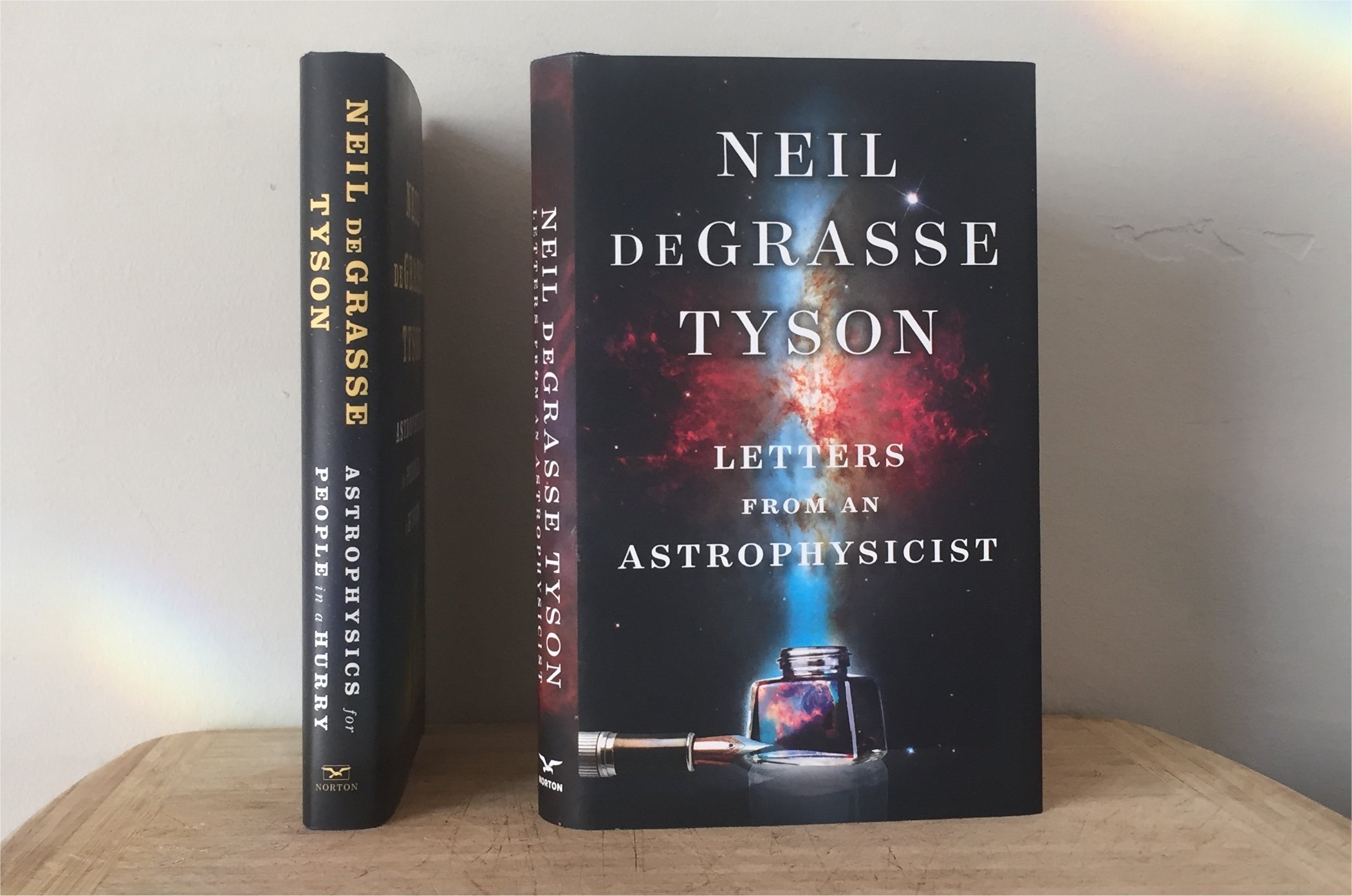
Here’s a new book by Neil deGrasse Tyson, just published a couple weeks ago. It’s blurbed as a ‘companion’ to his previous book, ASTROPHYSICS FOR PEOPLE IN A HURRY; post about that one here.

This is a collection of 101 letters (or emails) he’s received over the years, with his answers. In a few cases he summarizes the original query. Throughout Tyson is polite and restrained where he could be confrontational. Keeping the outline of the book, here are some highlights.

  • Prologue is a “Happy 60th Birthday, NASA” Facebook post, from Oct. 1, 2018. Tyson was the same age, and he recalls seeing the early space missions on TV as he grew up.
  • Ethos – the characteristic spirit of a culture, manifested in its beliefs and aspirations
    • Ch 1, Hope
    • About what to hope for in a universe that seems designed to kill us. How not to fear change, or failure. About how he doesn’t intend to ‘convert’ anyone, just show them how to think for themselves. About how no one should care what your IQ is; what matters to succeed in life are many other things. About it wouldn’t matter if he, or anyone else, is president; what’s needed are voters who are not dysfunctional.
    • Ch 2, Extraordinary Claims
    • How there’s no evidence for aliens, and how UFO sightings are most likely explained by anything other than alien spacecraft. How eyewitness testimony is unreliable (especially after decades). How the world will not end in 2012, citing previous such predictions. Dismissing gravitics and astrology. How sometimes relatively small investments in outlandish ideas (the example is ‘psychic teleportation’) can be prudent. How if someone sees ghosts, try asking them questions. Why Jonathan Swift might have imagined there would be two moons of Mars, long before they were discovered (by extrapolating Kepler’s ‘laws’ given one moon around Earth, four around Jupiter). About perpetual motion: if a claimant is so certain, then just build the machine. About how the African Dogon tribe might have heard about the discovery of Sirius B and incorporated it into their mythology. About why people would believe in Bigfood, or psychic premonitions.
    • Ch 3, Musings
    • About how simple rules do, in fact, lead to complex realities—DNA; 92 elements. About why he is not particularly curious about exploring his ancestral ‘roots’. About how BC/AD, despite being religiously inspired, nevertheless represents the most accurate calendar ever devised. About an elderly lady who had never seen Venus until the high-rise outside her apartment window was taken down. Some generous advice to a filmmaker anxious to be technically accurate. And his vote for the movie with the worst scientific accuracy—The Black Hole, in 1979, and then Armageddon, in 1998.
  • Cosmos – the universe seen as a well-ordered whole
    • Ch 4, Hate Mail
    • Replies to readers upset at his support for the demotion of Pluto from planetary status. Debating a correspondent about the value of settling on the Moon. Defending his comment that, compared to Europe, the US sucks at science. Responding to an angry letter someone who doesn’t want his tax dollars going to the space program, with a list of other things everyone’s taxes pay for, and a specific list of technological devices that he would have to live without, by rejecting what the space program discovered or enables. And a long reply from a Christian who thinks scientists would feed Christians to the lions, if they could.
    • Ch 5, Science Denial
    • Defending the conclusion that global warming is human caused. Defending the pursuit of scientific knowledge. Defending evolution as a matter of evidence, not belief. Responding to a claim that the Qur’an predicted many scientific discoveries by pointing out the connections were made only after the discoveries were made; no religious text has been found to offer clues to things as yet undiscovered. And patiently explaining the evidence behind evolution and the age of the universe to a writer who thinks these must be lies because they conflict with the Bible.
    • Ch 6, Philosophy
    • About whether science deals with truth, or meaning. The difference between how and why. Rejecting the suggestion that everything in the world is a matter of yin and yang, of balance. About how he thinks philosophers aren’t of much use, since the discoveries of modern physics.
  • Pathos – a plaintive appeal to emotions that already reside within us
    • Ch 7, Life and Death
    • About a writer who thinks his dead father spoke to him: next time this happens, ask him some questions. He consoles a writer whose mother is dying with the points of his ‘cosmic perspective’ that ended his previous book. Responding to the dilemma of whether spending money on, say, space projects make sense when cancer still hasn’t been cured.
    • Ch 8, Tragedy
    • The most striking section of the book, with several letters describing the morning of 9/11, from where Tyson lived just four blocks away; each observation ends with “Upsetting enough, but then…” and is followed by something even more horrific. And later deals with a 9/11 conspiracy theoriest who thinks it was staged.
    • Ch 9, To Believe or Not to Believe
    • Does a NASA photo show the Eye of God? No, it’s just the Helix Nebula. His list of 8 great books, leading with the Bible, for a reason that upset some readers (to understand how it’s easier to be told what to believe, than to think for oneself). Does he believe in God? The evidence is against a god. He replies to a Christian fundamentalist by pointing out how many fundamentalists of other religions believe things entirely different. About another Biblical literalist who thinks science is a liberal conspiracy, with advice about how science never ‘proves’ anything. About how a numerologist ‘proof’ of the value of pi, from Bible passages, simply shows that anything can be ‘proved’ with numerology if one hunts long enough. He points out the obvious objections to notions of intelligent design. Asked about meaning of life if there is no God: how most people find meaning or purpose in life without reference to religious texts.
  • Kairos – a propitious moment for decision or action
    • Ch 10, School Days
    • How to learn: read and think and read. On the perceived respect for teachers and scientists. To a police officer, how to think about the world. About problems with ‘gifted’ students—those who succeed are instead those who work hard. About pointless accuracy in certain contexts.
    • Ch 11, Parenting
    • About motivating children: expose them to many things, but pushing them too hard in one direction often backfires. About home schooling and what he teaches his own children: how to think, how to explore, not what to believe. How Bible stories can be treated as traditional stories that don’t have to be literally true.
    • Ch 12, Rebuttals
    • Objecting to rules about taking advanced placement tests. Responding to a hip-hop artist who believes the earth is flat. Responding to an Idaho paper’s criticism of his work as liberal and therefore anti-American. And a NYT op-ed wondering why Hollywood films can’t be bothered to get various details correct.
  • Epilogue—A Eulogy, of Sorts
    • A farewell letter to his father upon his death.
Posted in Book Notes, Meaning, Science | Comments Off on Tyson, LETTERS FROM AN ASTROPHYSICIST

Links and Comments: Trump vs California; Rural America vs the big cities

Here’s another. Paul Krugman, Sept. 20th: Trump Declares War on California. Subtitled: “It’s a liberal state, so it must be punished.”

I’m on a number of right-wing mailing lists, and I try to at least skim what they’re going on about in any given week; this often gives me advance warning about the next wave of manufactured outrage. Lately I’ve been seeing dire warnings that if Democrats win next year they’ll try to turn America into (cue scary background music) California, which the writers portray as a socialist hellhole.

Examples about auto emission regulations, and making San Francisco’s homeless population some kind of environmental hazzard. Yes, the latter is a problem.

But in many other dimensions California does very well. It has a booming economy, which has been creating jobs at a much faster pace than the nation as a whole.

The nation’s second-highest life-expectancy; drops in the uninsured via accepting Obamacare; and crime near historical lows. The point:

[I]t’s a reality the right refuses to accept, because it wasn’t what was supposed to happen.

You see, modern California — once a hotbed of conservatism — has become a very liberal, very Democratic state, in part thanks to rapidly rising Hispanic and Asian populations. And since the early years of this decade, when Democrats won first the governorship, then a supermajority in the State Legislature, liberals have been in a position to pursue their agenda, raising taxes on high incomes and increasing social spending.


The striking thing about the right’s new focus on homelessness, however, is that it’s hard to detect any concern about the plight of the homeless themselves. Instead, it’s all about the discomfort and alleged threat the homeless create for the affluent.

Bottom line:

[I]t’s yet another illustration of the intellectual imperviousness of the modern right, which never, ever lets awkward facts disturb its preconceptions.

\\\\

One more, also from about a month ago. An op-ed by Sarah Smarsh, writing from Wichita, Kan. Something Special Is Happening in Rural America. Subtitled: “There is a ‘brain gain’ afoot that suggests a national homecoming to less bustling spaces.”

I find this interesting because most prognosticators feel that the only hope for the expanding population, and the reduction of humanity’s impact on the planet’s environment, is greater density in big cities, and that small rural populations will gradually evaporate. But let’s see what she says.

First, the issue of unaffordability [inequality]:

The nation’s most populous cities, the bicoastal pillars of aspiration — New York City and Los Angeles — are experiencing population declines, most likely driven by unaffordability.

But the bottom line perhaps is:

Last year, Gallup found that while roughly 80 percent of us live in urban areas, rural life was the most wished for.

People are happier in small towns, perhaps.

The writer concludes,

We need policymakers who understand this (and care about it). Good news: Progressive Democratic presidential candidates have unveiled a spate of rural policy plans more robust than any in recent political memory. They suggest actions for which rural advocates have argued — investing in rural people and economies to lead a Green New Deal, cutting out oppressive middlemen in moving food from producers to eaters and much more.

What I see here is the attraction of most people to relatively small, tightly knit communities. And that this reflects humanity’s evolutionary heritage, in which most people, until less than 10,000 years ago, lived in small tribes of a few dozen or a few hundred. The modern cosmopolis is strange. But small communities tend to be insular and tribal, hostile to people who follow different traditions and rituals. And so there’s a tension between this innate preference in most people, and the growing population of the planet, in humanity’s future.

Posted in Culture, Evolution, Politics | Comments Off on Links and Comments: Trump vs California; Rural America vs the big cities

Status mid-October 2019

I’ve been light posting here for months now. Here’s the arc of where I’ve been this year, and where I’m going.

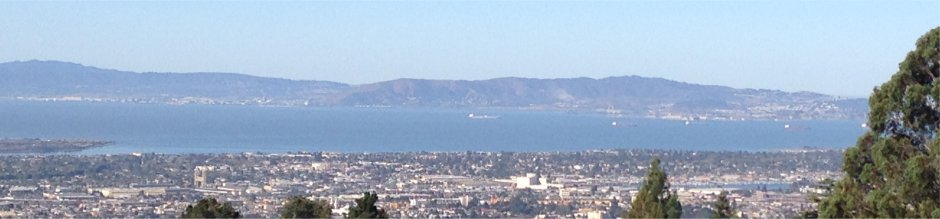
It’s now just about 7 years since I was laid off from my 30-year career at Rocketdyne. It’s nearly 5 years since Yeong, also laid off, got a new job in the Bay Area and we moved to our house here in Oakland. It’s two years since Locus took over the website I’d run for 20 years. It’s over a year and a half since my surrogacy plans were derailed, despite my having spent $70,000. It’s nearly as long since we adopted two cats, and a year since we took in a third feral cat, which we named Pixel, that disappeared three weeks ago.

At the beginning of the year I had goals in three general areas: 1, ‘finish’ my sfadb.com website, in the sense of completing the rankings of novels and short fiction, and displaying the results on a timeline; 2, ‘finish’ to some extent scanning personal and family photos, and posting sets of them on this site; and 3, pursue my ambitious agenda to read and reread classic science fiction, in support of my pipe dream of writing a book.

As a couple months passed at the beginning of the year, an outline of the coming months appeared. Yeong had been hankering for a trip to London for some time, and so I planned the trip, which we took at the end of April. Also, his older son James announced wedding plans early in the year for the end of August.

Thus the year seemed to be dividing into thirds.

In the first third, I spent much time reading, mostly classic SF novels, and also some substantial nonfiction. I took notes on everything, but only transferred those notes to blog posts in a few cases. I need to improve on this. I have the sense that reading books by myself is an indulgence, but if I present my thoughts about them to the world, it’s a kind of service.

Returning from London, I decided to focus on sfadb, and I have in fact made a great deal of progress in the five months since: I’ve refined the scoring algorithm and the timeline, and compiled many more anthology contents in support of ranking short fiction. And, intermittently, I’ve scanned more personal and family photos, and posted some of them on this site.

The second third I thought would end with Jimmy’s wedding, but in fact the demarcation dragged on for an entire month; two of Yeong’s sisters and one brother-in-law made the long trip from China to attend the wedding, and stayed with us for an entire five weeks. They were away on side-trips three times, for several days at a time, but even so, there was little normalcy over that entire time. Thus my retreat to watching DVDs of old TV shows and movies. (And their on and off presence over that time is what drove Pixel to escape; he was freaked out by so many strange people in the house.)

So, as of right now. The sfadb project entailed compiling contents of many hundreds of anthologies. That’s an open-ended task; one can portray the entire history of science fiction (and fantasy and horror) through trends in anthologies. But I think, as of today, I’m cutting that off; I have enough data to move on and do the short fiction rankings, and perhaps compile more anthology pages later. So I will do that next, and compile the timeline. I would say I would do that by the end of the year, but all of these projects keep expanding: over the summer my plan for the rankings is to provide paragraph-length descriptions, or assessments, of the top ranking novels and stories in the three short fiction categories. But this requires some amount of rereading, or research, and that will take a while. So we’ll see.

Will anyone care? It’s hard to know. One never knows, perhaps.

Posted in Personal history | Comments Off on Status mid-October 2019

Links and Comments: Fear and Playing Dirty

Two items from about a month ago, both from The New York Times.

Why Republicans Play Dirty. Subtitled: “They fear that if they stick to the rules, they will lose everything. Their behavior is a threat to democratic stability.”

The writers are Steven Levitsky and Daniel Ziblatt, political scientists and the authors of “How Democracies Die.”

“The greatest threat to our democracy today is a Republican Party that plays dirty to win.” They give examples, such as the refusal to hear Obama’s choice for the Supreme Court vacancy left by the death of Antonin Scalia. And gerrymandering. And Republican state legislators passing laws to limit the powers of incoming Democratic governors. And Trump’s shenanigans.

Why is the Republican Party playing dirty? Republican leaders are not driven by an intrinsic or ideological contempt for democracy. They are driven by fear.

They review historical counterparts.

Republicans appear to be in the grip of a similar panic today. Their medium-term electoral prospects are dim. For one, they remain an overwhelmingly white Christian party in an increasingly diverse society. As a share of the American electorate, white Christians declined from 73 percent in 1992 to 57 percent in 2012 and may be below 50 percent by 2024. Republicans also face a generational challenge: Younger voters are deserting them. In 2018, 18- to 29-year-olds voted for Democrats by more than 2 to 1, and 30-somethings voted nearly 60 percent for Democrats.

Demography is not destiny, but as California Republicans have discovered, it often punishes parties that fail to adapt to changing societies. The growing diversity of the American electorate is making it harder for the Republican Party to win national majorities. Republicans have won the popular vote in presidential elections just once in the last 30 years.

Much of the Republican base views defeat as catastrophic. White Christians are losing more than an electoral majority; their once-dominant status in American society is eroding. Half a century ago, white Protestant men occupied nearly all our country’s high-status positions: They made up nearly all the elected officials, business leaders and media figures. Those days are over, but the loss of a group’s social status can feel deeply threatening. Many rank-and-file Republicans believe that the country they grew up in is being taken away from them. Slogans like “take our country back” and “make America great again” reflect this sense of peril.

Similarly, Paul Krugman: Republicans Don’t Believe in Democracy

Many examples.

What the stories have in common, however, is that they illustrate contempt for democracy and constitutional government. Elections are supposed to have consequences, conveying power to the winners. But when Democrats win an election, the modern G.O.P. does its best to negate the results, flouting norms and, if necessary, the law to carry on as if the voters hadn’t spoken.

What can Democrats do about this situation? They need to win elections, but all too often that won’t be sufficient, because they confront a Republican Party that at a basic level doesn’t accept their right to govern, never mind what the voters say. So winning isn’t enough; they also have to be prepared for that confrontation.

These issues remind me of the ways religious conservatives cut corners that would seem to undermine their supposed high morals, to get their way. (E.g., manufacturing fake or misleading tapes to undermine Planned Parenthood.) My impression there, and perhaps this applies to Republicans too, is that they have a sense of a ‘higher cause’ that must be served, and ordinary rules and standards don’t matter, at least when dealing with heathens. The continued support by evangelicals for Donald Trump is the most glaring example of this, and which completely discredits the religious right’s claim to any kind of moral standards. To me, all of this means, if you have to lie and cheat to get your way, your positions must be indefensible on their grounds.

Posted in Politics, Religion | Comments Off on Links and Comments: Fear and Playing Dirty

Horror Flix: The Mummy

The Mummy was released in 1932, though the copyright, curiously, is 1933, right there in the credits, in roman numerals. It was released in December 1932, according to Wikipedia, just over a year after Frankenstein’s release in November 1931. Familiar faces return: Boris Karloff is now the mummy, Imhotep; Edward Van Sloan is the local expert, Dr. Muller. Observations:

  • As in both Dracula and Frankenstein, we get repeated full face-on shots of the title monster, looking menacing. Karloff now has make-up like wrinkled paper covering his entire face.
  • This film is set in Egypt, mostly in Cairo, in contrast to the European settings of the earlier films.
  • Still, there are numerous scenes of high society here as in the earlier two, of dinner parties and receptions at the Cairo Museum.
  • Plot:
    • The film begins portentously – again using Swan Lake over the opening credits – with titles about the Scroll of Toth and how death is a doorway to new life.
    • In 1921 a Field Expedition from the British Museum digs up a mummy and a gold box with a message inside: eternal death for anyone who opens the inner casket. Local expert Dr Muller warns them not to touch the casket. He steps outside, and the junior archaeologist, of course, opens the casket. Behind him, the mummy (whose face is already visible) steps forward to claim the scroll. The junior scientist, seeing this, goes crazy, laughing maniacally.
    • Ten years later, we see a later British expedition, led by the son of the leader of the first. He is visited by a Saturnine Egyptian man, Ardeth Bey, who offers to point out a sensational find. Soon the archaeologists uncover the tomb of Princess Anck-es-en-Amon, behind seals that are 3700 years old.
    • Flash forward, through whirling newspaper headlines, to how this important discovery now resides at the Cairo Museum.
    • We see elegant people at some kind of reception; we see Ardeth-Bey lurking in the museum. We meet Helen Grosvenor, a young woman who is Dr. Muller’s patient, or ward, who is half Egyptian.
    • Ardeth Bey, the resurrected mummy, thinks Helen is the reincarnation of his ancient bride Anck-es-en-Amon, and so he kidnaps her and intends to mummify and resurrect her to be his bride. His plans are foiled and Imhotep crumbles to dust.
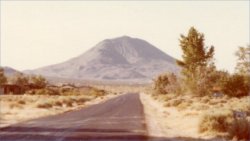
  • The scenes of the 2nd expedition are filmed at Red Rock Canyon, a familiar sight along route 395 in California north of Mojave on the way to the Owens Valley – those familiar hills of angled sedimentary layers, used for many film locations.
  • According to Imdb, another filming location was Rocky Buttes, a spot near Saddleback Butte in the Mojave Desert between Lancaster and Victorville, an area I’ve driven, and bicycled through, numerous times over the years. I didn’t spot in the movie where the site might have been used.
  • I think I’d only seen the first part of the movie before; most was unfamiliar.
  • The impressive set piece comes late, as Helen, somehow hypnotized by Ardeth Bey, comes to his house and is let in to see a pool of water, in which appear visions: love and crime and death; Imhotep kneeling by his bride; a funeral expedition; slaves carrying the coffin into the ground. Imhotep attempting to resurrect her; his father condemning him to death. Imhotep bound by cloths while still alive, and buried in a coffin. All the slaves are killed so no one would know; and the soldiers who killed the slaves are killed themselves.
    • Even if all the actors look like white guys in various shades of skin makeup.
  • And there is a later scene as Helen seems to revert to her role as the ancient princess, Imhotep ready to sacrifice her. Her guardians arrive to rescue her, but it is her plea to Isis, apparently, that saves her—the statue of Isis strikes Ardeth Bey and turns him to dust.
  • The film was inspired by the opening of Tutankhamun’s tomb in 1922 and the supposed “Curse of the pharaohs,” says Wikipedia.
  • The primary take-away, perhaps, is that Westerners should respect ancient eastern religions, and that those religions are real. Similar to Dracula, perhaps, where the Van Sloan character is familiar with the lore of Transylvania and confirms to skeptics that the legends about vampires are real. In that film the character used that lore to defeat the monster. In this one Van Sloan’s character is insistent about destroying the scroll in the first place, taking the Egyptian religion at its word.
  • Curious note from Wikipedia: “Filming was scheduled for three weeks.” They made them fast in the old days.

https://en.wikipedia.org/wiki/The_Mummy_(1932_film)
https://en.wikipedia.org/wiki/Red_Rock_Canyon_State_Park_(California)
https://www.rockybuttes.com/

Posted in Movies, Skiffy Flix | Comments Off on Horror Flix: The Mummy

Skiffy Flix: Bride of Frankenstein

So Dracula begat Frankenstein, and Frankenstein begat Bride of Frankenstein (no ‘the’ in the title, note). Though actually it took nearly 3 ½ years, and there were intermediaries: Boris Karloff did The Mummy next after Frankenstein, and James Whale next directed The Invisible Man. More on those when I get to them.

Comments, more in the context of a plot summary than previous posts.

  • The structure of Bride roughly parallels the first Frankenstein film, with a further experiment to create life bringing on tragic and unexpected consequences. And again, the main character(s) die, apparently, at the end of the film.
  • Boris Karloff is back again as Frankenstein, and Colin Clive as Henry Frankenstein, but not Edward Van Sloan, whose character Dr. Waldman was killed in the first film. James Whale follows up with his direction, and the result is regarded as an improvement on the first film, and one of the best sequels of all time.
  • The credits now show “Mary Wollstonecraft Shelley,” not “Mrs. Percy B. Shelley.” Maybe someone realized that wasn’t quite properly respectful to the author. Music is by Franz Waxman. And the monster is credited simply to “Karloff,” as if no first name was necessary.
  • The film begins with yet another castle amidst a stormy night. Inside are three elegantly dressed people in a drawing room with a fire. But, in a clever introductory device, these aren’t characters in our story, but rather an historical flashback showing Mary Shelley, Percy Shelley, and Lord Byron, three of the very people who, in reality, inspired Mary to write her novel Frankenstein. We see them discussing the savagery of nature (that storm outside), introduce each other for the sake of the audience, and hear that Mary has already written her tale, though not yet published it. She repeats the moral lesson of the first film: it’s about the punishment for a moral man who dared to emulate god. As flashbacks of the first film remind us of its story, Mary is ready to tell what happened after that…
  • And so we return to the mill fire from the end of the first film. The mill collapses; the crowds move out. A cackling woman – this is Minnie, later seen as a servant – talks as if there have been lots and lots of murders and drownings — though we only saw one murder and one drowning, in the first film, IIRC; or were some of the torch-bearing villagers at the end also killed? But this establishes the monster as a killer. Sure enough: Hans, the drowned girl’s father, lingers, anxious for proof the monster is dead. It’s not dead! Down in the stream beneath the mill, the monster lurks, and kills first Hans, and then his wife. Minnie sees the monster, and shrieks, and runs.
    • Back at the mansion, Henry, thought dead, is brought in on a stretcher. When he moves his hand, Minnie (now in her servant garb) shrieks “He’s alive! He’s alive!”, echoing the first film’s signature lines. Humor!
  • Henry recovers and the new story gets underway, after some conversation between Henry and Elizabeth about how “we’re not meant to know those things” about the power to create life. She worries about a dangerous apparition—
    • And sure enough, someone new shows up. We lost Dr. Waldman last film, so in this film we have a Dr. Pretorius to serve as a foil for Henry Frankenstein. Pretorius is an apparently disgraced professor of philosophy who urges Henry to resume his work.
  • Pretorius takes Henry by coach to his lab, serving him gin and toasting him “To a new world of gods and monsters.” He displays a row of glass cylinders containing tiny homunculi – tiny little people, fully dressed as a queen, a king, an archbishop, a devil, a ballerina.
    • These are remarkable special effects for the time! We see the tiny people moving around and talking, in tiny insect voices, in the same shots as the full-sized Pretorius in the background.
    • (At the same time, how does Pretorius keep these creatures fed and clean and clothed? One wonders.)
    • Henry is appalled; this isn’t science, it’s black magic. Pretorius explains that he grew these creatures from cultures, like nature does, from seed.
    • –and so here is creation of new life in a way Dr. Frankenstein in the first film did not, by merely reanimating patched up corpses.
    • (More comedy, as the king climbs out of his cylinder and pursues and queen and has to be returned to his jar by tweezers.)
    • Pretorius wants to collaborate with Henry, citing Biblical tales about being fruitful and multiplying: they must create a mate for the monster. A woman. (And, implying that Henry is indirectly responsible for the earlier deaths.)
  • Then follows a series of scenes in which the monster roams the hills, frightening people. Men from town pursue and capture him, but the monster easily pulls out his chains and escapes. It encounters a camp of gypsies.
    • In film’s most poignant scenes, the monster encounters a blind man in cottage playing Ave Maria on a violin. The man hears someone outside and invites him inside, giving him food, realizing he cannot speak. The man welcomes the visitor as a friend he thought he would never have. Later he teaches the monster words, and explains good and bad: cigar good, music good. But monster, once burned, considers fire bad.
    • But then two lost hunters come by, see the monster and shoot it, and set the cottage on fire.
    • Monster escapes, scares a group of children, rages through a graveyard, and takes refuge in an underground crypt… just as Pretorius and his assistants come through, looking for an appropriate brain for the creation of that bride. Pretorius explains to the monster what he is doing…
  • We return to the mansion, where Pretorius pressures Henry to cooperate by having the monster kidnap Elizabeth and carry her into a cave.
  • Final scenes, as in the first film, are in a hilltop tower, the tower experiment room, where a wrapped body lies on a pallet. The heart fails and Karl, the assistant, abducts a girl on the street to provide another.
    • The storm rises. Kites are sent up. (No mention of ray beyond the ultraviolet.) The body on the table is lifted up through the ceiling, as in the first film. They talk about the ‘cosmic diffuser.’
    • The table lowers, and the eyes move. “She’s alive! Alive!”
    • Unwrapped, the bride for Frankenstein – played by Elsa Lancaster, who played Mary Shelley in the intro scenes – has a huge mound of frizzy hair. (Where did that come from? A few moments ago she was wrapped in cloth.)
    • And then, in a tragic irony, the original monster enters, approaching his bride. Friend? Bride screams, screams again, runs. She’s just as terrified of the original monster as all the humans are.
  • And so the monster, telling Henry and Elizabeth to flee, but Pretorius to stay – they deserve to die — pulls a lever that causes the entire castle to explode and collapse. The end.

Summary comments:

  • The bride’s image is the most striking of the film.
  • The great irony is that she finds the original monster just as horrifying as everyone else did.
  • The center section with the blind man is the most poignant, and shows, again, that the monster is not inherently evil, but responds to kindness, and is able to learn.
  • Again, did the monster and wife actually survive? What’s the setup for the next film?
  • Note the trailer for this film confuses the monster with its creator: “Frankenstein returns…. In search of a bride!” Popular culture has always confused the name Frankenstein with both the monster with its creator.
  • The Wikipedia entry on this film is extensive, with much detail about the film’s production, issues of censorship, and interpretations of Christian imagery and Queer reading.
Posted in Skiffy Flix | Comments Off on Skiffy Flix: Bride of Frankenstein

Monster Flix: Dracula

Having realized that Dracula actually preceded Frankenstein – both from Universal Studios, and together the founding pair of the entire genre of horror films in the 1930s and ‘40s, even though Frankenstein might be taken as science fiction, not horror – I rewatched Dracula a couple days ago to see to what extent there was any resemblance between the two.

Dracula was released in February 1931, Frankenstein in November. A long enough interval, I’m guessing, that the success of the first inspired the studio to find another property to adapt into film and get into theaters.

No detailed plot summary; just general reactions and observations.

  • Both films were adapted from plays that had been inspired by the respective novels. The books were published in 1818 and 1897, so in both cases decades had passed before the advent of talking motion pictures and for, in both cases, earlier stage plays and silent films to have been produced based on the novels.
  • The structures of the two films are similar. Both involve remote castles and native villagers; both involve relatively wealthy aristocratic or professional families, and an impending wedding; both involve a monster on the loose and a cavalier disregard, but the female leads, for closing their bedroom doors and windows.
  • On the other hand, Dracula ends with the monster killed through the efforts of one man (Van Helsing); Frankenstein ends with an angry mob storming a mountain-top windmill and apparently killing the monster – though, as we see in the sequel, they didn’t.
  • Dracula is noticeably more primitive in terms of production and directing. All these pointed close-ups of Dracula with only his eyes illuminated (and too much lipstick). The way the bats fly like the crudest of toys hung on strings. The lead roles are almost hilariously overplayed; Bela Lugosi as Dracula is lugubriously campy, and Dwight Frye as Renfield is comically maniacal. Edward Van Sloan as Van Helsing is soothingly effective as the voice of reason, while except for these actors, the other players speak in the same flat American accents as did the cast of Frankenstein.
  • Further, Dracula is very stylized in a rather amateur way. Is the direction, and Lugosi’s acting, deliberate and exaggerated in order to be creepy, or because everyone involved is incompetent? It’s almost as if the film is parodying some previous film we haven’t had a chance to see.
  • On the other hand, the film lacks a soundtrack (the opening credits are shown to a brief excerpt of Tchaikovsky’s “Swan Lake”), and this rather enhances some of the suspense. Those repeated shots of Dracula lurking in the background, with those illuminated eyes, are all the more effective without the musical cues another director might have supplied; as such they emphasize how the other characters are unaware of this lurking threat.
  • The very opening shot of the stagecoach rushing through the hills, according to a book I have, was shot at Vasquez Rocks in southern California. Everything else was shot on sets at the Universal lot in what’s now Universal City.
  • After the opening in Transylvania, and the tragic passage at sea, most of the story takes place in London, where Dracula has leased an abbey next door to the Seward Sanitarium, where the mad Renfield has been taken. Almost every scene is set at night, and even those that aren’t are dark.
    • It takes an awful long time for Van Helsing to figure out where Dracula could possibly have hidden the box of native soil he must have brought with him. Where else by the abbey’s cellar?
    • And why does Renfield, an inmate, keep wandering into the drawing room where the owner’s family and guests reside?
  • I assume the details about vampires and werewolves and Nosferatu were either original to Bram Stoker, or adapted by him from folklore – that is, not original to this film – but I find the blend of such folklore with Christian iconography – that a crucifix, like a mirror, should frighten a vampire – curious.
  • I also noticed that the terrified lady characters almost always scream off-camera; I wonder why.
  • Finally, and the very end of the film, after Van Helsing has driven the stake into Dracula and Mina has come to her senses, she and her fiancé embrace and exit that cellar up those long stone steps. But Van Helsing says he has to stay behind a moment. The End. Wait, what? Why did he have to stay behind?

A couple fun facts:

  • There was in fact a score composed for the film, years later, by Philip Glass, and released in 1999. The DVD of Dracula I have actually offers the Glass score as one of the audio options, but I left it off this time.
  • There was a simultaneously filmed Spanish language version of Dracula, using the same sets and script but a different cast. It’s also on the DVD that I have. Curiously, it runs half an hour longer than the Bela Lugosi English-language version.

SFE correction: the line in Frankenstein is “It’s alive!” not “He lives!”

Posted in Movies, Skiffy Flix | Comments Off on Monster Flix: Dracula

Skiffy Flix: Metropolis

I mentioned this on Facebook a couple weeks ago: I finally watched, all the way through, Metropolis.

Tonight I watched the 1927 silent film Metropolis, for the first time all the way through. (I watched the first 45 minutes or so a couple times before.) A fascinating film, of course, for its futuristic dystopia, its vision of an enormous city ruled by elites and powered by underground workers — but also because, in its last half hour or, it’s an action-adventure disaster film! The first, long before movies about the Titanic or earthquakes or burning skyscrapers?

And in a comment to comments about that post:

I never saw the Moroder version. What I just watched was a restored version using footage found in Argentina, of all places, in 2008, grainy bits edited back to recreate the original release. Somehow they smoothed out the music (re-recorded it? not sure) so everything fits. The music is pretty good, very expressive in a Wagner/Strauss sort of way.

Here are some specific notes.

  • First: years ago I had a very old DVD of this film which didn’t play on my current DVD/Blu-Ray players, so I ordered a newer version. The one I got was a ‘restored’ version that includes footage that was cut after the film’s premiere – rather as Kubrick cut 20 minutes from 2001 after initial showings – footage that was found, in all places, in Argentina, in 2008. (Perhaps they didn’t get the memo about cutting too long a film.)
  • It’s a silent movie, with lots of music – pretty good music, as mentioned above – but otherwise we only see actors speaking without hearing them; in the convention of the day, we see occasional title cards displaying lines of dialogue, when it’s really important for us to know what the characters are saying. But most of the time, the film – as did most silent films – assume you can deduce, from context, what the characters are saying to each other, from context.

The film begins.

  • We see credits for director and screenplay, etc.; and the cast. And then an epigram: “The mediator between brain and hands must be the heart!”
  • And then we see a huge city, an imaginary, futuristic version of New York City. Then: images of huge pumps going up and down; a clock, with a 1 to 10 scale reaches zero and whistles blow; and the shift changes, with side-by-side lifts, one row of workers marching to leave, another to enter, all very robotic, all in black dungarees. “Deep below,” the title card reads, “the earth’s surface…lay the workers’ city.” The city is an underground cavern, with squared building rising several floors toward the ceiling. The workers march off the elevator, literally looking downward. Very stylized.
  • And then we see the land above, the “Club of the Sons,” we are told, “with lecture halls and libraries, stadiums and theaters.”
    • We see an open-air track field, with many rather skimpy white men [not physically fit by any modern standard] racing around it, in white shorts.
    • And then we see the “Eternal Gardens,” a place with huge plant-like structures, and a man dressed like a foppish orchestra conductor trying to corral a number of young women in outlandish garb. He is, we gather, choosing a companion for Master Freder, Joh Frederson’s son. The ladies curtsy and turn. Freder runs in, quickly chooses one woman to chase around the fountains and pheasants. Freder wears all white, shirt and tie and odd pants that billow at the top, as if dressed like a boy; he’s not an adult. He grabs one the women and they speak—
  • But then a door opens, and a plainly dressed women enters leading a group of children, all poorly dressed. They look around tentatively; the music is plaintive. “Look, These are your brothers” she tells the children. Freder stares at her. She stares back, as other men arrive to guide them back into the elevators. Freder asks the ‘conductor’. “Who—was that?” and he rushes out to follow her. Title card: “But this is what happened to Freder – son of Joh Fredersen, master of Metropolis – when he went to search of the girl:”
    • [Oddly, the son here is named Freder, while the father is named Fredersen; generally, it’s the other way around.]
  • We then see Freder down among the huge machines, where men work at banks of dials and levers. The direction is very stylized: the workers bend back, and forth, in unison. There’s a huge machine with central stairs. Then there’s an accident: steam erupts. The worker there can’t reach the lever; he struggles, fails. The temperature rises; steam hisses—men collapse, Freder falls back.
    • Freder has a vision: the machine is a monster, Moloch, a huge head with an open mouth, the stairs leading up the mouth, where priests lead slaves up the stairs to throw them into the fire.
    • The illusion fades; Freder sees injured or dead workers being taken away on stretchers.
  • Freder runs outside and commands a taxi to take him “To the new Tower of Babel – to my father–!”
  • Now we see the grand city shot with bridges of motorways and trains among the skyscrapers, and biplanes (!) flying between [banking oddly in tight turns]; a shot of three highways full of cars; then the grand building in middle distances, traffic in front and below. Also dirigibles.
  • And then we are inside a huge office, on a high floor in one of those skyscrapers, with enormous windows giving a view of the city. Fredersen, a distinguished older man, walks back and forth giving orders to minions. On a wall creep numbers, like stock tickers. Nervous underlings write everything down.
    • His son, Freder, rushes in, crying expressively to another man, and then his father [about the accident in the underground, we understand]. The father responds by turning to this other man: “Why is it, Josaphat, that I learn of the explosion from my son, and not from you–?” “The details—”
    • The son pleads with his father, worried about those “in the depths” who might rise up against him.
    • Another crisis: the chief foreman of the Heart Machine arrives with two more plans, diagrams of some kind, found on the men involved in today’s accident. Didn’t Josaphat know about this?
    • Father fires Josaphat.
    • Freder follows Josaphat out, offering assistance.
  • Freder returns to the factory, offering to trade lives with one of the workers, to tend the machine.
  • Frederson, the father, visits a “strange house” in the middle of Metropolis, where lives Rotwang, an inventor. Rotwang shows Frederson a female robot. It stands, walks, to delicate music. Rotwang promises that soon no one will be able to tell it’s a robot.
    • Frederson asks Rotwang for advice—what to do about these secret plans that the workers have?
  • M/w Freder finishes his shift and follows other men down into the catacombs, where a woman, Maria – the same woman he saw earlier, with the children – stands before several tall crosses and speaks to the crowd, to tell them the legend of “THE TOWER OF BABEL.”
    • We see the story told, the tower rising, then collapsing; the men could not understand one another.
    • “Head and hands need a mediator… the heart.” Who could the mediator be? She looks at Freder. He offers himself. They kiss.
    • But Fredersen and Grot, the foreman of the Machine, are spying on them; Frederson tells Grot to make the machine into an image of Maria.

And that’s just the end of the ‘prelude,’ about a third of the way in.

The ‘intermezzo’ and ‘furioso’ show the transformation of the robot into Maria, and the infiltration of this robot into the workers’ underground to foment, or quell, revolution. Workers panic, attack the machines, and the city begins to crumble. In particular, flood water pours into the underground city. This becomes a disaster film, as actors, including many children, are washed away, and miniature building sets crumble.

Eventually the mobs catch up to Maria, who they think is a witch, and burn her on a pillar of fire… only to see she is really a robot.

The real Maria survives. The film ends with workers meeting with Fredersen, Freder, and Maria, and the offering of a handshake. And the epigram: “The mediator between brain and hands must be the heart.”

Comments:

  • The takeaways from this film are the visuals: of the vast cityscape, with enormous buildings and levels of different modes of transportation; of the stylized humanoid robot Maria; of the monstrous underground machine and the robotic human workers; of the aerie-like office of Fredersen, the Master of Metropolis.
  • The plot is both simplistic, in its contrast between the elites above and the workers below, and muddled, with a confusing subplot about Fredersen and the scientist Rotwang and their past – the original reason for the robot, you see, was to recreate the daughter lost by something something. Soap opera. The central theme is pure science fiction in its dystopian depiction of the dangerous of industrialization and the way mass production would dehumanize workers, but the film doesn’t offer any solution to this problem except for the shaking of hands.
  • As noted I was surprised that the last quarter or so of the film was an extended, disaster movie-like action sequence, with riots and cascading waters and collapsing buildings.
Posted in Skiffy Flix | Comments Off on Skiffy Flix: Metropolis

Skiffy Flix: Frankenstein

Have been busy the past few weeks with 1) family visits and 2) work on sfadb – the end is in sight. Very little reading in the past two months. But I have taken the occasional couple hours to watch old classic movies.

Today: the 1931 Frankenstein, which I’ve seen a couple times before, but not in decades. I’ll just post a few bulletized notes.

Sunday 29Sep19: some additional comments, and the bottom of the post.

  • The film is directed by James Whale, about whom a much later movie, Gods and Monsters, was made, with Ian McKellan as Whale.
  • The opening credits credit the source material to both a play and to the original novel by “Mrs. Percy B. Shelley,” because Mary Wollstonecraft Shelley had been married to Percy Shelley. That’s how women were regarded, nearly 90 years ago, as attachments to their husbands.
  • The opening shot has a man — Edward van Sloan, who’d just starred in Dracula and stars here as Dr. Waldman — come onto the stage, as if in a theater, to address the audience, and advise them that the film might be disturbing, because, it is about a scientist “who sought to create a man after his own image without reckoning upon God” — immediately setting the conflict in homey terms, appealing to religious prejudices about scientific investigation and the supposed risks of “playing God.” I very much doubt these sentiments were in the original Shelley novel; but the film was made in 1931 Hollywood, and so appealed to American prejudices. Indeed, Wikipedia documents several examples of censorship or banning of the film.
  • Yet the central theme is not what it’s fear-mongeringly advertised to be: Frankenstein doesn’t “create” life in the sense of making something living from a petri dish of chemicals; he is reviving dead people. Or more precisely, reviving a collage of dead people parts.
  • I haven’t seen yet why the character names were changed from the novel, where it was Victor Frankenstein; in this film it’s Henry Frankenstein, and another character is given the name Victor. And Frankenstein’s assistant here is Fritz (not Igor as in Young Frankenstein).
  • The critical theme, it seems to me, is about the monster itself: innocently created, why does the film portray it as evil and violent? Well, because the crucial element of horror and thriller movies (and many stories) is that anything new and strange must be evil and dangerous. (Rather the opposite of science fiction’s presumptions.) The excuse here is that the brain used was a criminal brain. That’s doesn’t explain the monster’s physical power.
  • To the film’s credit the monster’s essential innocence is fully evident in several scenes, notably his encounter with a young girl at the lake. The monster’s innocence — it doesn’t understand the difference between tossing flowers into the water, and tossing in the girl — is tragic, but not evil. (And yet, the girl drowned from being thrown in a couple feet of water?)
  • This is the film in which the seemingly mad scientist cackles “It’s alive! It’s alive!”. This is the film in which the townspeople rise up with torches and chase the monster into a hilltop windmill and then burn it down.
  • It’s also about the scientist’s wealthy father, Baron Frankenstein, a dotty old man who’s only worried about his son’s marriage. The house they live in is lavish, with enormous drawing rooms and high ceilings and a large staff, lying at the edge, apparently, of a small village otherwise occupied by peasants. But lavish lifestyles depicted in films were one thing that drew people to the movies, in those days.
  • They key scientific premise, by the way, is that Dr. Frankenstein has discovered some new ‘ray’ beyond the ‘ultraviolet ray’, and this new ray is what brought life into the world, which he proceeds to prove through demonstration. He hoists the monster’s body up into the thunderstorm (it’s quite a grand set, actually) so that the electricity will activate the ray, apparently, not because electricity will directly bring the stitched-together corpse (back) to life.
  • The actors all speak in very flat American, almost New Yawk, accents, even when speaking German words (Herr as “hair”).
  • There’s virtually no music in the film, save at beginning and over the end credits.
  • The film is shot mostly on sound-stages, on those forced perspective sets you see in films of this era, where the stage rises and curves away at the back as if to suggest the other side of the hill is where a stage backdrop actually is. There’s one scene in which the cornered monster keeps turning as if to leap over a cliff, but he can’t because the stage doesn’t go back any farther.
  • The lake scenes were filmed at Lake Sherwood, just south of Thousand Oaks, northwest of LA.
  • Whale’s direction is occasionally very expressive, some of the closeup shots of the monster downright poignant, even if the editing there is abrupt.
  • The film ends with a wedding — as so many pulp SF stories of the day did — and a toast to the house of Frankenstein.

Later comments:

The Frankenstein story is famous, part of popular culture and known far beyond the field of science fiction, where it is regarded by some as the first actual science fiction novel (long before the idea of the genre of science fiction existed). Because it is about the idea of scientifically experimenting to see what the results are.

But I suspect the Frankenstein story endures because it confirms the fear many people have about what scientists do – the popular conception of the singular ‘mad’ scientist working alone in his lab – even if that was not the point of Shelley’s novel. This plot never seems to get old: scientist, not properly humble before the will and domain of god, creates something that gets out of hand, and then destroys him before the threat can become a danger to everyone else. Michael Crichton wrote this sort of story over and over, the story that fears discovery and change and whose resolution means defeating the change and returning everything to normalcy. There will always be conservatives and reactionaries for whom this story resonates.

At the same time, while I haven’t read Mary Shelley’s original novel in decades, I suspect that was not the simplistic message of her original novel, but that playwrights, and Hollywood, have simplified her book in a way to appeal mass audience prejudices. Just as, to take another example at hand, the idealistic themes of the original Star Trek series have become degraded and forgotten into the basis for standard Hollywood action/special-effects films.

Posted in Skiffy Flix | Comments Off on Skiffy Flix: Frankenstein