About the Pandemic and Individual Liberty

There’s a point to be made about the zealots insisting on individual liberty, when they go ballistic about refusing to wear masks (example links below). Do they bristle at the intrusion on individual liberty that there are laws that prevent them from smoking cigarettes in department stores? Do they object to their exercise of personal liberty by being obliged to buy auto insurance, or to wear seat belts? (There actually was a debate about personal liberty and government intrusion, in the 1960s when seat belts came to be required.) To buy homeowners’ insurance to get a mortgage? Do they object to having to stop at stop signs because their individual liberty should allow them to blow through intersections never mind the risk and danger to themselves and others? Answer: No, they do not. They’ve accepted that these are matters of policy that are part of the formal or informal social contract, agreements made to enable us all to get along and to suppress selfishness at the expense of others. Yet they don’t understand that the mask situation is exactly like that. Thus Americans’ perverse obsession with personal liberty, and denial of scientific expertise, is resulting in more deaths, proportionally, than all but a dozen other countries on the planet.

I think these people are upset not out of principle, but because they resent anyone telling them to do something today that they didn’t have to do yesterday. Resistance to change.

This relates to my issue with Libertarianism; we don’t all live separately on isolated islands or ranches on the prairie. We live in a complex society, even those who don’t live in big cities, that depends on the cooperation and interconnection of us all. Americans seem to have this fetish about personal liberty that is especially dangerous in situations like a GLOBAL PANDEMIC, when people should behave in ways that promote the common good. It’s not socialism, it’s not communism — it’s the most effective strategy for SURVIVAL. Thus compared to many other countries, the US is miserably failing in our response to the pandemic. And our moron president is in denial of this; and a substantial portion of US voters believe anything he says. Sigh.

These people are dimwits, or worse.

Sean Feucht Calls California COVID-19 Restrictions ‘Tyrannical’ and ‘Insane’

DeAnna Lorraine Claims That ‘God Does Not Want Us Wearing Masks’

Posted in Conservative Resistance, Lunacy, Science | Comments Off on About the Pandemic and Individual Liberty

Quotes: Opening Lines: Carl Sagan, Gene Wolfe

Carl Sagan, COSMOS (1980)

The Cosmos is all that is or ever was or ever will be. Our feeblest contemplations of the Cosmos stir us — there is a tinging in the spine, a catch in the voice, a faint sensation, as if a distant memory, of falling from a height. We know we are approaching the greatest of mysteries.

The size and age of the Cosmos are beyond ordinary human understanding. Lost somewhere between immensity and eternity is our tiny planetary home. In a cosmic perspective, most human concerns seem insignificant, even petty. And yet our species is young and curious and brave and shows much promise. In the last few millennia we have made the most astonishing and unexpected discoveries about the Cosmos and our place within it, explorations that are exhilarating to consider. They remind us that humans have evolved to wonder, that understanding is a joy, that knowledge is prerequisite to survival. I believe our future depends on how well we know this Cosmos in which we float like a mote of dust in the morning sky.

Gene Wolfe, THE FIFTH HEAD OF CERBERUS (1972)

When I was a boy my brother David and I had to go to bed early whether we were sleepy or not. In summer particularly, bedtime often came before sunset; and because our dormitory was in the east wing of the house, with a broad window facing the central courtyard and thus looking west, the hard, pinkish light sometimes streamed in for hours while we lay staring out at my father’s crippled monkey perched on a flaking parapet, or telling stories, one bed to another, with soundless gestures.

Posted in Quotes | Comments Off on Quotes: Opening Lines: Carl Sagan, Gene Wolfe

Links and Comments: Search Engines; Responses to Disease

I found the piece mentioned two days ago about London reforms after the Black Plague. Actually it was New York reforms after the 1860s. It’s an opinion piece in the NYT that was online four days ago, and that appeared in today’s print edition.

(Search engines on all sites are still seldom completely useful. One issue with the NYT site is that news stories and opinion pieces have different headlines online vs. in print. (Why? I’m not sure.) So after seeing this essay again, in print this morning, searching the NYT site for the headline “Mass Death Is Not Inevitable” turned up nothing. The online title was Your Ancestors Knew Death in Ways You Never Will. At least NYT made one improvement recently: the online articles say at the bottom what day’s print paper, even to the section and page, the article will appear in. But I’m not sure they do this in advance, or in this case I would have taken note.)

Donald G. McNeil Jr., Your Ancestors Knew Death in Ways You Never Will. AKA in print: “Mass Death Is Not Inevitable.” Subtitled online, “Some say we’re doomed. But science and public spending have saved us from pandemics worse than this one.”

The online version as an interesting graph (does this link work?) of death rates since 1800 due to various epidemics, of various diseases like small pox and cholera now defeated via vaccines. But here are the key para’s:

The death rate began dropping after the 1860s. New Yorkers — both citizens and doctors — had finally stopped arguing and reached consensus on some basic issues.

First of all, most finally accepted the “germ theory” of disease, acknowledging that it was caused by invisible enemies, not by swamps, trash, manure or the other nuisances that underlay the “miasma theory,” which held that bad smells caused disease. (Only a century earlier, Americans had given up on the “humors theory,” which posited that disease was caused by imbalances among blood, urine, sweat and bile that had to be rebalanced by bleeding, sweating or purging.)

They also agreed that whether immigrants had brought some diseases or simply suffered from them, no one was safe until everyone was safe, so they made public health universal.

As a result, New Yorkers took certain steps — sometimes very expensive and contentious, but all based on science: They dug sewers to pipe filth into the Hudson and East Rivers instead of letting it pool in the streets. In 1842, they built the Croton Aqueduct to carry fresh water to Manhattan. In 1910, they chlorinated its water to kill more germs. In 1912, they began requiring dairies to heat their milk because a Frenchman named Louis Pasteur had shown that doing so spared children from tuberculosis. Over time, they made smallpox vaccination mandatory.

Libertarians battled almost every step. Some fought sewers and water mains being dug through their properties, arguing that they owned perfectly good wells and cesspools. Some refused smallpox vaccines until the Supreme Court put an end to that in 1905, in Jacobson v. Massachusetts.

And goes on with:

Today, Americans are facing the same choice our ancestors did: We can listen to scientists and spend money to save lives, or we can watch our neighbors die.

Thoughts on this:

  • Medicine, as Lewis Thomas wrote a book about, is the “youngest science.” It was only 100 or so years ago that doctors realized washing their hands saved people’s lives.
  • The demonization of immigrants, denying them health coverage and driver’s licenses, hurts everyone. “No one was safe until everyone was safe.” It’s an investment; it’s risk management. How immigrants get here is a separate issue.
  • Reforms based on science.
  • And how Libertarians objected. (In the way religious fundamentalists object to so many other measures of progress.) I don’t want to debate about libertarianism, but I will say that there are flavors of the idea. On the one hand, I have no objection to the idea that people should be allowed to live their lives freely, without government oppression. On the other hand, libertarians seem to think an ideal society would involve no taxes and no regulations. The way I’ve seen this formulated is that libertarians want all the benefits of society without paying for any of its obligations. (“You didn’t build that road.”) Without taxes and regulations and government oversight, who would have built the Interstate Highway System? Launched men to the moon? Keep corporations from cheating their customers and killing many of them for the sake of capitalist profits?
Posted in Conservative Resistance, Science | Comments Off on Links and Comments: Search Engines; Responses to Disease

Quotes: Edward Abbey, David Deutsch

Some things are relative, and some things are not.

Edward Abbey, DESERT SOLITAIRE (1968)

This is the most beautiful place on earth.

There are many such places. Every man, every woman, carries in heart and mind the image of the ideal place, the right place, the one true home, known or unknown, actual or visionary. A houseboat in Kashmir, a view down Atlantic Avenue in Brooklyn, a gray gothic farmhouse two stories high at the end of a red dog road in the Allegheny Mountains, a cabin on the shore of a blue lake in spruce and fir country, a greasy alley near the Hoboken waterfront, or even, possibly, for those of a less demanding sensibility, the world to be seen from a comfortable apartment high in the tender, velvety smog of Manhattan, Chicago, Paris, Tokyo, Rio or Rome—there’s no limit to the human capacity for the homing sentiment. Theologians, sky pilots, astronauts have even felt the appeal of home calling to them from up above, in the cold black outback of interstellar space.

David Deutsch, THE FABRIC OF REALITY (1997)

If there is a single motivation for the world-view set out in this book, it is that thanks largely to a succession of extraordinary scientific discoveries, we now possess some extremely deep theories about the structure of reality. If we are to understand the world on more than a superficial level, it must be through those theories and through reason, and not through our preconceptions, received opinion or even common sense. Our best theories are not only truer than common sense, they make far more sense than common sense does. We must take them seriously, not merely as pragmatic foundations for their respective fields but as explanations of the world. And I believe that we can achieve the greatest understanding if we consider them singly but jointly, for they are inextricably related.

Posted in Quotes | Comments Off on Quotes: Edward Abbey, David Deutsch

Links and Comments: How Science Really Works; How Pandemics Can Trigger Cultural Renewal; Newton’s work during a Plague Year

(updated 18jul20)

Slate, Shannon Palus: How Public Health Experts Feel About Being Wrong. Subtitle: “That they change their advice is actually why we should trust them.”

The subtitle is precisely right. Experts, scientists, anyone with intellectual integrity change their minds when evidence warrants it. Especially in novel situations where the evidence trickles in slowly, and differently from previous experiences.

Is Peter Navarro a dimwit, or a conniving Trump cultist? The former is a possibility; people who don’t understand science, who don’t understand that scientific conclusions are tentative and change as the evidence comes in (as in police detective work), who think that every question has a definite, unchanging answer (as in religion), may truly think that Fauci has “made mistakes.” No. His advice was the best possible at the time, and new evidence and circumstances caused him to revise his advice. This CNN piece,

Trump team’s circular firing squad goes after Fauci

patiently explains how every point Navarro made was cherry-picking or taken out of context, especially in ignoring the conditions Fauci put on his advice in the first place.

This should not be difficult to understand.

Yet some people refuse to understand this, apparently. Or — is this is a calculated attack to discredit Fauci in the eyes of the Trump cultists, who will believe anything they are told from their leader and his minions, to discredit a decades-renowned scientist in order to open up the economy in a desperate bid to hope the virus goes away and Trump can still win re-election…?

A similar feat of magical thinking was on display with White House press secretary Kayleigh McEnany’s remark White House press secretary: ‘The science should not stand in the way of’ schools fully reopening. Ironically, this NBC piece’s subtitle is about her accusing the media of bias. Many news outlets characterized her remarks as saying science should be ignored in the face of reopening school; in fact she meant (her wording was poor) that the science does actually support reopening the schools. No it doesn’t; you can trust her; she’s motivated by Trump’s wanting the reopen the schools, and the economy, at any cost to human lives.

\\

As for a silver lining… here’s a long essay by Lawrence Wright, author of books like God Save Texas: A Journey into the Soul of the Lone Star State and Going Clear: Scientology, Hollywood, and the Prison of Belief, as well a novel about a global pandemic, The End of October, published in April but written long before Covid19 was on the horizon.

The New Yorker: How Pandemics Wreak Havoc—and Open Minds, subtitled, “The plague marked the end of the Middle Ages and the start of a great cultural renewal. Could the coronavirus, for all its destruction, offer a similar opportunity for radical change?”

It’s a long article and I haven’t read it all. His point is that catastrophes like a global pandemic can jolt society into reforms they otherwise would not otherwise have made. But here’s a key point, from a conversation between the author and the retired John Hopkins University scientist Gianna Pomata, an Italian.

In an e-mail, she condemned those who blithely ignored scientific advice, writing, “What I see right now in the United States is that the pandemic has not led to new creative thinking but, on the contrary, has strengthened all the worst, most stereotypical, and irrational ways of thinking. I’m very sorry for the state of your country, which seems to be in the grip of a horrible attack of unreason.” She continued, “I’m sorry because I love it, and have received so much from it.”

\\

I saw another essay whose link I now cannot find, about the aftermath of the Black Plague, about how London made various reforms, such as a sewer system, to reduce the spread of disease, though such measures were opposed by libertarians. [Update 20jul20: I found the essay and link, and discuss it in the next post.]

\\

And one more. Revisiting Carl Sagan’s 1980 book (and TV series) Cosmos recently, I came across this passage, about Isaac Newton. (Page 68 of the book.)

In 1666, at the age of twenty-three, Newton was an undergraduate at Cambridge University when an outbreak of plague forced him to spend a year in idleness in the isolated village of Woolsthorpe, where he had been born. He occupied himself by inventing the differential and integral calculus, making fundamental discoveries on the nature of light and laying the foundation for the theory of universal gravitation. The only other year like it in the history of physics was Einstein’s “Miracle Year” of 1905.

A year.

This was the same plague that Daniel Defoe documented in his book A Journal of the Plague Year (https://en.wikipedia.org/wiki/A_Journal_of_the_Plague_Year).

Posted in Psychology, Science | Comments Off on Links and Comments: How Science Really Works; How Pandemics Can Trigger Cultural Renewal; Newton’s work during a Plague Year

Skiffy Flix: Things to Come

This is an ambitious film from 1936, based on a treatment by H.G. Wells depicting future history from 1950 to 2036. Again, Wikipedia has a fairly detailed plot at https://en.wikipedia.org/wiki/Things_to_Come.

I’ve read that for decades after, Things to Come was considered the most serious, big-ideas science fiction film of all time. (Until 2001, maybe.) It has some striking ideas and images, but it hasn’t aged well.

This film breaks into roughly three parts.

  • In 1940, war breaks out. We witness events from a generic city called “Everytown,” beginning as the main character, the forceful John Cabal (played by Raymond Massey), and his friends discuss the inevitability of war and its impact on technological progress. Then sirens sound and the war begins; we see the center of town as people run, cars crash, aircraft attack, tanks roll through the central square. Bombastic music. Buildings collapse, burn. Then shots of ships at sea, futuristic tanks, planes over the coast. Title cards display the years as war goes on… 1945, 1960. Finally it’s over in 1966, but then a pestilence spreads; no one who catches it survives.
  • Everytown is now ruins, occupied by poor villages. The town is now run by a warlord, who wears furs and has a chatty wife. Despite common thought that technology is over, one day a plane flies over and lands nearby. Its pilot is John Cabal, wearing an oddly huge helmet, and he explains that the engineers and mechanics of the Mediterranean area have united into an organization called “wings over the world,” and are rebuilding civilization. The warlord arrests Cabal and tosses him in a dungeon. Sample lines from the warlord: “Who wants books that muddle our thoughts anymore?” and “Why was all this science ever allowed? What was it ever let begin, science? The enemy of everything that is natural in life.” But huge flying-wing airplanes appear in the sky and overwhelm the warlord’s ancient planes, then drop sleeping gas over the villagers. Cabal remarks, about the warlord, “Dead and his world dead with him…” “Now for the rules of the airmen, and a new life for mankind.”
  • Then there’s a transitional montage of the rebuilding of society, via huge technology. Mountains are blown up; enormous machines grind away; men pass through factories on gliding platforms. More music.
  • Then we see the result, in 2036: the area where Everytown lay is now grassland and low hills, while the city has been rebuilt inside a huge nearby cave! It’s an enormous spacious well-lit cavern, rather like the interior of a huge shopping mall or Las Vegas hotel, where all the residents wear white robes with enormous shoulder pads. The story immediately becomes one about progress, as an artist (played by Cedric Hardwicke) wants to rebel, to stop progress before it’s too late! The head of the ruling council, Oswald Cabal (again played by Raymond Massey), plans to launch the first mission to the moon via an enormous “space gun.” After some debate about who to send, the space gun is prepared, and launches despite converging mobs. Looking into the starry sky, Cabal speechifies about progress and knowledge, concluding with “All the universe or nothing? Which shall it be, Passworthy? Which shall it be? ..”

The film is an admirable attempt to imagine a disastrous, and then expansive future; it recalls a quote from Wells: “Civilization is in a race between education and catastrophe.” Comments:

  • The acting style is broad and the music, by Arthur Bliss, bombastic and grating. The music was popular at the time and released separately on recordings, but you don’t hear it much anymore, all these decades later.
  • The film equates progress with enormous technology, which was appropriate for a time when Empire State Buildings and Hoover Dams were being built, but isn’t so true anymore.
  • I don’t find the idea of building utopia, so to speak, in an underground cavern, plausible, and wonder it was thought so. (Somewhat similarly, in the 1950s and ‘60s and ‘70s there were science fiction stories and movies about building cities under the sea, another idea that’s rather faded away.)
  • On the other hand, the production design is striking, especially of the underground Everytown. This is another case where a feature on the DVD, about Vincent Korda and others, is as interesting as the film itself.
  • There are some cute scenes in the final section with a little girl and her grandfather, reclining on glass furniture and watching a big screen showing Manhattan as it used to be, as grandpa explains about the age of windows, when they were diseased and had colds, not like today.
  • One of the DVD features points out that the “space gun” is implausible—its passengers would quickly turn to raspberry jam—but Wells, who had considerable influence and involvement with the making of the film, wanted the resemblance of the vehicle to go to the moon with the cannons fired earlier when war broke out.
  • The debate in the final sequence is rather insipid; what is the artist complaining about, exactly? Religious opposite would have been more plausible (as was a theme in written SF of the ‘40s and ‘50s), but there’s no mention of religion here. At the same time, the contrast from the middle section of the film, of barbarity, to the final section, of gleaming building and expansion into space, is sharp, and moving.

I grant that standards and styles have changed over time, which accounts for much of my reaction. And I’m aware that similar stylistic complaints would be made about 2001: A Space Odyssey, especially about its slow pacing compared to virtually all modern cinema. So I’ll grant Things to Come its status and try to understand it in its context.

Posted in Movies, Skiffy Flix | Comments Off on Skiffy Flix: Things to Come

Skiffy Flix: King Kong

This very famous and popular film, from 1933, isn’t exactly science fiction, but somewhat adjacent to SF: a variation of the “lost world” story popular in the 19th and early 20th centuries, when there were still unexplored areas of the world, and it was possible to believe that those areas held bizarre creatures from prehistoric times that had been driven away from civilization, or simply hadn’t been driven to extinction yet. Arthur Conan Doyle’s 1912 novel THE LOST WORLD is the titular example; elements of the idea play a key role in the recent Pixar animated film Up.

So King Kong plays off this theme, by finding an obscure island containing an enormous gorilla-like creature, and a colony of primitive humans walled off from the creature at one end of the island.

Again, no need to recount the plot of such a famous film; it’s here on Wikipedia: https://en.wikipedia.org/wiki/King_Kong_(1933_film).

I watched this again, after many years, out of a sense of duty to revisit all the famous 1930s and 1940s horror and pre-SF films, not because I have any special affection for it. I’ve always found it implausible at its core, the way the creature is captured and somehow shackled aboard a ship for its return to New York, an event that is elided. (We never see the crewmen shackle the creature or get the beast to their ship on a, what, dinghy? How would that work?)

The whole premise is questionable as well. Why would such an enormous creature be found on this small Skull Island? Large mammals don’t live on small islands; ecology, and evolution. And how is there just one of them? That there’s just one plays to the notion of the individual monster, which just doesn’t exist in real life. (Science fiction indulges in this conceit at times; even Star Trek played with the notion of singular, unique creatures somehow existing and threatening the Enterprise, with out any justification for how they came to exist, or how a single creature survived the extinction of its race.)

Yes, yes, they’re not science fiction – as I said – they’re fantasy/horror stories about things people fear. And think they can subdue, to their misery; the recurrent theme of human hubris.

Still, I took notes as I watched and will record a few of them here.

  • The premise involves a film producer who knows about the secret island and is leaving in the morning to make a film there. But he knows the public wants a love interest. So, on the night before his ship sails, he goes into New York to find a girl. He finds a girl at a fruit stand and, within an hour or so, convinces her to come overseas with him and star in a film. Wow! An example, it seems, of how easily women were manipulated by men, or were thought to be, at the time.
  • Also, everyone smokes.
  • It’s fascinating seeing how the director, Carl Denham, does film tests aboard the ship, literally cranking the camera by hand as his girl star acts, miming screaming.
  • The natives are your standard Hollywood ooga-booga natives who sacrifice young women to Kong, to be his “bride.” Because of course they do.
  • The bulk of the film is set on the island, as the natives capture our girl, Ann Darrow (played by Fay Wray), and offer her to Kong, who carries her away. A bunch of the boat crew pursue, and there are endless scenes of tramping through the jungle, encountering various dinosaurs, most of them getting killed.
  • For its time, it’s worth recognizing, this was a masterpiece of special effects – stop-motion animation, done by Willis O’Brien, which consists of models of Kong and dinosaurs physically manipulated, very slightly, for each frame to frame shot, and then combined against a realistic background. There’s a lot of this, with dinosaurs, snakes, pterodactyls…
  • Still, the bulk of this part of the film is dominated by Fay Wray screaming, over and over and over.
  • The last act of the film occurs after Kong has been (somehow) put aboard the ship and returned to New York. Now a theater marquee advertises Kong, and a huge, very-well dressed, audience files in to see. The audience oohs and ahs. But then photographers are brought in…and their flashbulbs drive Kong into a frenzy. He breaks free, escapes into the alley, and then into the city. Kong smashes trains, climbs a skyscraper and reaches into an apartment and pulls a woman out of her bed—and drops her to the street below. Undoubtedly scary, dramatic fare for audiences of 1933.
  • And of course the very very famous final scenes show Kong climbing the Empire State Building, with Fay Wray in his hand. We understand that, like the Frankenstein monster, Kong isn’t evil, he’s a victim; he’s gentle and kind, to Fay Wray, with whom he is somehow in love. But the biplanes are called out, and attack him from the air, and drive him down. In a genuinely moving and emotional ending, Kong fades, growing weaker from the planes’ attacks, and slips, and falls, into the streets below.
  • And in the famous final line, someone in the street below (where we see Kong’s bulk lying there) says, it wasn’t the airplanes, it was beauty that killed the beast.

I’ve not seen any of the remakes.

Posted in Films, Skiffy Flix | Comments Off on Skiffy Flix: King Kong

Skiffy Flix: Son of Frankenstein

This third Frankenstein film, Son of Frankenstein, from 1939 (https://en.wikipedia.org/wiki/Son_of_Frankenstein), again features Boris Karloff as the monster. I saw this film decades ago, likely in the 1990s when there was a fine, independent video rental store around the corner from my house in Granada Hills (now of course long gone). It was from that video rental store that I watched many of the 1950s SF movies I am now about to watch again, as well as where I discovered the films of Preston Sturges, especially The Lady Eve.

The various popular horror films of the 1930s, about Frankenstein and Dracula and the Wolf Man, were the earliest franchises. Sequels were made as long as they kept making money. Yet however serious the originals versions were, the sequels became invariably crude and trivial; thus various mash-ups were created to drum up kiddie interest, at least, like Frankenstein Meets the Wolf Man (https://en.wikipedia.org/wiki/Frankenstein_Meets_the_Wolf_Man), which made no sense.

I recently bought DVD sets of all the Frankenstein and Wolf Man films, but don’t intend to watch any of the later ones. (The boxed sets were bargains.)

What I recall especially from seeing Son of Frankenstein was a particular feature of the film, distinct from the earlier two films. That is: the set design. Especially the interior of the Frankenstein mansion. The phrase I recall to describe it is “German Expressionism,” meaning highly stylized and perhaps symbolic. In Son of Frankenstein, the interior of the mansion is enormous, and the angles are odd, the lighting to match. (Wikipedia has this, https://en.wikipedia.org/wiki/German_Expressionism, which mentions many familiar examples, but not this film.) The odd thing is, I’m not sure how I was alerted to this feature, or where I heard the term. The videotape box? Some reference work I have that I haven’t glanced at in years? The Wikipedia entry for the film doesn’t use the term, nor is there a DVD feature about it or a mention on the DVD case.

The plot, very roughly is this: the son of the original Henry Frankenstein, Baron Wolf von Frankenstein, played by Basil Rathbone (who was famous in later years as playing Sherlock Holmes in many films), returns to his father’s village, to reclaim his estate and redeem his father’s reputation. The villagers are hostile; they remember, perhaps in exaggerated detail, the depredations wrought by the monster. Taking occupation of the house, he meets Ygor, a demented sidekick (the first film had the hunchback Fritz), who reveals both Frankenstein’s father’s crypt, and—the body of the monster! The Baron decides to revive the monster as a way to redeem his father’s original vision. (Ygor is played by Bela Lugosi, also in The Wolf Man, as if Hollywood figured he had to be part of every high-profile horror film.)

Things go wrong; the revived monster responds only to Ygor’s commands. Ygor has him murder several townspeople who were jurors at Ygor’s trial for grave-robbing. The Baron shoots Ygor; in revenge the monster abducts the Baron’s son but cannot bring itself to kill him; the Baron managed to push the monster over into a Sulphur pit under the lab. (Here again the monster is shown to be kind and generous at heart; it’s the people who fear him and overreact.) The Baron departs, leaving the mansion to cheering villagers.

Basil Rathbone is a much better actor than was Colin Clive as the senior Frankenstein, but either he or the director make an odd choice about half way through this film, as Rathbone goes from playing the character sympathetically, to seeming half-demented once he’s revived the monster, with an obsequious little sneer on his face.

I may have seen the 1974 spoof Young Frankenstein before I saw, in the 1990s, any of the original films. It’s worth noting that that spoof film uses a couple essential elements of this third original film: the character Ygor, and the character or a local police inspector with a mechanical arm. A Wiki check on Young Frankenstein indicates a basis on the first four or five original films, not just the first three…so perhaps I’ll check out one or two more later Frankenstein films, if only to better appreciate Young F when I revisit it.

Posted in Films, Movies, Skiffy Flix | Comments Off on Skiffy Flix: Son of Frankenstein

Links and Comments: Psychology Trumps All?

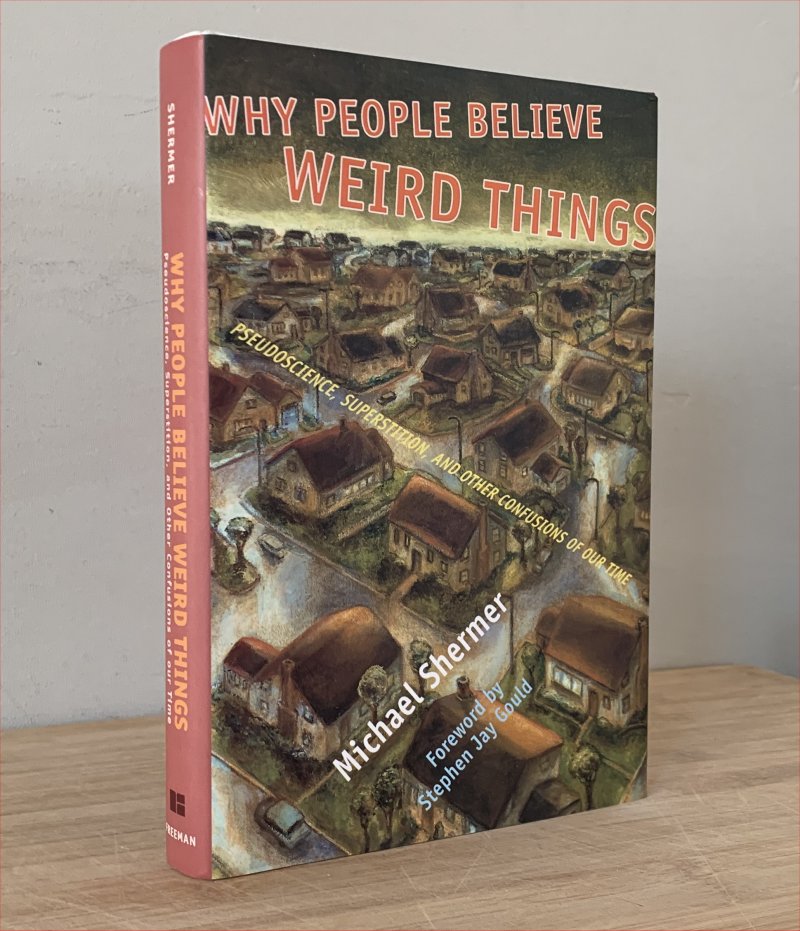
Two items came up today on very similar topics. They both play to my interest in the psychological underpinnings of belief and apprehension of the world. As I’ve alluded, this is one of my major themes (as on my Principles page), and perhaps I haven’t emphasized how recent a development this is. None of this was generally realized two decades ago. Yes, I knew about logical and rhetorical fallacies from way back (e.g. http://www.markrkelly.com/Blog/2013/09/12/the-one-book-id-have-every-college-student-read/), and there was a taste of psychological issues in Shermer’s 1997 book, but it wasn’t until Jesse Bering’s 2011 book, then especially the 2011 and 2013 books by David McRaney, and then Jonathan Haidt’s foundational 2012 book (though I didn’t read it until 2015), that I began to appreciate how forcefully human psychology overrides logic and evidence (in favor of group cohesion, alliance with friends and family, mostly). If physics explains chemistry, and chemistry explains biology, well… psychology overrides them all, in terms of what humans think they know about the world.

In the latest issue of The Week (a terrific magazine that gathers news and opinions from across the political spectrum; its website is only OK), dated July 10/July 17, the “editor’s letter” on the table of contents, focuses on a review in the issue of a book by Maria Konnikova (https://en.wikipedia.org/wiki/Maria_Konnikova), called THE BIGGEST BLUFF: HOW I LEARNED TO PAY ATTENTION, MASTER MYSELF, AND WIN. She applies her psychological understanding, and uses her discipline, to learn to play expert poker. Here’s the key part of the editorial intro:

One of the great paradoxes of psychology—maybe the great one—is that while being wrong should make us question our assumptions, it regularly has the opposite effect. Presented with signs that we have made a mistake, we very often choose to discard the evidence and dig in on our prior beliefs. So it is that once they’d committed to reopening, governors across the country chose to ignore every early signal that they were wrong and push onward into the cresting wave of a resurgent epidemic. And when what is involved are questions not of just policies but also of values, people retreat even further into their certainties.

There’s obviously more to the US situation than this – because virtually every other country on the planet (except for those led by similar to Trump authoritarian leaders, Brazil and Russia), and human psychology is the same everywhere – have done better at managing the pandemic than the US has.

\\

Next, a big substantial article in The Atlantic, The Role of Cognitive Dissonance in the Pandemic; Subtitled, “The minute we make any decision—I think COVID-19 is serious; no, I’m sure it is a hoax—we begin to justify the wisdom of our choice and find reasons to dismiss the alternative.”

This takes the idea of motivated reasoning — where one finds reasons to dismiss evidence against beliefs one has made on emotional grounds – up a notch, to the idea of cognitive dissonance. How humans are able to make sense, and accept, views that contradict each other. Every scientist, like Francis Collins, who claims religious faith while doing science is doing this.

Opening of the article:

Members of Heaven’s Gate, a religious cult, believed that as the Hale-Bopp comet passed by Earth in 1997, a spaceship would be traveling in its wake—ready to take true believers aboard. Several members of the group bought an expensive, high-powered telescope so that they might get a clearer view of the comet. They quickly brought it back and asked for a refund. When the manager asked why, they complained that the telescope was defective, that it didn’t show the spaceship following the comet. A short time later, believing that they would be rescued once they had shed their “earthly containers” (their bodies), all 39 members killed themselves.

Heaven’s Gate followers had a tragically misguided conviction, but it is an example, albeit extreme, of cognitive dissonance, the motivational mechanism that underlies the reluctance to admit mistakes or accept scientific findings—even when those findings can save our lives. This dynamic is playing out during the pandemic among the many people who refuse to wear masks or practice social distancing. Human beings are deeply unwilling to change their minds. And when the facts clash with their preexisting convictions, some people would sooner jeopardize their health and everyone else’s than accept new information or admit to being wrong.

They discuss how Leon Festinger’s notion of “cognitive dissonance” in 1950 “inspired more than 3,000 experiments that have transformed psychologists’ understanding of how the human mind works.” (Which is how psychology has become a science, far surpassing the intuitive, largely-unverified by experiement, notions of Freud and Jung.)

The essay goes on with examples of reactions to the pandemic. With a final note about how scientists change their minds, because evidence. That’s how science works.

This nasty, mysterious virus will require us all to change our minds as scientists learn more, and we may have to give up some practices and beliefs about it that we now feel sure of. The alternative will be to double down, ignore the error, and wait, as Trump is waiting, for the “miracle” of the virus disappearing.

Posted in Psychology | Comments Off on Links and Comments: Psychology Trumps All?

Skiffy Flix: The Wolf Man

As I’ve said, the basis for these posts, and for my taking the time to watch these rather primitive films from the dawn of the movie era, is to revisit the predecessors of the earliest science fiction films; I have no particular interest in horror films per se. Except for Metropolis (in 1927) and Things to Come (in 1936), there were no true science fiction films, in the modern sense, until 1950. (And my interest in those is how they presumed misunderstandings of how the world, the universe, actually works.) Rather, the 1930s and 1940s were dominated by horror films, beginning with the iconic films about Dracula and Frankenstein.

So yes it’s mostly because the subjects of these films have become iconic. No matter how obscure the original novels were, the films made in the first and second decades of the film industry, about Frankenstein and Dracula and the Wolf Man, have rooted themselves into popular culture. That’s why we see new versions of them every decade or so.

So here we are with The Wolf Man, https://en.wikipedia.org/wiki/The_Wolf_Man_(1941_film), the 1941 film starring Lon Chaney Jr., along with Claude Rains and Ralph Bellamy.

I’d never seen it before. What I knew about was mostly from comments by Harlan Ellison – the famous, firebrand short story and TV writer and anthologist, profoundly influential in the 1960s and 1970s, and who died in 2018 – who spoke of Lon Chaney Jr., and Bela Lugosi, in their famous roles, as if they were some kind of gods. Ellison grew up in the 1940s, and these movies and performances were imprinted on him, in a way I suppose like Star Trek and 2001 imprinted on me, in both cases in our teenage years. He would speak of those actors, those movies, in his appearances, in his essays.

So then, Lon Chaney, Jr.? He’s big, he’s tall, and the word that came to mind to describe him as I watched the beginning of this movie was galoot. Right at home in one of those old American TV series set in the south, e.g. Mayberry R.F.D. Big and dumb and with a dopey grin. The plot of the movie is there on Wikipedia, but let me observe, again, how the mansions these people live in, in these early 1930s and ‘40s films, are improbably large and luxurious. Talbot Castle is in Wales, supposedly, and we see the same kind of charming village as we saw in some of the Frankenstein films. So Larry Talbot returns to his father’s estate in Wales, is attracted to a local shopworker, Gwen. Nearby is a camp of gypsies. What is the premise here? That werewolves, men who transform into wolves “at certain times of the year,” turn others into werewolves by biting them [much like vampires].

And so Larry Talbot (Chaney) is bitten by one of the gypsies (played by Bela Lugosi, because of course), and becomes a werewolf himself.

And the fascination, even redemption, of this film, compared to the other early horror films, is that Talbot is horrified by this transformation and how it affects those around him. Chaney, the galoot, becomes a sympathetic, tragic character; he understands what’s happening to him and tries to overcome it. He seems to die at the end – in an ironic scene that mirrors an earlier scene – and yet Chaney came back to play the Wolf Man in a number of sequels.

The DVD I watched has a long feature about the life of Lon Chaney, Jr.; a bit character, in the shadow of his father’s reputation, until he stuck the audition for this movie, and played the character in all the sequels, and did well in many other films through the 1950s. Sometimes the stories of these actors are just as interesting as the movies they played in.

Posted in Movies, Skiffy Flix | Comments Off on Skiffy Flix: The Wolf Man