(Basic Books, August 2022, 333pp, including 83pp of acknowledgements, appendices, figure credits and data sources, notes, and index)
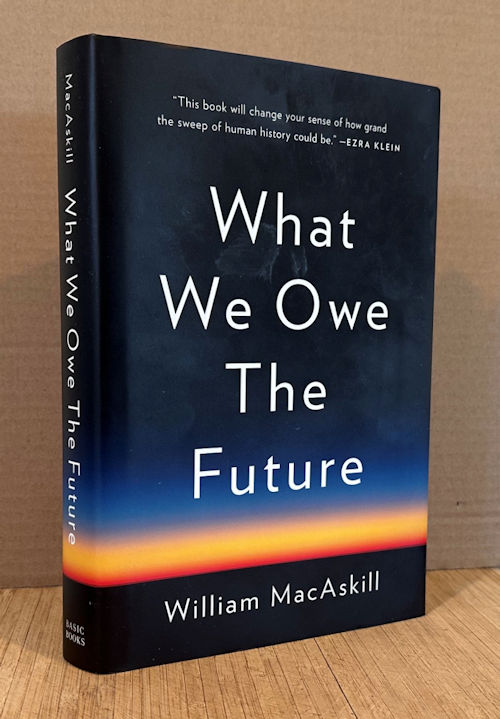
This book, which I read shortly after its publication in 2022, is by a young Oxford philosopher who is at the center of the Effective Altruism movement. The other book on that theme that I read about the same time is LONGPATH by Ari Wallach (review here) which IIRC mentions MacAskill only once, while this MacAskill book doesn’t refer to Wallach at all (while both refer to a core group of other writers, like Nick Bostrom ). Don’t know if that means anything.
I put off writing up this book because struck me as a bit overly earnest. Even tendentious. Almost trying too hard. Actually, I got that impression from the encyclopedic end notes, more from the text, which is straightforward. Set that aside for now.
At the same time I don’t disagree with any of the fundamental perspectives here. Thinking about the future, appreciating the extent of humanity’s past and potential future, looking at the big picture, is what science fiction is all about, and what most people never think about.
I’ll summarize some key points, then discuss the controversy around the book, then do detailed notes, about 5000 words worth.
*
Key Points
- Part I is about the case for Longtermism, the idea of taking into consideration, even prioritizing to some degree, the well-being of future human beings.
- We can do this using EV, expected value theory, to assess the number of past and present human beings against the number of potential future human beings, along with assessing their well-being and happiness. And consider things we can do now to shape the course of future history.
- Part II considers how morals change, e.g. how slavery disappeared rather quickly given the scale of history, and how morel regress can occur. How there are moments of plasticity when circumstances allow such changes; the rise of AI may be one of those moments.
- We need to aim for a ‘long reflection’ about our values before they become locked in. Keep options open; favor political experimentation, i.e. diversity; structure things to guide morally better views and societies. Reason, reflection, empathy. Free migration would be helpful.
- Part III considers threats to civilization (paralleling to a degree the Toby Ord book, which I’ll summarize next here). From extinction (pathogens, or a great-power war), collapse (since civilizations only last a few hundred years anyway, or from climate change or fossil fuel depletion), or stagnation (slowing of technological progress, and how positive trends can’t continue indefinitely, and the risk of locking-in values). Values tend to progress during periods of change, where critical thinking and scientific inquiry are favored; and regress during stagnation, when hierarchy and conformity prevail.
- Part IV concerns meaning, drawing heavily from Derek Parfit, again echoing themes of other books, (e.g. a Todd May book I just read), about making people happy vs ending suffering. Author decides having more happy people makes the world a better place, but considers a variety of options of what that would require. But there’s no agreement on what to do when there’s significant uncertainty.
- Author wonders whether people are getting happier; many say no, even though materially the world is getting richer. Author is optimistic; people usually do good things just because they are good.
- Part V is about taking action. Rules of thumb: take actions we’re confidant are good; expand options; learn more. We choose among problems by their tractability and neglectedness. Keep things in proportion. Donations are good. So are political activism, spreading good ideas, and having children. Make wise choices in your career. (Echoes of the recent Rutger Bregman book here.)
- Finally he considers some objections to longtermism, most along the lines that future people can take care of themselves, or that it’s too demanding.
*
Comments
Some of this strikes me as pointlessly academic — or perhaps simply philosophical, as in May — debating matters over which we have no control. Overall, though, this is a valuable book that, like the best of science fiction, puts everyday human concerns against a broad context, and forces us to think big.
This book was controversial when it came out, for reasons I don’t entirely understand, but which I think had to do with the rather analytical way the author considers the relative value of human beings living today, with relative value of the potentially far greater number who may live in coming centuries, even millennia. He even does that with equations, in one of the appendices, “The SPC Framework,” combining terms for Significance, Persistence, and Contingency, where assigning different values to these terms can lead to counter-intuitive (some would say) results, e.g. prioritize the future people to the point of neglecting people alive today. These equations seemed cold-blooded to some, and they seemed to justify, to some, elaborate investment schemes that would pay off big for future beneficiaries, but which were dicey for current investors. And somehow Samuel Bankman-Fried was one of these guys who took great liberties with such investments and got put away for his troubles.
But his over-zealousness does not invalidate the concern we, as a species, should take for our long-term survival.
*
Detailed Summary Notes
Part I. The Long View
Introduction
Imagine living the lives of everyone who’s ever lived—they would amount to four trillion years in total. Then imagine all future lives, too. Even if the species lasts only a million years. What would you do in the present to make their lives better? Morality is about putting ourselves in other people’s shoes and treating their interests as our own.
Longtermism is the idea that positively influencing the longterm future is a key moral priority of our time. P4b. Understanding that we will be the ancients to most of humanity. So we need to act wisely now. Author was originally skeptical of the idea, but gradually came around. He co-founded two organisations. 6m.
Three primary metaphors. 1) humanity as an imprudent teenager. 2) history as molten glass. 3) a risky expedition into uncharted terrain. This book is about promoting longtermism, and working out its implications. Many consultants and assistants.
Ch1, The Case for Longtermism, p9
The silent billions. Future people count, and there could be a lot of them.
Future people count, p10. Examples of present day actions that will affect future people, some trivial. We build memorials for future people. We care about climate change, etc. Examples of past policies. How much weight do we give future people’s interests? Consider partiality, and reciprocity.
The future is big, p12. Suppose genus Homo have been around for 2.5 my. Our species, for 300,000. See timeline 12b. And 13t. Suppose we have 1 million years for our species to exist. Out of 500my of earth being habitable. How many people will be alive at any one time? Could be much bigger. Especially if we take to the stars. Diagram p15-19 showing one human-shaped icon for every 10 billion people, and spreading over parts of 6 pages.
The value of the future, p19. The future could be very good, or very bad. Consider past and present lifespans. A rich British man in 1700. Technology and morality have changed. Yet negative trends could return.
Not just climate change, p21. Yet what can an individual do? Poets provide a clue. Their words have endured. Thucydides. The US Constitution. Its ideas go back thousands of years. Now we have the impacts of climate change. Premature deaths. Decarbonization is a proof concept for longtermism.
Our moment in history, p26. We live in an unusual time—look at growth of GDP, 26b. This is unlikely to continue forever. Also, we’re unusually connected, compared to the past; everyone can easily be in touch with everyone else. That might change if we spread to the stars. … That our time is so unusual gives us an outsized opportunity to make a difference. Our connectedness allows new ideas to spread rapidly.
Ch2, You Can shape the Course of History, p29
Why are there still many species of megafauna in Africa? Elsewhere around the world many went extinct some 12,000 years ago. Mostly because humans hunted them down. In Africa they had all evolved together. Humans made other decisions with longterm consequences, such as burning forests for croplands. Of course they didn’t know what they were doing. We can do better. How do we do that?
A Framework for thinking about the future, p31. Think about significance, persistence, and contingency. The average value; how long it lasts; and noninevitability. Details p33b. Consider how they apply to the imprudent teenager. Author’s own life. In general, two ways to improve the future are to ensure survival, and change trajectory. Thus Part II deals with values changes and persistence; Part III about ensuring survival. (summary 36t). Part IV concerns the balance of priorities. Part V turns to action.
Thinking in bets, p36. How to make decisions in the face of uncertainty is the idea of expected value theory. EV. Details p37. Involves probabilities; assigning values to outcomes; and measuring how good or bad something is. Example of inaction on climate change p39.
[[ So far this sounds similar to risk assessment. Much of this so far is very plain, even dull. What upset the critics about this book so much? Speculation on virtual people? ]]
Moments of plasticity, p40. We need to be aware of periods of plasticity, when things are easily changed, before they become set. Examples of Korea, controlling nuclear warheads. New Testament, not fixed until the 4th century. And climate change activism. A Frank Capra movie; we’ve known about the danger for decades. We missed that period of plasticity; but maybe not for AI. “Early plasticity, later rigidity.” Perhaps true of values as well.
Part II: Trajectory Changes
Ch3, Moral Change, p47
Abolition. About slavery, which was everywhere until early 19th century with an abolitionist movement in Britain. Why then? Example of one Benjamin Lay, born 1682, who became opposed to slavery as a sailor. He exhorted the Quakers to take action against the slave trade. … eventually Britain abolished slavery in 1807. An example of how values change, across a society.
The Significance of Values, p53. Consider the status of women. Still vary widely across countries. Similarly LGBTQ+ people. Corporal punishment. Immigration. Treatment of animals. Better to promote the goal rather than just the means to it. Example of ScotsCare, concerning Scots in London.
The Contingency of Values, p55. We need to take into account whether some change to values would have happened anyway. Was abolition inevitable? Time scale is important. There’s a chance that dominant values get ‘locked in’ and persist for a long time. Compare biology. Evolutionary contingency. Gould. If rerun, results would be quite different. E.g. niches formed by continental drift. While some traits evolve independently. So evolution can be both. Thus there’s a 3D ‘fitness landscape’ p57. These ideas apply to evolution of cultures as well. Especially values, e.g. norms that favor caring for children. Proselytizing religions. There can be different ways to accomplish certain goals, e.g. advertising wealth, or showing moral integrity. Some of these entrench themselves. Religious purges; Hitler, Stalin, Pol Pot. Some of these last a long time by suppressing competition. In other areas there are correlations between values, e.g. women in the workforce v GDP, p61. Other examples.
The Contingency of Abolition, p62. Did such factors affect slavery too? Maybe abolition wasn’t inevitable after all. Was it due to economic changes or moral attitudes? The economic argument hasn’t held up. Author concludes it was a moral issue. So why did those happen? Note how easily moral regress can occur, with Nazism and Stalinism. Examples of how serfdom and slavery have waxed and waned in various cultures. There are inconsistencies between moral views in many countries. Conscription; the death penalty. Penal labor. Consensus seems to be abolition was contingent on many misc factors.
What to Do, p70. So we can imagine many ways in which moral beliefs might have been different, depending on where certain developments arose. Counterfactuals. So which moral values should we promote? Author suggests we focus on promoting more abstract or general moral principles (like the golden rules). And how? Remember inspiring examples. Author’s example of Benjamin Lay; animal rights. And how long can we expect improved moral norms to last?
Ch4, Value Lock-In, p75
Background about China, 6th century BC, the ‘Hundred Schools of Thought’ and famous philosophers like Confucius, who advocated self-cultivation and moral refinement. In contrast were the Legalists, who focused on punishment for wrong-doing. And Daoism, more spontaneous and noncoercive. Then the Mohists, now mostly forgotten, who advocated policies to promote the most benefit for all people. They were consequentialists, like Mill and Bentham much later.
The era came to an end in 221 BC when Qin conquered all of China, Legalist, purging all others, but lasting only 15 years. Then the Han dynasty. Eventually Confucianism emerged and became the philosophy of the Han empire. For a thousand years it was taught to all educated persons in China. It lost its position in 1912, in favor of economic development. Its influence remains.
The Persistence of Values, p78. Thus the Bible, Quran, and Confucius’ Analects remain bestselling books. What causes such value systems to persist for so long? Anything locked in this century or next might last indefinitely…
We know changing technology allows values to persist—i.e. with writing. We are now living in a period of plasticity. Until some technology comes along to lock something in. AI is key. Why?
Artificial General Intelligence, p80. Examples are DeepMind’s AlphaGo in 2016. Others recognizing speech, images, etc; searching, voice recognition. More examples. The goal is an artificial general intelligence, AGI, not a device that can do only a single thing. These could greatly stimulate the economy. Or automate technological innovation. E.g. the protein folding problem. This could continue to increase the rate of growth. AGI would be monumental also because AGI are potentially immortal. Information, software, is easily replicated.
P83, AI and Entrenchment. Thus AGI enables values to be locked-in indefinitely. They might even emulate human brains. Lock-in has been a goal throughout history. Including methods of removing competition. And cultures that seek lock-in last longer than those that don’t. Immortality has always been desired; or any kind of life extension. Soviets; North Korea. And tech CEOs. Then there’s cryogenics. Or digital uploads. With such common desires, AGI could allow them to become reality.
On the other hand, AGI systems might take control. Nick Bostrom’s book Superintelligence focuses on the idea of a human stand-in for an AGI, having different goals than humans, to the point where humans might be eliminated. The ‘alignment’ problem is to be sure AIs do what humans want them to do. Strictly speaking the risk from AIs is not an extinction risk. In analogy with being colonized… An AI civilization might well retain much from human civilization. In either case a set of values might be locked in indefinitely. Which values do we want them to be?
P89, How long till AGI? This likely won’t take millions of years; humans always underestimate how fast the future will unfold. Note Haldane. See figure 4.1 comparing actual with projections for solar panels. So AGI could appear in 50, or 20 years. (Discussion of studies about computing power, etc.)
P92, Culture and Lock-in. Whenever it might be, there would be a lock-down of then current values. Cultural conquest is common, thus Christianity and Catholicism persist around the world. Values shift and converge due to conquest, to immigration, perhaps in ability to survive in novel environments, e.g. space colonization. And via population growth (as with Christianity). Given trends it’s unlikely atheism will increase. Atheists have fewer children, and vv. India and Nigeria. Other values, like gay rights, meditation, might shift the valueset.
P95, How Locked-In Are We Already? Which values might remain unchanged in the future? As Homo sapiens locked out the other Homo species. A second point is that colonization brought the world together, so a single ideology might have global reach. Such as Western European culture. Consider the range of responses to the Covid pandemic. Relatively similar around the world. Risky strategies that might have brought vaccines to market earlier weren’t tried by any country.
P97, Building a Morally Exploratory World. Worst case scenarios are e.g. Orwell and Burdekin. But it would be a mistake to lock in, now, what we think is right even to prevent such a dystopia. Compare today to Western values of 2 ½ centuries ago. Values change; each generation thinks its values are the best. So it’s unlikely *ours* are the best. We know there are things we haven’t figured out yet. And there are issues we haven’t even thought of yet.
We need to make as much moral progress as possible before any lock-in. Ideally we aim for the ‘long reflection’. Take the time to make decisions that might be locked in for billions of years. This seems unlikely. Rather we need a world structured to allow morally better options to win out.
First, keep our options open. Second, favor political experimentalism, i.e. diversity. Mill’s marketplace of ideas. E.g. the diversity of American society. Charter cities, 100t. Shenzhen. Third, structure things to guide morally better views and societies (as opposed to, say, the GDP). Reason, reflection, and empathy. Free speech. Techniques for duping people should be discouraged, 101t. Free migration would be helpful; voting with feet. With perhaps norms to prevent any single country from being too populous.
The paradox: we need to lock in some institutions and ideas in order to avoid complete lock-in of values. Religious fundamentalists would object. It’s analogous to tolerance in general—don’t tolerate intolerance. We just have to live with such paradoxes.
Smry. 102.
[[ This actually keys into Shermer’s Moral Arc; does his definition of moral progress allow speculation into possible future issues? The answer must be to avoid lock-in and guarantee flexibility. ]]
Part III: Safeguarding Civilisation
Ch5, Extinction, p105
Author quotes first page of Clarke’s Rama. Then cites the comet hitting Jupiter in 1994. Then the two movies in 1998. And a real Spaceguard funded in 1998.
This chapter is about avoiding near-term extinction. Not just from asteroids. [[ And this section aligns with Toby Ord’s book ]]
P107, Engineered Pathogens. Covid has been bad enough; engineered pathogens could be far worse. They’re difficult now, but it’s only a matter of time. And security is shockingly low. Outbreaks in the UK. Soviet Union. Smallpox, most recently in 1978.
And some countries have had bioweapons programs. In secret. Japan. Al-Qaeda. The risk of an accidental or deliberate pandemic cannot be ruled out; perhaps 1%, or 3%, by the end of the century.
P114, Great-Power War. Fortunately, perhaps, there have been no wars between the great powers since the end of WWII. The “Long Peace.” (Pinker’s term.) But now Russia is invading Ukraine. And there have been close calls. We can’t count on this peace indefinitely.
P117, Would a technologically capable species re-evolve? Could another species take our place, e.g. the chimps? Or other mammals? It’s too easy to think so; we can’t anticipate the pace of evolutionary change. Unlikely. Consider the Fermi paradox. And how long it took Homo sapiens to evolve. There seem to be between three and nine ‘hard steps’ on the evolutionary path to advanced life. Thus the extreme rarity of our kind of life brings the responsibility to maintain it. Another risk is that civilization simply collapses and never recovers.
Ch6, Collapse, p121
In AD 100 half the world’s population lived in the Han dynasty or the Roman empire. Rome was the pinnacle of civilization, for good reasons. It was at war most of the time. It didn’t last; it peaked by 200 AD and then collapsed. The Visigoths and the Vandals. There were many reasons the empire fell, 123.6. Most civilizations last only a few hundred years. How likely is such a collapse today? And would we recover?
P124, The historical resilience of global civilization. After Rome standards of living fell, especially in England. Hundreds of years later came the Renaissance etc, and the scientific revolution out of the fragmentation of Europe. The fall of Rome did not affect other civilizations of the time. Even in the 20th century, the world wars did not significantly reduce the economy, or the population. Only in the 17th century did something like that happen, 125m. another example of resilience is the Black Death in the 14th century. In the long run Europe recovered. Other examples: Hiroshima. Other cities. Vietnam. Bosnia. Cuba after the fall of the Soviet Union.
P127, Would we recover from extreme catastrophes? Still, with potential nuclear war and bioweapons, future catastrophes could be far worse. In a nuclear war, hundreds of millions would be killed directly. Nuclear winter might follow. Suppose 99% of the population dies. Would civilization recover? Well, probably. Much infrastructure and knowledge would be preserved. Survivors would retain some knowledge. Impact on the Southern Hemisphere would be limited. [[ This was true in ON THE BEACH. ]] Island nations might avoid effects of bioweapons. Australia and New Zealand.
Second, if we lost agriculture, would we ever get it back? We’d still have the domesticated varieties of plants already developed. The climate would likely still be in place. How about industry? It came only 13000 years after agriculture, not a long time in context. And we’d have remains of the old to guide us.
P134, Climate Change. We can be optimistic because steps are being taken to fight it. More activism, progress on renewable energy sources. Lowering costs of solar panels. But we can’t be complacent. Worst-case scenario would lead to some 7 degrees of warming. Agriculture would migrate. Possible feedback effects. Things might be bad, and might be for tens of thousands of years.
P138, Fossil Fuel Depletion. If we burn them all up we may be unable to conduct another industrial revolution. (Ref here Dartnell, The Knowledge.) Perhaps with solar and wind. With difficulty. Charcoal perhaps, pyrolyzed wood. Would needs lots of wood. Difficult to do without fossil fuels. How much do we have left? Much of the easily accessed coal is gone. What’s left will last only a couple hundred more years. It might help recover civilization once, but not a second time. Author guesses we will phase out burning fossil fuels this century.
P142, Conclusion. So, a probability of 1% seems reasonable.
Ch7, Stagnation, p143
Efflorescences. The 11th century was the Islamic Golden Age. It didn’t last. An example of an ‘efflorescence,’ a short-lived period of advancement. Ancient Greece. What if our age is another? Suppose we’d plateaued with 1920s technology. We would have run out of coal; it was unsustainable. Remain at any unsustainable world and it’s bound to end eventually.
P145, Is technological progress slowing down? Perhaps. We measure progress by looking at inputs, and outputs from given inputs. Data shows the growth rate of productivity has been declining. Perhaps also qualitatively. Consider the change from 1870 to 1920, then from 1920 to 1970. Enormous differences both times. Then to 2020. Not that much difference. So has the pace of change slowed? See chart p148. Slowing this growth could harm future generations. OTOH, exponential growth can’t go on forever. Growth has to plateau eventually. Sooner or later may not matter. It’s stagnation we must avoid.
P150, How Likely Is Stagnation? There’s an entire range of possibilities. Perhaps as technological progress picks off the low-hanging fruit, it slows. OTOH past discoveries might make future ones easier. Recall miracle year 1905; Einstein’s work then, to expensive colliders today. A study found that ideas are getting harder to find. Double the amount of research, e.g. Still, there are many more scientists now than decades ago. This is done by increasing the proportion of the population, or increasing the entire population. There’s a positive feedback loop between population expansion and new tools and technology. But such trends can’t continue indefinitely. Fertility rates are falling, p154. World population will eventually decline. What could governments do? Increase funding? Increase fertility? Perhaps AGI would replace researchers. But it could be very hard; or it might be restricted, like human cloning is.
P156, How Long Would Stagnation Last? It seems unlikely it would be indefinite. It only takes one instance to get rebooted. Look at European history. It would only take one society, changing a bit, to grow over time and become dominant. Still, stagnation might last centuries or millennia. A single global culture is a risk; recall the need for diversity. Population decline might contribute to stagnation. Especially in any global catastrophe.
P159, Stagnation from a Longtermist Perspective. How bad would it be? Stagnation would lock-in values for a while, perhaps. Values tend to progress during periods of change, regress during stagnation. The former favor critical thinking and scientific inquiry; the latter hierarchy and conformity. But other values than those might break us out of stagnation. … We know we’re in an unsustainable state now; we can’t stagnate here.
Smry 163
[[ this entire section seems academic. So what? Eventually a stagnation will end. ]]
Part IV: Assessing the End of the World
Ch8, Is It Good to Make Happy People?, p167
About Derek Parfit, a brilliant, obsessed philosopher. Obsessed with avoiding suffering. Died in 2017. In particular population ethics, considering actions that could change how many people are born and what their quality of life would be. 1984, Reasons and Persons. Extinction is bad because of all the people who would never live at all. Trillions of people. Author greatly influenced by this thinking. Will discuss the idea, with caveats, that having more happy people makes the world a better place. These are abstract, graduate level ideas. Will discuss happiness or wellbeing on a 100 to -100 scale. Without defining those terms. Also, are there people living below neutral wellbeing who would be better for never having been born? Not quite the same as not worth living. And the discussion will consider all people across all time.
P171, The Intuition of Neutrality. This notion seems counter-intuitive. It’s similar to thinking about whether or not to have a child. It’s easy to see that to have a child whose life would be miserable would be bad. So is there an asymmetry? Then the intuition is wrong.
P173, Clumsy Gods: The Fragility of Identity. A second argument, from Parfit, comes from the exceptionally unlikely chance of our existence in the world. Example Back to the Future. A different person could easily have been born aside from you. Every small action we make has effects on the future. Changing a policy means that different people will be born in the future.
P176, Why the Intuition of Neutrality is Wrong. Example of couple deciding to have a child, if the child would have periodic migraines their entire life. It seems obvious that it would be better to have a child with no migraines. Considering those options compared to having no child leads to a contradiction. So what theory of population ethics should we have?
P177, The Average View. This is the idea that the average happiness of a population is what matters. Philosophers agree this is wrong. The average is no guide if everyone is miserable. The ‘Hell Three’ argument.
P179, The Total View. This is that one population is better than another if it contains more total wellbeing. But this would mean that a lot of mildly happy people are better than a few very happy people. Parfit called this the Repugnant Conclusion. Not everyone agrees. But there are three premises that everyone agrees on. One, making everyone better off is a good thing. Two, the non-anti-egalitarianism premise. Third, the rules of transitivity. See figures pp181-183. But these imply the Repugnant Conclusion. … Continue this line of thought until you have a huge world of mildly happy people. So either reject one of the premises, or decide the conclusion isn’t so bad. Another alternative is the…
P185, The Critical Level View. It’s good to bring into existence a life only if it’s ‘sufficiently’ good, above some critical level of wellbeing. But this leads to another counterintuitive conclusion. A Sadistic Conclusion.
P186, What you ought to do when you don’t know what to do. This is no agreement among philosophers about these matters. How do we act given uncertainty? We take the action with the highest expected value.
P187, The Benefits of having kids. Author thinks it a mistake to not have kids because of, say, climate change. Kids can have positive effects too.
P188, Bigger is better. The main conclusion of population ethics is that it’s a loss if future people are prevented from coming into existence. Similarly, we should hope that future civilization will be big. This is a moral case for space settlements. If not right now. The priority is to prevent catastrophes that face us this century.
[[ Comment as I read the book: this all seems pointlessly academic, arguing about nonexistent people, about whom you have no control… ]]
Ch9, Will the Future Be Good or Bad?, p191
Reflect on the thought experiment from the opening of the book. Suppose you lived the lives of all sentient creatures. … Do we think it good if civilization continues into the distant future? There are optimists and pessimists. Some think it better if there were no more people at all, 192b. Parfit was optimistic. Even about ‘supra-humans.’
P193, How many people have positive wellbeing? People alive now. How can we tell? We have to rely on self-reports. We need to understand what well-being is. It could be one, your life is going as you wanted; two, hedonism, positive experiences; three, an ‘objective list’ view of everything that is good for you. There are surveys of life satisfaction that suggest a neutral point of 1 or 2. Others ask about happiness. Most people say they are, even in poor countries. Experience sampling asked if people would skip to the end of whatever they were doing. On average people would skip 40% of their day. Author commissioned his surveys about aspects of happiness. Some would re-live their lives, others would not. But positive responses were more common. See table p200. Overall, author estimates some 10% of global population lives with below-neutral well-being. Now we can ask,
P201, Are People Getting Happier? The common view is that people are no happier now even though the world is getting richer; happiness is relative. Easterlin’s paradox. More recent work shows this to be false. Happiness does increase with wealth, chart 202b. Despite select anecdotes, lottery winners are happier. Income and life expectancy have improved over time. Hunter-gatherers were actually happier than people after the agricultural revolution. Though life expectancy was lower. …
P208, Nonhuman animals. What about farmed animals? Obviously they suffer; billions are raised and killed for food every year. Details. Even fish. Consider the number of neurons animals have, and how many animals there are; table p211. And of course animals in the wild experience pain. Overall, do they have good lives? Trends are negative, especially for farmed animals. Even as our attitudes have shifted about farming conditions.
P214, Non-wellbeing Goods. Some philosophers disagree that the wellbeing of sentient creatures is all that counts. Some argue for natural or artistic beauty. Or democracy, equality, spread of knowledge. For the natural world, the trend is negative; we keep cutting down forests. For knowledge and achievements, the trend is positive.
P215, The Case for Optimism. Author considers ‘eutopia’ and ‘anti-eutopia’. Author figures the badness of the worst possible world is greater than the goodness of the best. Quotes Russell and Dostoevsky. How likely is either? People usually do good things just because they are good, and not vv. The exceptions are sadism. Mao, Hitler. Others, 219.3. Overall the expected value of the future is positive.
Part V: Taking Action
Ch10, What To Do, p223
In English, the past is behind us and the future in front. As in most languages. But there are exceptions.
Author has changed his mind on some things while writing this book. There is much disagreement among experts about things like AI. And there are things we haven’t thought of yet. Rumsfeld quote. Actually an important point. A third issue is that it can be difficult to bring about particular outcomes.
We can employ three rules of thumb. Take actions we can be confidant are good; increase the options open to us; try to learn more. We can use these lessons to choose which options to pursue.
P227, Which Priorities Should You Focus On? Reminders of threats: lock-in of bad values; end of civilization one way or another. We can take actions for some of these. And measure the results for some. For others, we prepare. For others, build up options and learn more. For AI; for avoiding great-power war. Which problems are the most pressing? Consider tractability, and neglectedness.
P231, How to Act. Having chosen a problem, then what? Keep things in proportion. Recycling plastic bags will do very little, compared to reducing airline flights. Or becoming a vegetarian. Better to donate to certain organizations, 232. For many problems changes in personal consumption aren’t possible. So donations are a way of doing enormous good.
Three other things to do: political activism; spreading good ideas; having children. Voting. Even if individual votes may not make much difference, given potential huge payoffs. And be an informed voter. Talk to friends and family about important ideas. And consider having children.
P234, Career Choice. Author co-founded an org called 80,000 Hours (the number of hours in a career of 40 years). So it’s important to make a wise choice. Apply the three lessons: learn more, build options, do good. Learning might entail changing jobs for the first few years of their careers. Examples. Doing good involves doing something important, depending on your personal fit. [[ This roughly echoes the latest Bregman book. ]]
P240, Doing Good Collectively. Be careful not to do harm while thinking you’re doing good. Examples. Example of the EA community itself.
P243, Building a Movement. Or go ‘meta’ and spread the idea of longtermism itself. Though ideas can take a long time to take hold, e.g. abolishment of slavery and women’s rights. Recent history suggests these ideas are already taking hold. But there are enormous challenges, 244b.
Starting with you. Everyday people can make a difference; look at history. If not now, when?
\
Final comment:
In a way this is a nonfiction consideration of how long the human race might last, considering various factors that would affect that, recommending that it be for as long as possible, and drawing conclusions about what should be done now. I don’t see any nefarious statements along the lines of “let the poor starve they don’t matter in the long run” as some seem to have accused him of advocating. In fact, isn’t such criticism equivalent to complaints about going to the moon when problems down on Earth haven’t been fixed yet?