Links and Comments: Sapiens; Leaving Religion; Conspiracy Theories; Weather Forecasting

1. From yesterday’s NYT Book Review.

Chuck Klosterman likes Harari: https://www.nytimes.com/2019/07/18/books/review/chuck-klosterman-likes-writers-who-arent-self-absorbed-sociopaths.html

What’s the last great book you read?

I picked up “Sapiens: A Brief History of Humankind,” by Yuval Noah Harari. I thought: “This will probably be O.K. I’ll probably learn a few things about Neanderthals and wheat.” But it ended up being the best reading experience I’ve had in at least 10 years. Harari writes about complicated things with unbelievable clarity, and I don’t think I’ve ever experienced a book where the author so often makes bold, original arguments that (somehow) immediately seem self-evident. It was so good that I started looking for any other book that seemed vaguely similar, most notably “Guns, Germs, and Steel,” by Jared Diamond. Diamond’s book won the Pulitzer in 1998 and is (probably) a little more respected, simply because it’s more rigorous and the style is more academic. And while that book is also undeniably excellent, I still liked “Sapiens” more. This is partially because Harari had the benefit of Diamond’s pre-existing work, but mostly because of the overall presentation. “Guns, Germs, and Steel” is a book that says, “Here are things that happened, and here’s why they happened the way that they did.” “Sapiens” is a book that says, “Here are things that happened, here’s why they happened, and here’s what that says about the experience of being human in the modern age.”

2. A review by C. E. Morgan: https://www.nytimes.com/2019/07/01/books/review/leaving-the-witness-amber-scorah.html

LEAVING THE WITNESS
Exiting a Religion and Finding a Life
By Amber Scorah

Though religious fundamentalism has surged globally in recent decades, the anti-intellectualism of these authoritarian movements, their staunch refusal to cede ground to reason and empiricism, often confounds nonbelievers. How can people devote the totality of their lives to the unseen, the unevidenced? How can faith subsume thinking?

But reason is a poor weapon against the believer whose very religious identity springs from an embrace of the unreasonable. Many fundamentalists are conscious of the seeming absurdity of their position, but it is precisely the stridency of their faith, their ability to withstand the irrational, that confirms for them their exceptionalism and salvation. They reject modernity’s demystification project and instead construct meaning in the supernatural. Their faith becomes very thick armor indeed, one that even the sharpest Enlightenment rationalism won’t penetrate.

But the stunted psychology of those raised in extreme religion is another problem altogether. For these children, there is no obvious forfeiture of common sense or flight from existential chaos that informs adult conversion. Rather, they experience a totalizing indoctrination that so severely limits the formation of an adult psychology that many don’t ever achieve maturity in the way secular society conceives of it, a state of empowered capability that permits complex life choices, a state in which contradictory ideas can be held in tension without psychic recoil. Instead, the fundamentalist child, raised on fear and limitation, lives a life of diminished options, constrained by strict dualisms: black and white, good and bad, God and Satan, and (perhaps most alarmingly for the broader culture) us and them.

The reviewer, curiously, teaches at Harvard Divinity School.

3. The New Yorker: Elizabeth Kolbert on conspiracy theories: https://www.newyorker.com/magazine/2019/04/22/whats-new-about-conspiracy-theories

America has always had a weakness for paranoid fantasies. … Russell Muirhead and Nancy L. Rosenblum are professors of government at, respectively, Dartmouth and Harvard. A few years ago, they found themselves, in their words, “startled into thought.” Yes, they knew, crazy ideas were a fixture of American life. But not this crazy. “The subject required more detailed and thoughtful interpretation,” the two write at the beginning of “A Lot of People Are Saying: The New Conspiracism and the Assault on Democracy.”

“Classic” conspiracy theories, according to Muirhead and Rosenblum, arise in response to real events—the assassination of John F. Kennedy, say, or the terrorist attacks of September 11th. Such theories, they argue, constitute a form of explanation, however inaccurate they may be. What sets theories like QAnon apart is a lack of interest in explanation. Indeed, as with the nonexistent child-trafficking ring being run out of the nonexistent basement, “there is often nothing to explain.” The professors observe, “The new conspiracism sometimes seems to arise out of thin air.”

The constituency, too, has shifted. Historically, Muirhead and Rosenblum maintain, it’s been out-of-power groups that have been drawn to tales of secret plots. Today, it’s those in power who insist the game is rigged, and no one more insistently than the so-called leader of the free world.

Personal comments: It occurred to me recently that the appeal of conspiracy theories is among those who find ordinary explanations for things unconvincing. There must be something more; life can’t be just about coincidence. And it’s analogous to the appeal of creationism. How can natural forces result in all this complex natural world, in *us*? That it was all ‘created’ by some magical being is a kind of conspiracy theory: a simple-minded but unlikely explanation for something that has a natural explanation.

Another thought about conspiracy theories, from a couple comments I’ve read somewhere: No one who has worked in Washington DC, or who has been a project manager, can possibly believe in conspiracy theories. On the latter point, how often has a team of 30 or 3000 designers and engineers ever coordinated a project and gotten everything done on time and on budget? It never happens. It would have to have happened for any of those conspiracies theories about faking the moon landing or hiding evidence of alien visitors to be true.

4. Among the many ways life is better now than it was decades or centuries ago – despite the MAGA cultists – is how good weather forecasting has gotten. Hannah Fry in The New Yorker: https://www.newyorker.com/magazine/2019/07/01/why-weather-forecasting-keeps-getting-better.

In our world, weather forecasts are so ubiquitous that we treat them as notable only when wrong. It’s easy to forget what a crucial role they play, and to overlook the monumental achievement they represent. But Andrew Blum’s new book, “The Weather Machine” (Ecco), asks us to pause and marvel at the globe-spanning networks of collaboration required to turn the weather from something we experience to something we can predict.

The supercomputers have brought improved accuracy, too. In 2015, the E.C.M.W.F.’s six-day forecast was as good as its three-day forecast was in 1975. In 2012, its computers correctly foresaw Hurricane Sandy at least six days in advance. By 2025, they are expected to be able to detect high-impact events two weeks into the future.

The E.C.M.W.F.’s American cousin, run by the National Weather Service, tends to be a little less accurate a little more often. (Notably, it had Hurricane Sandy turning out to sea until just four days before it made landfall.) The two systems differ in the way they take observations into account, and there is no shortage of people who are vehement proponents of one model over the other. But both, of course, have their shortcomings: anyone who has ever been caught short without an umbrella won’t need to be told that even an “accurate” prediction isn’t the same as a perfect one.

It’s easy to forget that behind each prediction is one of humankind’s greatest accomplishments—something that requires armies of people all over the globe collecting and sharing data, exquisite mathematical modelling, and staggering computer power. The weather doesn’t respect political or geographic boundaries: we’re all living under the same sky. And so weather prediction has been a marvel not only of technology but also of international coöperation. As we enter an era of more storms and greater uncertainty than we’ve ever experienced, let’s hope it stays that way.

E.C.M.W.F. is the European Centre for Medium-Range Weather Forecasts. These are the European and American models that Al Roker frequently mentions.
Posted in Human Progress, Psychology, Religion, Technology | Comments Off on Links and Comments: Sapiens; Leaving Religion; Conspiracy Theories; Weather Forecasting

Apollo 11

Like most others of my generation, I remember watching the Apollo 11 moon landing in grainy footage on a black & white TV in July 1969. I was not quite 14, and was living with my family in Glen Ellyn, Illinois, where we gathered around that TV set, and heard Neil Armstrong’s famous words.

I grew up with continuous news of the growing space program; the Mercury missions, the Gemini missions. There was a certain inevitability, perhaps the flavor of a manifest destiny, about the exploration of space and the expansion of mankind into the planets and the universe.

At the same time, on TV, there were early Twilight Zone episodes, like the very first, that presumed the inevitability of launches into space, Then, proceeding from the ridiculous to the sublime, there was Lost in Space, that assumed the need for colonizing other planets; and there was Star Trek, that showed the exploration of space far advanced, by a multi-cultural, multi-species, egalitarian society. And there was Kubrick’s film 2001: A Space Odyssey, just a year before Apollo 11, that depicted a grandiose space station and moon base.

So the success of Apollo 11 was gratifying, but not especially surprising. It was just the next step, in a long series expected to continue.

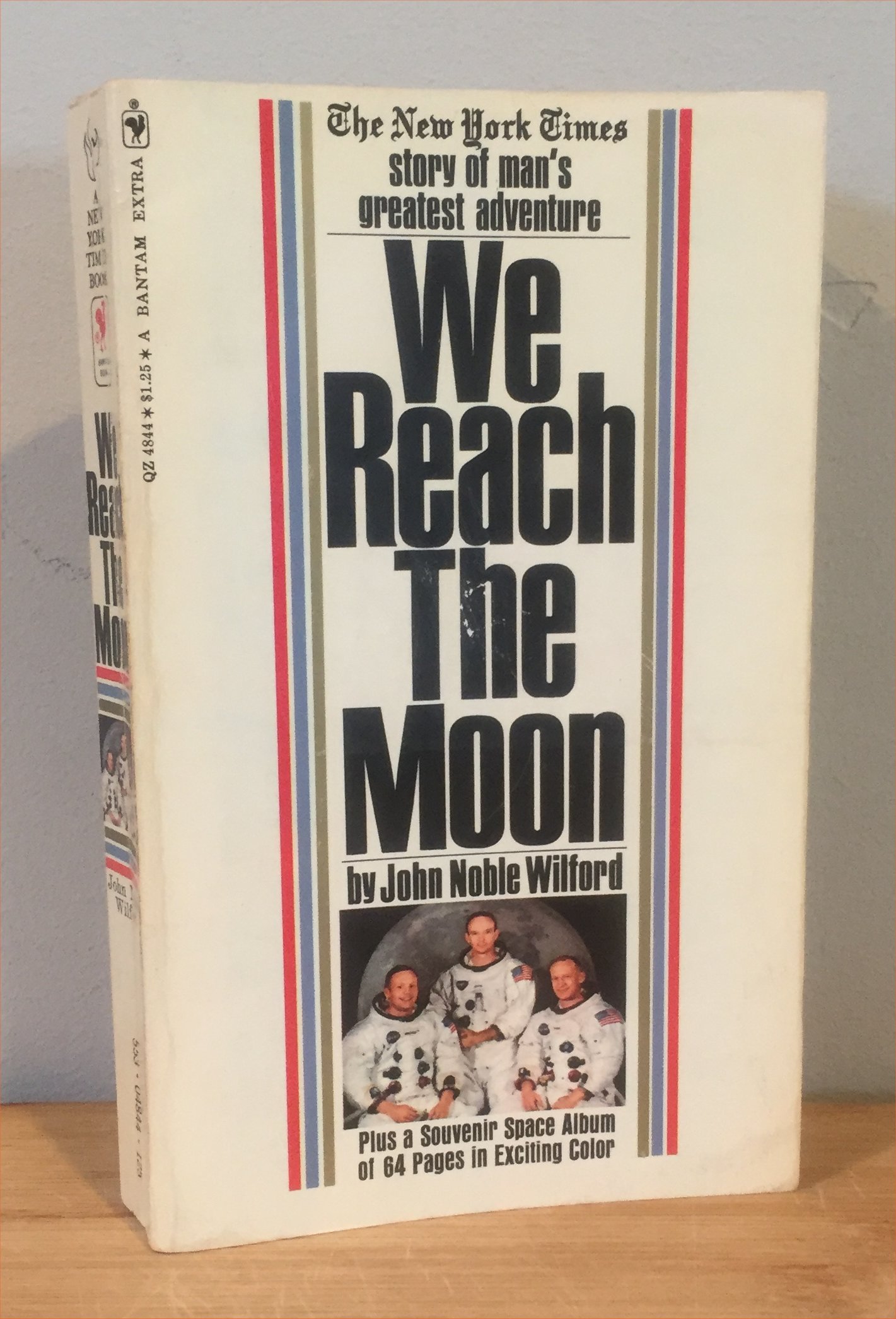
I have other distinct memories of July 1969. Just a week or two after the Apollo 11 landing, my family took a road trip east, from where we lived near Chicago. We drove through Smokey Mountains National Park. And then we stayed with a cousin of my mother’s and her family just outside Washington DC. We visited Dulles Airport, because my father was an architect and admired its design and wanted to see it. There, on a paperback rack, I bought a book called WE REACH THE MOON, by John Noble Wilford. It was what came to be called an ‘instant book,’ one written and published very quickly after the event it covered. (Just 72 hours after the event, the book claims; so obviously it was mostly written in advance, assuming the mission’s success.) It detailed the history of space flight until then, with 64 pages of color photos and appendices of past missions and transcripts of the Apollo 11 flight. Wilford still writes for the New York Times, so he must have been very young when he published that book. (I also recall, visiting those cousins, explaining 2001 to them, having both seen the movie and read the book. I’m not sure I succeeded.)

In later years I spent most of my career working for Rocketdyne, a rocket engine factory in the San Fernando Valley area of Los Angeles, supporting for many of those years first the Space Shuttle Main Engines and then the power system for the International Space Station. I was too young to support Apollo, and the Space Shuttle is long gone, but the Space Station persists. Though likely the systems and software I contributed to have long since been replaced by newer versions.

Posted in Personal history, Space | Comments Off on Apollo 11

Asimov, Six Lucky Starr novels


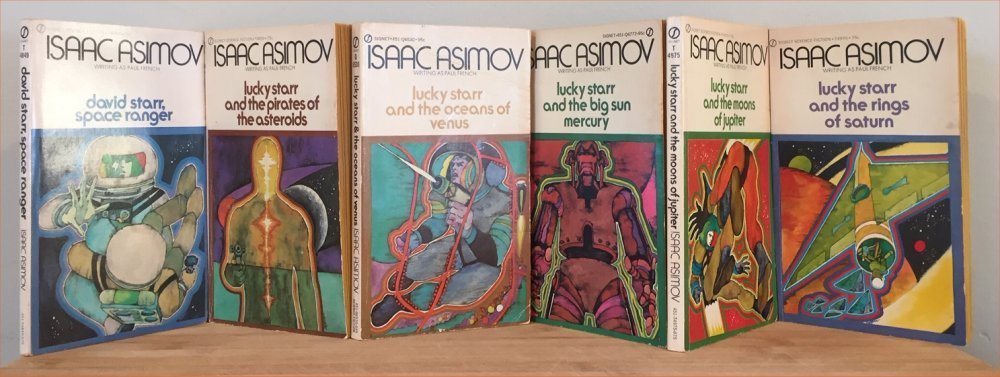
In the 1950s Isaac Asimov wrote six short science fiction novels for the ‘juvenile’ market, what today we would call ‘young adult.’ These were:

  • DAVID STARR, SPACE RANGER (1952)
  • LUCKY STARR AND THE PIRATES OF THE ASTEROIDS (1953)
  • LUCKY STARR AND THE OCEANS OF VENUS (1954)
  • LUCKY STARR AND THE BIG SUN OF MERCRUY (1956)
  • LUCKY STARR AND THE MOONS OF JUPITER (1957)
  • LUCKY STARR AND THE RINGS OF SATURN (1958)

They were all originally published by Doubleday, his regular publisher. I’m reading the New American Library/Signet paperback editions, published in 1971 ad 1972, with Bob Pepper cover art.

Let me stipulate that these are probably the least significant novels Asimov ever wrote. No one should start reading Asimov with these. But I’ve discovered that sometime the most ordinary novels of an era are more revealing of assumptions and attitudes of its time. The ‘classic’ novels are classic specifically because they’re out of the ordinary and do something different and unusual – they’re atypical. Typical works can be just as interesting, in different ways.

So. Why did Asimov write these books? I can speculate a little. No doubt Asimov explained why in his very detailed autobiographies (IN MEMORY YET GREEN and its sequel), but I haven’t read them and don’t even own copies. Perhaps because Robert A. Heinlein was having some success writing his ‘juvenile’ novels, at a rate of one a year (beginning with ROCKET SHIP GALILEO in 1947). Or perhaps because there was a growing library market for juveniles in general; other sf writers of the time were writing ‘juveniles’, like Wollheim and del Rey. In any case, Asimov’s six books are different than most of the others in that they concern a single recurring character. The books also provide Asimov with an opportunity to tour the solar system, as you can tell by the titles, and take the pedagogical opportunity to present the state of planetary science as it was in that era. (Actually, Wikipedia https://en.wikipedia.org/wiki/Lucky_Starr_series notes that Asimov’s agent and publisher wanted him to write a series of books as the basis for a TV series. The series was never made, but Asimov kept writing the books, even planning a 7th, before abandoning fiction entirely for some years to write only non-fiction.)

The first book introduces us to a future some 5000 years after the atom bomb, when the solar system and galaxy are all populated. The setting is International City, on Earth, which reads like a future New York, and technical wonders like tri-television and force-fields (e.g. to provide an invisible table top) are common.

Earth’s food comes from Mars, and the action opens as David Starr, a prodigal young man and full member of the Council of Science, witnesses a diner in a restaurant collapse from having eaten a Martian plum. Learning of reports that 200 people have died from eating Martian products, David – who is impulsive and inclined to sidestep authority – sets off to Mars to investigate. He pretends to be a common worker, gets a job on a Martian farm (in a huge dome), and is alert for clues about sabotage or threats. Hearing speculation about possible Martian intelligence underground, he descends into a deep crevice and…

And eventually David solves the mystery of who’s sabotaging the Martian food and why. But that is the least interesting part of the novel. Much more interesting are these aspects of the book:

  • David is an orphan, we’re told early on, the sole survivor of a pirate attack in space that killed his parents. Two friends of his father’s, Hector Conway and Augustus Henree, being unmarried, adopted David and raised him. This is told matter-of-factly (p18-19 of the Signet edition) as if entirely unremarkable.
  • The highlight of the novel, and perhaps of the entire series, is David’s discovery of intelligent Martian life, deep underground, as he descends into a fissure using a silicon rope with force-field anchors. An opening appears, and his body is taken over and lifted into an airlock. He is spoken to by unseen entities who talk about matter-mind transformations (p89), how they descended underground a million years ago and have become pure mind and energy, and are sufficient living by themselves instead of exploring the universe. They suggest that David’s kind will eventually achieve such an ‘Inner Life’, despite their fragile flesh and penchant for secrecy. They decide David should be described as ‘Space Ranger’. They give him a kind of force-field mask, and return him to the surface, as if by magic.
  • Here’s the reason why such an ordinary book is interesting: because here we see the commonplace assumptions and presumptions of 1950s science fiction. Force fields. Beings of pure mind and energy. Superior minds without the need for physical travel. If these sound like themes of Star Trek episodes, that’s exactly right. Star Trek, in the mid-1960s, drew on common themes of science fiction of the couple decades before it. There wasn’t much conceptually original in Star Trek; its endurance as part of our popular culture, 50 years later, is one way in which (traditional) science fiction has conquered the world.
  • So this is the origin story of a superhero! David, who becomes known by his nickname Lucky in the second book, keeps his force-field mask secret. He claims to have been saved from the Martian desert by a ‘Space Ranger,’ and when necessary, takes on the identity of Space Ranger himself, wearing his mask. He’s an ordinary person with a secret identity! Wikipedia notes the character is based closely on the Lone Ranger, down to the Western-like setting on Mars, but surely Batman comes to mind as well.
  • And yet, reading the following books – this superhero secret-identity angle is abandoned. Lucky uses his mask at least once more, but he never uses his secret ‘Space Ranger’ identity to intervene when he can’t himself.
  • David never reveals his discovery of the Martian intelligence. He keeps that, and his mask, secret.

More incidentally,

  • All the men smoke pipes or cigars. (Curiously, Asimov came to loathe smoking, but it was common in the era of these books.)
  • The future envisioned here, in International City, is oddly familiar given 5000 years have passed; but that is a very typical failure of imagination in virtually all science fiction, which underestimates the rate of change over centuries or millennia.
  • Asimov imagines a society apparently run by a Council of Science, experts who decide all the important things. Wishful thinking, perhaps.
  • David ‘Lucky’ Starr picks up a sidekick, the ironically nicknamed Bigman, a short loud man ever anxious to defend himself in fights, who initially befriends David and later recognizes that David and the ‘Space Ranger’ are the same person. Bigman appears in all the following books.

The second book concerns the “pirates of the asteroids,” presumably the pirates who killed Lucky Starr’s parents. Lucky’s father figures Conway and Henree prepare an unmanned rocket as a booby-trap for those pirates, but Lucky sneaks aboard. When he’s found by the pirates he pretends to be disaffected, with no opportunities for him on Earth or the colonies, and wants to join them. He’s taken to meet a wealthy hermit, Joseph Hansen, in his own private luxurious asteroid – who knew Lucky’s father, and recognizes Lucky. Escapes and pursuits ensue, with much detail about relative coordinates and positions of various asteroids. Key points:

  • As with the first book, this plays out as a mystery that Lucky solves and reveals in a long speech at the end.
  • This book introduces the ‘Sirians’ (presumably from Sirius, though it’s not clear in this book if these are aliens or human colonists – eventually clarified to be the latter, since all of Asimov’s early works depicted a human-only occupied galaxy) as villains, collaborating with the pirates.
  • There are info-dump passages here about asteroids, moving in orbits, etc.
  • With this book we see that there are one or more fistfights in every book, sometimes involving Lucky (incognito) as a means of establishing his order in a social group, sometimes with Bigman anxious to defend his honor. Was this because TV series of the times required action scenes? Certainly Star Trek exhibited the same taste for physical action, as in Westerns, a taste that had faded by the time of Trek TNG (cf Pinker).
  • Lucky uses his Martian mask to protect himself as he transits across the solar system on a close pass over the sun, with much detail, calling it his ‘glimmer shield.’
  • The resolution involves Lucky’s understanding that he’s met, and captured, the pirate who killed his parents. So there’s a nice emotional resolution here.

Book three takes us to Venus, and it’s the traditional Venus of early SF, a warm world decked by clouds, here imagined as inhabited by people in underwater domes. Lucky and Bigman come to Venus to investigate a charge against an old roommate of Lucky’s, Lou Evans, that he stole information and ruined a vat of yeast, the planet’s main commodity and valuable export. Action scenes: the ‘coaster’ ship used to take them to the surface crashes when the pilots suffer a blackout. A man barricades himself at a sealock and threatens to flood the city; Bigman crawls through ducts to save the day. Evans flees as if guilty; in pursuit, Lucky and Bigman’s subsea craft are buried under a huge orange ‘patch’ creature. Specific interesting bits:

  • Early on a long (two-page) description of a six-legged V-frog, apparently merely a common pet, signals part of the solution – that humans are having strange blackouts due to telepathic manipulation by these frogs.
  • Late in the book Lucky has telepathic contact with the frogs, who claim they distrust humans because they end life by eating meat, and threaten the extermination of humans on Venus.
  • But Lucky realizes the frogs are only tools, being controlled by the bad guy, chief engineer Turner, whom when introduced earlier carries a ‘computer’ around with him always – an invention unlike anything in the galaxy, he says.
  • What was Turner’s motive? Apparently just dictatorial ambitions, p141. But because he’s built this unique computer, he will be rehabilitated, not executed.
  • As in the first book it seems the entire galaxy is occupied by humans, and here it’s said Earth’s system is the oldest in the galaxy, p35.

Book four, Mercury, again relies on 1950s ideas of what the planet was like – and in this case, Asimov provides a new foreword to this 1972 Signet edition to explain that Mercury does not face one side to the sun after all. (He had an analogous foreword in the Venus book.) But that’s what was thought at the time, and like one of Asimov’s robot stories, “Runaround,” the setting is the narrow band between the sunlit side and the backside forever in shadow. Lucky and Bigman come to Mercury to investigate failures that are plaguing Project Light, an ambitious project to send energy from the sun, via sub-etheric options, to Earth. They meet various supporters and critics of the project: an operative sent by a Senator on Earth afraid of wasting taxpayer money [anticipating Proxmire!], and Perverale, an observatory head afraid the project will leave Earth more vulnerable to the Sirians, among them.

  • Perverale provides some background about the Sirians, humans who’ve refined themselves into a unified race, and developed positronic robots as servants. Ah ha! Asimov had written his early robot stories and early Foundation stories by the time he wrote this book, without ever suggesting why there were no robots in the empire of the Foundation. Since the Lucky Starr books might well be taken as being set in a precursor to that empire, it’s significant that he suggests reasons why some planets might have adopted the use of robots, and others not.
  • Yet the discussion of robots isn’t incidental; the solution of the mystery involves a Sirian robot instructed to damage the project and is half insane from the heat. Lucky even recalls and tries to use the three laws to control it. [The books were originally published under a pseudonym, Paul French, but by including discussion of the famous three laws of robotics, Asimov was giving away the author’s actual identity.]
  • This book’s fight is a duel between Bigman and another, initially held in Mercury gravity until one of the villains switches gravity back to Earth normal.
  • And this book’s alien life-form is something in the old mining tunnels that feeds off heat, but which plays no part in the mystery about the project.
  • And once again Asimov asserts that scientists are the ones to best run the world, p21: “In this age of Galactic civilization, with humanity spread through all the planets of all the stars in the Milky Way, only scientists could properly cope with mankind’s problems. In fact, only the specially trained scientists of the Council were adequate.”
  • And yet, at the book’s very end, Lucky reflects on that hostile senator: “No, Senator Swenson is not a real cause for worry. He’s ruthless and dangerous, but for that very reason he keeps the Council on its toes, keeps us from getting flabby. Besides, the Council of Science needs its critics, just as Congress and the government do. If ever the Council began to consider itself above criticism, then the time might come when it would establish a dictatorship over the Earth, and certainly I wouldn’t want that to happen.”

Book five takes us to Jupiter, or least the moons around Jupiter. This time the project is an experimental anti-gravity ship, and again the Sirians have perhaps infiltrated the project to sabotage it.

  • Lucky brings a V-frog with him to check for telepathic leaks.
  • This book’s fight is a challenge to Lucky in an agrav corridor.
  • Despite the hostility of the local engineers – some hundreds of men, apparently, living inside Jupiter Nine, which is riddled with caverns and corridors – to Lucky’s visit, and despite the possibility of a hidden saboteur (perhaps a robot in disguise?), the first test flight of the agrav ships gets underway. Asimov provides much detail about Jupiter and its moons and the trip.
  • They land on Jupiter’s moon Io, where Bigman plays in ammonia snow and gets trapped down a crevasse. Fortunately one of the crew, the blind Harry Norrich, has brought his dog, who helps rescue Bigman. (Yes the dog wears a spacesuit too.)
  • They depart. Someone sabotages the controls of the agrav ship; they land on Jupiter Five, Amalthea, for repairs, and realize that one of the crew never boarded at Io. Tracked down, that saboteur admits having sold out to the Sirians, for a decent way of life away from Earth (recalling a story Lucky used in book two).
  • There is in fact a robot involved, but not in the shape of a human. (Saw this coming several chapters early on.) Not a mechanical robot; a creature with a robot mind. At the same time a biological creature, or people would have noticed.

Finally to Saturn, with its two rings – again per astronomical knowledge of the time. Lucky and Bigman come there because a suspected Sirian spy on Earth has fled in a ship toward Saturn. When Lucky, Bigman, and another Councilman, Wess, approach, they are challenged by a Sirian ship. So Lucky withdraws! But soon returns by himself to investigate whether the Sirians have occupied Saturn’s big moon Titan.

  • An interesting legal point is at the core of the dispute: a so-called Hegellian Doctrine (p125), whether or not an unoccupied world is open to colonization by anyone, even if it’s in the same system as other inhabited planets. That is, is it OK for Sirians, on a planet orbiting the star Sirius, 8.6 light years away, to occupy Titan, in Earth’s own solar system?
  • We get Asimov’s usual astronomical tour as they linger near Saturn: the rings, the gap, the ‘crepe ring’, the Cassini division; As in previous books, frequent descriptions of how far they are from earth, how big the nearby planet appears in the sky, how much dimmer it is than the earth or moon, etc. We also learn about the small moon Mimas, where Lucky’s ship drills a hole and hides—the moon is just a big snowball—until it emerges and they are challenged by the Sirians.
  • Eventually Lucky and Bigman are taken to Titan, where a colony inside a dome looks just like Earth, with buildings and lawns. The Sirian leader, Devoure, is contemptuous of Earthmen, especially ‘deformed’ ones like Bigman – who shortly challenges him to a personal fight, and wins. (This book’s fist fight.)
  • There’s some nice steady tension as the book’s climax approaches—a formal conference, on Vesta, to determine Sirian rights to Titan. Lucky is willing to testify, and his compatriots worry that he can’t help but support the Sirian case. Lucky testifies—and points out that his extraction from Mimas by the Sirians is exactly what the Sirians claim Earth is, unfairly, doing to them. Their case is lost.
  • This story is more political than the others, having the flavor of the Foundation stories, with immediate action backed up by larger issues of principle.
  • There’s also a strong theme in what we might understand today as nationalism vs. globalization: The Sirians are obsessed with racial purity and improving their breed, while Lucky claims the diversity of Earthmen is their strength.

So these books are pleasant but not terribly consequential. The paperbacks are all about 140 pages, and so are quick reads. They’re significant in that Asimov as always does the science right, even as he uses commonplace space opera devices like pseudo-gravity and telepathy, but especially because the books can be seen as part of Asimov’s grand project of imagining a future galactic civilization, one entirely populated by humans, that already saw its culmination in his earlier Foundation stories. And here (and also in 1950’s PEBBLE IN THE SKY, which I happen to be reading now) he was already considering how to reconcile that future with the one dominated by robots he had imagined in the stories in I, ROBOT, a concern he addressed in much greater detail in his later 1980s novels.

Posted in Book Notes, Isaac Asimov, science fiction | Comments Off on Asimov, Six Lucky Starr novels

Film Notes: Mulholland Drive

Over the past couple nights we re-watched one of my favorite movies of all time — Mulholland Drive (stylized, in Wikipedia’s take, Mulholland Dr.). I like it for its depiction of ’70s era Hollywood, and especially for Angelo Badalamenti’s score — here’s the key passage of his compelling, mysterious music at YouTube. We watched it so long ago, maybe 15 years ago, I didn’t remember what the ‘solution’ was, if any, for all the discordant and seemingly supernatural events. Having watched it again, I got a take — but according to Wikipedia, there is no single interpretation of the film, beyond resource to ‘dream logic’. My rough take: the first 3/4 of the film is a fantasy by a young actress from Ohio about what Hollywood is like, from charming cottages to a brilliant audition, about high-strung directors and mysterious mafiosi. And the final quarter is about her waking up to reality. And killing herself.

Posted in Movies | Comments Off on Film Notes: Mulholland Drive

Ron, Ken, Howard

Following up on the end of the previous post…

Ron Hardcastle died in 2014. He was only 12 years older than me, but since I was in my mid-20s when I met him, he was half again my age, and it seemed like a lot. Here’s a brief LA Times obit, with a pic.

Ken Rudolph is still alive and well, apparently. He’s a member of the Motion Picture Academy and apparently reviews virtually every film that comes out. Here’s his movie reviews page, and his main page.

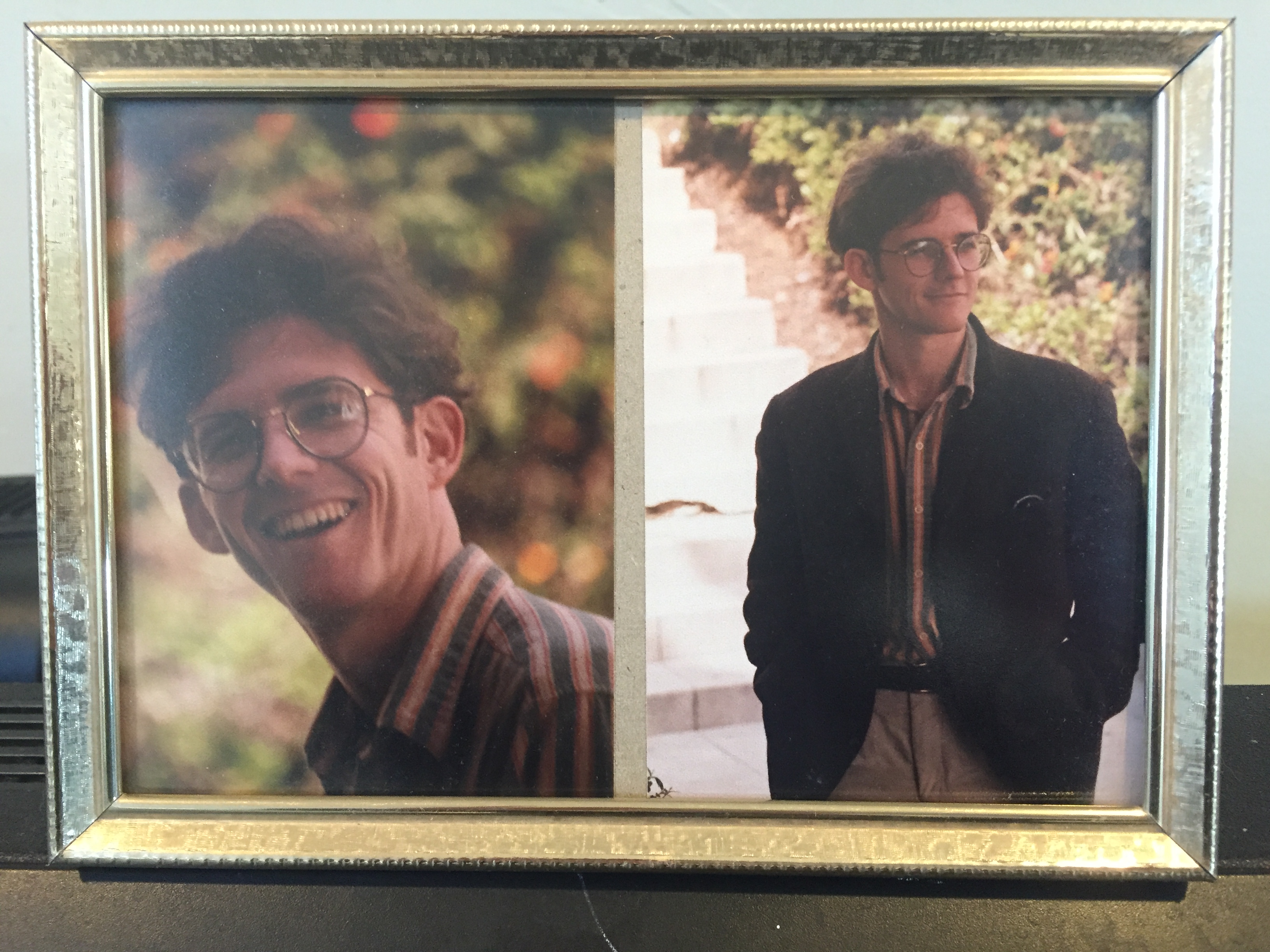
All I can find online about Howard Faye is this post from 14 years ago remembering his death 10 years before, on a soc.motss archive page that includes a post from Ken Rudolph. (motss = members of the same sex, an early online newsgroup.) But I have these two pics, which I took.

Posted in Personal history | Comments Off on Ron, Ken, Howard

Cleaning Out the File Cabinet

Some months ago I went through various folders in my small (two-drawer) file cabinet to see if there were things I still needed or if there were things I could dispose of. I pulled out several folders tentatively identified for the latter, and piled them on the floor. Months later I’m picking them up again and going through them one last time… before throwing them away.

As I do, I’ll summarize, if only for my own records, what is going into the recycle bin. With comments. Going from the least to the most personal.

Locus Foundation. For at least 15 years I’ve been on the Board of Directors of the Locus Foundation, and protocols for such a non-profit organization have required an annual meeting followed by meeting notes distributed to members. These were done by paper mail up to about 2010. I also have paperwork concerning the Charles N. Brown Trust, distributed in 2010 and his death in 2009. Since 2010, all matters like these have been done by email. Also: statements and check stubs from the early days of Locus Online, when proceeds from an online ad service were received by Locus HQ and forwarded to me.

1982 Hughes offer. When I was searching for my first industry job in 1982, I applied to three places: Rocketdyne, JPL, and Hughes. JPL never did make an offer; my interview went OK but they had no immediate openings. Hughes made an offer — it was for $25,400 a year — but the job was in El Segundo, by LAX. I took the Rocketdyne offer instead, for slightly more, and much closer to home. I saved the offer letter (did I save the Rocketdyne letter?) and correspondence to decline the offer.

Aunt Maude inheritance. In 2004 my Great Aunt Maude, who lived most of her life in Davenport Iowa died. I had last seen her, in a nursing home, in 1992 when I traveled to Cambridge, Illinois, in the aftermath of my grandfather’s death. Aunt Maude and Uncle Edwin (who had died earlier) lived a prosperous life in a big house on a shady street in Davenport that my family must have visited once or twice around 1970. They were my father’s aunt and uncle on his mother’s side. After her death paperwork was sent out to her designated heirs to distribute her estate, which was worth almost $300,000. There were 15 heirs named, including my father, but since my father had died in 2001, his share went to his four children; and since my sister Lisa had died in 2002, that left three of us. My share was $4805.56. At the same time, the Edwin O. Olson Trust was distributed; it was worth $679,000, and my share was $11,350.

TV Show Listings. In my college years and into my 20s, I compiled episode lists of TV shows I watched regularly, some of them in syndication, like The Twilight Zone, shown five times a week, others newly broadcast in the evenings, like Hawaii Five-O. I compiled episode titles, writers and directors, and guest stars. UCLA had an excellent film/TV library and in some cases I paged through old issues of Hollywood Reporter that reported episodes I had never seen and when they were first broadcast. Other shows I compiled data on were Jonny Quest, Upstairs, Downstairs (when first broadcast in the US), Mission: Impossible (notorious for one or two word titles, often “The Something”, which were not displayed in the episodes themselves, unlike virtually all these other shows), the ’80s revival of Twilight Zone, Hill Street Blues when first broadcast in the ’80s (it didn’t display titles either), and a few older shows I saw in reruns, like Mannix, The Avengers, The Outer Limits, The Invaders, It Takes a Thief, and The Time Tunnel. And of course Lost in Space and Star Trek. In the ’80s and ’90s popularity of some of these old shows made it profitable for books to be published about them, with exhaustive listings and background material, and nowadays of course all the listings are in Wikipedia or on similar sites.

Change of Hobbit newsletters. A Change of Hobbit was a specialty science fiction bookshop near UCLA, that I discovered when I started college there, and patronized for about 15 years, until it closed (after having relocated twice to larger quarters) in the early ’90s. It was run by Sherry Gotlieb. She published a one or two page newsletter once a month, listing visiting authors and books scheduled for publication.

Database notes. I’ve always compiled lists of books I owned (when and where bought, since 1970) and in the early ’90s began developing macros in Microsoft Word to convert straight listings of book contents into indexes alphabetized by author. The purchase records and library records eventually migrated to Microsoft Access (though I still have the ledger books) and the indexing project became focused on awards, perhaps because by that time William Contento was indexing books for Locus, and issuing annual volumes of the contents of all books and magazines published in each year (before migrating to the web by the ’90s, and then overtaken by isfdb.com). While my own awards index, at one point generated using Word macros into 100 pages or so of formatted output like a published book, moved to the web, first for Locus Online and now for sfadb.com. These old notes from the earliest versions of these projects are fascinating, mostly because I have no memory at all of how I would use Word macros to do that, but also because at one point I used another database product (Dbase?) and have notes about tables and fields and whatnot using that terminology.

Gay Articles. That is, articles from newspapers or magazines that I tore out and saved, articles about the dating scene or campus groups or true stories of how, e.g., “Gay Air Force Captain Forced to Resign” from 1986. (How times have changed.)

Personal Ad correspondence. My earliest forays into dating — long before email and the internet — were launched by answering personal ads in various magazines and newspapers published in LA. You wrote a letter and mailed it, and hoped for a reply in a few days, and maybe would go on a date. In retrospect I’m amazed I saved so much of this stuff, especially since, obviously, none of these contacts became a serious relationship. Out, out, now, into the trash — before any of my survivors paw through it after I’m gone.

It’s worth mentioning that I pursued ads like these because I never, more than once or twice ever, visited bars to meet people. Because I didn’t like the noise, and I hated the cigarette smoke (of that era). By the late ’80s or early ’90s the personal ads scene moved online, first to ‘bulletin boards,’ which were DOS based dial-ups (via the old modems that made those noises) that enabled a few or dozens of people to be logged in at any one time; you could browse profiles or ‘chat’ privately. The two I frequented were Delos and NoName. They were succeeded by AOL with its chat rooms, and then personals websites that are still around.

Personal Correspondence. There’s a companion folder of letters and cards from people I kept in touch with, or perhaps tried to date, over the years. Chuck A, from the CSUN on-campus gay group. Bruce O, whom I roommated with for one year. Larry K, whom I shared a house with for about a decade, and who now lives in Texas, and remains my oldest friend. Taro S, whom I dated a bit before he became too needy.

Even More Personal Correspondence. The last two and most personal (because slightly awkwardly embarrassing, not because of anything racy) folders are full of letters from two specific people that I kept in touch with for quite a while. The first was Ron Hardcastle, an older man (20 years older) who lived in one of a row of cottages on Wilshire Blvd. just east of Westwood, called The Grove, now long gone. We shared an interest in classical music, and he was interested in me, but I did not reciprocate, and he didn’t understand why. The second was Howard Faye, whom I met via one of those bulletin boards in the early ’90s. He was younger than me (by 7 years I think), very cute, smart and well-educated, but temporarily living back home with his parents (not far from where I was living in Granada Hills at the time). I was smitten. We met two or three times before he announced he was moving in with an older guy in Hollywood, Ken Rudolph, who owned a small special effects shop — and who coincidentally I had met myself via some ad some months before, and who couldn’t understand why I didn’t want to pursue anything. Then oddly, it seemed to me, Howard wanted to keep in touch and be friends. So we sorta did, seeing movies, traveling once to Chicago and another time to Seattle (to attend the local film festival). I grew uncomfortable with his relationship with Ken, whom I thought he was taking advantage of, and he cut me off. He had AIDS even when I first met him (that’s why he had moved back home with his parents), and he died in 1995. It was only quite by chance that I saw notice of his passing, on some online newsgroup.

I am doing no more than flipping very briefly through these stacks of letters. Not reading them. Throwing them out. They evoke precious memories that I want to remember fondly, without revisiting the difficult parts.

Posted in Personal history | Comments Off on Cleaning Out the File Cabinet

Dawkins v Wilson on Group Selection

A minor irritant in Dawkins’ book just discussed is that he several times describes claims by other scientists and then patiently explains why they are wrong. In one case it’s a recently published paper in a journal. In another he takes on E.O. Wilson on group selection, in Wilson’s book Sociobiology: The New Synthesis, that had just been published the year before. These are irritating because he makes the issues a bit too personal.

Without attempting to explain group selection, I note here only that there remains an ongoing debate, or perhaps merely a lingering disagreement, about the concept of group selection vs. individual selection, whether group selection ever applies. Dawkins is insistent upon the position that it does not, and he has several examples in his book of behaviors that may seem to benefit only the group (perhaps by relation) but which in fact can be understood the individual only.

At the same time Wilson has carried forward the banner for group selection, a steady theme through his many books and especially prominent in the last few of his books since The Social Conquest of Earth (2012). In these later books Wilson claims to have developed (along with his students) mathematical models that prove that group selection applies in certain circumstances.

Yet his does seem to be a minority position. Jerry Coyne had a blog post recently wondering why Wilson has hitched his wagon, in his declining years, to an invalidated theory. And Steven Pinker published an essay somewhere a few years ago called IIRC “The False Allure of Group Selection.”

Dawkins, I recall noting, is not quite as harsh on the subject as he used to be. And yet (just now checking several of his later books’ indexes) he’s only ever referenced Wilson once or twice. Wilson, for his part, has never referenced Dawkins at all.

And Wilson in his recent books is persuasive. I suspect the dispute arises in how different analyses make different starting assumptions, or prioritize one kind of analysis over another.

My impression is that Wilson’s analysis applies more at the level of social or cultural evolution. In any case, one of the fascinations of science is watching how some matters are never completely settled. Yes, maybe it’s different starting assumptions or different perspectives, or maybe each side is looking at different subcases of a larger phenomenon. It has to be something like that. If it were a trivial disagreement, it would have been settled by now. The issues still open in science are necessarily not the simple or trivial ones.

Posted in Evolution, Science | Comments Off on Dawkins v Wilson on Group Selection

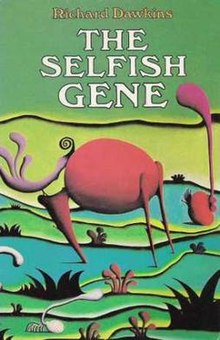
Dawkins, THE SELFISH GENE

Opening paragraph, of a chapter called “Why are people?”The Selfish Gene3.jpg

Intelligent life on a planet comes of age when it first works out the reason for its own existence. If superior creatures from space ever visit earth, the first question they will ask, in order to assess the level of our civilization, is: ‘Have they discovered evolution yet?’ Living organisms had existed on earth, without ever knowing why, for over three thousand million years before the truth finally dawned on one of them. His name was Charles Darwin. To be fair, others had had inklings of the truth, but it was Darwin who first put together a coherent and tenable account of why we exist. Darwin made it possible for us to give a sensible answer to the curious child whose questions heads this chapter. We no longer have to resort to superstition when faced with the deep problems: Is there a meaning to life? What are we for? What is man? After posting the last of these questions, the eminent zoologist G.G. Simpson put it thus: ‘The point I want to make now is that all attempted to answer that question before 1859 are worthless and that we will be better off if we ignore them completely.’

Here’s a classic nonfiction work I hadn’t read until this past week. (Though I’ve had a copy for decades, and also recently acquired its 40th anniversary edition, expanded with detailed notes.) I’ve said more than once that, in a sense, it’s not worth reading older nonfiction books when newer ones might have superseded them. Perhaps an exception to this rule is for books that do have some classic status, that were influential in their time, that are still cited in bibliographies of so many later books. As one might now read Darwin, knowing how much has been discovered since his time.

This book was published in 1976, while Dawkins was a zoologist at Oxford, long before he became famous as a public intellectual. (That he especially in these days of social media sometimes commits gaffes that attract detractors should not diminish the content and significance of this and his many later books.)

It’s known now perhaps primarily for establishing the idea of a ‘meme’, a cultural counterpart to the biological gene. But that idea is in the last chapter, almost as an afterthought. Upfront, he states that the book isn’t about Darwinism in general, but about the biology of selfishness and altruism.

His major idea is that natural selection is best understood at the level of the gene, and the early chapters describe the idea of replicators (like DNA), of competition, of how our genes are replicators that survive inside us and use us as ‘survival machines’. As are all plants and animals. He goes into considerable detail about chromosomes, sexual reproduction, cell division, mutations. He admits that his very specific definition of a gene is not one every biologist would agree with, but it makes his claim that natural selection operates at the level of the gene correct.

He repeatedly challenges various claims about ‘group selection,’ especially the idea that animal behavior might cause one to sacrifice itself ‘for the good of the species,’ an idea common among certain writers of the earlier 20th century.

An interesting reflection in Chapter 4 is about the difference between plants and animals. To paraphrase: Plants move slowly; animals are fast, and to move fast, developed functions analogous to punched cards in machines: nerve cells or neurons connected to thousands of others, drawn out into axons, bundled together as nerves, a cluster of them forming a brain, that coordinate the control of muscles to the sense organs that detect events in the outside world. In primitive organisms these connections are direct; in higher beings the brain, with its memory, intervenes. The impression of purposiveness is what we recognize as consciousness…

The bulk of the book examines behaviors that do not seem to obviously support the survival of individual organisms — Aggression, altruism, the fallout in ideas first explained in the 1960s and which by now are common currency: kin selection; why aggression; competition between siblings, and between parents and children; and the differing strategies of fathers and mothers. Likely no one before Dawkins had, in a book for general readers, spelled out the remorseless logic of how natural selection explains such behavior – or even had revealed that such behavior exists. A key concept is the “evolutionary stable strategy” or ESS, a term from John Maynard Smith, to understand how proportions of populations evolve into stability — males vs female; aggressors vs pacifists.

The final chapter introduces a new kind of replicator, which he dubs a meme. Culture, e.g. language, evolves, changing over time in ways that often seem progressive. Memes are units of culture that spread through brains. He consider why the idea of god can become stable in a cultural environment, by providing psychological appeal, or how ideas of hell-fire and faith survive because blind faith can justify anything, thus propagating ideas of faith, and of patriotic and political beliefs.

He notes how a person’s genetic endowment disperses quickly in a few generations, while a person’s contribution to culture – his memes – can last centuries or millennia.

And finally, he notes how humanity has the capacity of foresight, and perhaps for genuine altruism – that is, we can consciously use foresight to overcome the selfish excesses of our genes. We alone can rebel.

\\
On his final point, I often find it ironic that social conservatives, who reject evolution, so often behave in ways that perpetuate the selfish behaviors our genes have endowed us with. I could go on…

Posted in Book Notes, Evolution, Science | Comments Off on Dawkins, THE SELFISH GENE

Miller, A CANTICLE FOR LEIBOWITZ

This 1959 novel is one of the most popular and celebrated science fiction novels of all time. It’s set in the years following an atomic war, it portrays religion in a relatively favorable way (in contrast to the skeptical or dismissive attitude of much other SF), and it dwells on the theme of man’s destiny, and its possibly inevitable fate in cycles of building and self-destruction. It’s sober and deadly-serious in parts, and it’s also quite funny in parts.

As this book is so well-known, I’ll summarize the plot only briefly. The book is in three parts.

The first part, Fiat Homo (Let there be man), is set some 600 years after a ‘Flame Deluge’ has destroyed civilization. (Some years pass in this section, at the end of which it’s the year 3174, so the book’s nuclear war apparently doesn’t take place until the year 2500 or so.) In the desert southwest Brother Francis Gerard at the Leibowitz Abbey stumbles upon (what we recognize as) an ancient fallout shelter, and discovers artifacts which may have belonged to Leibowitz himself – including what we realizes are radio parts and a blueprint, but which no one at the abbey understands in the slightest. Messengers arrive from New Rome, because Leibowitz is under consideration for canonization, and there’s a concern the artifacts may be fake and would jeopardize that process. Eventually New Rome approves, and Brother Gerard is allowed to attend the ceremony, though on his return journey (– spoiler –) he is killed by mutant ‘sport’.

The second part, Fiat Lux (Let there be light) is set 600 years later. Society is recovering, as a political leader in Texarkana is anxious to unite the continent, dealing with various local tribes to do so – planning to wipe them out with cattle plagues if necessary. A secular scholar, Thon Taddeo, still curious about the authenticity of the Leibowitz documents, travels to the abbey, where the brothers have managed to re-invent a dynamo and an arc lamp. Taddeo studies the documents and reports his findings, careful not to offend the brothers. News come of another war, and a message that the surviving mayor of Texarkana has broken with the church.

The third part, Fiat Voluntas Tua (Thy will be done) is set another 600 years later. Technological society has recovered, and there are spaceships again, and even colonies on worlds of several stars. This section reads like a contemporary political thriller, with rumors about use of atomic weapons. A secret plan of the church goes into effect – to launch its own starship to Alpha Centauri, with sufficient volunteers to establish a new church hierarchy. As the bombs fall and the abbey is destroyed, priests at the launch site in New Rome lift children into the rocket ship, and the ship takes off, escaping the earth.

Major points

  • What I had mismembered from reading this novel decades ago was the nature of the escape at the end. The novel’s arc goes from destruction to civilization to destruction again – with the rocket launched by the Church implicitly saving the last gasp of humanity to survive on another world. But – humanity has already settled other planets! (We’re told this at the beginning of Part Three.) The only thing being saved at the end here is the church itself. That’s why there’s concern in the final weeks about the proper composition of the crew on the rocket—they need the correct church officials on the new planet so they can perpetuate church hierarchy. The book leaves you with the flavor that the church has saved humanity. But it hasn’t.
  • Given that understanding, the novel still gives great credit to the church for preserving knowledge over hundreds of years that otherwise would be lost. But—it’s always ‘the’ church, the Catholic church of course, and there’s never the slightest acknowledgement that there might be other religions in the world, or even protestant churches. (Ironically, it was Islam in Europe’s Dark Ages that preserved knowledge of the Greeks that the Christian church condemned.)
  • At the same time, as the author takes the church business very seriously – as another example, the passionate debate about euthanasia for those poisoned by radiation (Ch 27) — he surely is wise to the ways of human culture and how stories grow in the telling, how other species might think the world created for themselves, and so on.

Other interesting notes and quotes

  • P62, how after the first atomic war, the populists strike out at the elites [to use modern terms] to destroy what’s left:

    So it was that, after the Deluge, the Fallout, and plagues, the madness, the confusion of tongues, the rate, there began the bloodletting of the Simplification, when remnants of mankind had torn other remnants limb from limb, killing rulers, scientists, leaders, technicians, teachers, and whatever person the leaders of the maddened mobs said deserved death for having helped to make the Earth what it had become. Nothing had been so hateful in the sight of these mobs as the man of learning, at first because they had served the princes, but then later because they refused to join in the bloodletting and tries to oppose the mobs, calling the crowds ‘bloodthirsty simpletons.’

  • Is it odd that Brother Francis takes it upon himself to create an illuminated copy of the ancient blueprint he’s found? Perhaps, like the medieval monks, these latter brothers have little else better to do.
  • There’s a fantasy element in the novel in the implication that the pilgrim at the beginning is the actual Leibowitz – or is he the famed Wandering Jew? Note, p168b, how the hermit seems to remember thirty-two centuries.
  • There is occasional broad humor. How Brother Francis is dimwitted; the battle with the Autoscribe machine in Chapter 24; the story of the brother’s discovery grows in the telling, p88:

    Brother Francis closed his eyes and rubbed his forehead. He had told the simple truth to fellow novices. Fellow novices had whispered among themselves. Novices had told the story to travelers. Travelers had repeated it to travelers. Until finally—this!

    “No halo?” “No heavenly choir?” “What about the carpet of roses that grew up where he walked?”

  • Who decides? 220b; debate 221.9. On the responsibility of academicians to control the power they give rulers: p220.8

    But you promise to begin restoring Man’s control over Nature. But who will govern he use of the power to control natural forces? Who will use it? To what end? How will you hold him in check?

  • In Chapter 22 (p228) the scholar discovers a book that suggests the man is not descended from Adam, but is a servant species created by the original humanity. Others reply that what he is reading is just a play, and speculate on his motives. (After enough time has passed, how can you tell between history, myth, and fiction?)
  • Ch 12, a scholar and a politician debate why civilizations fall.

    “How can a great and wise civilization have destroyed itself so completely?”

    “Perhaps by being materially great and materially wise, and nothing else.”

    “…during the time of the anti-popes, how many schismatic Orders were fabricating their own versions of things, and passing off their versions as the work of earlier men. You can’t know, you can’t really know. … But where is the evidence of the kind of machines your historians tell us they had in those days? Where are the remains of self-moving carts, of flying machines?”

    “Beaten into plowshares and hoes.”

  • Each section ends with an appearance by buzzards, Section 2, p239:

    As always the wild black scavengers of the skies laid their eggs in season and lovingly bed their young. They soared high over prairies and mountains and plains, searching for the fulfillment of that share of life’s destiny which was theirs according to the plan of Nature. Their philosophers demonstrated by unaided reason alone that the Supreme Cathartes aura regnans had created the world especially for buzzards. They worshiped him with hearty appetites for many centuries.

    And the book ends with a rather different passage about sharks.

Posted in Book Notes, science fiction | Comments Off on Miller, A CANTICLE FOR LEIBOWITZ

Projects

Today I spent a couple hours setting up a ‘Projects’ page that is linked in the menu at the top of the site. And I’ll be setting up bibliographic pages for SF and NF to organize links to my posts of comments about books.

Posted in Website Issues | Comments Off on Projects