
Gilovich, 2, part 1

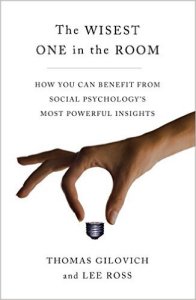
The new book by Thomas Gilovich (author of the 1991 volume HOW WE KNOW WHAT ISN’T SO: The Fallibility of Human Reason in Everyday Life, just discussed here) and coauthor Lee Ross is THE WISEST ONE IN THE ROOM: How You Can Benefit From Social Psychology’s Most Powerful Insights.

As in the earlier book, some 2/3 or more consists of discussion of various psychological discoveries about how people perceive things, with the balance about how these understandings can be applied to personal and social issues. (In a loose sense, then, this is a ‘self-help’ book.)

The early chapters echo subjects from the earlier book, but are more broadly applied.

Chapter 1, “The Objectivity Illusion” concerns how people aren’t so much objective observers of the world as they are subject to “naive realism”, the idea that what we experience is what is real, and somehow assume that others perceive the same ‘reality’ that we do. Whereas in fact, our perception of events (example: driving past a political protest) depends on our own prior beliefs. Interesting point I had not realized: the idea that people are subject to the ‘Lake Wobegon effect’ (everyone thinks they’re an above-average driver) is to some extent valid — because people use differing standards for what constitutes, e.g., a good driver (edit: mentioned later, p88). Example of people defending tastes in 60s vs. 80s music; their defenses use very different examples of each!

Great quote from British philosopher Isaiah Berlin, p31t — it’s the first para under the digit 1 on this page.

The general principle of perceiving bias in others, but not ourselves, affects how people regard sports announcers and debate moderators, who can never please everybody. p34b:

If you are like most people, you probably think the media generally are overly critical of the party and candidates you favor, and insufficiently critical of the party and candidates you oppose. You find media coverage of political and social issues frustrating because those on your side seem to be “telling it like it is,” while the other side’s contributions consist of little more than a series of lies, distortions, and half-truths.

And thus about the media, 35b

Because people tend to think of their own take on events not as a “take” but as a veridical assessment of what is taking place, anyone who tries to offer an even-handed account of events will tend to be seen as biased and hostile to the perceiver’s interests. This is one reason that the fourth estate is held in such low regard by the public. Right wingers in the United States curse the “lamestream” media, while those on the left complain that the major news outlets maintain a mindless neutrality by giving extreme right-wing perspectives the same coverage and treatment as much more centrist positions offered by those on their side of the political spectrum. And both groups regard the networks’ “pandering” to the other side as blatantly dishonest, whereas they see the network that shares their perspective as a source of refreshingly clear thinking.

(Well, yes, I do find Rachel Maddow, for example, a source of refreshingly clear thinking, so am I really subject to my own bias in the same a Rush Limbaugh or Glenn Beck fan is about those guys’ conspiracy theories? I’d like to not think so… especially since conspiracy theories can be understood via the same suite of psychological insights that are discussed in books like this.)

Chapter 2, “The Push and Pull of Situations”, discusses what in other books is called “priming” — we respond to situations quite differently depending on how they are presented. Examples: how war bonds were promoted and sold; how participation rates for savings plans or organ donations depend on whether they are presented as Opt-in vs. Opt-out. Eliminate obstacles: recycling is promoted by cities providing colored recycling bins.

There’s insight here into slippery-slope situations, including the famous Milgram experiment. In that case subjects were trapped in a situation with no clear way to stop. Many things happen in series of small steps; another example, how gay rights expanded to include social acceptance of same-sex marriage.

And the fundamental attribution error, FAE, whereby we attribute one’s situation to their essence; we confuse the person with the role. Leonard Nimoy was not really Spock. New Orleans residents who didn’t flee Katrina didn’t ‘choose’ not to leave (and were thereby irresponsible); they had no way to leave. Slave owners, even Thomas Jefferson, perceived slaves as unable to manage their own lives.

Lesson for the wisest one in the room: don’t rush to judgment until you appreciate situations and constraints in which people actied.

Chapter 3, “The Name of the Game”, is about how people *understand* the situation they’re in. How Social Security, signed in 1935, was framed as a type of savings plan, not a transfer of wealth; how issues like abortion are framed differently by rival sides; how organ donations and college tuitions depend on what people perceive as the meaning of their actions. Even smart people, like surgeons, choose differently depending on an option is framed. Framing can depend on how rates are expressed, the choice of denominator. Lesson: if your preference is risky, frame the issue as about which to select; if less risky, about which to reject.

Chapter 4, “The Primacy of Behavior”, is about how *acting* as if you are winning can promote the confidence in yourself and *in others*. Discussion of William James about how emotion follows the body’s response to events (cf Haidt), and how in evolution reflective thought is a later development than instinctive action (again). Self-perception theory vs. cognitive dissonance (Festinger). Lesson: just get the ball rolling; but bribes can backfire. At the same time, we’re all subject to rationalizations. Lesson: consider if someone else offered the same rationalization. Discussion of how this applies to the idea of evil, and the “banality of evil” p125-126.

This uncomfortable truth is crucial to an understanding of the link between rationalization and evil—an understanding that starts with the awareness that sane people rarely, if ever, act in a truly evil manner unless they can successfully rationalize their actions. Hollywood films notwithstanding, villains who proudly embrace evil are virtually nonexistent in real life. The problem is that people are extraordinarily adept at rationalizing. …

[[ Listening to political news just now puts this entire topic in a larger context, that is, that the ideas in books like these are subtle, and would almost certainly be dismissed by the many in the population of who perceive only simple black and white truths, about, in this example, ‘evil’. Any subtle introspection on this matter, or many another, would be dismissed by the typical conservative base as elitist university thinking, a threat to religious faith, and a liberal conspiracy. It will always be this way. ]]

Final passage in this chapter is about a book by a Holocaust survivor who tried to identify common traits of the various ‘heroes’ who helped Jews escape. There were no common traits. Heroic efforts more typically begin in a series of small steps.

Chapter 5, “Keyholes, Lenses, and Filters”, evokes some of the more specific mental biases and logical errors people are prone to, as discussed in the earlier book. Cherry-picking data (Iraq). How our range of vision is limited; how we can hold only 5 to 9 ideas in our head at any one time; how we have ideological lenses; how information is restricted by circumstances of the world. Two types of thinking: intuitive and rational. Confirmation bias, “the mother of all biases” — beware want we *want* to believe. People shown counter-evidence double-down, because we regard counter-evidence with more scrutiny than we do confirming evidence, and finds ways to dismiss the former.

Consider if the opposite might be true. Alas, the Catholic Church abandoned the idea of a “devil’s advocate”, and as a consequence the rate of confirming saints has soared in recent decades.

And so on: hidden information; self-fulfilling prophecies; pluralistic ignorance; groupthink.

Will do one more post about this book, to cover the second section, “Wisdom Applied”.
Posted in Book Notes | Comments Off on Gilovich, 2, part 1

Gilovich, 1

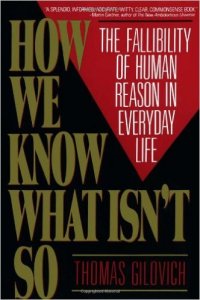
I just finished a new book co-written by Thomas Gilovich, author of the 1991 volume HOW WE KNOW WHAT ISN’T SO: The Fallibility of Human Reason in Everyday Life, the earliest volume in my library on the theme of that subtitle, which, from my perspective as a casual reader, seems to have matured substantially over the past two decades, judging from the increasing frequency of books such as those I’ve read in the last couple years by David McRaney, Jonathan Haidt, Jesse Bering, and Chris Mooney (all of which liberally cite many more recent specific psychological studies performed over those past couple decades).

The new book, cowritten with Lee Ross, is THE WISEST ONE IN THE ROOM: How You Can Benenfit From Social Psychology’s Most Powerful Insights. This is the second recent book — the other is Matthew Hutson’s THE 7 LAWS OF MAGICAL THINKING: How Irrational Beliefs Keep Us Happy, Healthy, and Sane (2012) — that take the lessons of all these psychological insights and present them to the reader as ideas to *use* to one’s advantage. This parallels one of the key themes of this blog: the way in which these discoveries, and other discoveries in the past couple centuries about the extent in time and space of the natural world, and in a different sense the ideas of science fiction, can be used to suggest that one’s personal experiences and social circumstances are only the tiniest sliver of reality, that reality is in fact deeply weird and unintuitive, but by using these tools, and heuristics, it’s possible to *think around the problem* and, at least intellectually, perceive a larger truth.

But first a summary of Gilovich’s 1991 book. Compared to more recent books on its general theme, Gilovich focuses not so much on human mental biases, as on real world considerations for how people do not experience balanced, objective data. Thus early chapters consider how people draw conclusions from what is actually random data, incomplete or unrepresentative data, ambiguous or inconsistent data, and so on. (Some of his examples overlap with those of mathematician Jordan Ellenberg.) He then moves on to psychological issues, ideas currently described as various biases (confirmation bias, self-enhancement bias, and so on), without those exact labels. He does mention the “Lake Wobegon effect”, the notion of reacting to confirming or challenging evidence as being about “can I believe” vs “must I believe”, and the idea of second-hand information, how a famous psychological case about “Little Albert” (from 1920) got recounted in many psychological textbooks, but with details omitted or exaggerated…to make it a better ‘story’.

This book had some ideas I had not heard about before, including considerations of what makes a ‘good story’, in the sense of a story being told by one person to another. Such accounts are subject to ‘sharpening’ and ‘leveling’, i.e. highlighting key points and leaving out extraneous points. Informative stories often omit qualifications, especially in service of promoting an agenda, e.g. in service of a ‘greater truth’. [[ Which I suppose must explain the many examples of conservative politicians and evangelical historians who seem to have no trouble bearing false witness on matters of fact. ]] And the book discusses the ‘imagined agreement of others’, how people project their own ideas and values to others, especially these days via filters of news sources.

Finally, as in the current book, the 1991 book ends with several examples of “Questionable and Erroneous Beliefs” that were current in back then: “alternative” health practices, interpersonal strategies (why people boast or name-drop or self-handicap), and especially ESP, with emphases on how news coverage claims sell, while rebuttals of claims do not, and the ‘will to believe’ in some kind of ‘transcendental temptation’.

Concluding chapters suggest that we can at least compensate what we can’t cure, p186t:

The underlying causes of faulty reasoning and erroneous beliefs will never be eliminated. People will always prefer black-and-white over shades of grey, and so there will always be the temptation to hold overly-simplified beliefs and to hold them with excessive confidence. People will always be tempted by the idea that everything that happens to them is controllable. Likewise, the tendency to impute structure and coherence to purely random patterns is wired deep into our cognitive machinery, and it is unlikely to ever be completely eliminated. …

And so we should develop habits of mind:

  1. First, be aware of trying to draw conclusions based on incomplete and unrepresentative evidence;
  2. Second, be aware of how often our role, status, or position in society can cut us off from certain classes of informative data.
  3. Third, be aware of how we are inclined to interpret data to conform to our pre-existing beliefs. E.g., consider how you would react if the opposite happened—would that also support your beliefs?
  4. Finally, — and this is my most important take-away from this book — the value of a science education, the concepts of control groups, regression, doubt, and uncertainty. For these reasons it may be more useful for students to be exposed to the ‘probabilistic’ sciences, psychology, economics, even medicine. Social scientists may have ‘physics envy’, but the social sciences have developed methodological innovations to deal with messy, real world situations – and have an obligation to pass on these lessons to students.

What social sciences might best offer both their students and the general public is their methodological sophistication, their way of looking at the world, the habits of mind that they promote—process more than content. … An awareness of how and when to question and a recognition of what it takes to truly know something are among the most important elements of what constitutes an educated person. Social scientists, I believe, may be in the best position to instill them.

P193b

In short: require every college student to take a course in a social (or medical) science, so they understand the ideas of messy data, control groups, and uncertainty. I would endorse that.

Notes and comments about the new Gilovich and Ross book in next post.

Posted in Book Notes | Comments Off on Gilovich, 1

Review: Woody Allen’s Magic in the Moonlight

I’m a bit under the weather this week, with a cold or flu that began Sunday, or Saturday night — I took DayQuil to get through our Sunday adventures in the city, with a walking tour of Nob Hill, drinks at the Top of the Mark, and V Day dinner at North Beach Restaurant. But since then, I’ve been sniffling and coughing and napping, and running behind Fb and blog posts. (I have dozens of links about current events to post.)

However I have managed to drill down my inbox a fair amount today, and just now saw this review, saved in email, of the August 2014 Woody Allen film “Magic in the Moonlight”, which apparently I never posted. (I write lots of drafts of things, reviews and comments, that never get posted.) So here it is:

We went to see the latest Woody Allen film, “Magic in the Moonlight”, despite some rather savage reviews upon its initial release that suggested Allen is coasting, or phoning it in. Really? Really? Yes, every Woody Allen film has certain familiar aspects, beginning superficially with the white on black opening and closing credits, and with any number of minor thematic tropes, and the balance one way or another between drama and comedy, and the mix of famous and near-famous actors who participate because of their desire to work with Woody Allen. And why not? Though individual films are more or less successful (depending on the writing, one would have to say), they are all beautifully directed and photographed, and almost every individual scene is a delight.

In the case of this film, I was drawn by the theme: a stage magician (played by Colin Firth), in the 1920s, is drawn to investigate and debunk a supposed psychic, Sophie (Emma Stone). This plays on reality: actual magicians, including Harry Houdini, have always been critical of ‘psychics’, who always use parlor tricks (like thumps on the bottom of the table and candles raised into the air on wires) to prey on credulous clients who want to think they are connected to their dear departed. In the film, Colin Firth’s character pursues Emma Stone’s character, Sophie, in the lovely south of France, being very critical until, after a point, he becomes convinced his skepticism has been wrong, that Sophie is the real deal, and he has been wrong in his entire life about his non-belief in the afterlife…

As a film viewer, at this point, you wonder, where is this going from here? Movies are much more predictable than literary fiction (including … SF and fantasy); movies generally reinforce audience suppositions rather than challenge them in any way. So, the simple resolution to this plot development, that would appeal to the audience credulity about psychics and the afterlife.

To the film’s credit, it does not take this easy course. On the other hand– here is where some legitimate criticism might come into play — I can’t quite appreciate that Colin Firth’s character is such a boob, sprouting insensitive remarks at every turn, as if someone who is smart must also be emotionally insensitive. And the film’s overall plot arc rather subsumes the implications of its conclusion with a…rather implausible romantic development. Not that it’s the kind of romantic development that hasn’t served many a film over the past 80 years…

Still, bottom line, despite all those critics– this is a well-done film that addresses a substantive topic about what people believe and how they live their lives.

Posted in Films | Comments Off on Review: Woody Allen’s Magic in the Moonlight

NYRoB on PKD’s The Man in the High Castle

I haven’t picked up an issue of THE NEW YORK REVIEW OF BOOKS in many years. On the one hand, it has been characterized in my reading life by the Harlan Ellison story, “The New York Review of Bird”, which dismissed and excoriated it as being snobby and up-tight; on the other hand, I do occasionally see references to some essay or review from it that covers some issue of interest to me; its contents are always very intellectual and comprehensive. I bought an issue a few weeks ago at the newsstand in Alameda and flipped through it this afternoon, and as I suspected, its contents are almost entirely about politics, culture, and art, with little or nothing about the bigger issues. (Which I generally am concerned with in this blog.)

(I do see that according to the online TOC of the Feb 25th issue, here, there seems to be a comprehensive piece by Tamsin Shaw covering numerous books about current psychological takes on various issues, including books by Jonathan Haidt, Steven Pinker, and Joshua Green, which are on my shelves. That I would read.)

So I bought the Jan. 14th issue a few weeks ago, and first of all, my impression is all the full-page ads from mostly university presses about the books they have published… books you don’t see advertised anywhere else, let alone featured on Amazon or stacked on the front tables of the few physical bookstores you might visit.

Aside from that: there is one piece of interest: a review by Adam Kirsch of the Amazon TV series The Man in the High Castle. The NYRB website offers only the beginning of the piece to nonsubscribers. I will offer a few passages quotes below.

Despite the recognition by Gary K. Wolfe in his recent lecture series about SF, that mainstream cultural magazines and reviews have mostly gotten over their snobbishness about SF, this Adam Kirsch essay evokes some familiar, snobbish themes. Kirsch begins by citing a NYT Magazine readers’ poll from last October about killing the infant Hitler, and describes the Twitter response as a “mockery of the entire idea”, and that the notion of “the idea of changing history” is “seen as a not quite respectable fantasy”, which is a blend of “fascination and condescension”; tales about alternate history “have been regarded as mere genre fiction — pulp sci-fi or mysteries”.

He mentions the works by Robert Harris and Len Deighton, Philip Roth and Michael Chabon, and then turns to the Philip K. Dick book, which — in a turn — he describes as a “masterpiece”, and then goes on with seemingly informed and insightful comparisons between the book and this TV miniseires. (I say “seemingly” because I haven’t watched the TV version.)

He charactizes the novel as “mainly internal — the story of how (white) Americans, so used to independence and supremacy, learn to think of themselves as subservient and second-rate”, while the TV series “focuses on resistance, which means that the action is mainly external”. And, “The result is that the TV version of The Man in the High Castle is much more conventional and melodramatic than the book it is based on, even as the two share many characters and scenes”.

Kirsch goes on to consider the historical variations, inside or outside of the book:

But ours is also a world in which the Holocaust took place and the atom bomb was dropped on Hiroshima and Nagasaki. The happy ending of World War II was a forty-four-year cold war in which the world stood constantly at the brink of nuclear annihilation. Perhaps, Dick leads us to wonder, we see true history only because it is the one we are used to. Seen from another perspective, we ourselves inhabit what be called “bad history”– a reality in which things occurred that ought not, by any standard of sanity and justice, to have taken place.

So: this is a very insightful essay, despite the initial dismissive remarks about genre. I don’t think I’ll subscribe to NYRoB just now, but I will look at it on the newsstand (where I buy my fresh, unmolested by USPS copies of Asimov’s and Analog every five weeks), to see if there is something of interest, and when I do, will report about it here.

Posted in Reviews | Comments Off on NYRoB on PKD’s The Man in the High Castle

Links and Comments: Susan Jacoby; Erasure; Boars and the Sixth Extinction; Jerry Brown and Jean-Pierre Dupuy

From last Sunday’s papers, the New York Times and the San Francisco Chronicle.

» NYT: Susan Jacoby: Sick and Tired of ‘God Bless America’

Well, of course; this is someone daring to point out the obvious, mostly unmentioned privilege that the faithful have in the US, despite Christians’ protestations of being persecuted (they love to feel persecuted; it’s in their prophecies). Which is to say, all the presidential candidates pander to the faithful. Despite the rise of the “nones”,

our political campaigns are still conducted as if all potential voters were among the faithful. The presumption is that candidates have everything to gain and nothing to lose by continuing their obsequious attitude toward orthodox religion and ignoring the growing population of those who make up a more secular America.

With many examples, even from the Democrats. Jacoby emphasizes what should be the larger values:

Freedom of conscience for all — which exists only in secular democracies — should be at the top of the list of shared concerns. Candidates who rightly denounce the persecution of Christians by radical Islamists should be ashamed of themselves for not expressing equal indignation at the persecution of freethinkers and atheists, as well as dissenting Muslims and small religious sects, not only by terrorists but also by theocracies like Saudi Arabia.

And points out the obvious:

As defined by many pandering politicians, “religious freedom” is in danger of becoming code for accepting public money while imposing faith-based values on others.

And ends with:

“God bless America” has become the standard ending of every major political speech. Just once in my life, I would like the chance to vote for a presidential candidate who ends his or her appeals with Thomas Paine’s observation that “the most formidable weapon against errors of every kind is Reason.”

This rise of the ‘nones’ in the population, if not yet the politicians, is yet another cultural shift in expanding morality, which, like the acceptance of same-sex marriage and the shared equality and dignity of all sexual minorities, is actually happening quite rapidly, at least in American culture, compared to the vast weight of past history. Happening within a single generation! Of course, progress in morality happens among a few at first, and gradually shifts to the majority, via that Overton Window; but politicians necessarily pander to the majority, or they would not win elections.

\\

Two items in the NYT Magazine.

An essay by Parul Sehgal, Fighting ‘Erasure’, that triggers off recent news, about how events that concern minorities, or the conquered, are systematically erased from history.

‘‘Erasure’’ refers to the practice of collective indifference that renders certain people and groups invisible. The word migrated out of the academy, where it alluded to the tendency of ideologies to dismiss inconvenient facts, and is increasingly used to describe how inconvenient people are dismissed, their history, pain and achievements blotted out. Compared with words like ‘‘diversity’’ and ‘‘representation,’’ with their glib corporate gloss, ‘‘erasure’’ is a blunt word for a blunt process. It goes beyond simplistic discussions of quotas to ask: Whose stories are taught and told? Whose suffering is recognized? Whose dead are mourned?

The casualties of ‘‘erasure’’ constitute familiar castes: women, minorities, the queer and the poor.

History is written by the winners; and journalism is written by folks, honest or dishonest, with conscious or unconscious biases. There is no such thing as purely objective history, or journalism. You have to try to understand the point of view of of who is doing the writing, and adjust.

Recent examples, the essay points out:

Texas Board of Education issued new textbooks for some five million public-school students that omitted mentions of Jim Crow and the Ku Klux Klan and made slavery a side issue in the Civil War.

Because American exceptionalism — about which I will have more anon, in a future post.

\\

And Helen Macdonald, author of the acclaimed 2015 memoir H Is for Hawk, about how wild boars in the woods of England bring to mind humanity’s relationship with nature: A Hint of Danger in the Forest.

When animals become so rare that their impact on humans is negligible, their ability to generate new meanings lessens, and they come to stand for another human notion: moral failings in our relationship to the natural world. As the boar ran up to the fence on that summer day, I felt a huge and hopeful pressure in my chest. The world has lost half its wildlife in my own lifetime. We are living through the earth’s sixth great extinction; climate change, habitat loss, pollution, pesticides and persecution have meant that vertebrate species are dying out up to 114 times as fast as they would in a world without humans. Seeing this single boar gave me a sense that our damage to the natural world might not be irreversible, that creatures that are endangered or locally extinct might one day reappear.

I’ve bolded the key point. Here’s my post about Elizabeth Kolbert’s The Sixth Extinction.

\\

Finally, a column by San Francisco Chronicle writer Joe Mathews: Why Jerry Brown is practicing ‘enlightened doomsaying’

Jerry Brown is by a large consensus an uncommonly successful governor, who has improved the California economy and initiated progressive climate change remediations, among much else. This fascinating essay claims that his philosophy derives from his long-time friend,

the French techno-philosopher Jean-Pierre Dupuy, who practices what is called “enlightened doomsaying” from perches at Stanford University and Paris’ École Polytechnique.

So what is his philosophy all about?

Dupuy’s work doesn’t just provide reassurance that there is a coherent philosophy behind our governor’s ramblings. The work itself is irresistibly thought-provoking, brilliantly connecting history, science, religion, economics and art in an open spirit. I’d recommend that all Californians — as citizens of a global hub for apocalyptic and utopian thinking — read his most accessible book, “The Mark of the Sacred.” It should be required for state workers.

Here’s a summary: We are doomed to destroy ourselves because humanity has lost touch with its sacred origins — not just faith but also rituals and traditions that remind us how many things are beyond human control.

This hubris creates two problems. First, we no longer understand our own limits, and recklessly reshape the world without anticipating the consequences. Second, without a respect for the sacred, we can’t convert our knowledge about the threats we’ve created to our own existence — from nuclear weapons to climate change — into the visceral belief necessary to galvanize humanity to save itself.

And this curious cultural tangent:

[H]e grounds his philosophy in a California classic: Alfred Hitchcock’s film “Vertigo,” a tale of humans falling, from Fort Point to Mission San Juan Bautista. Dupuy calls the film “the womb from which I am issued,” and sees humanity’s delusions in the fictions within that movie’s fictions, particularly Jimmy Stewart’s imposition of a false reality on Kim Novak’s character.

Vertigo is one of my favorite films, but I’m not sure that to say his philosophy is based on some movie does his philosophy much credit. Still, I will check out his books.

Posted in Atheism, Evolution, Morality, Philosophy, Politics, Religion | Comments Off on Links and Comments: Susan Jacoby; Erasure; Boars and the Sixth Extinction; Jerry Brown and Jean-Pierre Dupuy

Links and Comments: Living in the Real World

Salon: College students were asked simple questions about politics and history and their answers are a dramatic wake up call about the state of our education system. (The same video has been posted elsewhere.)

Street interviews with college students asked questions like “Who won the Civil War?” and responding with complete cluelessness.

An indictment of the educational system? Perhaps. There’s nothing much like a core curriculum of things (like history, like basic science, like critical thinking) that all students are expected to take, these days. That is perhaps unfortunate. At the same time, it illustrates that many people can live a functional life without knowing much about anything — about history, about the world outside their immediate environment, and so on.

\\

On a similar theme, a week or so ago there were many posts about a rapper who was aggressive in his belief in a flat earth, in tweets that were responded to by Neil deGrasse Tyson, that illustrates a similar principle: not only that people can live fulfilling lives being blissfully unaware of the reality outside their own local circumstances, but that many people cannot imagine how anything can exist that is different from their own local environment. If the Earth seems flat (more or less) in one’s immediate neighborhood, why shouldn’t it be so forever in every direction?

Similar logic applies to creationists, who can’t imagine why a universe would exist that’s any older than the myths in their holy books suggest.

There’s also elements of conspiracy theories (see that rapper rail against the scientific establishment) and anti-intellectualism, resentment of expertise and authority (a proud American tradition).

Vox: B.o.B. and Neil deGrasse Tyson’s fight over Flat Earthism, explained

At the same time, there’s a legitimate issue here: how do we know, outside are personal everyday experience, what is so?

Atlantic: In Defense of Flat Earthers: Rapper B.o.B’s theory may be ridiculous, but he’s motivated by the same questing spirit that gave us science.

In this case, however, there are easy ways to understand that the earth is not flat, as has been understood for millennia (far before Columbus).

PBS: 7 DIY experiments you and rapper B.o.B can do to prove Earth is round

I’m fascinated by the idea of watching a sunset lying down on the beach, then standing up the moment you think the sun has disappeared — and see it appear again, momentarily. If I ever have the chance, I will try it.

Finally, here is Lawrence Krauss at Slate: How a Celebrity’s Silly Belief in Flat Earth Can Be Useful

While the claim of a flat earth is at least four centuries behind the times, simply dismissing a claim by a celebrity as nonsense is not that useful. For behind the silliness lies a distrust both of science and government. B.o.B apparently believes NASA is a tool of the Defense Department, designed to distract us all from the truth.

He mentions my favorite ordinary-world experience that flat earthers can’t explain: Time Zones. Also: GPS. Unless everything, one’s entire reality, is a government conspiracy to hide the ‘truth’.

Bottom line:

It is sometimes worth sitting down and asking why we believe even the most fundamental things that science has told us about nature. Because we should all be skeptical, and we should remember that in science there is no such thing as authority. Every “fact” we assert has to have some sound, and testable, empirical reasoning behind it. Nothing should be accepted on faith.

\\

Slate: Marco Rubio’s Spinelessness: The Florida senator attacks Obama for a perfectly normal speech about Muslims

William Saletan files this under Obama Derangement Syndrome; there was also a Bush Derangement Syndrome. I’d file it under political tribalism: to some, everything Obama says or does (he could cure cancer…) must be repudiated, because he’s on the other side.

\\

More about politics v. reality:

Salon: Make them talk about evolution: Why won’t a single Republican presidential candidate admit that Darwin’s right. They don’t believe in science, and pander to evangelicals — as a result, the Republicans remain a party of stupid.

As above, there will always be people who won’t believe anything that’s not simple and immediately apparent before their eyes – who cannot be persuaded by indirect evidence and chains of reasoning – and who prefer self-enhancing mythologies. There will always be such people, and in American politics, these people align themselves with conservatives and the Republican party (which includes people who are ‘conservative’ on other grounds).

This will always be true; it is a perennial issue. Some people are this way because their mode of reasoning *works*, in some deeply biological, evolutionary sense, as a way to perpetuate the species (otherwise we might not be here). What’s different about recent centuries, compared to the previous history of the human race, is how those people who can think around this tendency, to apprehend reality and exploit it, i.e. via science and technology, have generated immeasurable results in the betterment of the human condition, and in humanity’s understanding of the actual universe around us.

\\

Another example:

Salon: Amanda Marcotte: Ted Cruz’s radical supporters: He won Iowa on the back of the scariest Bible-thumpers in the business: Cruz came on top in the Iowa caucus by presenting himself as a messiah and winning over the radical religious right.

Cruz is currently the best Republican appealing to the base: those most inclined to believe self-enhancing myths about their superiority and are willing to rewrite history to bolster that sense. With an example about the notorious David Barton:

Cruz also enjoys the support of David Barton, a powerful crank who rose in the ranks of the religious right by feeding the masses totally false but pleasing stories about American history, designed to create the illusion that our country was basically formed as a theocracy. Barton’s willingness to lie and deceive on behalf of this claim is truly breath-taking, as the SPLC demonstrates:

Another Barton whopper is his repeated claim that John Adams supported religious control of the U.S. government. To make that point, Barton quoted the following Adams passage: “There is no authority, civil or religious — there can be no legitimate government — but what is administered by this Holy Ghost. There can be no salvation without it — all without it is rebellion and perdition or, in more orthodox words, damnation.” But Barton conveniently omits the next part of the quote, in which Adams makes it crystal clear he is mocking those with this belief.

You can fool some of the people all of the time.

Posted in Lunacy, Psychology, Religion, Science | Comments Off on Links and Comments: Living in the Real World

Item’s from Sunday’s New York Times: Pace of Change; Criticism; Religion in Politics; Creative Children

Most interesting, a review, by Paul Krugman, of a book by Robert J. Gordon, The Rise and Fall of American Growth, whose thesis is that the extraordinary growth and change brought about by technology over the past century has pretty much come to an end, especially when you contrast change from 1870 to 1970 (five great inventions: electricity, urban sanitation, chemicals and pharmaceuticals, the internal combustion engine, modern communication) to change from 1970 to now.

Krugman writes,

Is he right? My answer is a definite maybe. But whether or not you end up agreeing with Gordon’s thesis, this is a book well worth reading — a magisterial combination of deep technological history, vivid portraits of daily life over the past six generations and careful economic analysis. Non-economists may find some of the charts and tables heavy going, but Gordon never loses sight of the real people and real lives behind those charts. This book will challenge your views about the future; it will definitely transform how you see the past.

But it’s a 762 page book! Sometimes a review will do. (I’ll think about it.)

What happened between 1870 and 1940, he argues, and I would agree, is what real transformation looks like. Any claims about current progress need to be compared with that baseline to see how they measure up.

And it’s hard not to agree with him that nothing that has happened since is remotely comparable. Urban life in America on the eve of World War II was already recognizably modern; you or I could walk into a 1940s apartment, with its indoor plumbing, gas range, electric lights, refrigerator and telephone, and we’d find it basically functional. We’d be annoyed at the lack of television and Internet — but not horrified or disgusted.

By contrast, urban Americans from 1940 walking into 1870-style accommodations — which they could still do in the rural South — were indeed horrified and disgusted. Life fundamentally improved between 1870 and 1940 in a way it hasn’t since.

One might reflect that…. most of the basic ideas in science fiction were well-formed by the mid-20th century, and changes in the field since then have been mostly cultural — stylistic, more diverse participation, and so on. Could there be a connection?

\\

A.O. Scott, Everybody’s a Critic. And That’s How It Should Be

We are far too inclined to regard art as a frivolous, ornamental undertaking and to perceive taste as a fixed, narrow track along which we stumble, alone or in like-minded company. At the same time, we too often seek to subordinate the creative, pleasure-giving aspects of our lives to supposedly more consequential areas of experience, stuffing the aesthetic dimensions of existence into the boxes that hold our religious beliefs, our political dogmas or our moral certainties. We belittle art. We aggrandize nonsense. We can’t see beyond the horizon of our own conventional wisdom.

The real culture war (the one that never ends) is between the human intellect and its equally human enemies: sloth, cliché, pretension, cant. Between creativity and conformity, between the comforts of the familiar and the shock of the new. To be a critic is to be a soldier in this fight, a defender of the life of art and a champion of the art of living.

It matters less what you follow — science fiction, opera, TV — as how you approach and react to it, perhaps.

\\

Frank Bruni, The G.O.P.’s Holy War

On how the Republicans seem to be running for preacher rather than president, with doubts about Trump.

It’s impossible to know the genuineness of someone’s faith. That’s among the reasons we shouldn’t grant it center stage.

//

Adam Grant, How to Raise a Creative Child.

Back off.

One study compared the families of children who were rated among the most creative 5 percent in their school system with those who were not unusually creative. The parents of ordinary children had an average of six rules, like specific schedules for homework and bedtime. Parents of highly creative children had an average of fewer than one rule.

Creativity may be hard to nurture, but it’s easy to thwart. By limiting rules, parents encouraged their children to think for themselves. They tended to “place emphasis on moral values, rather than on specific rules,” the Harvard psychologist Teresa Amabile reports.

Posted in Book Notes, Culture, Human Progress, Religion | Comments Off on Item’s from Sunday’s New York Times: Pace of Change; Criticism; Religion in Politics; Creative Children

On Trying to Read 100 Books a Year

Here’s some advice from The Observer [a British weekly newspaper] about How to Read 100 Books a Year.

Long ago on this blog, or its precursor, I mentioned something about how I would describe the kinds of lists and statistics I keep about my reading. (Despite my recently compiled tables of contents, here and and here, I haven’t found that mention, but it must be there somewhere. I haven’t forgotten my promise to do so.)

I am the kind of person who keeps lists, in Excel spreadsheets and Access databases, of my reading, of my daily acitivities, of my purchases, of movies I’ve seen, and so on and so on. [Not to mention the comprehensive databases of books and magazines and stories that support Locus Online and sfadb.com] I’ve kept lists of books read (and books and magazine purchase) since 1970, when I was a wee 15 years old — those lists were hand-written on paper and in logbooks for many years, and eventually transferred to an Access database, and then into Excel spreadsheets, which made it easy to calculate books read per year, pages read per day, and so on.

I am not a fast reader; I’m a slow, painstaking reader, and a reader who does not have a long memory. [I’m flabbergasted by readers like John Clute and Gary Wolfe and Paul Di Filippo, who can summon memories of books they’ve read long ago enough to write about them years later.] And so for the past 30 years — beginning, actually, when I was reading and reviewing short fiction for Locus — I read with a notepad at hand, to take notes, which I would then sit down at my computer to type up, and which I would then use to write reviews for Locus, or for summaries on this blog.

So, about the lists and statistics: In my golden age, my college years, I read upwards of 100 books every year. 153 books in 1976; 136 in 1977. I was attending UCLA, as a full-time student; but my summers were mostly free, and I would spend those summers at my family’s house in Apple Valley CA, sitting for three months in the hot desert summer afternoons, reading almost a short paperback a day.

Books are longer these days, and life takes more time. But I’m acutely aware of how the idea of keeping lists, and statistics, drives behavior: when I’m obsessed about statistics of books read per year, or pages read per day, I’m more inclined to read short books or trivial books just to keep up the stats. I’m so aware of that psychological bias that I’m conscious about resisting those tendencies, and try to keep the statistics as a sideshow. It’s more important to read important books…

I still maintain an Excel spreadsheet where I log in books read, with page counts, with fields that automatically calculate pages read per day over the month and year. My gold standard is 100 books a year; or, 100 pages per day, which translates roughly to 120 books a year, given average length of books. As I’ve said, it’s been a long while since I’ve achieved either of those goals… though this year, 2016, now settled into our Oakland house, I think I might actually achieve both of those standards this year.

Psychology: I think keeping such lists actually encourages performance. When I was working out at the gym with a trainer, he ridiculed me for keeping a notebook where I would record every exercise and how many sets and how much weight I did on those sets — I couldn’t convince him that keeping those records, being able to look back at them, helped enforce my future performance. (My trainer back in LA long gone, I still keep my notebook, and use it.)

Which is to say, my keeping of lists and statistics of books read actually helps me to read more. I think there might be something along the autistic spectrum that might illuminate this. I could give other examples.

The lists are only a mechanism. It’s only the results that count. And I’m working on those results every day.

Specifically about that article:

I am not obsessive about reading everywhere. I do, more and more, try to focus on relevant books, and avoid attractive trivia. I do read several books simultaneously — I find it helps to read ‘foundational’ books — heavyweight tomes, that I take detailed upon and blog about — over a period of time when I might read several relatively lightweight ‘occasional’ books, those I can read while exercycling at the gym, and don’t need to take notes on, but which are still informative and influential.

Despite the article’s advice, I cannot write in books. I can never write in books; it’s sacrilege. And I don’t fold the corners of pages I want to remember. But I do, as it says, write down my own words, and copy quotes. With results on this blog.

Posted in Personal history | Comments Off on On Trying to Read 100 Books a Year

Syllabuses and Sfadb.com rankings

This op-ed item in Sunday’s New York Times, What a Million Syllabuses Can Teach Us, caught my eye initially because part of my long-range plans for sfadb.com involves continuing to add ‘citation’ and ‘anthology’ references to complement the awards data, and I’ve long had the thought that an interesting set of citations could be from college syllabuses, to see which SF/F titles were most frequently assigned in courses about SF (or anything else). But there are thousands, perhaps, of such college courses, and how to do such research? Now the authors of this essay have done it for me, and posted it online as their Open Syllabus Explorer beta project.

(The data on that site can be filtered by academic field, but nothing finer for my purposes than “English”, where I see that Mary Shelley’s Frankenstein ranks 2nd, Shirley Jackson’s story “The Lottery” ranks 33rd, and William Gibson’s Neuromancer ranks 183rd. I think I can still compile much useful data from them, just by using the search box on individual authors, and do that for all authors with any kind of standing in my statistics so far.)

But what caught my eye especially in the NYT essay is their description of their “teaching score” metric. Rather than tally books and essays by the raw number of appearances on college curricula, they scale those counts so that the most frequently assigned title, “The Elements of Style”, gets a score of 100, any title getting four or five class citations get a score of 1, and everything in between is ranked on a percentage scale. Thus, on their overall list, Plato’s “Republic” has a score of 99.9 — even though its raw count of 3573 is only 90.8% of “Elements of Style”‘s 3934 count. Whatever.

Still, their metric is somewhat similar to the metric, or index, or score, I’ve been setting up to combine and rank the data in sfadb.com — except mine is a little more complex. (Note that these sfadb metrics are in-work and not yet posted, but they’ve been in development for several months.)

I’ll preview this content, which I expect to go online in the next few months, as follows:

1) Each book or story accumulates various references to awards (nominations and wins), citations (references in academic volumes or expert lists, almost all about books), and anthologies and collections (almost all about short fiction).

2) Rather than just tallying raw counts of these three references, the various references are weighted by (my editorial opinion of) their importance and contribution to the site’s overall goal of identifying the most significant books and stories for each year over the past century or more. This is done by awarding each title not just a single tally for each reference, but a weighted score depending on the reference. To take a simple example, a Hugo or Nebula award is worth more than any number of relatively minor awards; a reprint in an anthology that presents itself as a definitive volume (e.g. The SF Hall of Fame, or any number of Hartwell tomes) is worth more than any individual anthology characterized by theme (i.e. a theme such as cats, or time travel).

3) Next, the combined scores of every book and story are weighted against the combined *possible* score for any work published in that particular year. This is to remove the advantage recent books and stories have, among awards, given that there are so many awards in recent decades, compared to books and stories that appeared in earlier decades, especially the 1950s and ’40s, when there were few or no awards. Citation and anthology references are similarly allotted depending on the scope of each source.

4) Finally, after the previous steps have produced a percentage score for each book or story, the highest ranking book or story is awarded a 100% score, and all lower ranking items are scaled accordingly. This is where my metric is similar to the syllabus ranking… except that my notion was to score lower titles, percentage-wise, by the accumulated score, not some adjusted score based on the span of the complete list.

My latest notion (which I recorded in my development log on November 1st) is to call the overall score an ‘ARC Score’, or perhaps an ‘ARC Index’, where ARC is Awards/Reprints/Citations. This would entail renaming the tab on the main sfadb.com site from ‘anthologies’ to ‘reprints’.

Some of this weighting already appears on the current site, as on the annual Ranked Awards Titles page, e.g. for 2015, with the weighting of various awards implicit and not explicitly defined.

Posted in science fiction, Website Issues | Comments Off on Syllabuses and Sfadb.com rankings

My memories of David G. Hartwell

(Expanded a bit from Facebook post, 20jan16)

I met David G. Hartwell​ in the mid 1990s and had lunch with him on the Queen Mary, one Nebula Awards weekend (it was 1997), where I described my idea of compiling a comprehensive book of SF/F awards data — I had a draft of such a book, printed and formatted in MS Word, a huge stack of paper. (I recall how scrupulously he cleaned his plate, a piece of bread to wipe up every bit of sauce.) He said something about Tor having a previous commitment for such a volume, by himself. Thus my notion was never published by Tor, or anyone else, as a book, and so it went online first on the locusmag.com site, and then where it’s now at www.sfadb.com. (Just as well; any physical book would have been instantly out of date. Which is why I suspect David’s book was never published either.)

Years later, the second time Locus Online was nominated for a Best Website Hugo, and lost, he leaned over to me (sitting in the nominees’ section at the ceremony) and said, “You was robbed.” A few hours later voting statistics were distributed, which revealed Locus Online had lost (to Craig Engler and Ellen Datlow’s SciFiction, a site ironically discontinued just a year or so later) by a single vote. (Meanwhile, my Locus Online site is still chugging along, after almost 20 years.)

In later years I had many friendly chats with David in passing, often in the books room at ICFA, the International Conference on the Fantastic in the Arts, held annually in Florida, in Ft. Lauderdale and then Orlando. He was always very friendly and supportive; a generous person in every way; a true mensch in the SF field, with whom I am sorry I did not have more interaction. He’d invited me.

Posted in Uncategorized | Comments Off on My memories of David G. Hartwell