Link and Comments: Molly Worthen on Evangelicals and Fake News

New York Times’ Sunday Review: Molly Worthen on The Evangelical Roots of Our Post-Truth Society.

The arrival of the “post-truth” political climate came as a shock to many Americans. But to the Christian writer Rachel Held Evans, charges of “fake news” are nothing new. “The deep distrust of the media, of scientific consensus — those were prevalent narratives growing up,” she told me.

Although Ms. Evans, 35, no longer calls herself an evangelical, she attended Bryan College, an evangelical school in Dayton, Tenn. She was taught to distrust information coming from the scientific or media elite because these sources did not hold a “biblical worldview.”

Bryan College is named after William Jennings Bryan, known partly for running unsuccessfully for President three times, but mostly for participating in the famous Scopes Trial in 1925 Tennessee, about the right of a teacher to teach evolution, which was technically illegal, but which attracted national publicity and the participation of famed defense attorney Clarence Darrow. (The event inspired a play, “Inherit the Wind”, which I happened upon early in my reading history, saw a performance of at UCLA when I was a student there, and later saw the film version a couple times, including recently.)

Conservative evangelicals are not the only ones who think that an authority trusted by the other side is probably lying. But they believe that their own authority — the inerrant Bible — is both supernatural and scientifically sound, and this conviction gives that natural human aversion to unwelcome facts a special power on the right. This religious tradition of fact denial long predates the rise of the culture wars, social media or President Trump, but it has provoked deep conflict among evangelicals themselves.

The essay concludes,

By contrast, the worldview that has propelled mainstream Western intellectual life and made modern civilization possible is a kind of pragmatism. It is an empirical outlook that continually — if imperfectly — revises its conclusions based on evidence available to everyone, regardless of their beliefs about the supernatural. This worldview clashes with the conservative evangelical war on facts, but it is not necessarily incompatible with Christian faith.

In fact, evangelical colleges themselves may be the best hope for change. Members of traditions historically suspicious of a pseudoscientific view of the Bible, like the Nazarenes, should revive that skepticism. Mr. Nelson encourages his students to be skeptics rather than cynics. “The skeptic looks at something and says, ‘I wonder,’ ” he said. “The cynic says, ‘I know,’ and then stops thinking.”

He pointed out that “cynicism and tribalism are very closely related. You protect your tribe, your way of life and thinking, and you try to annihilate anything that might call that into question.” Cynicism and tribalism are among the gravest human temptations. They are all the more dangerous when they pose as wisdom and righteousness.

And this cycles back to my PvCs about religion as tribalism.

Posted in MInd, Religion | Comments Off on Link and Comments: Molly Worthen on Evangelicals and Fake News

Links and Comments: Thinking about the Future; Doctors and Fake News; Polls about Atheists

Slate: Our Puny Human Brains Are Terrible at Thinking About the Future, to follow up on the Elizabeth Kolbert post a few days ago.

Some people regularly connect with their future selves, but a majority does not. And this matters, beyond the links between future thinking and greater self-control and pro-social behavior. Thinking about the five-, 10-, and 30-year future is essential to being an engaged citizen and creative problem-solver. Curiosity about what might happen in the future, the ability to imagine how things could be different, and empathy for our future selves are all necessary if we want to create change in our own lives or the world around us.

\\

Vox: Doctors have decades of experience fighting “fake news.” Here’s how they win. Subtitle: “Some lessons from the health community’s long battle with misinformation.”

Lessons:

  1. Take time to explain why you believe something — not just what you believe and why your opponent is wrong
  2. Make sure your information is reliable and easy to access
  3. Teach them while they’re young
  4. Evidence is necessary but not sufficient
  5. Don’t be afraid to hold misinformation peddlers to account

Lesson #3 is exploited by religions, of course; and Lesson #4 is the the big lesson of recent years about how evidence by itself cannot overcome childhood beliefs and motivated reasoning.

\\

Vox: How many American atheists are there really?; “why most polls on religious belief are probably wrong.”

The article discusses why people are reluctant to admit they might not be believers — to counter the common trend — and in consequence a clever experiment to ask about belief in the context of a long list of questions, in which each participant answers only the number of questions they agree with or not.

My own thought about this, as I’ve mentioned before, is that I suspect there are many people who are smart enough to understand that the supernatural claims of religions have no basis in reality, yet understand that religious tradition and performance have some kind of social good, and so go along with the flow and never express their true thoughts.

Posted in MInd, Religion | Comments Off on Links and Comments: Thinking about the Future; Doctors and Fake News; Polls about Atheists

That Dress, and How to Do Science

Slate: Two Years Later, We Finally Know Why People Saw “The Dress” Differently

Two points here. First, the controversy over the color of the dress — blue and black or white and gold — is certainly the most widely-known example in recent years about how the human mind cannot be trusted to perceive ‘objective reality’. There’s only one dress. The answer has to do with how the mind ‘interprets’ color based on assumptions about surrounding lighting — people who experience more daylight saw one color, those who experience more artifical light, another, for the most part.

The article also makes a good point about the need for scientific methodology. It took two years to figure this out, because the author didn’t rush to a conclusion for the sake of a quick publication. Rather, the author did an “internal replication of these findings before seeking publication…”

Good science takes time. I want to be comfortable that my findings are true before publishing them, so that they will stand the test of time. Yet this approach is remarkably uncommon. Given our current science environment, all incentives are aligned to rush to publication and to prioritize quantity over quality of papers. If this is the case, it should not be surprising that scandals—putting entire bodies of work into question and possibly invalidating decades of work—surface with some regularity. Indeed, most of science is currently mired in a “replication crisis,” with only about 1 in 4 reported findings standing the test of time in social psychology. The situation is likely even worse in fields like cancer biology or genomics.

Posted in MInd, Science | Comments Off on That Dress, and How to Do Science

The Mendacious David Barton

Amanda Marcotte at Salon: First fake news, now fake history: Glenn Beck wants to train young people to promote an alternative history

About Glenn Beck and his partner, David Barton -!

If there are two characteristics that really define Trumpism, they are a total disregard for the importance of facts and a nostalgia for a mythical, vaguely defined time of American “greatness.” That makes the Trump era ripe for Glenn Beck’s ongoing project of creating and promoting his revisionist view of American history — one that valorizes straight white men as humanity’s natural leaders and grants Christian fundamentalism a centrality to American history that it does not, in reality, have.

Beck has been ramping up a program he runs with the pseudo-historian David Barton to peddle Barton’s fake history version of American history.

For example,

In 2012 Barton’s tendency to talk utter nonsense finally caught up with him after the publication of his book, “The Jefferson Lies: Exposing the Myths You’ve Always Believed About Thomas Jefferson,” a work that should have just been called “The Jefferson Lies,” because lies, mostly to minimize Jefferson’s history of slaveholding, are what it was full of. A handful of conservative outlets finally turned on him and his publisher eventually recalled the book.

A more recent example:

Chris Rodda at Huffington Post, History Advisor to Members of Congress Completely Twists Thomas Jefferson’s Words to Support Muslim Ban, and Hemant Mehta at Friendly Atheist, Christian Pseudo-historian David Barton Made Up a Thomas Jefferson Quote to Justify the GOP Agenda

Hemant Mehta produces the long Thomas Jefferson quote from which Barton shamelessly cherry-picks to justify the current Republican administration’s attitude about vetting immigrants. TL;DR version: Jefferson was speaking in the context of a Yellow fever crisis.

Barton’s mendaciousness is obvious, but there will always be customers for his fantasy-version of American history that makes it all about fundamentalist Christians. All humans are inclined toward narratives about the meaning of life that place their interests at the center; some of us are just more self-aware of this bias than others, and try to overcome it.

And if you still give David Barton the benefit of the doubt, how about this? David Barton: The Same Evil Behind Nazism Is At Work Today In The Push For LGBTQ Equality.

Posted in Conservative Resistance, MInd | Comments Off on The Mendacious David Barton

Elizabeth Kolbert on Trump and Climate Change

Elizabeth (The Sixth Extinction) Kolbert, in The New Yorker: Earth Day in the Age of Trump.

She wonders how “A White House characterized by flaming incompetence has nevertheless managed to do one thing effectively: it has trashed years’ worth of work to protect the planet.” She lists examples of actions the current administration has taken.

My initial reaction is that this is a case study of how this current administration, and conservatives in general, prioritize near-term benefits (e.g. jobs for coal miners) at the expense of long-term benefits. They cannot imagine sacrifices to anyone living right now, even if those sacrifices might prevent catastrophe to the entire planet, including the lives of all the grandchildren of everyone living right now, in 50 or 100 years. This is a tendency, or flaw, of human nature, but it’s most prevalent in conservatives — in fact, there is an essay about this today at Slate: Our Puny Human Brains Are Terrible at Thinking About the Future.

Kolbert’s take is twofold.

The simplest answer is that money focusses the mind. Lots of corporations stand to profit from Trump’s regulatory rollback, even as American consumers suffer. Auto manufacturers, for example, had argued that the 2022 fuel-efficiency standards were too expensive to meet. (This is the case even though, when they accepted a federal bailout, during the Obama Administration, the car companies said that the standards were achievable.) Similarly, utilities have argued that the power-plant rules are too costly to comply with. Coal companies will probably benefit from the rollbacks. So, too, will oil companies, and perhaps also ceiling-fan manufacturers, though, in the case of the appliance standards, the affected manufacturers were at the table when the proposed regulations were drafted.

Though there’s arguably more money to be made by investing in alternative energy sources…

Perhaps there’s another explanation.

Combatting a global environmental problem like climate change would seem to require global coöperation. If you don’t believe in global coöperation because “America comes first,” then you’re faced with a dilemma. You can either come up with an alternative approach—tough to do—or simply pretend that the problem doesn’t exist.

Kolbert concludes,

Almost a hundred days into Trump’s Presidency, it’s obvious that he has no agenda or coherent ideology. But two qualities that clearly have no place in his muddled, deconstructive Administration are caution and restraint. As a result, the planet, and everything on it, will suffer.

Posted in Conservative Resistance | Comments Off on Elizabeth Kolbert on Trump and Climate Change

Science Fiction as Engagement with Inhuman Reality

A thought for the day. I’ve seen a post by SF critic Paul Kincaid wondering how a film like Hidden Figures — a historical film about the early US space program — can be nominated for a Hugo Award, an award for science fiction.

Because SF is about the future, or alternate realities, and whatnot.

I think my conception of what SF is answers that. The meaning of SF isn’t that it ‘predicts’ or anticipates potential futures. The meaning of SF is that it’s the only form of literature that in any way considers how human values and priorities are not closed systems — that is, how they relate to the larger, objective real world, however alien that world may be to human values. (As just discussed in my post about Lawrence M. Krauss’ book.) That’s why historical examples, like Hidden Figures and Apollo 13 (both have been nominated for Hugos) seem to qualify as SF, even if they’re not about the future. It’s because they’re engaging with exploration of a realm still outside the ordinary experience of humanity.

Posted in science fiction | Comments Off on Science Fiction as Engagement with Inhuman Reality

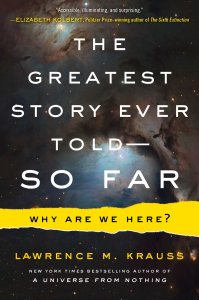
Lawrence M. Krauss: THE GREATEST STORY EVER TOLD — SO FAR

Lawrence M. Krauss’ new book is a book by a theoretical physicist, and so the greatest story turns out to be — a history of physics, especially of the last few decades.

He begins by emphasizing how this is a story of how science reveals a world that is profoundly nonintuitive, and undermines the simple assumptions humans have made about their world throughout history. Some sample lines from the prologue:

“It’s a story that deserves to be shared far more broadly. Already in the first world, parts of this story are helping to slowly replace the myths and superstitions that more ignorant societies found solace in centuries or millennia ago.” 1b. (1b means bottom of page 1, etc.)

2.8, “…what cosmic arrogance lies at the heart of the assertion that the universe was created so that we could exist?”

3.1, “Everything about our evolutionary history has primed our minds to be comfortable with concepts that helped us survive, … Evolution didn’t prepare our minds to appreciate long or short timescales or short or huge distances that we cannot experience directly…

3.7, “Surely that is the greatest contribution of science to civilization: to ensure that the greatest books are not those of the past, but of the future.”

A major step was humanity’s realization that there’s more to the universe than meets the eye, 4.8; we need a narrative to make sense of our existence; 6t, “We cannot understand that hidden world with intuitions based solely on direct sensation. That is the story I want to tell here.”

Then he begins with Plato’s cave as a powerful metaphor for how its residents do not perceive the outside world directly, but only as shadowed projected on the cave walls. Jumping forward, the first hints of a non-intuitive world were experiments in the 19th century showing that light behaved like particles in some contexts, like waves in others. Then Einstein a century ago, considering the points of view of observers moving relative to one another. Then quantum mechanics, and the uncertainty principle.

Along the way Krauss humanizes the scientists who did this work, with anecdotes about Feynman, about Fermi, Sheldon Glashow, Steven Weinberg, and others.

The story moves through the discovery of new forces, the advent of fission and the H-bomb, the understanding of fusion as what powers the sun; the idea of symmetry breaking, how all the various subatomic particles relate to each other and to field. And then to speculation about other particles, a potential unification, the construction of larger and larger colliders, culminating recently with the detection of the Higgs boson in 2012.

This gets a bit abstruse at times — symmetry breaking, gauge theories –and I did not follow every detail. (I was an astronomy major in college, until I hit physics for which I had no intuition for and couldn’t force myself through with math. So I became a math major, focusing on very different kinds of math.) I wasn’t familiar with the notion of spontaneous symmetry breaking, and how an apparent accident in the history of the universe resulted in our actual set of forces and their interactions, which had that breaking gone randomly a different direction, nothing we know of in the universe would exist. Krauss offers a couple elegant metaphors: a round dining table set with wine glasses; do diners pick up the glasses to their right, or left? Never mind convention — in principle it could be either way, and once a single diner makes a choice of left or right, that determines the choice for everyone else. Also, the way ice crystals form on a glass window, in treelike patterns in which the crystal lattice structure makes forces along the spine of a crystal quite different than a force perpendicular to that.

Krauss makes only brief mention of theories that attempt to extend the Standard Model of physics that has been vindicated by detection of the Higgs boson — superstring theory, M-theory. He calls them “mostly speculation”. He ends with the detection of gravity waves, portending something called quantum gravity, which might finally relate gravity to all the other forces wrapped up in the Standard Model. All the questions are not answered yet.

He concludes by considering the philosophy of what all this means and why we should care. He cites two contrasting views of the world, as humans wonder, why is there a universe at all? And why are we here? The first view is to assume we have special significance, that the world was creating for us; and that is the conventional, comfortable view of most people throughout history. The second view is to assume nothing, examine the evidence, and discover “a universe whose laws exist independently of our own being.” (303t) “The answer seems all the more remarkable because it reveals explicitly just how deeply the universe of our experience is a shadow of reality.” (303.7)

p309:

If we now ask why things are the way they are, the best answer we can suggest is that it is the result of an accident in the history of the universe in which a field froze in empty space in a certain way…

Our primitive ancestors survived in large part because they recognized that nature could be hostile and violent, even as it was remarkable. The progress of science has made it clear just how violent and hostile the universe can be for life. But recognizing this does not make the universe less amazing. Such a universe has ample room for awe, wonder, and excitement. If anything, recognition of these facts gives us greater reason to celebrate our origins, and our survival.

To argue that, in a universe in which there seems to be no purpose, our existence is itself without meaning or value is unparalleled solipsism, as it suggests that without us the universe is worthless. The greatest gift that science can give us is to allow us to overcome our need to be the center of existence even as we learn to appreciate the wonder of the accident we are privileged to witness.

Posted in Book Notes, Physics | Comments Off on Lawrence M. Krauss: THE GREATEST STORY EVER TOLD — SO FAR

Apple Valley History

Apple Valley was not quite so obscure a place as I may have implied. Even as a child, I was aware of a couple exceptional circumstances. First, it was the home of then famous (if by now likely forgotten) singing movie and TV stars Roy Rogers and Dale Evans. Their signature song was “Happy Trails to You…” (YouTube). My family even met them once, outside after church, at Church of the Valley along Highway 18. (My parents were nominally Methodists, but were not hard-line about it the way so many people are now; they took their kids to church, as I grew up, more as a matter of social habit than out of any motivation toward religious inculcation.)

Years later after Rogers and Evans died, there was a Roy Rogers Museum in Apple Valley, along Highway 18, that stood for many years. It later relocated to Missouri (http://www.royrogers.com/museum.html) and eventually closed. A few of their artifacts remain at the Victor Valley Museum, in Apple Valley, (http://www.sbcounty.gov/museum/branches/vvm.htm), that I visited in 2011.) Their legacy lives in the names of roads in Apple Valley: “Happy Trails Highway” (Highway 18, as it runs through the valley) and “Dale Evans Parkway”.

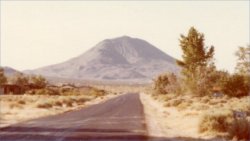
Apple Valley was also noted for its “house on the hill”. The hill is that narrow ridge that parallels the angled portion of Highway 18. At the top of which had been constructed a modernist house with a pool split between the indoors and the outdoors. The house was built by Newt Bass, one of the founders of Apple Valley, who along with Bud Westlund had developed the valley by buying 6300 acres of desert land with the intention of developing a cattle ranch; instead they sold the land as real estate, and became wealthy. There’s more background and many photos of the house in this article, Newt’s Paradise – Apple Valley’s Spectacular Hilltop House, on a blog devoted to historic southern California architecture.

The house was built in the 1950s (the article doesn’t say exactly when), and when my family lived there for several years in the late 1950s and early ‘60s, my father even took us on a tour of the house (enabled by the local real estate firm, Apple Valley Ranchos, if I recall). I remember that indoor/outdoor pool especially.

Years after we’d moved away, the house was nearly destroyed by fire in 1967. It was partially rebuilt, but never sold as a house, and was used as office space for some years, before being abandoned and falling into complete disrepair. The shell of the house is still there. I found this YouTube video of a local guy hiking up to the house in 2010, and discussing its history, and giving us views of the surrounding valley.

A story I heard later, from my father, was that a James Bond movie, Diamonds Are Forever (1971), had been filmed in that house. This was not true, I later discovered; the claim was some confusion with a similarly spectacular house in Palm Springs, the Elrod House, designed by John Lautner. (You can find a clip from that film, shot inside the Elrod House, on YouTube. And anyway the hilltop house in Apple Valley had burned down by then.)

*

I knew about Roy and Dale, and the hilltop house, as a child. More recently, in researching the area, and revisiting it in 2009 and 2011, I learned a bit more. Wikipedia’s Apple Valley entry tells us its history, including the railroad station established where Victorville is now, and how ranching and farming in Apple Valley fell off after World War I and the Depression. The last few apple groves were killed off by fungus infections in the 1940s.

In the ‘50s and ‘60s Apple Valley promoted itself as a desert resort town, a sort of cut-rate Palm Springs that was a bit shorter drive from LA and Hollywood, by 50 miles or so. Nestled below the Newt Bass hilltop house was the Apple Valley Inn, a high-end, for its time, collection of bungalows surrounding parking lots and a swimming pool. Wikipedia’s Apple Valley Inn page notes that that the Inn, which opened in 1948, “originally allowed only white Christians as patrons”. It closed to the public in 1987, though part of it still remains (www.historicapplevalleyinn.com/) as a facility that can be rented out for events.

The Wikipedia page for Apple Valley shows a long list of “notable people” who lived in or spent time there, evidence of its proximity to LA and its attraction as a desert resort. One example: none other than Richard Nixon spent three months at Newton Bass’s hilltop house, in 1961 (while we were living there!), writing his first book.

The Wikipedia page also has a list of films and TV episodes filmed there, including an episode of the popular TV series Perry Mason, and the film Ordinary People (the golf course scene perhaps? I’ve seen the movie a couple times and can’t now recall what scene might have been shot there).

The larger town of Victorville (Wikipedia), now cut through by Interstate 15 and traffic back and forth between LA and Las Vegas, has similar credits for films, if not residents. One notable Victorville event: in 1940 the screenwriters for Citizen Kane, Herman J. Mankiewicz and John Houseman, spent 12 weeks working on their script at the Kemper Campbell Ranch, in Victorville along the Mojave River and virtually on the border of Apple Valley.

On one of my return visits to the area, I think in 2009, I drove far into the still desolate north end of Apple Valley, to where my GPS map indicated a town named “Bell Mountain”, centered on an intersection of two roads a bit east of the actual mountain of that name. Little was there. Some web sleuthing turned up the fascinating information that a “community” had once settled there, by people who’d been rejected from staying at the Apple Valley Inn! There was even a post office there, for a while. But in 2009 there was no visible community (no commercial buildings at all, no shops, no gas stations, no diners), just remnants of old settlements, houses, and trailers. As ‘standards’ at the Apple Valley Inn relaxed over the decades, the need for segregation dwindled and vanished, presumably.

(As always — this is a first draft, potentially to be revised for later use.)
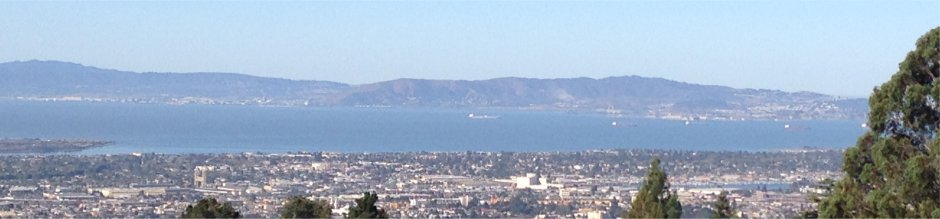
Posted in Personal history | Comments Off on Apple Valley History

Both Proud of Our Ships: TOS “The Corbomite Maneuver”

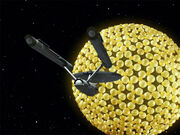
The Enterprise encounters an enormous alien vessel that blocks its path and threatens its destruction.

  • Now watching the episodes in production order; this one is production order #2, after “Where No Man Has Gone Before”; this was the first episode to feature DeForrest Kelley as Dr. McCoy, Nichelle Nichols as Uhura (wearing a tan uniform, though), and Grace Lee Whitney as Yeoman Rand. (And I have to say, in this and other early episodes, I’m impressed by the subtlety and complexity of Kelley’s characterization of McCoy. He was the equal of Shatner and Nimoy, even though he wasn’t given nearly as much to do.)
  • Along with “The Naked Time”, this has always been one of my favorite episodes, in part because it shows so much relatively routine interaction aboard the Enterprise; it details how things play out in a crisis, in ways elided in most later episodes.
  • Example of this: how systematically Kirk orders various changes to the ship’s speed – quarter speed, half speed, warp one, etc. – and thereby establishing the relationship between sub-light speeds and the warp speeds.
  • At the beginning of the episode the Enterprise is “star mapping”, a legitimate if rather routine task for such a big ship. Wouldn’t a smaller ship do just as well? Or automated probe? Also, with the stars, as usual, passing by the viewscreen pretty quickly, you wonder how it works when they time a star mapping shot to a particular moment. Aren’t they ‘filming’ or taking stills continuously? Bit of failure of imagination here, I’ve always thought.
  • Trek effects: the turbo-lifts are famous people moving devices, and the impression of the lifts moving quickly is illustrated entirely by the moving bars of light that presumably represent floors, or decks. But in almost every scene inside a turbolift, we see way too many of those moving bars than can be plausible, considering the number of decks imagined in the Enterprise – even before detailed schematics were developed after the show ended.
  • Bailey is a loose cannon, clearly unstable from the beginning, and I’m surprised how long he lasts. At first encounter with the alien ship, he says “I vote we blast it” and Kirk replies sardonically about the bridge not being a democracy. More to the point, this shoot-first and ask questions later attitude is typical of crude media science fiction, and one arc of this episode is how this attitude can be overcome – Kirk’s diplomacy and earnest appeals, trumping Bailey’s panic — into one of understand and mutual comprehension. [Conservative fear vs. humanistic acceptance, I am inclined to think.]
  • It’s fascinating in two or three scenes to see Kirk, not so concerned about the apparent danger from the alien ship, as he is curious about Bailey’s behavior, as Kirk eyes him.
  • At the end of Act 1, this is the first time we see the Enterprise fire its phasers. In typical Trek FX, the resulting explosion knocks everyone around aboard the Enterprise, and we see shots of crewmen in a corridor being tossed over to one side, and then the other.
  • In Act 2, more routine yet personal discussions, as McCoy counsels Kirk as they have a drink in Kirk’s quarters.
  • Yeoman Rand is introduced as bringing Kirk’s lunch, a “dietary salad” at McCoy’s direction. It was years after I first saw Trek before I understood that, in real life, a “yeoman” is not necessarily a woman. Kirk makes a remark here about how it’s irritating that he was assigned a female yeoman, but as the series went on, *all* the yeomen were female.
  • One of the great Trek FX shots is when the second ship, the Fesarius, approaches, appearing first as a small dot growing larger as it comes nearer… and keeps coming, until we realize that compared to the Enterprise, it’s *enormous*. A terrific sense of wonder moment. (Let me see if I can link to this image from the Memory Alpha page for this episode — though this isn’t as big in this shot as it gets.)
  • This episode has two great, memorable musical cues: the first, energetic and a bit frantic, when the initial cubical buoy is first seen; the second, a 2 by 4 note ominous theme, when the huge Fesarius appears. Music by Fred Steiner; I think the second theme may have been reused in later episodes, though I don’t think the first one was. [Later edit: it was]
  • The enhanced graphics versions of the Enterprise, from various interesting angles, and the Fesarius, are terrific; though I appreciate how the original cubical buoy was left deliberately fuzzy and multicolored, growing more and more fuzzy as it spun faster.
  • Interesting though uncharacteristic compared to later episodes, are how Kirk, several times, makes general announcements to the ship’s crew reminding them of the Enterprise’s noble mission, how misunderstands can be overcome, and so on. They serve of course also to inform viewers of what this show is about, as distinct from most movies and TV SF before it. And we never saw any such similar announcements in later episodes, as the series went on.
  • Balok, the voice from Fesarius – seen as a weird white bald head, through a fishy lens effect – informs the Enterprise that it will be destroyed. And it says, “We make assumption you have a deity, or deities, or some such beliefs which comfort you.” And so it gives them 10 minutes to prepare. This line represents a key theme throughout most of Trek, where time and time again we saw stories about how ideas of gods were obsolete, or how entities once thought to be gods were actually aliens, or computers, etc. (Though at least once there was dialogue in a later episode that implied an assumed monotheistic belief, as well.)
  • Kirk’s appeals to reason, to explain why the Enterprise is there, why they destroyed the buoy, and so on, grow frantic. “If you’ve examined our records… you know this to be true!!”
  • It’s nice how the Bailey/McCoy/Kirk character arc dovetails with Spock’s reference to chess, to inspire Kirk to another game, poker, which inspires the episode’s central conceit – the claim to Balok that the Enterprise is equipped with a special substance, corbomite, that reverses any attack on the ship to destroy the attacker. OTOH, his tone as he makes this claim (“We grow annoyed at your foolishness”) is so different from his earlier appeals, that anyone sensitive to human speech might immediately suspect some dishonesty.
  • Right after this there are a couple lines between Spock and Scott about Spock’s father and his human mother. One senses the insertion of these lines (likely by Roddenberry) to establish this key aspect of Spock’s character early on.
  • In Act 4 we see, again, a much more detailed rendition of an extreme ship event, in this case straining the engines, increasingly for several minutes, in an attempt to break the tractor beam hold from the alien ship towing them to their doom. Spock recites dangerous engine temperatures; everyone on the bridge shakes slightly, then moreso, as the ship vibrates dangerously; in the corridors, those crewmen fall over.
  • And so the threatening alien situation is redeemed: the Enterprise returns to assist the now disabled alien vessel that was towing it. The boarding party discovers that the weird white alien head was just a prop; the real Balok is a short little boyish creature. On the one hand, points here for supposing that the inside of an alien ship would not have the same dimensions as the Enterprise – the three who beam over and told to bend over, for the low ceiling at their destination, a consideration that I don’t think ever happened again in the entire series. On the other hand, the alien commander *assumes* that the humans would not have been frightened by his real form, thus the weird puppet prop – but surely it assumes too much to imagine what an alien race would be frightened, or comforted, by.
  • And while it’s striking to be told that this small Balok is in charge, without additional crew, of the whole Fesarius ‘complex’, we get no clue as to the purpose of such an enormous complex; or why Balok is suddenly so eager to recruit a companion for his travels. There’s a lot of unexplained backstory here – how big is his First Federation? When will they meet up again? And so on and on.
  • Yet the ultimate payoff is the comity between Balok and the Enterprise crew, representing the successful testing of unknown intentions and the defeat of xenophobic thinking, to the point where Balok offers to give them a tour of his ship. Last line: “Yes we’re very much alike, captain. Both proud of our ships.

The Blish/Lawrence adaptation, in ST12:

  • This very late adaptation is literal to the point of absurdity; we get words about characters crossing the room, or how the turbo lift comes to a stop and starts moving horizontally, p106.
  • And questionable wording, as in the first line: “Spock was making a map of the galaxy’s planet [sic] systems.”
  • And p110, “in the bridge”.
  • And in places there are a few extra lines, as if lines from the script were omitted during filming or edited out later:
    • Sulu warns Bailey about both Spock and Kirk
    • An explanation of what flypaper was (a reasonable thing to explain, in the 23rd century, perhaps)
    • Sulu says “this is for real” rather than, as broadcast, “this is not a drill”.
    • Near the end, Scott says “On your hunkers” rather than “Bend low”.
  • Most oddly, there are several passages that read as if the adapter is describing what was seen on TV, not what the characters were seeing, e.g. p117, referring to the bridge screen, “In the lower quadrant of its frame, the immense Enterprise hung motionless, and in the distance, the other ship (for it was a ship) was still small but was continuously growing.” And a similar passage later as Balok’s small ship tows the Enterprise. Just after that, the adaption has Kirk say to the bridge crew what he said, in the broadcast, as a captain’s log.
  • A striking scene not broadcast comes after Sulu utters the line, “I knew he would” [a continuity error; Sulu was responding to a line of Balok’s that wasn’t actually recorded], in which Kirk comments about Sulu not being “a very inscrutable Oriental” and Sulu responding—for half a page—about his watching movies from the time of the “Sino-Western trouble” in which the villains were Oriental and how Sulu was unable to mimic them. Cut from the script or cut for time in editing? And was that really appropriate banter during the last 60 seconds of a countdown that might have ended in the destruction of the Enterprise?
Posted in Star Trek | Comments Off on Both Proud of Our Ships: TOS “The Corbomite Maneuver”

Links and Comments: Expertise, Dunning-Kruger, Tactics of Denialists

NPR’s Adam Frank on Why Expertise Matters, commenting in part about Tom Nichols new book The Death of Expertise: The Campaign Against Established Knowledge and Why it Matters.

Frank quotes a couple key passages from Nichols:

Nichols is profoundly troubled by the willful “know-nothing-ism” he sees around him. Its principle cause, he argues, are the new mechanisms that shape our discussions (i.e. the Internet and social media). He writes:

“There was once a time when participation in public debate, even in the pages of the local newspaper, required submission of a letter or an article, and that submission had to be written intelligently, pass editorial review, and stand with the author’s name attached… Now, anyone can bum rush the comments section of any major publication. Sometimes, that results in a free-for-all that spurs better thinking. Most of the time, however, it means that anyone can post anything they want, under any anonymous cover, and never have to defend their views or get called out for being wrong.”

Nichols also points to excesses of partisanship in politics, the weakening of expectations in schools and, finally, to human nature. The last cause, he says, is particularly troubling. As he puts it:

“Its called the Dunning-Kruger effect, which says, in sum, that the dumber you are, the more confident you are that you’re not actually dumb. And when you get invested in being aggressively dumb…well, the last thing you want to encounter are experts who disagree with you, and so you dismiss them in order to maintain your unreasonably high opinion of yourself.”

Frank concludes,

More importantly, being a true expert means having a healthy dose of humility. If you have really studied something and really gone deep into how it works, then you should come away knowing how much you don’t know. In a sense, that is the real definition of an expert — knowing the limits of one’s own knowledge.

\\\\

From New Scientist, Links and Comments: Expertise, Dunning-Kruger, Tactics of Denialists

“Denialism is inevitable whenever powerful financial, governmental, cultural or religious interests come into conflict with scientific reality.”

Six tactics used by those who would deny climate change, the efficacy of vaccines, or challenges to the policies of the Trump administration:

  • Allege that there’s a conspiracy. Claim that scientific consensus has arisen through collusion rather than the accumulation of evidence.
  • Use fake experts to support your story. “Denial always starts with a cadre of pseudo-experts with some credentials that create a facade of credibility,” says Seth Kalichman of the University of Connecticut.
  • Cherry-pick the evidence: trumpet whatever appears to support your case and ignore or rubbish the rest. Carry on trotting out supportive evidence even after it has been discredited.
  • Create impossible standards for your opponents. Claim that the existing evidence is not good enough and demand more. If your opponent comes up with evidence you have demanded, move the goalposts.
  • Use logical fallacies. Hitler opposed smoking, so anti-smoking measures are Nazi. Deliberately misrepresent the scientific consensus and then knock down your straw man.
  • Manufacture doubt. Falsely portray scientists as so divided that basing policy on their advice would be premature. Insist “both sides” must be heard and cry censorship when “dissenting” arguments or experts are rejected.
Posted in Conservative Resistance, Psychology | Comments Off on Links and Comments: Expertise, Dunning-Kruger, Tactics of Denialists