Links and Comments: Bannon’s historical cycles; the Myth of Main Street; Late Bloomers

Interesting stories and essays from Sunday’s New York Times.

Bannon’s Worldview: Dissecting the Message of ‘The Fourth Turning’

A news article about a book that has influence Steve Bannon’s thinking about the world, a book by two amateur historians, that

makes the case that world events unfold in predictable cycles of roughly 80 years each that can be divided into four chapters, or turnings: growth, maturation, entropy and destruction. Western societies have experienced the same patterns for centuries, the book argues, and they are as natural and necessary as spring, summer, fall and winter.

This idea of inevitable cycles of history is almost certainly bogus. It plays upon the gullible by appeal to human nature’s tendency to understand the world through *narrative* — some kind of explanatory story that explains why otherwise random events happen. It’s also telling that such prophecies, when suitable vague, can be later cited to explain anything. And it’s also telling that stories like this are used to justify conservative conformity. (“Conform, or Else” is one of the example passages given in the article.)

The danger of this kind of thinking is that, like religious fundamentalists who believe the end of the world (and the second coming) is approaching, such believers may, even if unconsciously, strive to *bring about* the destruction they think is merely inevitable. That makes such crazies dangerous to the rest of us.

\\\

The Myth of Main Street, an op-ed by Louis Hyman, about the notion that small-town main streets represent the ideal state of American being.

Yet another example of the fallacy that some ideal state existed in the past; it’s a conservative fallacy. (Make America great again!) In fact, as the essay discusses, not only has this yearning been around for nearly a century, but the ideal of main street makes no economic sense.

It’s worth noting that the idealized Main Street is not a myth in some parts of America today. It exists, but only as a luxury consumer experience. Main Streets of small, independent boutiques and nonfranchised restaurants can be found in affluent college towns, in gentrified neighborhoods in Brooklyn and San Francisco, in tony suburbs — in any place where people have ample disposable income. Main Street requires shoppers who don’t really care about low prices. The dream of Main Street may be populist, but the reality is elitist. “Keep it local” campaigns are possible only when people are willing and able to pay to do so.
In hard-pressed rural communities and small towns, that isn’t an option. This is why the nostalgia for Main Street is so harmful: It raises false hopes, which when dashed fuel anger and despair. President Trump’s promises notwithstanding, there is no going back to an economic arrangement whose foundations were so shaky. In the long run, American capitalism cannot remain isolated from the global economy. To do so would be not only stultifying for Americans, but also perilous for the rest of the world’s economic growth, with all the attendant political dangers. The only choice is turning to the future.

And as an example of his first paragraph, the area of Oakland where I live is close to Montclair Village, a charming neighborhood of shops and restaurants just as described above. (It’s where we shop to support the ‘local economy’ and to stroll down pleasant streets, but not for the cheapest prices.)

\\\

Another op-ed: To Be a Genius, Think Like a 94-Year-Old

The essay discusses the notion that, like athletes and mathematicians, STEM students and technology innovators peak early.

On the contrary, there’s plenty of evidence to suggest that late blooming is no anomaly. A 2016 Information Technology and Innovation Foundation study found that inventors peak in their late 40s and tend to be highly productive in the last half of their careers. Similarly, professors at the Georgia Institute of Technology and Hitotsubashi University in Japan, who studied data about patent holders, found that, in the United States, the average inventor sends in his or her application to the patent office at age 47, and that the highest-value patents often come from the oldest inventors — those over the age of 55.

And note the graph.

(And for what it’s worth, my personal achievements of the past 5-7 years — sfadb.com and my reconception of science fiction around my set of ‘provisional conclusions’ — are, if yet incomplete, more significant than anything I did earlier.)

Posted in Culture, Narrative, Religion | Comments Off on Links and Comments: Bannon’s historical cycles; the Myth of Main Street; Late Bloomers

Religious Zealotry in Science Fiction

There has been a controversy within the SF field over the past few years about how groups called the “sad puppies” and the “rabid puppies”, for various reasons, have mounted campaigns to influence the Hugo Awards nominations. (They succeeded two years ago, had a lesser influence one year ago, and have still had an influence on this year’s ballot.) This isn’t a single campaign; some of these people are sad that all SF is not basic space opera, with obvious good guys and bad guys; others are right-wing racists, who think that any fiction by women or non-white men is somehow depleting the strength of the genre and Western civilization in general; and some of them are fundamentalist Christians, who think that any writers who do not think their way are enemies of the state.

An example of the last came to the attention of many of my Facebook friends this past week: an interview with an SF/fantasy author on a site called National Catholic Register: An Interview with Catholic Sci-Fi Author John C. Wright.

John Crowley, an esteemed author of science fiction and fantasy with literary bona fides, reacted to the interview on a Facebook post on April 3rd,

The most egregious thing about such notions is that the writers do not understand what fiction is. As they see it, it can only be a sort of fanciful representation of notions, thoughts, or programs. The concept of using strands out of intellectual or other history for the purposes of sheer play is inconceivable to them.

Among the many comments to Crowley’s post, author and editor Scott Edelman commented,

As this is the same writer who insisted, “I have never heard of a group of women descended on a lesbian couple and beating them to death with axhandles and tire-irons, but that is the instinctive reaction of men towards fags,” his blather is to be ignored. There are no life lessons of his worth minding.

This author’s interview describes his early ‘atheism’, or indifference toward religion, followed by a growing antipathy toward non-religious thinking.

My faith in faithlessness eroded over a period of years when I slowly realized that my loyal allies, the atheists, were not merely wrong, but brain-meltingly, blindingly, foam-at-the-mouth barking moonbat wrong on all the major political and social issues of the day, from war and peace to abortion to homosex to contraception.

As if these attitudes, which obviously disregard the slightest respect for how others might have different attitudes, are not bad enough — he then has a heart attack, and visions:

I went to the hospital to see what had happened. At the time, I thought it an attack of pleurisy. The doctor said I had five blocked arteries leading to my heart and I should be dead. I said I did not know I had five arteries.

While I was waiting, the Holy Spirit entered my body. The sensation was like a physical sensation, but it was not. It was spiritual. It was like wine being poured into a dirty cup.

And of course this medical incident, which one might suppose involved some kind of brain damage, confirmed his predispositions. And now he is so absolutely certain of his convictions, that he passes judgements on other writers for their lack of similar convictions — who are therefore “enemies of the camp”.

More dangerous are writers of real skill and talent whose spiritual vision is awake, but whose loyalty is in the enemy camp: I put the remarkably talented Ursula K LeGuin in this category, for she can capture the spiritual look, feel, and flavor of Taoism without ever once revealing her own spiritual preferences; and likewise Mr. John Crowley, who is a gnostic, and peppers his work with themes that make the heresy seem quite inviting and new.

Religious zealots are common throughout history, but here is one nesting in the heart of the science fiction field. I don’t dwell on this (to spend half an hour composing this post) except to note this conclusion: the more absolutely certain anyone is of their convictions, especially religious convictions, the more likely they are wrong, that their convictions are derived from psychological issues, and certainly not based on any kind of rational conclusion about empirical evidence from the real world.

(I might note that as editor of Locus Online, I’ve had no trouble reviewing Mr. Wright’s novels — e.g. this review by Paul Di Filippo.)

Posted in MInd, Religion | Comments Off on Religious Zealotry in Science Fiction

No Beach to Walk On: TOS “The Naked Time”

An infection brought on board the Enterprise causes crew members to reveal their innermost fears and desires, as the ship spirals in toward a disintegrating planet.

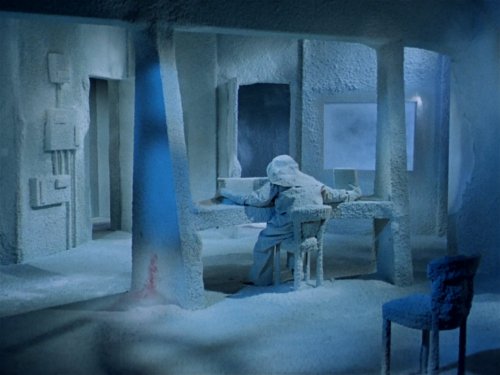
  • This time the planet is blue, appropriately, since it’s a cold ice-planet. In the enhanced graphics, there’s a new shot of the domed building of the scientific outpost.
  • The story is triggered by a doofus move – an idiot plot device – in that not only are the suits that Spock and Tormolen beam down in not sealed (so that any airborne contagion could still infect them), but Tormolen takes his glove off, to scratch his nose, and then touches a surface and gets infected.
  • Trek physics: the crisis of the episode depends on the idea that this planet, Psi 2000, is “breaking up”, which somehow means that its mass and magnetic fields are changing, which affects the Enterprise’s orbit, which is problematic because people on board are infected with a disease that renders them unstable and that puts the ship in jeopardy. What were they thinking of? What does it mean for a planet to “break up”? Real astrophysics suggests planets are extremely stable unless they are hit by something, in which case chunks might be blown out of them, yet would still remain largely stable (as Earth perhaps survived an impact that split off the Moon). Otherwise… even if a planet were disintegrating for some reason, its mass would have to go *somewhere*; that mass wouldn’t somehow just disappear, disrupting the Enterprise’s orbit.
  • Later in the show there’s a line about how, as the planet shrinks, the Enterprise adjusts its orbit to “maintain the same distance” from the planet’s surface. Why would it need to do that?
  • The enhanced graphics exacerbate the problem: we see the planet surface spinning past so fast, beneath the Enterprise, on the view monitor, that it’s amazing the ship doesn’t slingshot away into space. The new graphics aren’t any more valid scientifically than the old.
  • There’s a serious ethical theme here, as Tormolen wonders “if man was meant to be out here…” It’s not as trivial an issue as it might have seemed at the time, as here in the 21st century we realize what humanity has done and is doing to this planet.
  • This has long been a favorite episode – it was a Hugo nominee – mostly I suppose for its revelations of character among the crew: Sulu and his rapier; Riley and his song; Spock and his confessions; Kirk and his anguish.
  • Sexism: Riley, infected, locked into the engineering room, gives out fanciful orders over the intercom to the entire ship, focusing on women’s makeup and how their hair should be worn loosely around their shoulders.
  • It’s been one of my favorite episodes for one particular reason: the rhythm and pacing, especially of the second half of the show, maintains a tension unmatched in any other episode. You see it ratchet up, in a yin and yang of competing forces: routine communications alternating with increasingly emotional outbursts: Uhura to Kirk rather blandly: “Have you found Mr. Spock?” Kirk responds, almost hysterically: “YES I’VE FOUND MR. SPOCK I’M TALKING TO MR. SPOCK RIGHT NOW!” at which point Kirk realizes he’s infected too.
  • There are plot issues, of course – any show, like a series produced every week, is done so quickly it’s amazing they get so much done that still seems right decades later – but I couldn’t yet notice that, why weren’t Kirk and Spock infected earlier, when they brought Sulu down, instead of later via Nurse Chapel’s tears?
  • Famous line: Sulu, infected and playing swashbuckler, presumes to protect Uhura, calling her a “fair maiden”. To which Uhura replies, so quickly you almost don’t notice, let alone absorb the implications of what she says, “Sorry, neither.”
  • First time we see the (first season) engine room. I think. I really should watch these episodes in production order, rather than broadcast order.
  • And first time we see Scott’s “Jeffries Tube”. I think.
  • And first time we see Spock’s neck pinch, or nerve pinch, I think.
  • Trek physics: talk about the engines having been turned off, the “intermix formula” for matter and antimatter, and having to raise the temperatures of those without risking “implosion”.
  • The enhanced graphics include a chronometer on the nav panel where Sulu sits – it shows not only a clock but a *stardate* counter, which, in keeping with the dialogue and story line, changes from 1705.0 back to 1702.0.
  • Trek physics: the “theoretical relationship between time and antimatter”, as Spock says, results in the ship going back in time, and moving “faster than is possible for normal space”, as they start the engines anyway and escape from the planet. This sets up the later episode, “Tomorrow Is Yesterday”, in which they accidentally go back in time to Earth in the 1960s.
  • Still, the enduring highlight of this episode is the revelation of the characters. Spock’s breakdown was a last minute story idea (according to Memory Alpha), was shot in a single take, and resulted in fan mail to Nimoy going exponential.
  • The end: calm. They acknowledge the potential for time travel, to any era, any planet, and suppose they might try it someday. And Kirk says, “steady as she goes.”

Blish’s adaptation, in ST1:

  • Blish avoids the contamination scene, in which Tormolen takes off his glove and exposes himself to an infection, entirely. Blish has Kirk make some plausible speculation about why the dead members of the observation station behaved the way they did, in response to having some infection (e.g., someone would take a shower with clothes on in a hurried attempt to decontaminate themselves).
  • Blish has the planet named some long technical string, and the nicknamed “La Pig”, rather than the Psi 2000 of the script.
  • Blish tries to rationalize the idea of the planet’s breakup, and how it would affect the Enterprise orbit, p79t: “As the breakup proceeded, the planet’s effective mass would change, and perhaps even its center of gravity – accompanied by steady, growing distortion of its extensive magnetic field – so that what had been a stable parking orbit for the Enterprise at one moment would become unstable and fragment-strewn the next.”
  • There are substantial differences between Blish’s version and the broadcast story, since the latter involved some elements introduced in the last stages of production. In particular: Spock’s breakdown in the briefing room, and the entire time travel sequence at the end, are not here. Nor is Scott’s phasering through the wall to get into the engineering room. Instead, McCoy’s antidote to the disease involves a gas spray into the ship’s ventilation system. Riley recovers in the response to that, and lets the others into engineering himself.
  • At the same time Blish has some remarkably implausible sequences in which, Kirk having thrown emergency bulkheads inside the ship, to stop the spread of the disease, has Uhura crawl between the hulls and communicate the McCoy by knocking on the metal in “prisoners’ raps”…! The crews’ communicators don’t work inside the ship?
  • Instead of Spock’s breakdown and recovery seen in the broadcast version, in Blish’s story Spock experiences a “general malaise” and excuses himself to his quarters. At the end of the story, he is heard crooning to himself in his cabin and playing some instrument that “nobody else on board could stand to listen to it”.
Posted in Star Trek | Comments Off on No Beach to Walk On: TOS “The Naked Time”

You Can’t Know What It’s Like: TOS “Where No Man Has Gone Before”

In this second series pilot, the Enterprise encounters an energy barrier at the edge of the galaxy that triggers ESP in two crewmembers.

  • Watching the current CBS blu-ray set of these episodes, here we see nicely enhanced graphics of the galaxy, the haze of the Milky Way, as the Enterprise approaches the “edge of the galaxy”.
  • Trek physics: the whole concept of the “edge of the galaxy” is ludicrous, of course; it’s like speaking about taking a walk to half a yard outside a valley. There’s no edge of a galaxy, or a valley, that is that distinct. None other than Isaac Asimov wrote an article in TV Guide, around late 1966 or so (he’d at least seen this episode of Trek, and had seen Lost in Space), criticizing this point, though of course the errors in Lost in Space were worse.
  • This was the second pilot, to NBC, after “The Cage” [which was later incorporated into “The Menagerie”], though not the first episode shown as it ran on TV. By the time the show went into regular production, things had changed, like the uniform colors and trim, the shape of the viewscreen monitor on the bridge, and so on. Spock’s make-up here is relatively crude; Scott has an oddly colored tan shirt; Spock wears a gold shirt, like Kirk, not the blue one he wore later, throughout the series.
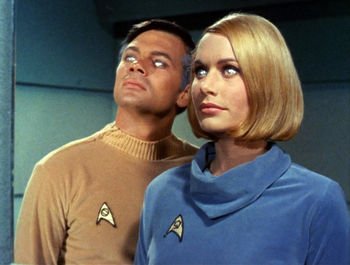
  • The two guest stars here were relatively prominent actors: Gary Lockwood, who played Gary Mitchell, later starred in 2001: A Space Odyssey, and Sally Kellerman, who played Elizabeth Dehner, later starred in the film MASH.
  • As in other early episodes, we see lots more crewman in the corridors, as well as ladders and overhead panels that weren’t bothered with in the later shows.
  • Sexism: there’s a “Yeoman”, Smith, on the bridge in the early scenes, whose job is merely to serve coffee apparently; she doesn’t do anything else. In a later scene, as the ship is endangered, Gary Mitchell reaches behind him to hold her hand, implying I’m not sure what – that they know each other? Or more likely that he feels compelled to offer comfort to the nearest frail woman?
  • (It was some years after watching Trek in its first run before I learned that the word “yeoman” didn’t automatically mean female… They always were on Trek.)
  • More sexism: when female crewmen appear (I think this is true throughout the show), they are either taken for granted as service providers (bringing lunch, or coffee, as Yeoman Rand does in “Charlie X”), or are treated an exceptional to the acceptable routine of male experts. When Elizabeth Dehner appears on the bridge to discuss ESP, Gary Mitchell asks sarcastically if her job is to “improve the breed” and then, when she says, “I heard that’s more your specialty” Gary turns away and remarks to the nearby helmsman, “Walking freezer unit”. (Because they couldn’t say the b word on 1960s TV.)
  • As Spock listens to tapes from the Valiant, the ship whose recorder they’ve picked up, which preceded them exiting the galaxy (by half a light-year!), he talks about a “magnetic space storm”. Is this a real thing? Trek repeatedly invokes such events, and Lost in Space did all the time (more often as “cosmic storms”), and I’ve never understood what they meant, if those were real things. (We do hear about solar flares that affect Earth’s magnetic field, but such ‘storms’ are surely a problem only relatively close to a star, compared to the Enterprise being out in interstellar space.)
  • It’s odd how the barrier becomes visible only as the Enterprise approaches it. Interstellar and intergalactic space is remarkably transparent — that’s how we can see galaxies a billion light years away. And why is it a band that happens to be horizontal with respect to the Enterprise’s current orientation? (Trek physics: because the writers and producers project movements and events that we experience on a subjectively ‘flat’ Earth into three-dimensional space, without thinking about it.)
  • The SFnal premise here is about ESP, extra-sensory perception. In the story, the lost Valiant had been investigating the topic, in their last hours. Now Kirk asks Dehner what she knows. “It’s a fact that some people can sense future happenings – read the backs of playing cards and so on.” This is an obsolete premise; it’s not a fact, as we know in 2017, that people can do that. ESP, telepathy, and the like, were fads in the 1950s and 1960s, when there seemed to be some reputed evidence. In SF literature, such themes were routine, even in the “hard SF” magazine Analog. But as the decades passed, reliable evidence never showed up, and modern understanding of neurology and the mind rules such powers out. There is no telepathy, no psychokinesis, no visions of the future, none of it.
  • After the Enterprise retreats from its exploration into the force field at the edge of the galaxy, its warp ability gone, Kirk comments in his log that “Earth bases that were only days away are now years in the distance.” This is a nice, and rare, acknowledgement of the difference between their warp drive, that allows fast transit between stars, and lack of warp drive, which is far less than the speed of light.
  • Watching this episode now on Blu-ray, on a big TV, I can see details I never saw before. You know those medical panels above the beds in sick-bay, with several vertical scales that display various medical conditions? Now I can see them: the scales are for Temp, Brain, Lungs on the left; Cell Rate, Blood, Blood, on the right. [Or are these enhanced graphics?]
  • Gary Mitchell, having been zapped by something in the force field at the edge of the galaxy, develops superpowers. He lies in bed in sickbay, and reads Spinoza on a small monitor that extends on an arm over his bed. To Kirk, he calls Spinoza “simple, childish”, and says he doesn’t agree with him at all. In the next scene on the bridge, Spock monitors Gary’s reading, as he reads faster and faster, a page every second. Now I can see that the pages are headed “The Ethics”. Which is in fact a work of Spinoza’s. Give the production team points for attending to such details. (OTOH I didn’t try to read the text on those screens.)
  • Dehner is assigned to monitor Mitchell. Mitchell complains to Kirk that with 100 women on board, couldn’t he do better? Point here, 100 women is about ¼ of the entire crew.
  • Sexism: Dehner tries to mollify Mitchell: “Women professionals do tend to overcompensate”. Argh.
  • Dehner challenges Mitchell’s reading retention, and he quotes a sonnet: “My love has wings, slender feathered things with grace and upswept curve and tapered tip”, that he attributes to Tarbolde from 1996 (!).
  • When Spock examines personnel records for Dehner and Mitchell, we see typewritten cards that display, among other things, dates of birth. Dehner’s is 1089.5, Mitchell’s is 1097.7. Are these… star dates? More about this below.
  • The Enterprise travels to Delta Vega, somehow only a few days away (without warp), that has an impressive lithium cracking station – impressive in the visual. At Spock’s cold advice, Kirk realizes he has to maroon Mitchell there, before his powers enable him to take over the ship, and the Earth colony they might next go to. It doesn’t go well. Mitchell escapes; Dehner develops similar powers, and Kirk chases after them. He tries to negotiate with Dehner, about the danger Mitchell portends: “You know the ugly savage things we all keep buried that none of us dare expose. But he’ll dare–!”
  • Mitchell makes tombstone appear, for Kirk, and it reads 1277.1 to 1313.7. The latter date coincides with the log entry star dates in this episode. But meaning what? I think that by this time the production staff had not decided what stardates meant. The eventual meaning was that one stardate meant one day… but this tombstone implies *years*. More about star dates in later episodes.
  • Despite Mitchell’s godlike powers, Kirk defeats him in a fistfight, with a laser rifle and a handy block of stone. Dehner, drained from fighting Mitchell, dies: “You can’t know what it’s like to be almost a god.”
  • Broad theme: would humans with superpowers be a good thing, or not? Would such beings threaten those without those powers? This theme is still very much with us.
  • Memory Alpha notes that the fistfight at the end is what sold NBC the show. -!! This was the primary way in which “Where No Man Has Gone Before” was superior to “The Cage,” in NBC’s view, apparently, and Trek TOS repeatedly staged such action scenes, in the manner of westerns at the time, since that was how real men dealt with their disputes.
    • In contrast, such crude violence went out of style in succeeding decades; did Picard ever get into a fistfight with anyone? (Not rhetorical; I don’t recall.) Steven Pinker, in his study of the history of violence The Better Angels of Our Nature, cites this diminished taste for physical violence in (certain kinds) of popular entertainment as one of many such trends of just the past 50 years.
  • We learn that “The Man Trap” was chosen as the first episode to be broadcast, because for various reasons the other episodes completed by then had issues, and the issue with “Where No Man Has Gone Before” was that it was too expository…
  • The episode ends on a reflective note, with Spock admitting that he too “felt” for Gary Mitchell, and Kirk wryly replying that “I believe there’s some hope for you after all, Mister Spock.” This is the first of many acknowledgments throughout the show, and especially in the first season, of Spock’s dual nature, though in ways that have always struck me as a tad patronizing. Spock’s heritage is one of subduing his emotions in the service of logic and rationality, and presumably this attitude has got him where he is, as science officer on a ship full of what amount to him as alien beings. (One might wonder, why didn’t Spock stay on Vulcan, or join the Vulcan starship we hear about in a later episode?) Yet those alien beings are always ready to rub in any example of his internal discipline slipping in any way. Hmm. May revisit these thoughts in later episodes.


The Blish/Lawrence adaptation (in ST 8, p85):

  • Being in a later book, this ‘adaptation’ is much more literal than those in Blish’s first three or four volumes. Discrepancies from the broadcast script are mostly incidental – a few extra or missing lines here or there, as if the adapter didn’t have the very final version of the script, or because changes were made during filming that were never documented in a script.
    • E.g. p86, reference to a “Q signal” before the Valiant’s recorder begins transmitting.
    • P108, more lines from Gary Mitchell as he and Dehner have escaped into the hills: “Soon we will fully control our bodies. We’ll never grow old. You’re woman enough now to like that. Always young, as beautiful as you desire to be.”
    • 6, Kirk’s plea to Dehner is “In God’s name, Doctor, make you prognosis!” using a phrase I think never uttered in the broadcast show.
    • P111, it’s missing Dr Dehner’s last line in the broadcast, “You can’t know what it’s like to be almost a god” in favor of “It’s—all over, isn’t it?” This seems like a last-minute inspiration on the part of the director or actor.
    • P111, and Kirk’s final line is different: as broadcast, “I believe there’s some hope for you after all, Mr. Spock” while the adaptation has “Watch yourself, Mr. Spock. Your compassion is showing.”
  • The adaptation does try to ‘explain’ the changes roles of some regular characters: how Sulu is now a physicist; how another doctor is on board because McCoy is on ‘special study leave’ p88. At the same time the adaptation retains obsolete terminology: “materializer” instead of transporter.
  • There are a couple passages in which one wonders how familiar the adapters were with the show, in odd choices of words: p105.8, after repairs the Enterprise is ready for “takeoff”.
Posted in Star Trek | Comments Off on You Can’t Know What It’s Like: TOS “Where No Man Has Gone Before”

I Have Taken My Form Centuries Ago: TOS “Charlie X”

The Enterprise picks up a human orphan who’s grown up supposedly alone on an alien planet.

  • The enhanced graphics, which in an episode like this matter only in scenes of ships rendezvousing or sailing through space, show a more detailed Enterprise, but especially in the first scene, with Enterprise and Antares, they look obviously CGI, a bit artificially phony compared with the relative solidity of seeing models.
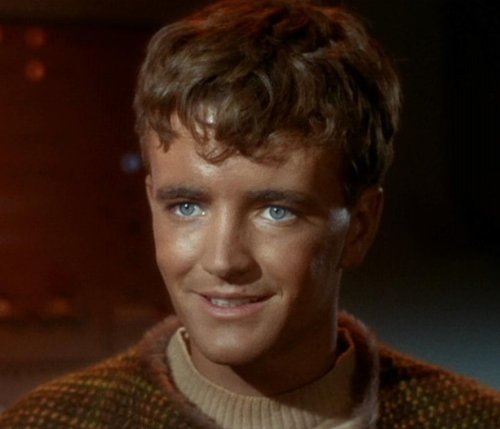
  • Interesting how the main guest character here has a telling tic, as in “The Man Trap,”  where Nancy or her other guises were constantly chewing on their knuckle – here Charlie, when provoked, rolls his eyes up into his head as he makes someone go away, or breaks Spock’s legs. These things might have been in the script, but sometimes they were inspired directorial suggestions.
  • Here we establish that each ship has a distinctive emblem patch sewn onto its crews’ uniforms.
  • Charlie is a classic awkward adolescent, but some of his behavior strikes autistic chords – he interrupts, he has no social skills, he frets about being liked. “I tried to make them like me!”
  • Trek physics: the ‘roar’ of the ship as it passes the POV, even in deep space.
  • As in other early episodes, there nice scenes of everyday crewmen busy about the ship, including a scene (with up and down scale harp music; music in this episode by Fred Steiner) as Charlie watches a technician guiding a plastic pipe downward through a hatch in the floor. And later, a key scene in which Spock, Uhura, and numerous random crewmen hang out in a rec room, with Spock playing his oddly-shaped harp, and Uhura singing, until Charlie interrupts and demands attention.
  • And later: a scene set in a gym, with random crewmen doing calisthenics in the background. We never see this gym again, in the entire series.
  • Set design: The astronomical photos mounted on the upper walls around the bridge are curious. They’re cool but pointless, like the huge galactic photo on the wall of Alpha Control at the very beginning of Lost in Space.
  • Set design: it’s been noted how much the set design benefited from lighting – especially in the corridors and rooms of the Enterprise, how colored lights gave the same sets different looks for different scenes.
  • Kirk isn’t actually particularly good at explaining awkward adolescent things to Charlie.
  • Tech anachronism, perhaps: in this episode we have Kirk instructing a chef to use meatloaf to simulate turkey for “Earth day’s Thanksgiving”, while later in the show (especially by Next Gen), virtually any food or drink can be manufactured with a push of a button, or voice command.
    • Of course he means the United States’ Thanksgiving, and it’s a parochial, nationalistic assumption in TOS that specifically American values will prevail, some 300 years from now. (Another example was how the list of potential starship names, as given in The Making of Star Trek (p164), includes Lexington and Yorktown, significant names in American history no doubt but hardly likely to be so in the world history of 300 years from now.)
  • I have a “Nitpicker’s Guide” book about TOS that points out continuity errors, and I’m trying not to look at it — but I noticed a huge continuity error while watching this evening. After Kirk tries to explain something to Charlie, Kirk is summoned to the bridge, and Charlie follows. Before leaving, Kirk is wearing his gold shirt. When they reach the bridge, he’s wearing his green lounge shirt.
  • Mention in captain’s log of “UESPA”, pronounced “you-spa”, which is never mentioned again.
  • Charlie’s awkward devotion to Yeoman Janice Rand: “If I had the whole universe, I’d give it to you.”
  • Trek physics: how the stars *stream by* as the Enterprise is underway to a new destination. Think about this: suppose the average distance between stars, in our area of the galaxy (not the galactic core) is roughly 4 light years, as our sun is from Alpha Centauri. When the Enterprise travels at warp 1, the speed of light [though I think the relationship between warp speeds and multiples of the speed of light is never specified in the show itself, but was extrapolated in various concordances and commentaries], it would take *four years* to travel from one star to the average next. At warp 10, 1000 times the speed of light [by those extrapolations], it would still take…. 1.5 days to travel from one star to the average next. So how fast would the Enterprise need to move for the stars to be visibly streaming past the camera?? It doesn’t bear close examination. But it makes for subjectively comfortable visuals.
  • Striking scenes from when I first saw this episode at age 11: Charlie turning a woman (a young woman, as is invariably referred to as a “girl” in this series) into an iguana. Another young woman he turns into a very old woman, who is horrified when she realizes her condition. And finally – as Charlie shuts down a raucous rec room, a victim, another woman, stumbles into the corridor *with no face at all*, just a featureless mask.
  • This story is tragic and has a sad ending. Charlie survived for 14 years on a desolate planet by being given special powers by the native Thasians – and now he can’t not use them, to qualm his adolescent fears and rejections, to strike back at those who offend or make fun of him. The Thasians come to take him back, and restore most of his damage. He pleads with his fellow humans. “I can’t even touch them! I want to stay….!”
  • Kirk, to give him credit, tries to negotiate.
  • Mysterious line: the Thasian appears on the bridge and says, “I have taken my form centuries ago so that I may communicate with you.” What does this mean? Centuries ago? No explanation – but its intriguing implications were the kind of thing that thrilled me about this show, more than its surface adventure. A sense of wonder moment, a momentary glimpse at something barely understandable.
  • Ending here also muted. Janice, having reappeared on the bridge (in the nightgown she was wearing when Charlie made her disappear from her quarters), weeps subtlety, stepping up to the comfort of the captain’s chair. Kirk comforts her: “It’s all over now.”
  • This was the first story adaptation by James Blish in his very first Star Trek book. He titled the story “Charlie’s Law”, and he ended it by emphasizing Janice’s anguish:

The boy and the Thasian vanished, in utter silence. The only remaining sound was the dim, multifarious humming surround of the Enterprise.

And the sound of Janice Rand weeping, as a woman weeps for a lost son.

  • After browsing Memory Alpha today – it seems to be the ultimate compendium for story details and production background of every Trek series and film that has ever existed – I should stand corrected on my comment two posts ago that Blish apparently improved on many of the scripts he turned into short story narratives. He was working from early versions of scripts – literally, early typewritten drafts the studio didn’t need any more and mailed to him – and so plot differences from broadcast episodes were at least in part for that reason. Thus, in his version of “The Man Trap”, which he called “The Unreal McCoy”, the characters were named Bierce, not Crater, and the planet was Regulus VIII, not M-113. Still, I should reread Blish’s versions, and follow Memory Alpha’s notes, and try to figure out why I thought Blish’s versions were sometimes superior to the broadcast episodes.

Blish’s adaptation, in ST1:

  • First, Blish renames the story “Charlie’s Law”, as in, be nice to Charlie or else.
  • As was common in these early books, Blish summarizes scenes as often as he transcribes all the dialogue from some scenes.
  • The story explicitly states that Kirk is fond of Rand – a point of possibility that, the producers of the show realized, led to Rand’s character being written out (so the possibility of a romance between them would not interfere with Kirk fraternizing with guest characters)
  • Twice in the book Blish calls Uhura “Bantu”.
  • He references the other ship’s “Nerst generator” – a term from his own Cities in Flight stories, I recall, since when I first read and reread Blish’s early Trek books, I also read his quartet of “Cities in Flight” novels.
  • Blish expands a last-word line from Charlie, p18t: “Being a man isn’t so much. I’m not a man and I can do anything. You can’t. Maybe I’m the man and you’re not”. The script did not include, or omitted, the final line.
  • Blish omits the silly scene of the bridge crew turning every device on to challenge Charlie’s control.
  • The line about “I have taken my form centuries ago….” Is missing, but Blish has a different mysterious reference, as the Thasian explains why they can’t restore the crew of the other ship: “We could not help them because they were exploded in this frame; but we have returned your people and your weapons to you, since they were only intact in the next frame.” The oddness of the reference has a similar effect.
Posted in Star Trek | Comments Off on I Have Taken My Form Centuries Ago: TOS “Charlie X”

She Lives in My Dreams: TOS “The Man Trap”

(This was, chronologically, my first post of notes and annotations I re-watched Star Trek TOS, The Original Series, beginning with this episode because it was the first broadcast is thus the first episode on the Blu-Ray set TOS that I bought a few months ago.)

In this episode: The Enterprise makes a routine visit to a planet occupied by an archaeologist and his wife, only to become prey to an alien monster that can change its form to look like anyone in the crew.

  • The episode’s premise is odd, though not in a way any original viewer of this debut episode would likely have recognized: why is this huge starship, with a crew of 400+, making a stop at a remote planet to perform an annual medical check for two archaeologists? This begs the question of what the starship is for, its authority, its scope, and so on. Would a modern aircraft carrier stop by a remote Pacific island to perform an annual physical on a couple botanists?
  • Kirk and his party beam down to meet Dr. Crater and his wife. The mysterious premise is established immediately: Kirk and McCoy are seeing different versions of Nancy Crater. And Crewman Darnell, an even different version! But it’s always struck me as implausible how, in the opening scenes, the monster can appear differently to three people *simultaneously*. (And what’s up with Crewman Darnell’s service discipline, that he should go wandering off into the wilderness to…shag a young woman who glances at him alluringly?)
  • Trek physics: Trek displayed recurring patterns of intuitive (and wrong) physics – most visibly, the Enterprise in orbit of a planet, always seemingly *banking* inward as it circles the planet like a plane that is turning in the air. And, visibly arcing, as if the planet below is only a few miles in diameter. (Not to mention that there’s no reason the side of the ship need stay aligned with the planet’s surface below; an object in orbit wouldn’t constantly turn to stay in orientation with the planet below unless it were being powered that way.)
  • Also, the planet is *visibly* rotating – both in original effects and in enhanced effects.
  • And the most recurrent bit of pandering to intuitive senses of physics: the silly *swish!* as the Enterprise flies past the viewer, in the credits.
    • All of these issues are not about the producers making careless mistakes. They are about the producers, and their special effects crews, making deliberate decisions, to make audiences feel comfortable with what they are seeing. If a plane makes a swoosh sound flying through the air, then a starship should make a similar sound flying through space. This entails the whole realm of intuitive physics — whose base example is why people assume a heavy object falls faster than a lighter one. (Though it doesn’t.) Science fiction — especially SF films and TV shows — is rife with examples of appealing to audiences’ intuitive physics. The original film Star Wars is one of the worst examples (spaceships flying like jet fighters!); the earlier film 2001: A Space Odyssey is one of the best examples of trying to depict spaceflight as it would actually occur, though even it has minor implausibilities.
  • The story develops as another crewman dies, and McCoy, in his lab on the Enterprise, discovers that the first crewman died of a complete lack of salt in his bloodstream…
  • There is a nice scene as the monster changes itself into a black crewman, apparently not replacing anyone, but responding to Uhura’s imagination. The two meet each other, speak Swahili to each other… the monster apparently mesmerizing Uhura until they are interrupted.
  • And then there’s a silly scene in a botany lab where Sulu is pursuing his latest hobby. (These early episodes, to give them credit, made more attempts to characterize the relatively minor recurring characters — Sulu with his botany here, his fencing in “The Naked Time” — than the last couple entire seasons did.) The scene is cute, but the plant that Yeoman Rand attends, Beauregard, is so obviously played by some guy under the table sticking his arm up into a puppet, it’s embarrassing.)
  • The story has two huge implausibilities. First, how is it a creature needs (only) *salt* to survive? Second, how is it it’s the last one left? What killed them off? Dr Crater explains later that the salt “ran out”. How could that have happened to a race that had presumably evolved and lived for millions of years?
  • On the other hand, there’s a striking echo here of our current awareness of the sixth extinction, and *why* the buffalo and passenger pigeon went extinct – because humanity expanded over the planet and killed them off. Too bad the scenario here did not suggest some more plausible reason for the extinction of these creatures.
  • Kirk’s log entries are narrated in an oddly hushed tone, compared to those in later episodes.
  • A nice touch: the low hum of background noise when on the planet. There’s no implied cause; it’s audio decoration to enhance the feeling of alienness.
  • Uhura is a little dippy here, in her scene mocking Spock.
  • One nice feature of early episodes like this one: there are lots of extras wandering around the Enterprise corridors, as if it really is a ship full of hundreds of crewmen. As the series went on, fairly quickly producers stopped paying for so many extras, and corridor scenes came to show only the main characters in each story.
  • On the other hand, in several scenes we get the impression that all the crewmen know each other. Plausible? Maybe, if the entire crew numbers only 400.
  • One of those quote I’ve always remembered: “She lives in my dreams, she walks and sings in my dreams.” Crater talking about his late wife.
  • Another plot issue: why is the creature suddenly so ravenous? As Nancy she seemed fine when they first arrived, not as if about to starve. They even had a few salt tablets left! And yet, as the story goes on here, no sooner does the creature strike one person down, then it turns on the next.
  • The ending here is muted and thoughtful (unlike many 2nd season shows where they felt the need to end on a joke of some sort) – Kirk thinking about the buffalo.
  • When the Enterprise departs at the end – at warp 1 – the planet recedes fairly quickly, more quickly than similar shots in most of the rest of the series. As if the producers thought it not quite correct. Actually, if the ship is departing at the speed of light (warp 1), the planet would recede fairly quickly.

Blish adaptation, in ST1:

  • Blish retitles it “The Unreal McCoy
  • Presumably following an early draft of the script, the adaptation names the planet Regulus VIII and the characters Bierce, not Crater – while Blish describes the encampment is being inside a crater.
  • Blish uses the term “petachiae” to describe the mottling on the dead man’s face.
  • Blish acknowledges that what Spock finds out about the “Borgia root” is only what the Bierces themselves said in an earlier report. (Otherwise, why would the Enterprise have details – and names – for every plant on every remote barely occupied planet?)
  • This version avoids the shoot-out with Crater in the broadcast episode; instead Kirk orders both Bierces aboard the ship.
  • Per Blish’s practice in his early Trek books, the narrative follows only a single character’s POV. Thus, Blish has none of the side scenes that we saw in the episode, with the creature changing into Uhura’s Swahili-speaking crewman, or the biolab scene with Rand, Sulu, and the silly plant “Beauregard”.
  • Blish adds a bit of speculation about why the race died out: “It wasn’t really very intelligent—didn’t use its advantages nearly as well as it might have” referring presumably to the shape-changing. Spock comments: “They could well have been residual. We still have teeth and nails, but we don’t bite and claw much these days.”
Posted in Star Trek | Comments Off on She Lives in My Dreams: TOS “The Man Trap”

About to Re-watch Star Trek

So a few words about my history with Star Trek, ending with my reflection that while I was obsessed by the show in my teens, I haven’t seen but a handful of episodes, at all, in 40 years. (I’m talking only about the original series.) But now I’m about to re-watch the entire series.

It’s fair to say that Trek is my favorite TV series of all time, and the series that had the most influence on me in my entire life. I saw most of it when first broadcast on NBC from 1966 to 1969, and became obsessed by it for the several years it then ran in syndication (i.e. reruns on local stations, typically five days a week).

Its impact on me was partly about me — I was 11 years old when the show debuted. There’s a saying in science fiction, “the golden age of science fiction is 12”. Meaning, the golden age isn’t a fixed era of classic stories from 1939 to 1950, or 1962 to 1969, or any such thing; the golden age is whatever kind of science fiction you discover when you’re 12 years old. That’s when it has its impact — the idea of greater realms, of other possible modes of being, of strange exciting worlds that you never suspected might exist.

At the same time, Trek *was* an important and influential show. Its impact on so many people is evidenced by its growth into a major cultural theme. What was a show followed in its time by a relatively small group of increasingly obsessive fans has grown, over the decades, into a world-wide cultural institution, where everybody knows who Mr. Spock is, and everybody recognizes the Enterprise musical fanfare.

For me Trek was preceded by Lost In Space, a much lesser show than nevertheless also affected me greatly (I was 10) and has garnered a loyal following over the decades, to the point where occasional remakes are floated or actually made. LIS had its attractive elements — and I’ll discuss them at length eventually — but also its absurdities, relying often on monster-of-the-week plotting, and crippled by scientific illiteracy. Trek, I recall, was advertised before its premiere as an “adult” science fiction show, and I remember assuring my parents — at age 11! — that, nevertheless, I was eager to see it.

Trek TOS ran for three years, at a time when I was the eldest child in a family of four, in a household with *one* TV — that was *black and white*! The former point meant that I didn’t always have dibs to see my favorite show; sometimes my sister would want to see “Tarzan” instead, and I would have to defer. Nevertheless, I’m sure I saw the majority of the series’ 79 episodes when they were first broadcast, which means that the episodes I saw, I saw in their entirety. The second point, that our TV was black and white, meant however that I never saw the show in its initial run in color.

My devotion to the show was fueled by the publication of a book called The Making of Star Trek, by Stephen E. Whitfield, in 1968, a history of the show’s development, with sketches of early Enterprise designs, interviews with Roddenberry, production staff, and actors, and so on, and ending with a list of episodes broadcast up to then — the first two seasons. I bought that book sometime in 1968 and read and reread it obsessively. I must have compiled my own list of 3rd season episodes as they were broadcast. Even if I missed a week for some reason, the TV Guide listings in those days included the episode titles, so I had a list of all the 3rd season shows even if I didn’t see them all at the time.

(I certainly remember seeing “The Cloud Minders” when it was first shown, because I was in a hospital bed recovering from a ruptured appendix at the time.)

TV was very different in those days, in that once a show’s broadcast run ended, the show could easily vanish into the ether, with no expectation by producers or studio execs or fans that it would ever been seen again. There were summer reruns, of course — a show like Trek produced 26 or 29 new episodes per season, running from September through April, with some of them rerun over the four summer months before the next season began. Thus if one did miss an episode on first-run, you could hope it would be rerun over the summer. But you couldn’t count on it.

But summer reruns aside — There were no video tapes, no DVDs, no Blu-rays, and no cable channels or streaming services. There was, however, syndication, a process whereby older shows were leased, or syndicated, to TV stations local to particular cities for broadcast as reruns, typically every weeknight. Generally this worked only for shows that had enough episodes to make it profitable for a local station to run them 5 times a week and keep the audience interested without cycling around to familiar material too quickly. Fortunately, Trek had lasted three seasons, the practical minimum, on NBC. And it had a devoted, if then small, audience, one that had gotten the show renewed for its third season when NBC was inclined to cancel it.

(This type of syndication is still around today, which is how we can watch The Big Bang Theory every single night, forever.)

The loyal fan base was enough to put Trek into syndication immediately after its summer reruns ended in 1969. Suddenly, all the episodes were available, shown at a rate of five times a week, and at that rate it took only 16 weeks to run through the entire series. I could catch up on all the episodes I missed! And I did, in fairly short order. (Since James Blish’s first couple Trek books had been released before the show ended, there were a handful of episodes I read his version of before I ever saw the originals.)

There was a catch, though. The local TV stations were under no obligation to show each episode in its entirety, and to maximize their advertising revenue, the universal practice (whether in suburban Chicago, were my family was in fall 1969, or in LA, to which we returned in the summer of 1971) was to snip 5 or 7 minutes out of each show, in order to show that many more minutes of commercials.

So while you could catch up on all the episodes, you weren’t seeing the *complete* episodes, and to an obsessed devotee, that was extremely frustrating.

On the other hand, as I watched the episodes again and again, in late 1969 and then in 1970 and 1971 — at some point I started taking notes, about the stardates in each episode, the names of planets mentioned, and so on; my own little concordance — I realized that the local stations apparently didn’t create a set of edits for indefinite use. They edited each episode each time they showed it. And more often than not, it was edited differently. That meant scenes that had been cut one time might be included the next time the episode turned up, 16 weeks or so later. And so by diligent watching, over many months and years, one might hope to have seen the entirety of each and every episode.

Also, at some point fairly early in Trek’s syndication run, my parents bought our first color TV (around 1970 I think). From that point on, my interest wasn’t only in seeing episodes of my favorite show again, it was seeing them in color! And color, in those early days of color TV, was deliberately vibrant, as the stark red/blue/tan colors of Enterprise uniforms in that show illustrated. (Compare the much more muted colors of Next Gen.)

As I’ve mentioned there was another resource about the show — James Blish’s “novelizations” of episodes that began with the book Star Trek in 1967 and continued for a decade, until Star Trek 12 (1977). Each book had short story versions of 6 or 7 episodes. Unfortunately, and ironically, Blish’s adaptations were much more liberal in the early books — condensations of detailed scripts, with changes that were usually improvements — while becoming much more literal in the later ones (at fans’ requests, apparently). So his early books were invaluable for being able to read versions of episodes I’d missed, but those versions weren’t exact enough to fill in individual scenes that I might have missed in the edited syndicated episodes I had seen. (I’ll post an appreciation of Blish’s early Trek books at some point.)

At some point part-way through college, say 1975 or so, when I was 20, my obsession with Trek rather suddenly evaporated. I think the reason was that by that time I had discovered, not just literary science fiction in books and magazine, which I’d already been reading since 1969 or 1970, but also SF journalism — I had discovered A Change of Hobbit bookstore near UCLA, and there discovered the newsletter called Locus. So now I wasn’t just reading random paperbacks by authors I’d already heard of (Asimov, Bradbury, Clarke), but was able to know about what new books were popular, what stories were being nominated for awards, and so on, and my attention turned there.

(Ironically, my reputation in my family as a Trek fan lasted forever; they never understood how my interest in science fiction became so much more than that. At my father’s funeral, in 2001, and old family friend giving a eulogy identified my father’s eldest son [me] as a “Trekkie”. I was mortified, but said nothing.)

Eventually, of course, VHS players came along (in the late ’70s) and then DVDs and their players (in the ’80s), and shows with followings like Trek became available in those formats. And I did buy a few VHS tapes, and later DVDs, of a few episodes. Early Trek DVDs had 2 episodes per disc, unlike current DVD and Blu-Ray sets. And at the time, perhaps in the ’90s, I watched only a handful. I never bought a complete series set.

I saw the early Trek films, and I watched every episode but one that I missed in the last season of Star Trek: The Next Generation. But I’ve never watched any of Next Gen again. (Perhaps I will, eventually.) And I checked in only once or twice with all of the subsequent Trek series and films. I’d moved on.

But I still retain an affection for the original series, and after all these years, I bought a complete Blu-Ray set last year. Not only does this set include all the shows, but it also has versions with “enhanced visual effects” that were produced a decade or so ago (by CBS, I think, who ironically owns the show now), and which I’ve never seen. And now I’m about to sit down and watch the entire series again, over the next few weeks or months. As I do so, I have these conclusions from this reflection on my history with Trek:

1, While I saw all these episodes over and over in my late teens, I don’t think I’ve seen most of them at all in the 40 years since then.

2, Because of the vagaries of syndication, and the fact that I missed original broadcast of some shows, it’s very likely that there are a few scenes in a few episodes that I’ve never seen in color. And possibly never seen at all! That’s a very intriguing possibility. If there are such scenes, will I recognize them when I see them?

3, I watched the show so obsessively for those few years from 1969 to 1975 or so, that certain lines of dialogue, and their intonations, and quite a few musical cues, have become cemented into my mental vocabulary. I wonder how I’ll respond hearing them again.

4, I’m also fascinated to reflect on the ways the show might now seem very dated. The gender relationships; the cheesy special effects; the slapdash science (in some cases); how so many stories were resolved with fistfights.

5, And finally, given my current retrospective reflections on the themes of science fiction and how they do, or do not, represent progressive social, technological, and moral issues, I’ll be looking to see how the Trek TOS episodes exhibited any such trends, or did not.

I’ll report back periodically as I proceed.

(Updated slightly 3Feb18)
Posted in Personal history, Star Trek | Comments Off on About to Re-watch Star Trek

Links and Comments: Religious Intellectuals; Lawrence Krauss; Daniel Dennett

Jerry Coyne asks, Are religious people a bit thick?.

He disagrees with someone who claims that many very smart people are also religious.

Look at it this way: if someone spent much of their lives worshiping Santa, elves, fairies, or even Zeus, and maintained in all seriousness that Santa delivers presents to Western children at nearly the speed of light each Christmas, you’d think they weren’t playing with a full deck. But somehow it’s okay if they do the same with Allah, Jesus, Muhammad, God, Vishnu, and the like. They can profess such stuff and still be considered “smart.” I can’t agree.

Of course it’s rude to say such things out loud, or write them down, and sure, one could waffle about how many people are *functionally* effective in their careers and in raising their families while at the same time apparently being quite sincere in their belief in various supernatural entities. The traditional way to think about this is that, these functional matters are one type of behavior, and the way that human minds partition things, often holding contradictory beliefs simultaneously, their religious or supernatural beliefs can be set aside as irrelevant to their otherwise intelligence. Yet Coyne concludes,

I’ll admit here, then, that if you tell me you’re a theist, or adhere to a religion that makes untenable reality claims, I’ll think less of you. I won’t deem you “stupid,” which is an overall assessment of one’s mental acuity, but I’ll think you somewhat irrational and, as the Brits say, perhaps a tad thick.

This reminds me of a Harper’s article from several months ago, The Watchmen
What became of the Christian intellectuals?
.

To which Gregory Feeley, on Facebook, posted: “A serious answer: If you are still a Christian in 2016, you are not an intellectual.”

\\

From Vox, and talk between Sean Illing and physicist Lawrence Krauss: Physicist Lawrence Krauss on the greatest scientific story ever told

Well, the greatest story ever told is the intellectual journey we’ve taken to understand the amazing universe we live in, and see that it’s an illusion in a sense. The reality beneath is much grander and more mysterious than we ever imagined. The greatest story is being told by nature, not by us. We’ve been dragged kicking and screaming, clinging to our illusions and grasping for truth, but nature is there to be seen and admired and studied, and the story it tells is far greater than any mythologies invented by human beings.

His “greatest story” (I’m part way through his new book that they’re talking about) is the history of physics, and how profoundly unintuitive the nature of reality is to human minds.

\\

And in The New Yorker, a long profile of Daniel Dennett, also on occasion of a new book: Daniel Dennett’s Science of the Soul.

If philosophy were a sport, its ball would be human intuition. Philosophers compete to shift our intuitions from one end of the field to the other. Some intuitions, however, resist being shifted. Among these is our conviction that there are only two states of being: awake or asleep, conscious or unconscious, alive or dead, soulful or material. Dennett believes that there is a spectrum, and that we can train ourselves to find the idea of that spectrum intuitive.

Posted in MInd, Physics, Religion | Comments Off on Links and Comments: Religious Intellectuals; Lawrence Krauss; Daniel Dennett

Links and Comments: Conservative Cruelty; Blue Lies

Chauncey DeVega at Alternet: Why Are Republicans So Relentlessly Cruel to the Poor?. Subtitle: “Paul Ryan has dreamed of slashing Medicaid since his keg-party days—and that blithe hostility is widespread”.

Because conservatives are more inclined to think that poor people *deserve* their fate. It’s called the Just-world fallacy (aka blaming the victim), and it’s a spin-off of the “everything happens for a reason” fallacy, and both, by examining real-world cases, can be shown to be false. Perhaps it’s also aligned with the “I’m more special than everyone else, in so many important ways” fallacy, AKA the “self-enhancement bias”, as McRaney called it. (Discussed in my review here.)

The essay at hand (retaining some of its links):

Conservatism is a type of motivated social cognition that by its very nature is hostile to those groups located on the lower rungs of the social hierarchy.

Conservatives are more likely than liberals or progressives to believe in what is known as the “just world fallacy,” where people who suffer misfortune are viewed as somehow deserving their fates. Conservatives are also more likely than liberals or progressives not to use systems-level thinking as a means of understanding that individuals do not exist separate and apart from society.  Conservatives are also more likely to defend social inequality as “fair and legitimate.”

Social psychologists have shown that, in effect, poor people are invisible to the rich and upper classes.

\\

Another topic, via Scientific American: Jeremy Adam Smith, The science of “blue lies”: There’s a reason Trump supporters embrace his alternative facts.

Subtitle: “Blue lies are a very particular form of deception that can build solidarity within groups”

Another example, is my first thought, about how human intelligence isn’t about accurate perception of the world, let alone any kind of rationalism, as about surviving and reproducing, and how group coherence is often key toward that goal. The article asks, how is it Trump can get away with telling so many lies?

Journalists and researchers have suggested many answers, from hyper-biased, segmented media to simple ignorance on the part of GOP voters. But there is another explanation that no one seems to have entertained. It is that Trump is telling “blue” lies — a psychologist’s term for falsehoods, told on behalf of a group, that can actually strengthen the bonds among the members of that group.

Children start to tell selfish lies at about age three, as they discover adults cannot read their minds: I didn’t steal that toy, Daddy said I could, He hit me first. At around age seven, they begin to tell white lies motivated by feelings of empathy and compassion: That’s a good drawing, I love socks for Christmas, You’re funny.

Blue lies are a different category altogether, simultaneously selfish and beneficial to others — but only to those who belong to your group. As University of Toronto psychologist Kang Lee explained, blue lies fall in between generous white lies and selfish “black” ones. “You can tell a blue lie against another group,” he said, which makes it simultaneously selfless and self-serving. “For example, you can lie about your team’s cheating in a game, which is antisocial, but helps your team.”

Posted in Conservative Resistance, MInd | Comments Off on Links and Comments: Conservative Cruelty; Blue Lies

Kurt Eichenwald on the Bible

This 2014 long article from Newsweek was being linked by some of my Fb friends; I don’t recall having seen it before.

The Bible: So Misunderstood It’s a Sin

It covers first the familiar points that believers, even evangelicals, are hardly more familiar with the Bible that skeptics or atheists. Because if they were, they’d have no grounds for their various claims and accusations of sin and supposed Biblical pronouncements intended to justify passages of laws against people they don’t like.

Beyond that, many examples of the inconsistencies of parts of the Bible, based on the increased scholarship over the past century that shows how it was cobbled together from multiple earlier documents — passed down orally, or copied only by amateurs who didn’t always know the language they were copying, over that time. The two creations; the repeated passages in the Noah story, and so on; in the NT, how phrases attributed to Jesus weren’t in the original gospels but were added by clerics later. How critical points of Christian dogma were established by Constantine’s Nicaea council.

With references to Richard Elliott Friedman and Bart Ehrman.

It ends:

The Bible is a very human book. It was written, assembled, copied and translated by people. That explains the flaws, the contradictions, and the theological disagreements in its pages. Once that is understood, it is possible to find out which parts of the Bible were not in the earliest Greek manuscripts, which are the bad translations, and what one book says in comparison to another, and then try to discern the message for yourself.

And embrace what modern Bible experts know to be the true sections of the New Testament. Jesus said, Don’t judge. He condemned those who pointed out the faults of others while ignoring their own. And he proclaimed, “Thou shalt love thy neighbor as thyself. There is none other commandment greater than these.”

That’s a good place to start.

Posted in Bible | Comments Off on Kurt Eichenwald on the Bible