Links and Comments: Conservatives and the Just World Fallacy

Among the dozens of articles in mainstream and progressive media (not to mention outraged posts by many of my Fb friends) about the insidious effects of the just-passed ‘Trumpcare’ law by the House of Representatives, here’s one that explores how Republicans can be so gleeful about passing a law that will cause many people to lose their health insurance — that will advantage the rich, and disadvantage the poor. It’s because conservatives/Republicans think the poor and disadvantaged deserve their fate.

Salon: The “pro-life” party has become the party of death: New research on why Republicans hate poor and sick people.

A belief in the “just world hypothesis” is a unifying theme in Pew’s findings: Republicans and conservatives are more likely to hold the erroneous belief that good things happen to good people and that individuals who suffer disadvantages in life that are out of their control are somehow responsible for their circumstances. The just world hypothesis is a fallacy.

In reality, people exist in a society where their life trajectories are largely determined by impersonal social and political systems. Nevertheless, the just world hypothesis can be compelling. It allows the privileged, the powerful and the rich to rationalize their opportunities: “I earned it! Those people are lazy!” “Good things happen to good people! Those people are immoral and made bad choices unlike me!” “Their problems aren’t my responsibility!”

The Just World Hypothesis is a fallacy. It’s not true. It’s a bias in the human mind, more or less present in a range among all people like the many other mental biases, that exists because it allows some people to move on with their lives without taking responsibility for the world around them. You can see how in many circumstances it might promote individual well-being, and the promotion of their descendants — lest such individuals get bogged down by the enormity of random and inevitable injustices in the world around them. At the same time, intelligent self-reflective individuals can become aware of how the world actually works — and still get on with their lives.

Here’s an essay on this by the aforementioned David McRaney: The Just-World Fallacy.

The Misconception: People who are losing at the game of life must have done something to deserve it.

The Truth: The beneficiaries of good fortune often do nothing to earn it, and bad people often get away with their actions without consequences.

This doesn’t mean that Republicans are necessarily heartless. (There used to be a contingent of intellectuals who defended conservative positions — e.g. William Buckley, et al. — but by now they have become overwhelmed by the racist, heartless, nationalistic, xenophobic elements of society. There seems to be no one making intellectual defenses of current conservative positions any more.)

It means that people who are heartless in this way tend to be conservatives, and therefore Republicans. (Despite the huge irony of WWJD.)

It means, to speculate just a bit, that the constellation of mental traits that includes the perception of agency in all things (from “God” to “everything happens for a reason”), conspiracy theories, the idea of the ‘prosperity gospel’, and many similar ideas, align toward one side of human nature — a side of human nature that advantages group competition in evolutionary history (as opposed to those *other* groups who are undeserving, like the poor and the disadvantaged) — that is opposite to the aspects of human nature that are creative, skeptical, and more likely to perceive the world as it is, whose aspects are manifested in individuals who are therefore, ironically, less likely to survive on their own. Bottom line: human species survival, across centuries and millennia of changing locales, as the species has spread across the planet, and changing climate conditions, as ice ages have come and gone, depends on both groups; on in-group thinking, and on independent thinking. Human history, and politics, swings back and forth among these ranges.

Cf., as always, Haidt, McRaney, and Wilson.

Posted in MInd | Comments Off on Links and Comments: Conservatives and the Just World Fallacy

Links and Comments: On believing; Waking up; Health care fantasies

Here’s a long, multi-panel cartoon from The Oatmeal called Believe, which illustrates how readily or not we take in new information that conflicts with our previous assumptions, or foundational beliefs. (Via We Should Celebrate New Information Even When It Means We Were Wrong.)

It’s inspired by a three-part series on the backfire effect from the You Are Not So Smart Podcast.

Topics like motivated reasoning and the backfire effect seem to have drizzled down into popular culture — or perhaps I just notice such references myself, having discovered such ideas four or five years ago, especially through David McRaney’s books (e.g.), and whose blog is cited there, an example of confirmation bias. No doubt the vast majority of the population remains unaware.

\\

A Former Fundamentalist Describes How He Used to Think His Church (and Only His Church) Was Right

Tedious to say so but: there are fundamentalists in every religion, including the major ones popular on the planet currently, and since their beliefs conflict, they can’t all be right. More than likely, none of them are right. (Their communities of like-minded believers are functional, no doubt, and that’s why they endure. Not because their beliefs are true.) Realize this, and it’s possible to escape the fundamentalist trap, or at least to become aware of it, as this author did. And wake up.

\\

On continuing a cultural/psychological theme, here’s a striking op-ed in today’s San Francisco Chronicle, from a professor emerita at UC Berkeley Kristin Luker: We don’t shop for health care like peas. (Print title: Republicans living in health care fantasy.)

She describes three fantasies: that people shop for health insurance they way they shop for peas; that the patient is the consumer (no, physicians are consumers and patients are end users); and that health care is an individual matter. This last point strikes a chord with me — how conservatives are basically selfish, consigning the poor and disadvantaged to their fates, since taking care of them would be government overreach, while liberals are relatively generous and caring, and willing to support an inclusive society. (Conservatives should ask themselves, WWJD?)

Fantasy No. 3 is that health care is an individual matter. This is nonsense — all health is public health. Like it or not, even in gated communities, we share the air we breathe, the sidewalks and subways we use, and the surfaces we touch with the human beings around us. You can eat healthily, work out until your muscles bulge, and fasten your seat belt religiously, but none of that will help you if your taxi driver or the person sitting next to you in the subway has drug resistant TB. Or if the busser clearing the table next to you in a restaurant is hosting a particularly nasty case of a gut bug, which, because he does not have health insurance or sick leave, he is hiding as best he can from his employers.

So dream on, libertarians and Republicans. I wish you very good luck in your stubborn belief in self-reliance, often admirable in other circumstances. But when it comes to health and health care you are — if you will excuse the expression — nuts. You, like me, have a vested interest in insuring — in the literal sense of the word — the optimum health of everyone we meet, citizen and noncitizen alike.

If you insist on sticking to your principles, you can move to a desert island, or you can hope people will visit you in the hospital. And when we do, I promise you I will not tell you, as I bring you flowers and chocolates, “I told you so.”

In the same way, we all depend on the highways built by the government, recalling the line, “you didn’t build that”.

And why a childless person such as myself is perfectly willing to pay taxes to support public schools. Because society is a better place with an educated citizenry. It’s not all about me.

Posted in Religion, Social Progress | Comments Off on Links and Comments: On believing; Waking up; Health care fantasies

I Could Have Called You Friend: TOS “Balance of Terror”

The Enterprise encounters an ancient unseen adversary, the Romulans, who emerge from their Neutral Zone confinement to test Earth’s defenses.


  • This is a striking episode, one of the best, but also problematic in its astronomical illiteracy, in a way sadly typical of the series.
  • The episode could also rightly be criticized as little more than a wartime submarine drama translated into space. If fact that’s what it is – cf. this episode’s entry at, as always, Memory-Alpha, http://memory-alpha.wikia.com/wiki/Balance_of_Terror_(episode), which indicates the story’s basis in two such movies, The Enemy Below and Run Silent, Run Deep.
  • The story opens in the ship’s ‘chapel’, with Kirk about to conduct a wedding, between Angela Martine and Robert Tomlinson, who both, we learn later, work in the phaser control room. The chapel is as nondenominational as could be imagined, with candles and a lectern and no religious symbols at all. Kirk speaks of coming together in recognition of their “laws and many beliefs” — as close an acknowledgement to the existence of such beliefs you get in this show, which for the most part assumes a post-religious, secular society.
  • This scene and a closing chapel scene form nice bookends to the story, a story which is otherwise a space battle between the Enterprise and a ship from the Romulan empire. This is the debut in the series of the Romulans, a race of humanoid aliens who look very much like Vulcans, in particular Spock, but whose appearance are unknown as this story begins.
  • As in “The Corbomite Maneuver”, Kirk addresses the entire crew (via ‘intercraft’) to provide background and resolve for their current mission. Spock adds some history, showing a map, explaining how a war fought over a century ago between ‘Earth’ [the story here is presuming Earth as the source of the Enterprise’s mission, though eventually the role of a larger ‘Federation’ would emerge as the context for the Enterprise, rather than being so Earth-centric] and the twin planets Romulus and Remus, at a time when no visual communication was possible – thus, neither side knows what the other looks like.
  • To begin the astronomical issues: the map we see implies a flat plane between planets R&R on the right, the band of the neutral zone in the middle, and a row of ‘Earth outposts’, built on asteroids we’re told, on the left. The reference to asteroids implies R&R are two planets within a single star system; you don’t have asteroid belts out in interstellar space. If so, wouldn’t the outposts be a ring around the star, at some point further out than those two planets? (As outposts surrounding Earth and Mars might be.) Not a single band as seen on this map. Otherwise how would you prevent approach to those planets, from any direction in three-dimensional space?
  • Another similarity with “The Corbomite Maneuver” is that here we have an upstart navigator, in this case Stiles. He had family members who died in that earlier Romulan war, and who is as eager to go to battle as Bailey was in that earlier episode. While Bailey was motivated by general belligerence, though, Stiles is motivated by racial animosity…once he sees the Romulans’ similarity to Spock.
  • Episodes of Trek would occasionally focus on individual functions within the ship that all other times remained out of sight. In this case, we see the “phaser control room”, and hear the elaborate (and inefficient) chain of commands to fire phasers that begins at the bridge and relays through crewmen in that room – including the couple who were about to get married – before the phasers actually fire. (In the rest of the series, Sulu presses a button and the phasers fire.)
  • Astronomical issues: the Enterprise has warp drive, and uses it a couple times in this episode (while the Romulans do not), but at this point in the episode, as they’re presumably entering a star system, they estimate 8 minutes to the nearest outpost. Well, maybe that’s fair; even at multiple times the speed of light, it takes some time to move through a solar system. More problematic: though presumably entering a single star system (asteroid belt, remember), the bridge’s monitor screen still shows *stars streaming past*, as if the ship is swimming through a galaxy of stars at millions of times the speed of light.
  • Another first: several times headings of the Romulan ship are identified as “111 mark 14”. This has a nice ring of plausibility; in space, you can move in any direction toward any point of a sphere, not just any direction toward the circle of a horizon; and so you’d need two headings to specify the direction you’re headed. OTOH, as the series went on, most often the first number in such a heading was larger, the second smaller (and never negative), and this wouldn’t be the case moving back and forth throughout the galaxy.
  • Near the end of Act One, the alarmist Stiles worries about their being possible Romulan spies on board; Sulu agrees. Why would they think this? Turns out, via the Memory Alpha entry, the earlier scene in which the Enterprise talks to Hansen, before his outpost is destroyed, was significantly longer when first written and shot, before being edited down; in the deleted portions, Hansen had talked about how the Romulan ship resembled “our” starships, which plans might have been acquired via spies. Hardly plausible, given the neutral zone set-up for the past century, I’d think; but that scene would explain Stiles’ suspicion.
  • And then – again as in “The Corbomite Maneuver” – the bridge crew manages to pick up a signal showing the interior of the enemy ship. And they all look like Spock! With pointed ears and upswept eyebrows! Stiles and Sulu gaze daggers at Spock; Spock looks bemused.
  • Musical cues: this episode has a great, memorable seven-note up-and-down theme, played at times upside-down, inverted; and played variously, depending on orchestration and tempo, ominously, threateningly, or introspectively. Case study in how one short motif can generate a versatile score for an hour-long story. Music by Fred Steiner.
  • We see scenes inside the Romulan control room that the Enterprise cannot – their private conversations. Per convention, they speak in English. Unrealistic, of course, but no more so many English-language movie showing foreigners speaking English; though later, more sophisticated SF shows would show aliens speaking their own weird alien languages, with English subtitles displayed.
  • And the Romulan commander, we quickly see, is a fascinating character – tortured and uncertain, conflicted about why his government has sent him on this mission to test the Earthman’s strength. Apparently having been through many war campaigns (with whom? Rival Romulan factions? They can’t have fought other alien races, having been confined within their star system), he’s weary of suffering another. Mark Lenard’s performance here is one of the best guest performances in the series.
  • Astronomical issues: As Kirk, Spock, Scott, McCoy, and Stiles (why is the engineer, doctor, and navigator involved in command decisions? Presumably they’re all some kind of ‘senior staff’) plan strategy in the conference room, Spock observes that they are approaching a comet, and that the Romulan ship is heading for it. Kirk even has a large, physical book at hand, called “Table of Comets”. What?? Comets are components of individual star systems; there are potentially thousands of them, hovering in spheres at the outer reaches of such systems (e.g. our Oort cloud), while only one or two every year falls down toward its sun to display such a debris trail as depicted here. There’s no way any kind of dictionary of comets could ever be compiled, even within a single star system – and throughout all space is a ludicrous idea, and a serious miscomprehension of the scale of the universe and the objects within it.
  • And Kirk [Shatner] mangles the pronunciation of the comet, “Comet Icarus 4”, running the words together and accenting the middle syllable of the name.
  • Then we get some background about the Romulans vis a vis the Vulcans – background invented by the writer here, Paul Schneider, that became essential fabric of the Trek universe. Spock alludes to a ‘savage Vulcan past’ as reason to confront the Romulans.
  • Astronomical issues: Again, as we see the comet with its long tail approach, we still see stars stream past on the view screen.
  • The phasers are prepped but something burns out and for some reason, and to fix it Spock has to duck down beneath his bridge station, open a grate, and put out a fire. Why is this technical problem solved beneath his command post, and not, say, down in the phaser control room?
  • Trek physics: The Romulan ship fires its weapon – some kind of plasma cloud – that catches up with the Enterprise, even as the Enterprise reverses course at “full warp astern”. That would be many times the speed of light. Suffice to say, the various writers of these episodes, and even producer oversight, did not pay close attention to the physical implications of their premises about warp vs. impulse speeds.
  • Back on the Romulan ship, the weary commander (who’s never given a name), strategizes, with a memorable line: “I must use all my experience now…to get home.
  • And as in a submarine move, he orders debris put out through the chutes, to try to trick the Enterprise into thinking his ship has been destroyed.
  • The Enterprise, having lost the Romulan ship after passage through the comet tail, plays a “waiting game”, shutting down all systems. Which is illustrated by the bridge crew switching off all the panels around the bridge, so they sit in silent semi-darkness. We see a shot of the Enterprise ‘hanging’ motionless in space.
    • Does this make sense? Maybe for a submarine, but not for a starship. Surely the equivalent of radar could detect the physical bulk of either ship by the other. And the Enterprise crew continues to use their turbolifts to move around the ship, which surely involves some kind of power. This is probably the least plausible aspect of the submarine to starship story translation.
  • We get one of the rare scenes in which McCoy comes to Kirk’s quarters to counsel him, and relieve his anxieties. (We saw a similar scene in “The Cage”, between Dr. Boyce and Captain Pike.) Kirk, unsure if what he’s doing in this confrontation with the Romulans is right, wishes he were on a “long sea voyage” somewhere, with no responsibilities. “Why me?” and “What if I’m wrong?” McCoy answers with some cosmic perspective, slowly and thoughtfully:


    In this galaxy, there’s a mathematical probability of three million earth-type planets… and in all the universe, three million million galaxies like this one. And in all of that, and perhaps more, only one of each of us. Don’t destroy the one named Kirk.

  • This kind of thinking, understanding the scope of the universe and humanity’s place in it, is where Trek occasionally excelled.
  • And then Spock makes his clumsy accident, where he reaches up from beneath his control panel, and accidentally hits a button, that sends out a signal. The plausibility of this accident only works to the extent the submarine parallel works. Kirk makes the best of it; but the Romulan ship detects them, and attacks. The Romulan ship also dumps debris, including a nuclear bomb, that causes the Enterprise to tilt alarmingly from the plane of the camera’s POV.
  • The climax of the story is reached as the phaser control room encounters a sealant leak, causing a delay in Kirk’s final attack on the Romulan ship; and Spock, who (very oddly) happened to have just checked the status of that room (why is he wandering around the ship instead of being at his station on the bridge?), rushes back in to hit the red button to fire the phasers.
  • The Romulan ship, disabled, hangs at an alarming angle from the horizontal plane of the camera’s POV – more inaccurate translation from submarine physics.
  • Kirk offers to rescue the Romulan crew, but their commander, stern and doomed, fulfills his destiny. “I regret that we meet in this way. You and I are of a kind. In a different reality, I could have called you friend”. And then he activates the self-destruct mechanism in his ship, and the screen goes blank.
  • We then have a scene in sickbay, where we learn that Stiles, who was in that phaser control room, was rescued by Spock – a plot move that overcomes his instinctive bigotry toward the Romulan-appearing first office — whereas the other guy there, Tomlinson – the “boy who was getting married this morning”, McCoy reminds Kirk – has died. It’s a dramatic closure, but no one wonders, or explains, how Spock rescued one of the two guys from the phaser control room, and not both.
  • The dramatic arc ends back in the chapel, where the grieving Angela Martine is gazing upwards; Kirk comes in, offers words of consolation. “It never makes any sense. We both have to know that there was a reason.” (There’s a lovely mysterious vocal theme here, from IIRC the first pilot.) She assures him that she’s fine. And so Kirk leaves, walking down the corridor, a corridor full of crewman about their business, Kirk striding with efficiency and determination.

Blish adaptation, in ST1:

  • In this one you can tell Blish, having seen only a handful of early scripts sent to him for this book, and never having watched the broadcast show itself, wasn’t entirely clear about some of the series’ premises. In the opening of this story, as he builds toward justifying the occurrence of a wedding on the Enterprise, he says: “Traveling between the stars, even at ‘relativistic’ or near-light speeds, was a long-drawn-out process at best.” p54.6. Even though at other times he refers to the warp speeds.
  • He notes the blandness of the chapel.
  • He identified Spock’s homeworld, Vulcan, as a planet of the star 40 Eridani.
  • Blish has a nice line describing the Romulan energy weapon fired at the Enterprise: “Moving with curious deliberateness, as though it were traveling at the speed of light in some other space but was loafing sinfully in this one, the dazzling bolt…” I’m guessing this was not a description in the script.
  • In Blish’s version, no one has seen a live Romulan – but bodies were found in the first Romulan war and so they are known to be of the “Vulcanite” type – though this doesn’t lessen the dramatic reveal of seeing the Romulans, and how they are “dead ringer”s for Spock.
  • Blish understands there would have to be a *sphere* of satellites around the Romulus/Remus system, p59t.
  • Technical jargon: Uhura (for some reason it is her) detects what turns out to be the invisible Romulan ship via a “De Broglie transform” and then Spock calculates that the ship is on a “Hohmann D” transfer orbit back to Romulus. Needless to say, not terminology in any version of a script.
  • Blish also isn’t quite clear, in this first Trek book, about the relationship between the characters; Spock is a “funny customer”; “his manners are bad by Earth standards”, and no one particular likes him.
  • Big plot change: Blish’s story has Kirk take time out to complete the marriage interrupted at story’s opening.
  • Also a substantial change: since Blish realizes they’re in a single star system, Spock has noticed a cold comet and now realizes they can use it as a diversion. Not, as in the broadcast show, does the Romulan ship for some reason fly into it directly. (Still, Blish has Spock find the comet in an ephemeris. An ephemeris of what, all comets in all planetary systems everywhere?? Or for some reason, an ephemeris of comets in this one system? Blish may have known his biology, but apparently had no sense for scale in astronomy.)
  • (Also, of course, again, Blish omits all scenes in the broadcast episode on the Romulan ship itself, sticking to a single story line.)
  • Kirk uses the comet’s passage between the two ships to accelerate toward the Romulan ship and fire its phasers. Then comes the scene in which the phaser crew down below is disabled. Kirk has already sent Spock there, and sees on the intercom screen Spock struggle to hit the phaser fire button.
  • And in Blish’s version, both Tomlinson and Stiles die – avoiding the issue, in the broadcast episode, of how Spock managed to save one, but not the other.
Posted in Star Trek | Comments Off on I Could Have Called You Friend: TOS “Balance of Terror”

I Want to Live: TOS “The Enemy Within”

A transporter malfunction splits Kirk into two beings, one a savage Kirk, one a docile Kirk, while crew members on a freezing planet below cannot be rescued until the malfunction is fixed.

  • In the enhanced graphics, we see a nice planet below the Enterprise orbit.
  • The episode’s cute alien animal is a small dog fitted out with a unicorn horn and a weird long tail.
  • There are curious continuity errors: in the early scenes, Kirk’s shirt has no insignia at all. Then when the evil Kirk challenges McCoy for Saurian brandy, his shirt has the usual insignia; and in subsequent scenes, the docile Kirk’s shirt does also. As the story develops, the docile Kirk wears his green wrap-around shirt for much of the episode, presumably to allow viewers to easily tell the two Kirks apart.
  • This story, written by the accomplished author Richard Matheson (though as always presumably rewritten by the producers to conform to the Trek bible), is curious in several ways. First, it challenges the notion of the transporter, how it dissolves a person at one end, and recreates them (him/her) at the other. What are the implications of this? Is the essence of the person held in electronics somehow, in the interim? James Blish’s one original Trek novel was called Spock Must Die! and it dealt with a similar implication: suppose the transporter created two Spocks? In that case both Spocks are identical and claim to be real. What to do? The topic is the subject of metaphysical qualms. If a Trek transporter existed, would you go through it? That is, if the transporter recreated your entire physical structure, every molecule and every atom, would the result be you? Or would you worry about some essence, a soul perhaps, that might not be transported along with the physical body…? Or leaving the neuro-physiologically discredited notion of soul aside, would you worry that somehow something implicit in the structure of your brain, in an emergent way, not appear in a duplicate? And what if, as these stories suppose, a duplicate would be created? Is that your identical twin?… or some kind of zombie?
  • I think the best understanding of neurology is that such a complete duplicate would in fact be another creature with a ‘soul’, however you choose to think of it, equivalent to yours. On the other hand, I think the idea of such a transporter is not very plausible.
  • Trek premise: this is a relatively early episode, which is why, viewing this later, we can’t point out that the Enterprise has *shuttlecraft* which might go down to the planet to rescue the stranded crewmen.
  • At the same time, this episode exhibits the “it was raining on Mongo” cliché, the idea that some weather condition is happening everywhere on the planet; in this case, that the temperature is dropping in the area where the landing party, including Sulu, is stuck. Maybe so.
  • The evil Kirk hits on his yeoman, Janice Rand, claiming feelings they’ve suppressed, and seemingly about to rape her, until she scratches his fact and struggles free. This would be the first time in the series Kirk has displayed his amorousness, albeit in a violent, atypical way. Later, Yeoman Rand tries to explain, almost to excuse what her captain did: “I can understand, I wouldn’t even have mentioned it…” – which by today’s standards is remarkably lame.
  • In terms of the dramatic arc of this story, the ‘evil’ Kirk is captured and restrained relatively early; the last half of the episode consists of several discussions between Kirk, Spock, and McCoy, about the idea of good vs evil in the human personality, and how without the aggressiveness of Kirk’s ‘evil’ side, the ‘good’ or docile Kirk finds himself more and more difficult to make decisions. The script, and the direction, are very good here. Spock emphasizes that the docile Kirk’s *intellect* will help him prevail.
  • [Added thought, 2019: this dichotomy is analogous to that between the intuitive/emotional and self-reflecting/rational modes of the human mind — Jonathan Haidt’s elephant and rider, Daniel Kahneman’s System 1 and System 2 — a more nuanced distinction than simple ‘good’ vs. ‘evil’.]
  • McCoy has an iconic line in this episode – “He’s dead, Jim”, — though he’s talking about that alien dog with the unicorn horn.
  • The scenes of the crewmen, including Sulu, on the freezing planet below are striking – “Rice wine would be fine too” – but probably not plausible. 117 degrees below zero, and they are still alive huddled under heat blankets?
  • Spock’s comment to Rand, at the very end, is out of character, and rather unforgivably crude – she’s been assaulted and almost raped, and Spock wonders if she didn’t find that version of Kirk had some “interesting qualities”. The actress to who played Rand (Grace Lee Whitney) was unhappy about the scene, and you might wonder if Leonard Nimoy mightn’t have objected, if the series had been further along and his character more firmly established.

The Lawrence adaptation, in ST8, p31:

  • A fairly complete adaptation of the script, with minor variations perhaps revealing an alternate draft, or changes made during filming and edited. And also several odd wordings, as if the adapter(s) were not very familiar with watching the actual show.
  • The text calls the second Kirk the ‘double’.
  • There’s an encounter between McCoy and Kirk1 before McCoy sees Fisher—and Kirk2.
  • The adaptation omits ‘Saurian’ in reference to brandy. There are more lines here, including McCoy advising Kirk to drink the brandy in his quarters, and a call from McCoy to Spock before, as broadcast, Spock visits Kirk in the latter’s quarters. At the end of this scene Kirk reaches for “his Captain’s coat.”
  • P35 reference to Deck 12 being “corridors above” Kirk in his quarters.
  • Then the adaptation refers to the second Kirk as ‘it’.
  • P36 example of too much (dubious) character analysis, here in which we’re told that Rand has always thought Kirk was the most desirable man she’d ever met. Is that so?
  • Kirk is much more brutal to Fisher here than we saw in the broadcast version.
  • P38 the Kirk double “pries” open the door to his quarters, and then “unlocks” the door to the sleeping compartment. Had the adapters ever seen the show? (Is it possible copy-editors at Bantam who’d never seen the show made these changes?)
  • Note that the adaptation makes no attempt to explain why shuttlecraft aren’t used to rescue Sulu and the others. (They weren’t because the story was conceived and filmed before anyone thought the Enterprise might have shuttles.)
  • After the second Kirk is found and confined in sickbay, Spock’s analysis is much longer than as broadcast, and does not use the terms good and evil. The scene reads as if tightened for the better, albeit replacing terms like “positive and negative energies” with the more simple-minded “good and evil.”
  • Later McCoy, in the adaptation, uses the words wolf and lamb to describe the two sides that must be recombined. Here again, the broadcast version, which omits those words and stresses strength of command and intelligence, seems better.
  • P56 Quite oddly, it is Rand who wants to apologize to Kirk (when the second Kirk has escaped and finds her), rather than, as broadcast, her reacting rather passively to the second Kirk’s show apology.
  • When the two Kirks meet on the bridge, the adaptation has the first Kirk use his phaser to take down the double, rather than, as broadcast, the two of them both realizing, in dialogue, that they need each other.
  • The adaptation includes, and even repeats, Spock’s final lewd suggestion to Rand that the duplicate had some interesting qualities.
Posted in Star Trek | Comments Off on I Want to Live: TOS “The Enemy Within”

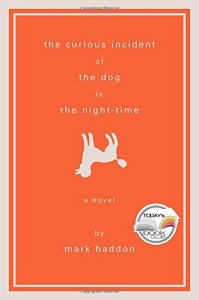
I Can Do Anything: Mark Haddon’s THE CURIOUS INCIDENT OF THE DOG IN THE NIGHT-TIME

Last week I posted a look back at 20 Years of Locus Online and, having asked my lead contributors over the years for their best or exceptional posts, revisited an 11-year-old essay by film reviewer Gary Westfahl, Homo aspergerus: Evolution Stumbles Forward, in which he identifies his self-diagnosis of Asperger’s Syndrome, and defends the syndrome as a potential evolutionary advance.

I’ll reconsider his essay more closely at a later date, but it inspired me to check out some online autism tests, and to reread the classic novel by Mark Haddon, published in 2003, which is told from the point of view of an autistic 15-year-old boy (though the text of the novel never uses that term, nor ‘Asperger’s’), in a town in England.

The novel starts as a mystery story (the title is an obvious quote from Sherlock Holmes) in which the narrator, Christopher, sees a dead dog late at night on a neighbor’s lawn, dead from a garden fork stabbed through its body. His reaction is to walk over to the dog, pick it up, and hug it. When he’s discovered by the dog’s owner, and then the police, he’s overwhelmed by too many questions and strikes out at the policeman. And is arrested.

His father rescues him, and the narrative proceeds to daily life, as Christopher’s attends a school for students with special needs, and pursues his sincere effort to investigate the dog’s death (by talking to neighbors and making deductions), and his discovery (spoiler) that his absent mother is not dead, as his father had told him. He then sets off on a quest to find his mother, in London — a quest which, considering his aversion to public spaces and unfamiliar circumstances, is surely as harrowing as any hero’s quest.

There are various questionnaires on the interwebs for autism diagnosis, but most of them rely on the same 50 question test (e.g.). I took a couple of these last week, thinking about some characteristics I might share with Gary Westfahl — at what point do a few personality quirks become a syndrome? — and then saw how Haddon’s novel illustrated many of those characteristics.

So here are some personality quirks exhibited by Christopher, divided into two groups…

Group 1,

  • He numbers his chapters in primes, rather than cardinals
  • His teacher gives him a set of simple diagrams of faces displaying various emotions, since he has a hard time understanding people’s facial expressions
  • He knows lots of countries and their capitals
  • He routinely makes asides to the narrative to ‘explain’ something, like the perspective into the Milky Way, (p9b), or how prime numbers are what results when you take all the patterns away (p12.7, an insight that had never occurred to me before, and which I think is rather profound)
  • He plays computer games obsessively, and keeps track of his scores
  • He thinks about heaven, which obviously doesn’t exist, p32; and how when you die nothing is left, p33
  • He’s fascinated by nature and science programs on TV
  • He likes math, and he explains the Monty Hall problem, which he likes because it shows how math intuition can go wrong (!!), how intuition can go awry
  • He explains how “God and fairy tales and Hounds of Hell [from the Sherlock Holmes story] and curses” are “stupid things”, because, as with metaphors, he’s very literal and only understands tangible things
  • He likes how science reveals how things you thought were true are wrong, p80.2
  • He likes drawing floor plans of new places he comes to; knowing the area he’s in makes him feel safer.
  • Aside about the constellation Orion, p125, how it doesn’t look like a hunter or anything else, how the stars are of varying distances.
  • Several times: he doesn’t like people who smoke
  • p153, he mentions computer games Myst and The 11th Hour.

Group 2,

  • Several times: he doesn’t like to be hugged, so his parents invented a touching of hands, fingers spread, in place of that, as a gesture of affection
  • He says he can’t lie. He’s very literal, 18.2, 19t; he’s OK with similes, but disapproves of metaphors, because they imply something that’s not real
  • When confronted by too many questions, he withdraws, and ‘groans’, 7b, and then strikes out
  • He can’t tell jokes, doesn’t understand them
  • He finds people confusing, because they talk without words; they use metaphors, which to him make no sense; p103.7
  • He doesn’t eat anything brown, or yellow (not just for the obvious reasons); reasons on p84
  • He sees four red cars in a row and concludes it’s a good day, as he rides the bus to school; while patterns of differently colored cars mean bad days.
  • He adds up the letters in people’s names to see if they make prime numbers
  • He doesn’t like foods on his plate that touch; if they touch, he can’t eat them
  • He can recall very specifically early memories of this mother, like rewinding a tape; he remembers things exactly, like the date he visited a certain place
  • He doesn’t like new places, because he notices all the details of a place, and a new place overwhelms him
  • When feeling threatened, he has a pocket knife he pulls out of his pocket
  • He notices the patterns on the seat and walls of a train, p185
  • When panicked by circumstances, like adults arguing in loud voices, he turns up the white noise between stations on a radio and holds it to his ears; or he does ‘maths’ in his head, like computing the cubes of the cardinal numbers
  • When panicked by being in public among crowds of people, as in a shopping mall, he lies down on the floor and screams, until his mother takes him away, p201

Will follow up with how these two lists relate to other topics.

Posted in Book Notes, MInd, Personal history | Comments Off on I Can Do Anything: Mark Haddon’s THE CURIOUS INCIDENT OF THE DOG IN THE NIGHT-TIME

Wishing Things Away: The Gays, and Abortions

Several recent items about two topics recently struck me as similar in the way some conservatives deny their reality or think they can simply wish them away.

In Chechnya, there have been reports in recent weeks that authorities are rounding up gays (by tricking them via social networking sites) and subjecting them to torture, even murder.

Reporting on People Who ‘Don’t Exist’

Chechnya denies the reports, because there are no gays in Chechnya.

The spokesman, Alvi Karimov, had been asserting that the authorities could not be arresting gay men because gay men did not exist in Chechnya. “I said before, and I repeat now, in Chechnya we just don’t have this problem,” Mr. Karimov told me.

That spokesman may be sincere: he may honestly believe that gay men, as he understands them from the western news media, don’t exist in his conservative Muslim country. At the same time, anyone not blinkered by conservative religion or local monoculture likely understands that gays have existed (if often ‘in the closet’) throughout history, in all cultures; they are the result of a variability in human sexuality that is fundamental to human nature, even if its expression across cultures has varied widely.

Or are there gays but they’re about to be eliminated? President of Chechnya Intends to Eliminate All Gay Men There by Ramadan. They should get their story straight.

\\

Similarly, conservatives think they can make abortions go away if they just repeal Roe v. Wade and/or pass enough restrictive laws to make it as difficult as possible for women to get an abortion. But of course such efforts won’t work: like it or not, women throughout history have occasionally been put in situations in which there seems no better option than to terminate a pregnancy. Laws won’t make such circumstances go away; they will merely drive the procedure underground, making it far more dangerous for the women’s survival.

The Amateur Abortionists:

That is the story of Jane, an underground group in Chicago that carried out thousands of abortions between 1969 and 1973, when abortion was illegal. It’s a story of code names and safe houses, a story of women taking control of their lives and teaching other women to do the same.

Abortion providers and the women they serve now fear that such an underground service may again become necessary. Abortion remains legal, but one conservative justice has just joined the Supreme Court and many are concerned that another will follow. This month the president signed a bill to cut funding to Planned Parenthood and other providers. Many states have enacted laws that make obtaining an abortion exceedingly difficult: About 90 percent of counties have no abortion clinics. In many areas, the procedure is nearly as inaccessible as it was in the days of Jane.

Meanwhile, Nicholas Kristof visits Haiti to see the effects of the US denying funds to a UN agency that provides contraception and abortions, and asks, Trump Thinks This Is Pro-Life?

When President Trump and his (male) aides sit at a conference table deciding to cut off money to women’s health programs abroad, they call it a “pro-life” move.

Yet here in Haiti, I’ll tell you the result: Impoverished women suffer ghastly injuries and excruciating deaths. Washington’s new women’s health policies should be called “pro-death.”

The birth control provided by the U.N. Population Fund averted more than 3.7 million abortions last year alone, health advocates say. So if you’re against abortion, you should support the U.N. Population Fund, not try to destroy it.

To reduce abortions, improve sex education and increase the availability of contraceptives. But religious conservatives are against those too. Expand the tribe at any expense, even the occasional dead mother?

A similar discussion could be made about the current efforts of transsexuals to be recognized, and treated fairly. (I admit the issue of transsexuals was not on my radar more than it was on anyone else’s, until recently.)

To me all these topics reflect the back and forth, but mostly progressive, arc of moral history: the expansion of the recognition of different kinds of people; the transition from thinking driven by religious suppression and magical thinking, to that informed by scientific understanding of human nature and the objective world. In one direction, gays and transsexuals and woman are treated as citizens worthy of self-expression and self-determination; in the other, we get Chechnya, or The Handmaid’s Tale.

Posted in Conservative Resistance, Morality | Comments Off on Wishing Things Away: The Gays, and Abortions

Neil deGrasse Tyson on Science

Dear Facebook Universe,

I offer this four-minute video on “Science in America” containing what may be the most important words I have ever spoken.

As always, but especially these days, keep looking up.

— Neil deGrasse Tyson

Science In America

Dear Facebook UniverseI offer this four-minute video on "Science in America" containing what may be the most important words I have ever spoken.As always, but especially these days, keep looking up.—Neil deGrasse Tyson

Posted by Neil deGrasse Tyson on Wednesday, April 19, 2017

Posted in Science | Comments Off on Neil deGrasse Tyson on Science

Harari on THE KNOWLEDGE ILLUSION

In today’s NYT Book Review, Yuval Noah Harari reviews THE KNOWLEDGE ILLUSION: Why We Never Think Alone, by Steven Sloman and Philip Fernbach.

The review’s opening echoes Harari’s own work, e.g.

What gave Homo sapiens an edge over all other animals and turned us into the masters of the planet was not our individual rationality, but our unparalleled ability to think together in large groups.

The book is about how most of us know very little about how the world around us works. For every complex product or process, only the specialists truly understand it.

This is not necessarily bad, though. Our reliance on groupthink has made us masters of the world, and the knowledge illusion enables us to go through life without being caught in an impossible effort to understand everything ourselves. From an evolutionary perspective, trusting in the knowledge of others has worked extremely well for humans.

The problem is,

Consequently some who know next to nothing about meteorology or biology nevertheless conduct fierce debates about climate change and genetically modified crops, while others hold extremely strong views about what should be done in Iraq or Ukraine without being able to locate them on a map. People rarely appreciate their ignorance, because they lock themselves inside an echo chamber of like-minded friends and self-confirming newsfeeds, where their beliefs are constantly reinforced and seldom challenged.

And of course, the discovery in psychology of recent years, that laying out the facts rarely changes anyone’s mind.

Scientists hope to dispel antiscience prejudices by better science education, and pundits hope to sway public opinion on issues like Obamacare or global warming by presenting the public with accurate facts and expert reports. Such hopes are grounded in a misunderstanding of how humans actually think. Most of our views are shaped by communal groupthink rather than individual rationality, and we cling to these views because of group loyalty.

Is there a solution? The book’s authors, and Harari, doubt it. What will happen? My own speculation, as previously discussed: in many ways it won’t matter. We all get along through social contracts and interactions; no one person needs to know all that much; we depend on each other. Where it will start becoming a problem will be when people’s ‘beliefs’ in things that are not true affect the long term survival of their groups.

Posted in Book Notes, MInd | Comments Off on Harari on THE KNOWLEDGE ILLUSION

March for Science

I’ve never marched for any cause — it’s not my style — but I think tomorrow’s “March for Science” is as worthy as anything could be, despite the inevitable casting of science as some sort of partisan issue. It’s the deniers, who are virtually all Republican, who have made it political. Marching for science shouldn’t be any more partisan than marching for arithmetic.

Sean Carroll has this short essay today in The Atlantic: Marching for the Right to Be Wrong

This principle of fallibilism is less clear, though equally important, to the practice of science. We have our wise heroes, our Newtons, Darwins, and Einsteins. But they are not infallible. There is no Science Pope to whom we can turn for final adjudication of sticky research questions.

Precisely the opposite: Science proceeds by showing how our wise heroes were, in larger or smaller ways, mistaken. Einstein overthrew Newton’s cosmos, and modern biologists are improving upon Darwin all the time. You may have a brilliant theory of the universe, but if it is contradicted by an experiment performed by a lowly graduate student, the data wins.

Science and democracy, in other words, both upend the ancient pyramids of power and knowledge: Answers bubble up from the bottom, rather than being imposed from the top.

Republican ideology, which of course overlaps with fundamental evangelical certainty over matters theological, does think they have all the answers from on high. Which is why they conflict with science.

This denial will eventually, in one or many ways, conflict with reality, as I’ve predicted before. People who deny the efficacy of vaccines, will get more diseases. If our governments think climate change is a liberal conspiracy fantasy, then its effects *will* happen, and coastal cities will be flooded in 50 or 100 years.

Posted in Uncategorized | Comments Off on March for Science

Fine, Evie, Fine: TOS “Mudd’s Women”

The Enterprise rescues the crew of a rogue spaceship and deals with Harry Mudd, whose scheme is to sell women to lonely miners on distant planets.

  • As the story begins the Enterprise pursues renegade ship, Harry Mudd’s. In the enhanced graphics, we see a spaceship, complete with nacelles, whereas in the original series, the ship was a blob.
  • Trek physics: the astronomy is dicey. The Enterprise is pursuing this smaller ship, and someone comments that they’re entering an asteroid belt. Really? Are they in a planetary system? You wouldn’t come across an asteroid belt out in interstellar space. But they do, so the plot can cause the destruction of the smaller ship and the Enterprise’s rescue of its crew.
  • Enterprise mechanics: now the crucial items are the “lithium crystal circuits” which burn out, one by one, as the ship over-extends its power to shield the renegade ship. In another episode, the concern is about the matter/anti-matter mix. Are these related? I’m sure the fans rationalized these later, and maybe the producers had some relationship in mind in the series’ ‘bible’, but seeing these early episodes just gives the appearance that these ideas were made up by separate writers without any overall guidance.
  • Thematically, this episode is the most sexist and dated story in the entire series. The idea is that Harry Mudd, a lovable rogue type, is on his way to transport three beautiful women – who appear throughout most of the story in tight evening gowns – to find husbands. Because, you know, pioneering men out in space are lonely; and these women have no ambition in their lives other than to find a husband. Worse, when the women first appear on the ship, the male Enterprise crew members – McCoy and Scott, initially – seem hypnotized by this female beauty, as if their female crew members are, what, sexless, compared to these beauties? And so as the women arrive, and walk down the corridor, the composer, Fred Steiner, offers some swanky, hubba-hubba music.
  • Mudd observes that Spock is part “Vulcanian”, a term soon abandoned; Kirk’s quarters are on deck 12, which doesn’t make sense in terms of later schematics of the ship.
  • OTOH, this episode features a four by two rising three then falling one theme that we hear over and over again, but in different instrumentations, being remarkably versatile to color a variety of different emotional situations.
  • As they’re down to one lithium crystal, they decide to head for Rigel XII, site of lithium miners, just ‘two days’ travel’. I’ve always thought Trek played fast and loose with real star names, using them for audience familiarity, without any regard for actual positions in the galaxy; I suspect if one plotted them out, the implied voyages of the Enterprise would make no more sense than stories about a Navy ship that visited Hawaii one week, London the next, and Antarctica the week after that.
  • In the briefing room hearing scene, note the portrayal of the talking computer. The computer monitor displays a meaningless oscillating sine wave; the voice [by Majel Barrett] is underscored by teletyping sounds. This is a topic for how film and TV play — to this day, arguably, but especially 50 years ago — to intuitive, and wrong, ideas of how computers work; or more generally, how dramatic stories play to audience expectations, rarely, even in SF, challenging them.
  • Harry has a nice line, accused of being a menace to navigation: “My tiny little ship in this *immense* galaxy? A menace to nav—?“, he scoffs. He has a point.
  • Then he mentions planet Ophiuchus Three. Ophiuchus is a constellation, not a particular star. Again, the writers and production staff are not too careful about astronomical nomenclature.
  • And the women are always shown in soft focus, as in movies of the 1940s.
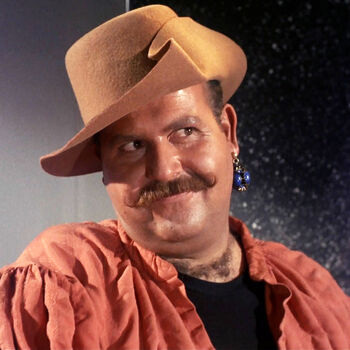
  • Of the three women, Eve McHuron is the only one with any character—she’s frustrated by Mudd’s promises and put off by his wheeling and dealing. Harry tries to mollify her: “Fine, Evie, Fine”, and she fires back, “No it’s *not* fine.”
  • The episode has several interestingly shot scenes, as with Kirk and Eve speaking to each other through a decorative grate in his quarters.
  • Trek physics: the Enterprise arrives at Rigel XII, but its remaining crystal allows only a ‘shaky’ orbit for only 3 days and 7 hours. Huh? A later episode, “Court Martial”, pulls this stunt too, implying that without power, the ship’s orbit will decay. (And “The Naked Time” implies that too.) No. Not unless they’re in such a low orbit that the ship is skimming the atmosphere. Otherwise they’re in space, in free fall, in endless motion without anything to hinder it. Just like the moon is, around the Earth.
  • The enhanced graphics have a better shot of the miners’ camp than the original.
  • Another early Trek theme: a ‘magnetic storm’ affects the ship and planet.
  • Plot point: why doesn’t Childress, the head miner, having gotten his woman, comply with Kirk’s command to provide lithium crystals? Perhaps because Eve, coughing from the dust storm, seems obviously unhealthy.
  • Eve runs off; the Enterprise searches for her from orbit; Kirk and Mudd confront Childress and Eve in his quarters, and reveal to him the secret of the Venus Drugs – that which made the women so alluring. “It gives you more of what you have…” Mudd explains, offering masculine and feminine examples. Eve, having become worn down, gives in to Childress’ desires and takes a pill, but crying out in pathos: “And I hope you remember it and dream about it! Because you can’t have it! It’s not real!!” For me this is the most memorable line of the episode.
  • But then it turns out she’s only *acting* beautiful; she was duped. Is this resolution plausible? I’ve never been completely convinced.
  • Finally, here’s an early episode that undercuts its drama with a flip, comedic ending, not just one but two. Mudd, about throwing away the key; Spock and McCoy, about the former’s internal anatomy. These endings became common especially in Season Two, and in retrospect, I find them annoying.

Adaptation by J.A. Lawrence in MUDD’S ANGELS:

  • Another late, very literal, adaptation, with a few extra lines and scenes here or there that are plausible, as if scripted and not shot, or shot but edited out for time.
  • Replaces ‘Vulcanian’ in the broadcast show by ‘Vulcan’
  • Note they’re just two days from Rigel.
  • Adaptation says “on landing” when the broadcast script said “on arrival”. Had the adapters ever seen the show?
  • P18, in between Ruth’s visit to Dr. McCoy, and Eve’s to Cpt Kirk, there’s a short passage with no dialogue in which Magda listens to Farrell talking about the ship’s communication system. (A plausible scene to have.)
  • The scene in which Harry finds the pills and hands them out ends with…Eve crushing hers and dropping the dust on the floor. In the broadcast episode, we see you holding the pill in her hand, but don’t see her actually take it.
  • On the planet, Childress’ line about getting lost a dozen feet from your doorway follows a question from Eve, “I understand there were originally four of you”, and his response, “Charley Shorr stepped out into that last month.” (These are plausible scripted lines, setting up Eve’s idea of escaping into the wind outside.)
  • Then follow a couple brief exchanges between the other couples: Gossett about how his house is exactly the same; Benson about the clicking sounds from the wind vanes on the roof. (Again, plausible passages, likely cut for time.) Magda and Benson then dance to the rhythm of the clicking.
  • Kirk’s bit of philosophy after Eve’s pill is revealed as a fake is, in the adaptation, “There’s only one kind of desirable woman, Eve—the one who knows she’s Woman.” As broadcast, Kirk said, “There’s only one kind of woman” and then Mudd said “Or man for that matter” and Kirk continues, “You either believe in yourself, or you don’t.” Better as broadcast.
  • And it ends, with a word or two variation, with Spock’s comment about his internal anatomy.
Posted in Star Trek | Comments Off on Fine, Evie, Fine: TOS “Mudd’s Women”